Photo(s) of the Week; 462nd Fighter Squadron Dispersal Area

506th Fighter Group ground crewmen push a North American P-51D-20-NA Mustang (Serial No. 44-72560) across Marsden matting in the 462nd Fighter Squadron dispersal area on North Field. While it is not known who was assigned to fly this Mustang, members of the 506th Fighter Group Association believe the plane was named Little Joe.

USAAF/Loomis Dean/National Archives via Fold3

Several things to note about this picture for modelers. First is the wear on the backside of the propeller blades from the sand and volcanic grit on Iwo Jima. The cuff at the bottom of the blade was made of a hardened rubber so it does not show the wear that the metal portion of the blade does. Second is the light color and the pattern of the exhaust staining down the side of the fuselage. Third is the wooden twin Uncle Dog antennae, and their location and spacing on the spine. Fourth is the AN/APS-13 rear warning radar installed on the tail.

The official caption to this photo is 7th Fighter Command personnel push a North American P-51 “Mustang” toward the dispersal area at an airfield on Iwo Jima. July 1945.
Photo(s) of the Week; Engine Removal

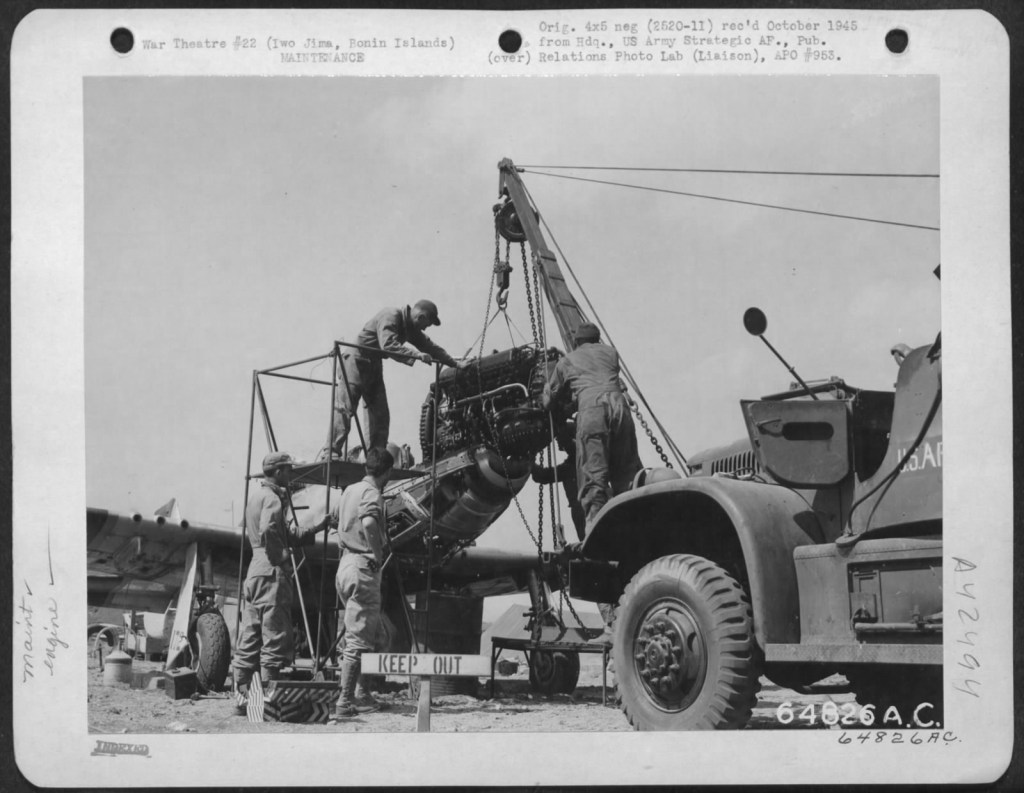
This photo is the companion photo to the last Photo(s) of the Week I posted recently; just taken from the right side of the plane. Ground crew have just hoisted the Packard built Rolls Royce Merlin engine after disconnecting it from the engine mounting framework and other connections. Very cool photo!

USAAF/National Archives via Fold3

This is 172, a 47th Fighter Squadron, 15th Fighter Group, P-51D Mustang. 7th Fighter Command ground crew worked under very challenging conditions. Just keeping the engine and machine guns clear of sand and the volcanic grit was a constant battle.

The official USAAF caption to this photo reads: Mechanics removing engine from a North American P-51 “Mustang”. Iwo Jima, Bonin Islands.

Photo(s) of the Week; Early Primitive Maintenance

A 47th Fighter Squadron P-51D Mustang, number 172, receives either engine maintenance or an engine replacement in an outdoor setting on Iwo Jima with another Mustang coming in for a landing in the background. This looks as if this may be a major periodic overall maintenance as engine work being done, the wing root fairing is removed, the machine guns are removed, the canopy is removed, and it appears that work is being done on the radiator as well.

USAAF/National Archives via Fold3

Early on, all maintenance and repairs were done outdoors. The construction of maintenance hangers would come later. The single antenna on this Mustang indicates that this maintenance was done shortly after 47th Fighter Squadron arrived on Iwo Jima as the twin Uncle Dog antennae have yet to be installed.

Please also note that the right tire has an oval tread pattern and the left tire has a diamond tread pattern. Different tread patterns were a fairly common occurrence, so important to check your photo references.

The official USAAF caption to this photo reads: A mobile repair unit of a 7th Fighter Command Service Group repairs a North American P-51 damaged in a landing on the rugged Iwo Jima airstrip. Soft spots, cross winds and roving clouds of volcanic dust make landings on Iwo Jima unusually hazardous. In the background another P-51 fighter comes in for a landing.

Photo(s) of the Week; All Important Maintenance

USAAF/National Archives via Fold3

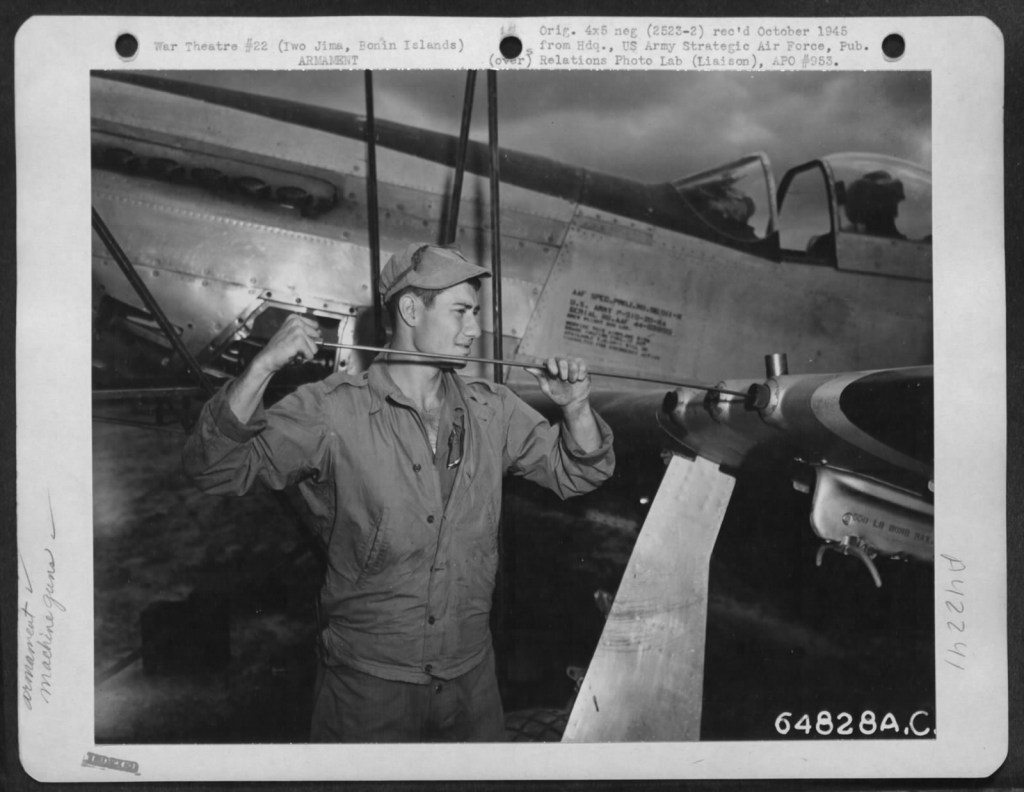
An armorer cleans the blast tubes on a 47th Fighter Squadron P-51D Mustang while other maintenance is being performed. The official United States Army Air Force caption to this photo reads: Armorers cleaning 50 cal machine guns on wing of North American P-51 “Mustang”. Iwo Jima, Bonin Islands.

The sand and volcanic grit was a constant problem for ground crew on Iwo Jima. With their pilots spending a majority of a very long mission over the vast expanse of the Pacific Ocean, 7th Fighter Command ground crew spent long hours maintaining their Mustangs to prevent a pilot from having to bail out over water due to engine failure. This post is dedicated to all the ground crewmen who served on Iwo Jima.

Photo(s) of the Week; Combat Air Patrol (CAP)

All three Iwo Jima VLR Mustang Groups were tasked with flying combat air patrols around Iwo Jima to protect the island against attacks by the Japanese. The photo below shows three 462nd Fighter Squadron, 506th Fighter Group Mustangs on combat air patrol around Iwo Jima. The closest Mustang, 626, is being flown by 1st Lt. Edward Linfante. The middle Mustang, 602 “Meatball” is being flown by 1st Lt. Edward Bahlhorn, and third Mustang, “Little Joe”, is being flown by 2nd Lt. Jesse Sabin. Really nice photo.

Three 462nd Fighter Squadron Mustangs flying Combat Air Patrol around Iwo Jima (506th Fighter Group Association via Ed Linfante)

Mt. Suribachi was the central orbit for all CAPs. Starting with North and every 45 degrees clockwise around the compass 10 miles is an orbit point each with a code name as shown on the diagram below.

Combat Air Patrol Diagram from 506th Fighter Group Indoctrination Handbook

In the event of an air raid during the time the CAP flights were airborne, they would join their respective squadrons at the designated orbit points when Agate Base on Mt. Suribachi announced “All flights Kalamazoo”. When Agate Base announced “All flights fluorescent”, all flights except the CAPs would return to Iwo Jima.