This is the fourth part of a nine part series on the markings of the VLR Mustang squadrons. Six of the nine squadrons changed their markings during their time on Iwo Jima after the 7th Fighter Command ordered the VLR Fighter Groups to adopt more simplified markings. The 46th Fighter Squadron was not one of those squadrons.
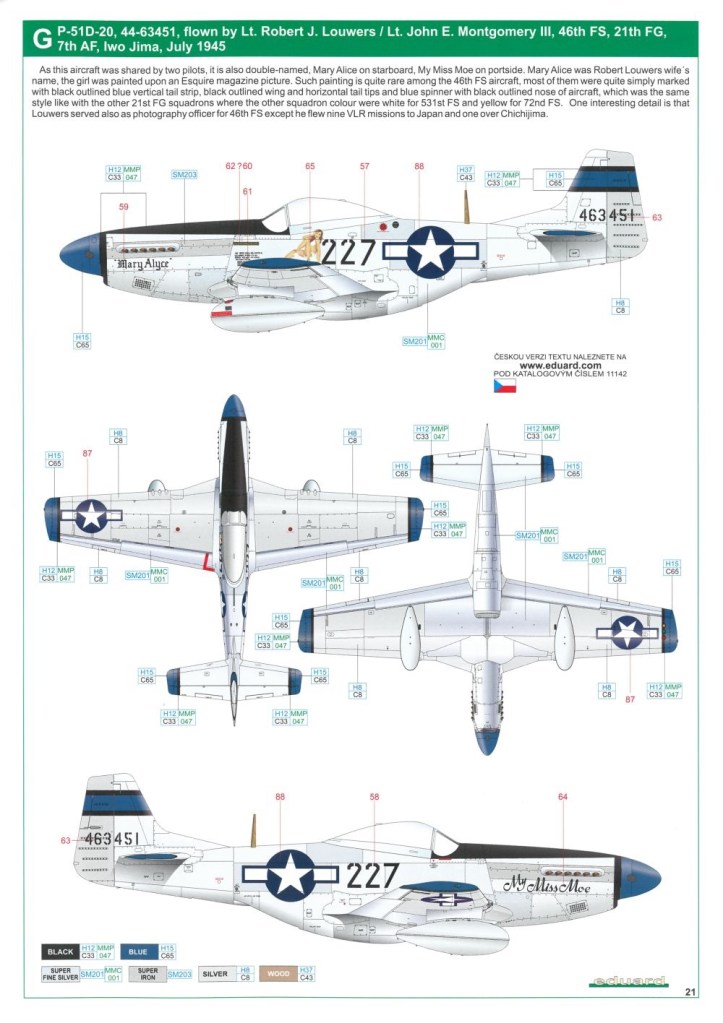
The fuselage numbers for the 46th Fighter Squadron Mustangs were 200 through 249. The standard squadron markings for 46th Fighter Squadron Mustangs was an all blue spinner with an adjacent narrow black band on the nose, a blue band outlined in black on the vertical tail surface, and blue wing and horizontal tail tips outlined in black as shown on Eduard’s excellent profile of Lt. Robert J. Louwers and Lt. John E. Montgomery III’s 227 Mary Alice/My Miss Moe.
Eduard
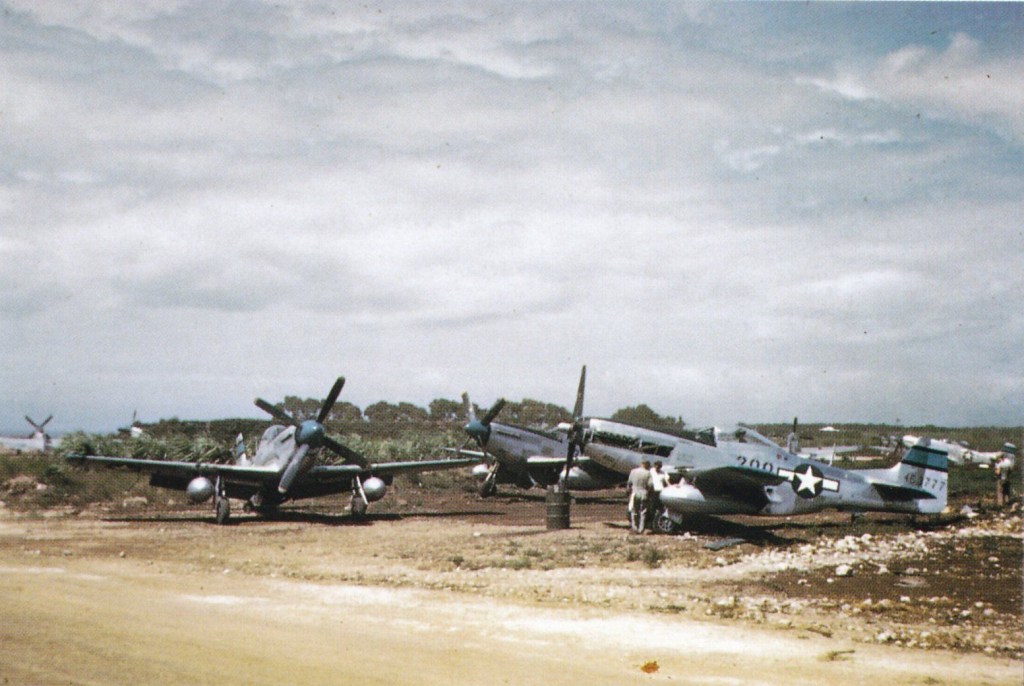
These were pretty simple markings that did not change while the 46th Fighter Squadron was on Iwo Jima. Below is a nice color photograph of 46th Fighter Squadron Mustangs during their brief stay on Saipan prior to their arrival on Iwo Jima.
46th Fighter Squadron Mustangs on Saipan
One interesting note is that it appears that a lot of 46th Fighter Squadron Mustangs had black anti-glare paint on the top of the nose instead of the standard olive drab color. Most 46th Fighter Squadron Mustangs were Block 20s, and it is not known if the black anti-glare paint was factory applied or field applied. However, as the photo below shows, it was not uniform on all 46th Fighter Squadron Mustangs.
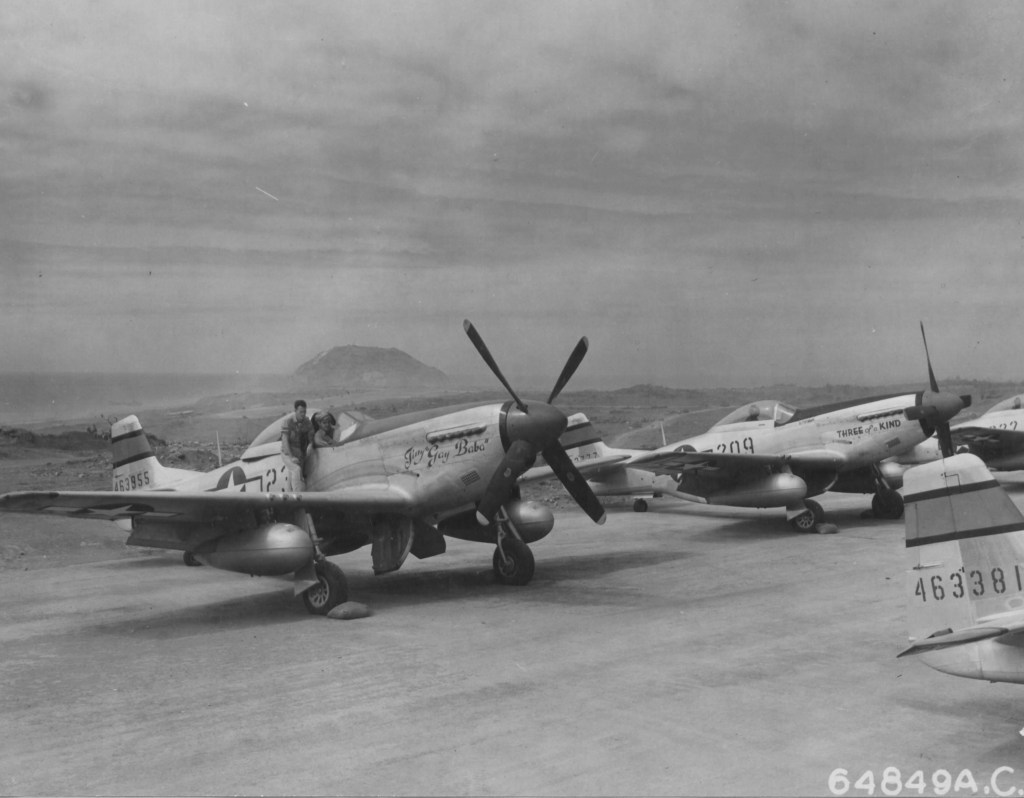
USAAF/National Archives via Fold3
The photo above shows several 46th Fighter Squadron Mustangs on a Central Field hard stand shortly after their arrival on Iwo Jima. I love this photograph as you can see South Field and Mount Suribachi in the background. 231 Tiny “Gay Baba” appears to have the standard olive drab anti-glare paint, and it appears to have been applied on the windshield framing as well which was not customary. The plane next to it, 209 Three of a Kind, appears to have black anti-glare paint. So, it is always important to check your references prior to starting a build.
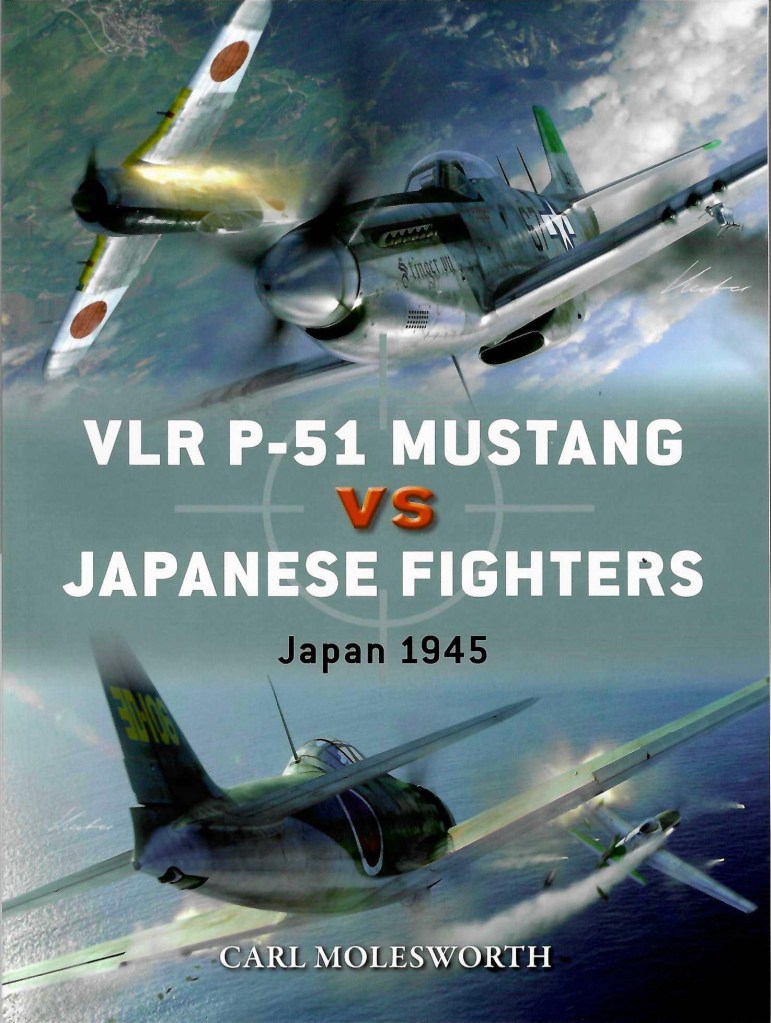
Published in 2025 by Osprey Publishing as part of their Duel Series (#147), this softbound book has 80 pages. Written by noted aviation historian and author, Carl Molesworth, the book focuses on the air war over Japan as fought by United States and Japanese pilots from April 7, 1945 through the end of World War II, and covers combat between the North American P-51D Mustang and the following Japanese fighters: Mitsubishi A6M5 Reisen (Zeke), Mitsubishi J2M3 Raiden (Jack), Kawanishi N1K2-J Shiden-Kai (George), Nakajima Ki-44 Shoki (Tojo), Kawasaki Ki-61 Hein (Tony), Nakajima Ki-84 Hayate (Frank), and Kawasak Ki-100 Goshikisen.
The stunning cover artwork above and the battle scene artwork below were created by Scottish digital artist, Gareth Hector.
Gareth Hector/Osprey Publishing
As is customary with Osprey aviation titles, airplane profiles and cockpit and armament views by Jim Laurier are included. The profiles and cockpit and armament views are all very nicely done as can be seen from the profile of the Nakajima Ki-84-I Hayate (Frank).
The text is supplemented with numerous photographs, many from the private collections of combatants who dueled over the skies of Japan.
Airplane profiles are provided for the North American P-51D Mustang and the Nakajima Ki-84-I Hayate (Frank). Cockpit views are provided for the Mustang and the Nakajima Ki-44 Shoki (Tojo). Armament views are provided for the Mustang, the Mitsubishi A6M5 Reisen (Zeke), Kawanishi N1K2-J Shiden-Kai (George), Nakajima Ki-44-IIb Shoki (Tojo), and Kawasaki Ki-61-Ia Hein (Tony).
After an introductory chapter, Chapter 2 addresses the design and development of each fighter aircraft. Right before this chapter, is a nice three page chronology spanning from 1939 to 1945 which touches upon the significant dates in the development of each plane. Chapter 3 discusses the technical specifications for each plane with the armament views for the planes identified above.
Chapter 4 discusses the strategic situation in 1945 including the build up of the United States Army Air Force’s B-29s on the Mariana Islands and the establishment of airstrips on Iwo Jima for the three VLR Mustang groups. Chapter 5 focuses on the combatants and contrasts the effectiveness of pilot training between the United States and Japan at that point in the war, and the organization and tactics of each air force.
Chapter 6 is where everything comes together and Mr. Molesworth discusses the actual aerial combats over the Japanese homeland. Specifically discussed are the escort or strike missions on the following dates: April 7, 1945, April 12, 1945, April 19, 1945, May 29, 1945, June 10, 1945, June 23, 1945, July 9, 1945, July 16, 1945, August 3, 1945, and August 10, 1945.
Chapter 7 discusses statistics and gives a brief analysis, and Chapter 8 gives an aftermath discussing the Japanese fighter planes that survived the war and where they are located.
If you are interested in the air war in the Pacific Theater of Operations or the air war over Japan in the closing months of the war, this book is highly recommended. Kudos to Carl Molesworth and Osprey Publishing!
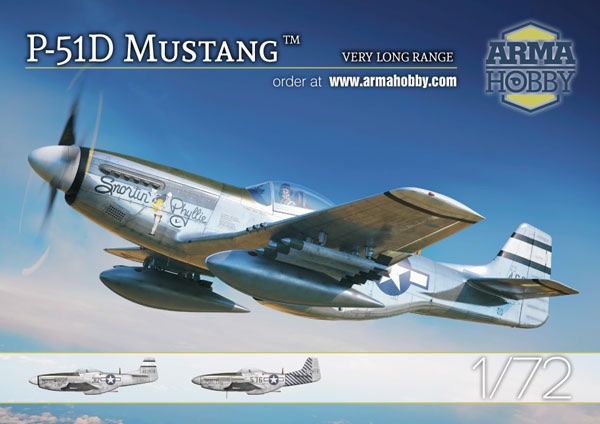
Arma Hobby recently released an Iwo Jima VLR Mustang boxing of their popular 1/72 North American P-51D Mustang kit. It was released in mid-May 2026, and is now making its way into US online retail hobby stores. The box art is striking with a 21st FG VLR Mustang loaded out with 165 gallon drop tanks and six HVAR rockets. Very cool!
Arma Hobby
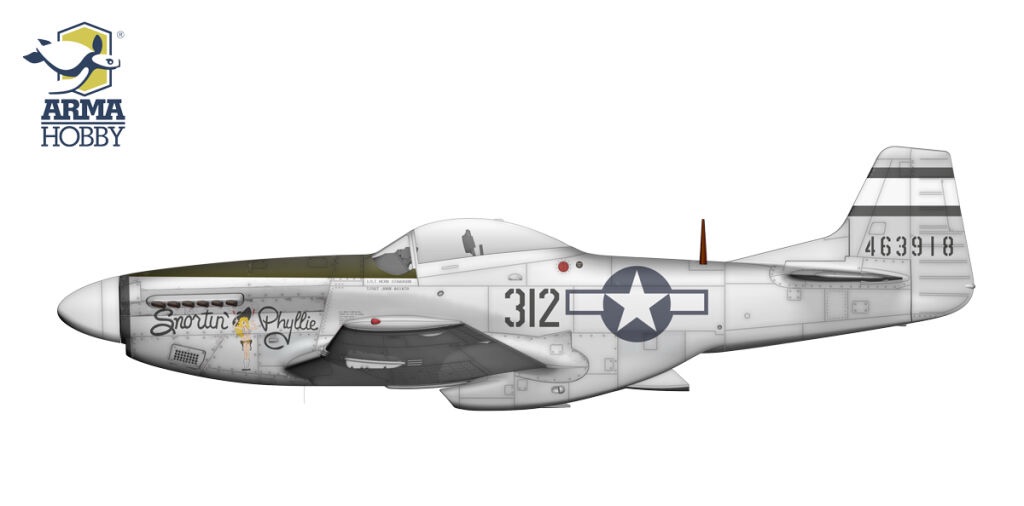
There are two decal options. The first is a 531st FS, 21st FG P-51D-20 NA (Serial No. 44-63918) 312 Snortin’ Phyllie flown by 1st Lt. Herbert Straughn. Nice to see a decal option for a 531st FS Mustang other than Major Harry Crim’s 300 My Achin’ Ass.
Arma Hobby
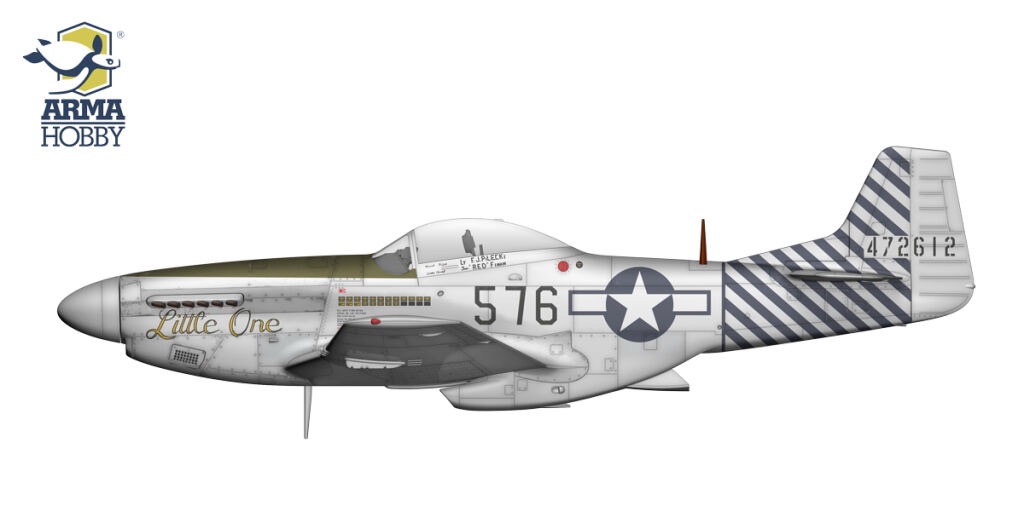
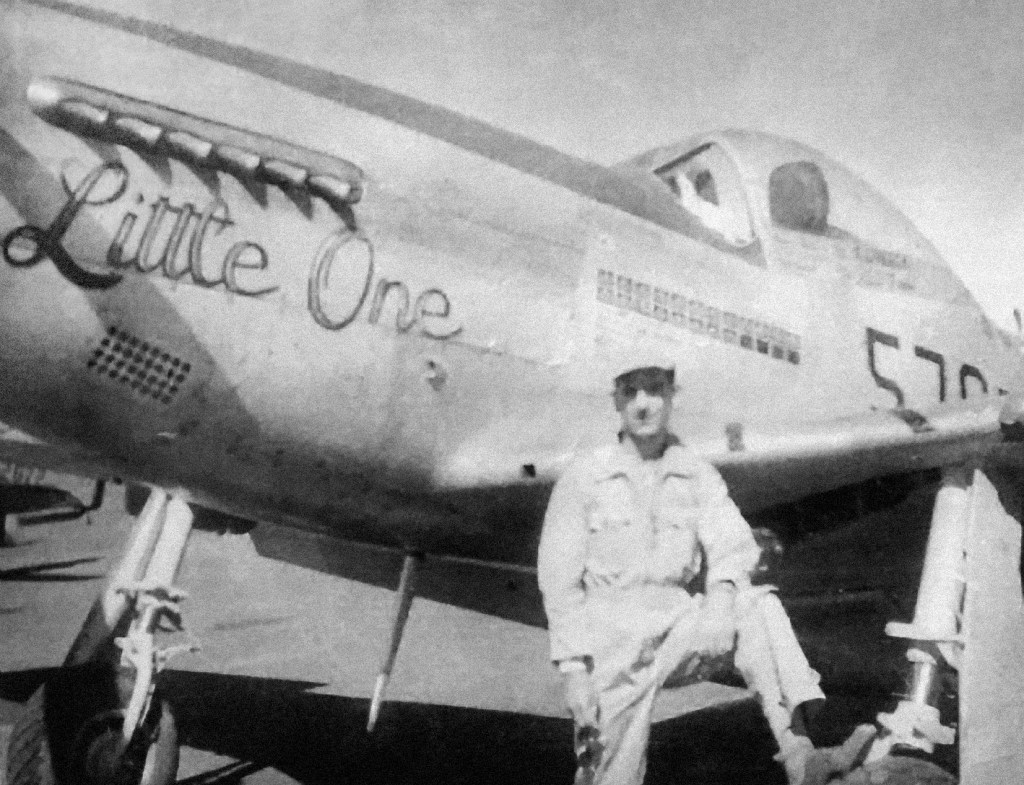
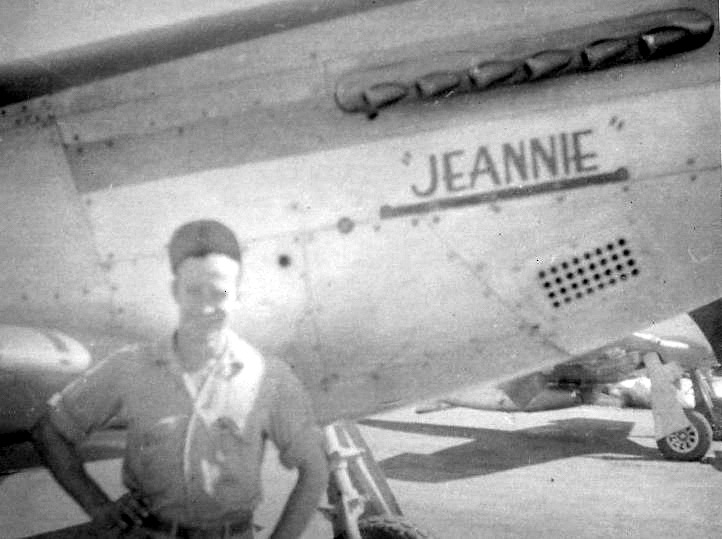
The second decal option is a 458th FS, 506th FG P-51D-25 NA (Serial No. 44-72612) 576 Little One/Jeannie assigned to 1st Lt. Max E. Ruble and 2nd Lt. Francis J. Pilecki. On June 10, 1945, 1st Lt. Ruble was credited with shooting down a Mitsubishi JM2 Raiden.
Arma Hobby
Again, thanks to Arma Hobby for providing two decal options not seen in other kits, and not well covered by after market decal manufacturers (decals for 576 Little One/Jeannie are provided in all three scales on the decal sheet which comes with the book: 506th Fighter Group: The History of the 506th Fighter Group, Iwo Jima 1945 by Robert Grant). This book is published by AJ Press as part of their Fighting Units in Color series. My review of this book can be found here: https://iwojimamodels.com/2019/12/14/book-review-506th-fighter-group-the-history-of-the-506th-fighter-group-iwo-jima-1945-by-robert-j-grant/
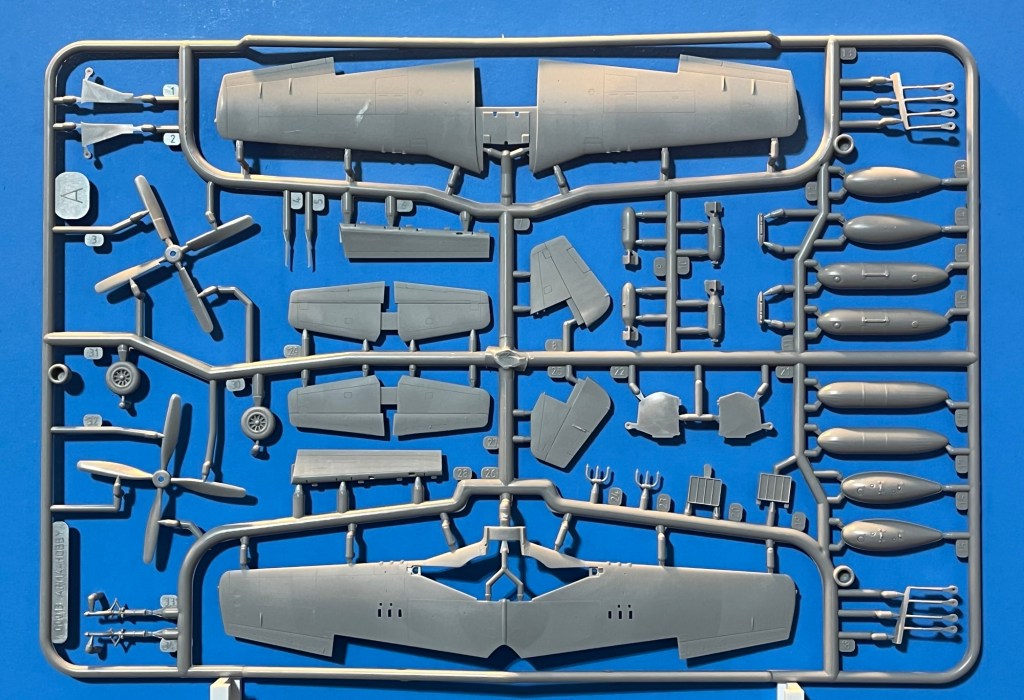
On to the sprues. Arma Hobby’s original release of its 1/72 P-51D Mustang (Kit No. 70070) contained three sprues; two molded in light gray plastic (A & B), and one in clear plastic (T) for the canopies and other clear parts. The Very Long Range boxing includes an additional sprue for the 110 and 165 gallon drop tanks, sway braces, and HVAR rockets. As can be seen from a review of the sprues, you can build any variant of the D model from the D-5 to the D-25 from this kit.
The first sprue (A) consists of the wings, control surfaces, standard drop tanks, bombs, landing gear components, wheel well components, propellers (both Hamilton Standard and Aeroproduct), and the two Uncle Dog antennas (parts A4 & A5). Arma Hobby gives you two different horizontal stablizers; one with fabric covered elevators and one with metal covered elevators. A nice feature on Arma Hobby’s part, and each set is molded as one piece which should help with construction and alignment.
A couple of items worthy of note. First, the panel lines on the wings are very faint except for the parts of the wings which would be accessed be maintenance crews. I am assuming this was done in this manner so if you wanted to represent model as having the puttied wings, it would not take much to fill the panel lines. In addition, the top wing halves have been molded as one piece so as to provide detail for the top of the wheel wells. Again, a nice touch on Arma Hobby’s part as this will allow for ease in masking the top of the wheel wells when painting the support stringers.
The second sprue (B) consists of the fuselage halves, interior and cockpit parts including both the Warren-McArthur and Shick-Johnson seats, separate spinners for the Hamilton Standard cuffed propeller and the Aeroproducts propeller, both types of dorsal fins (swayback for modified D-5s and early D-10s and the regular dorsal fin for later blocks), and both shrouded and unshrouded exhaust stacks.
A couple of items worthy of note. First, unlike the 1/72nd Eduard P-51D Mustang, the rivet detail on the fuselage halves is very restrained. So if rivet detail is important to you in 1/72nd scale, you are going to have to break out your riveter. Second, the structure of the cockpit sides is molded into the fuselage halves as seen below.
I like this approach because the cockpit sides will be easier to paint and detail and it should allow for an easier insertion of the completed cockpit into the fuselage.
The additional sprue contained in this boxing includes both styles of drop tanks carried by Iwo Jima VLR Mustangs, the sway braces for each type of tank, and six HVAR rockets that were carried during strike missions toward the end of conflict in the Pacific Theater. The shapes and contours of the drop tanks look good.
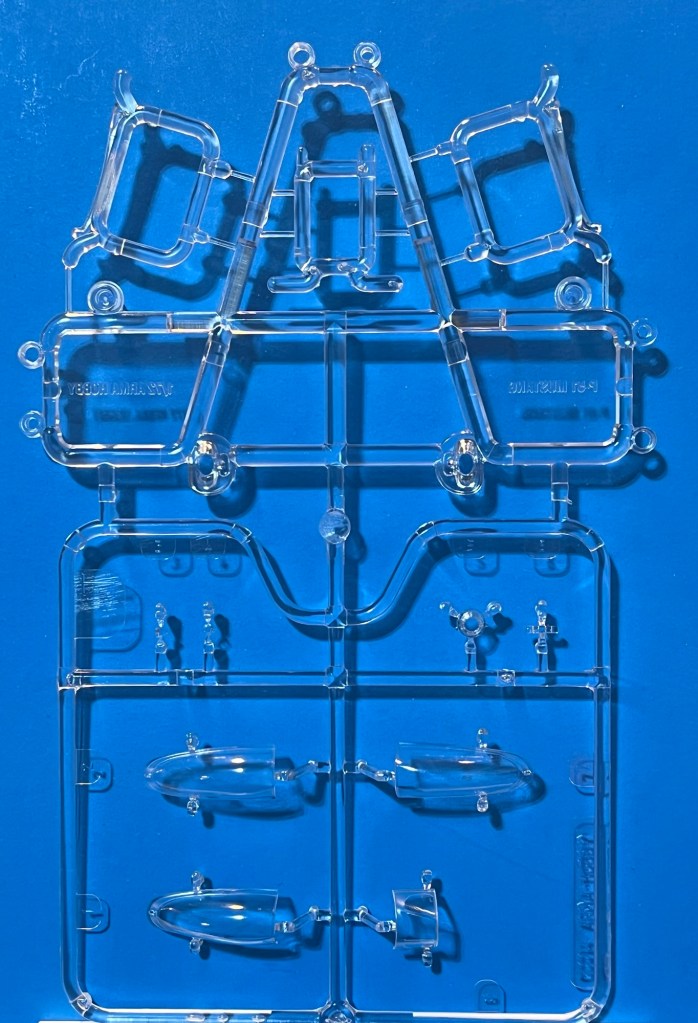
The sprue containing the clear parts (T) contains the windscreen, all three variations of the canopy, and the other clear parts. The windscreen and canopies are crystal clear and the clear sprue is bagged separately to avoid scratches.
The additional parts at the top of the sprue are parts for a display stand and/or construction jig as shown below. The main landing gear wheels fit in the slots at the front of the stand with wing supports at the sides and fuselage support at the back. Neat idea.
Are there necessary parts missing? Unfortunately, the answer to that question is yes. Arma Hobby failed to include the SCR-695 IFF transmitter that was situated behind the SCR-522 radio transmitter on Iwo Jima VLR Mustangs as shown in the computer generated image below.
John Terrell
This omission is confirmed by their own assembly instructions.
Arma Hobby
How big of an omission is this? Not very. First, in 1/72nd scale, most people viewing a built up model in your display case or even at a model contest would not even recognize this omission. Second, you could easily sand off the detail on the battery and add some plastic pieces to accurately represent the SCR-695 IFF transmitter. Third, you could build an early Iwo Jima VLR Mustang with a single mast antenna before the SCR-695 IFF transmitter/Uncle Dog twin antennae were installed as field modifications. There are a lot of pictures of 15th and 21st FG Mustangs after their arrival on Iwo Jima in early March with the standard single mast antenna.
The decals look really good and are printed by Cartograf so they should work well. Fuselage and tail stripes are provided for the 458th FS Mustang 576 Little One/Jeannie so you will not have to do all of the complex and tedious masking. Nice touch on Arma Hobby’s part. There are also aluminum colored decals for the tops of the wheel wells at the bottom of the decal sheet. The use of the decals will eliminate the need for masking. Just paint the tops of the wheel wells Zinc Chromate Yellow and apply the decals in their appropriate locations. An interesting and novel approach.
Arma Hobby
The aircraft profiles in the instruction booklet are well done. I do not have any photos of 312 Snortin’ Phyllie, so I reached out to Mark Stevens of the 7th Fighter Command Association to see if he could share any photos he has of the plane. Surprisingly, he did not have any photos either, and I could not find any on the internet. Someone obviously has a few photos of this plane.
Arma HobbyArma Hobby
The 506th Fighter Group Association has several very nice photos of 576 Little One/Jeannie in its collections.
506th Fighter Group Association2nd Lt. Francis J. Pilecki (506th Fighter Group Association)506th Fighter Group Association506th Fighter Group Association
This looks like an extremely nice 1/72nd North American P-51D Mustang kit. From what I have seen of already built models, they certainly look every bit the part of the real thing. If you are wanting to build a Iwo Jima VLR Mustang in 1/72nd scale, this is an excellent option.
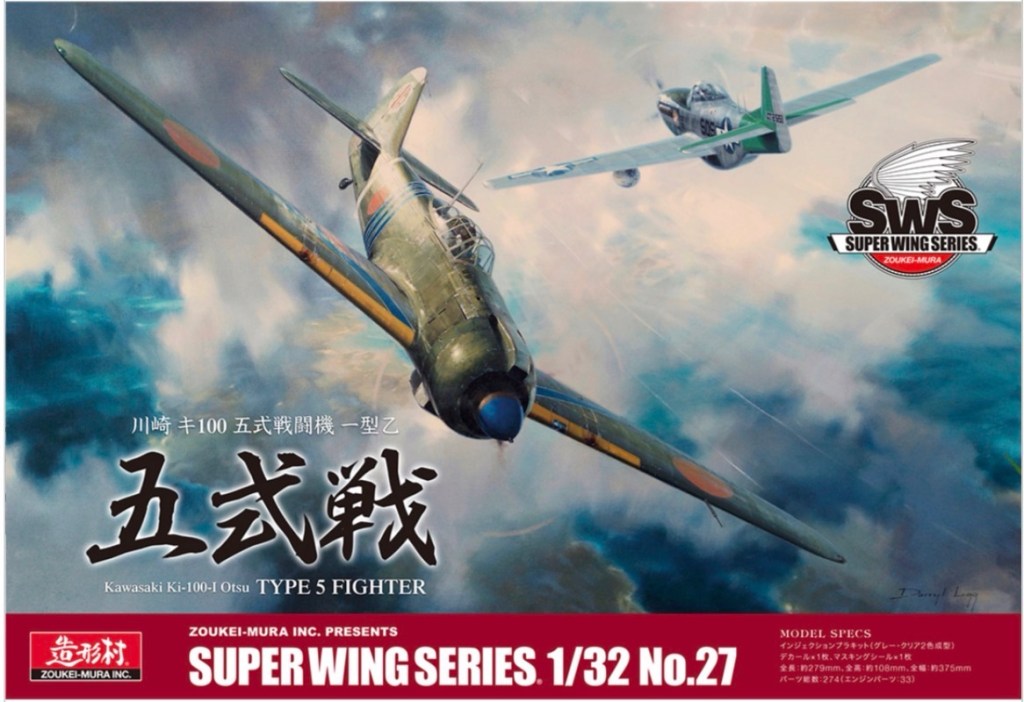
Zoukei-Mura recently announced that they are taking pre-orders on their new 1/32nd scale Kawasaki Ki-100-I Otsu “Goshikisen”. To say this has been a long awaited kit is a gross understatement. Prior to this release, there was no mass produced injection molded Ki-100 model in 1/32nd scale available to modelers. Kudos to Zoukei-Mura for recognizing the need and producing this kit!
Zoukei-Mura
The pre-order period on the Zoukei-Mura Official Site runs from June 26, 2026 through July 26, 2026. For pre-orders coming from Japan, Zoukei-Mura has announced that shipments will begin on August 8, 2026. You can also pre-order the kit through the Volks USA, Inc. website until August 31, 2026, and shipments of those pre-ordered kits will begin in mid-September. The pre-order price through the Volks USA site is $124.00 plus $6.27 in shipping costs.
Zoukei-Mura
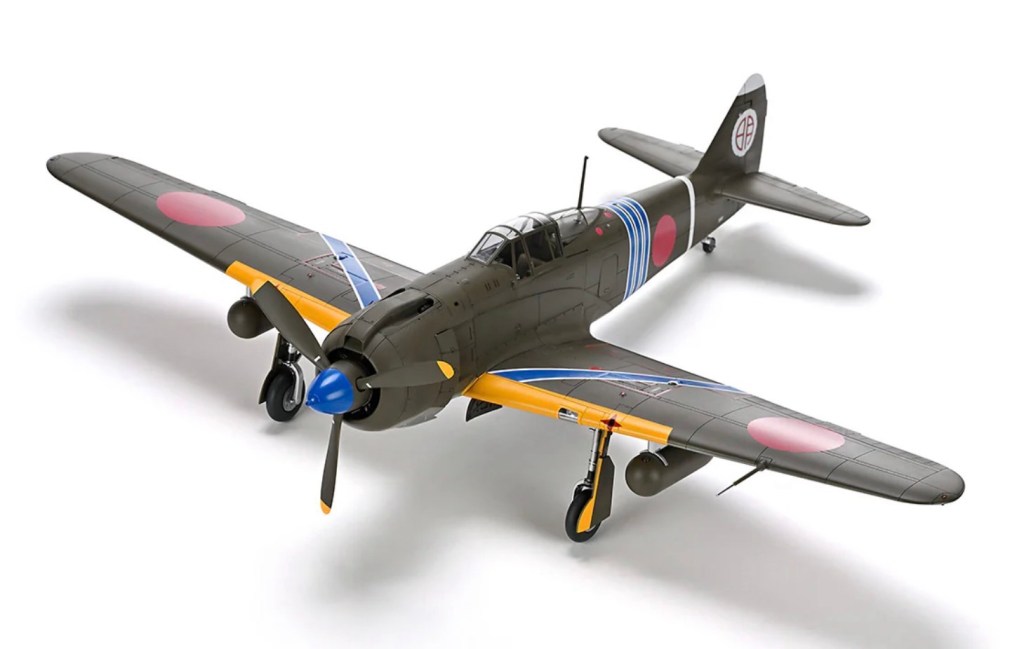
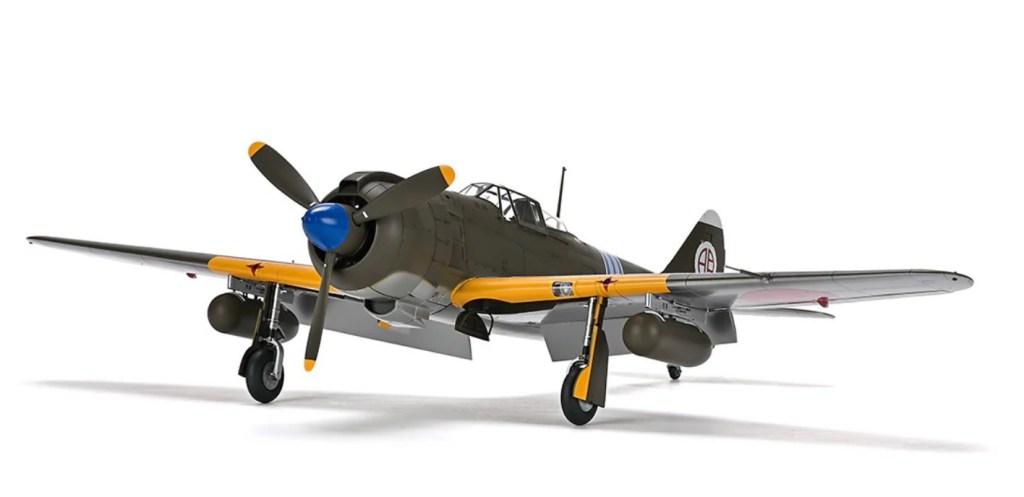
As you can see from the above and below photos of the built model from Zoukei-Mura’s website, it looks every bit the part of the real plane.
Zoukei-Mura
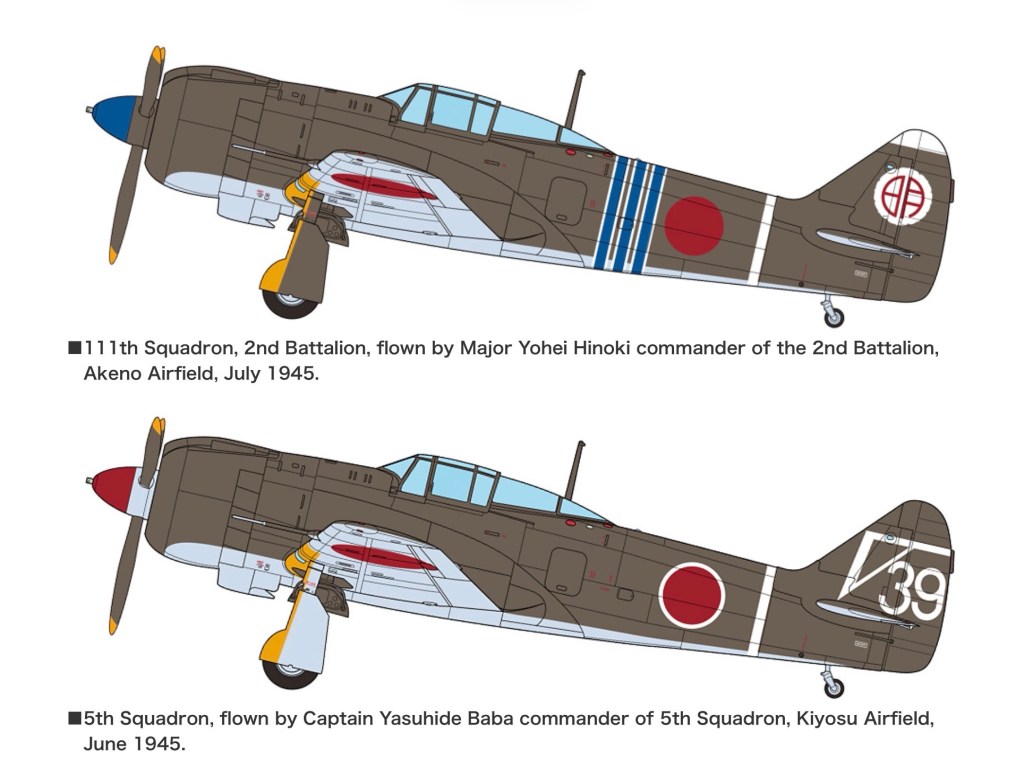
There appears to be two decal options as shown below. Both are well known aircraft, and I think it is a safe bet that after market decal manufacturers will provide us several other options as well.
Zoukei-Mura
Again, kudos to Zoukei-Mura for this long awaited kit. I have pre-ordered mine through Volks USA, and will do a review once I receive it in September.
Based on CAD drawings previously published by Zoukei-Mura, I believe modelers can also expect the release of the Ko version (fastback/razorback) of the Ki-100. I believe Radu Brinzan has confirmed that Zoukei-Mura will release both versions.
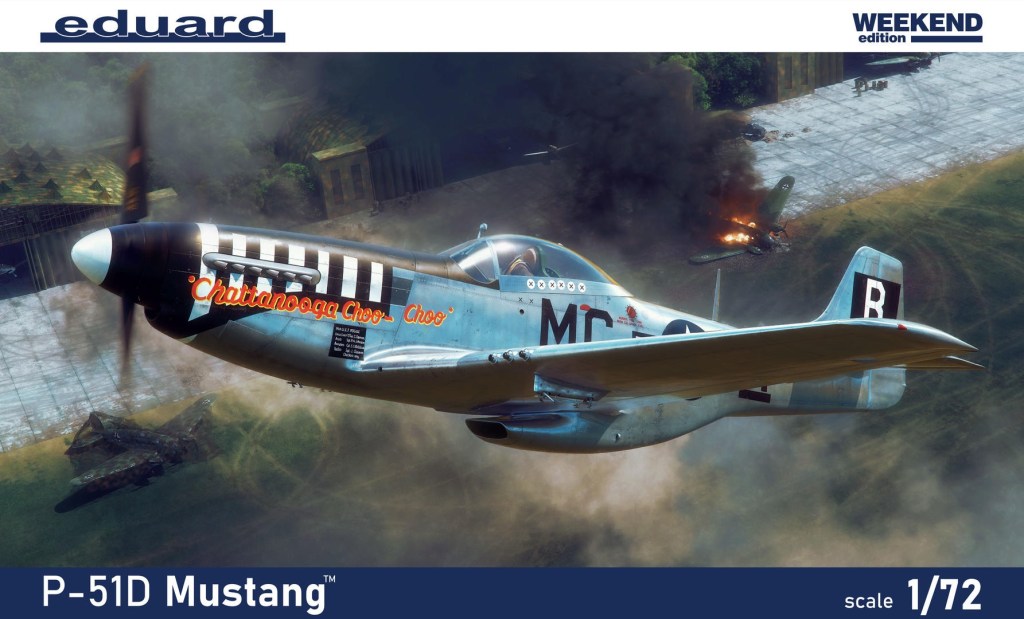
Eduard recently released the 2nd Weekend Edition boxing of its popular 1/72nd North American P-51D Mustang kit. The first three decal options are for Lt. Edward F. Pogue’s P-51D-5 “Chattanooga Choo-Choo” (79th FS, 20th FG, 8th AF); Capt. Clarence E. Anderson’s P-51D-10 “Old Crow” (363rd FS, 357th FG, 8th AF); Flt. Off. Charles A. Lane’s “Meatball Rap II” (99th FS, 332nd FG, 15th AF). All very interesting and popular subjects for modelers.
Eduard
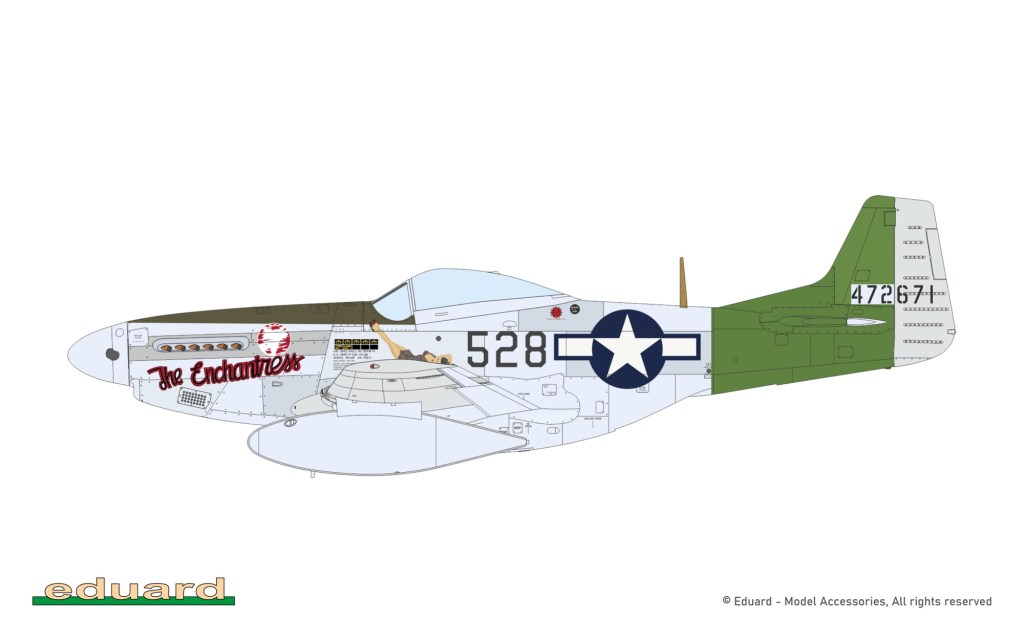
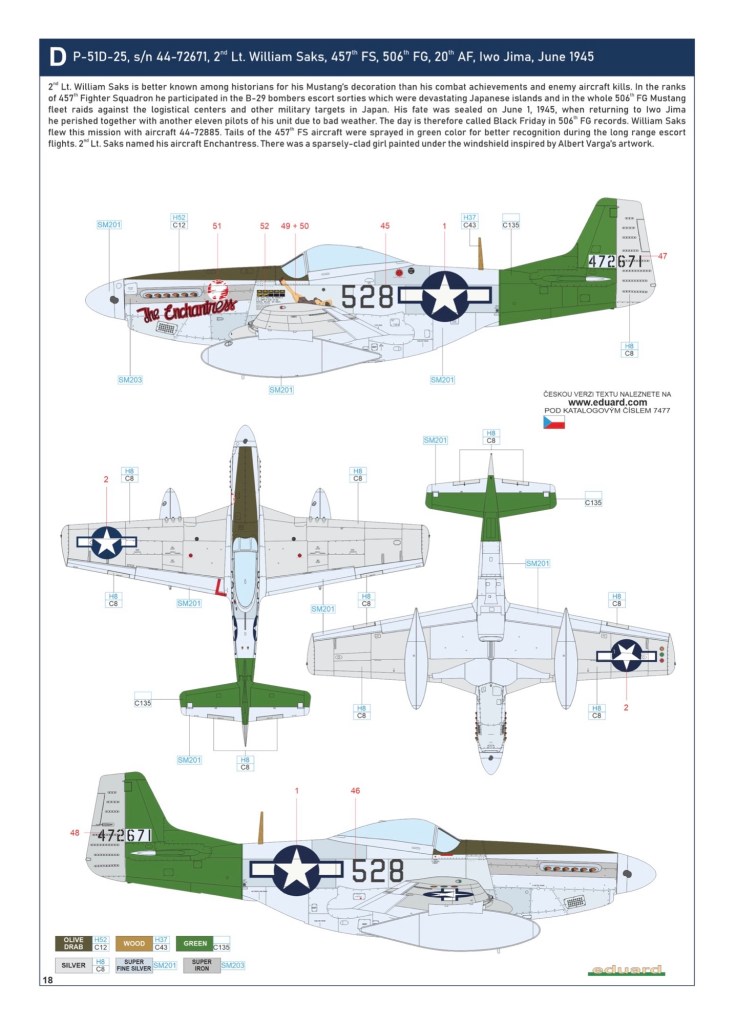
Iwo Jima VLR Mustang Decals: Eduard has again included decals for 528 “The Enchantress” (P-51D-25-NA, 44-72671), a 457th FS, 506th FG Mustang flown by 2nd Lt. William E. Saks. Unfortunately, 2nd Lt. Saks was one of the pilots lost on the infamous June 1, 1945 “Black Friday” mission, but he was not flying 528 on that day. “The Enchantress” is popular amongst modelers because the nose art and the Albert Varga pin-up girl that adorns the fuselage.
Eduard
2nd Lt. Saks did not score any aerial or ground victories and was lost within a few weeks after the 506th Fighter Group arrived on Iwo Jima.
Dr. Theodore Paprocki sitting on the wing of “The Enchantress (506th Fighter Group Association via Maurita Paprocki)
Below are the aircraft profile drawings for the plane that are included in the instructions for the kit.
Eduard
528 “The Enchantress” survived the war and was part of the USAAF’s inventory that was transferred to Japan as part of the occupation.
528 “The Enchantress” (506th Fighter Group Association)
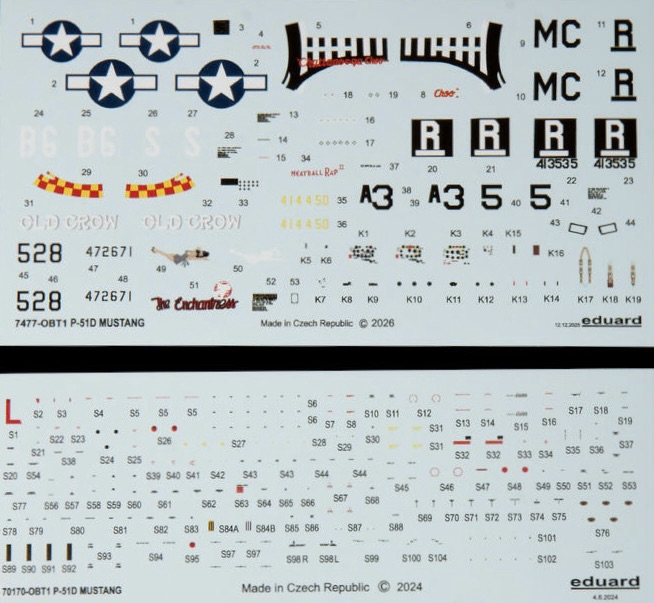
Because this is a Weekend Edition boxing, there are no photo etch or resin update sets within the kit. The decals included in the kit are very nice, in register, and with a full set of stencils for a 1/72nd kit. Just what we all have come to expect for Eduard.
Eduard
Kudos to Eduard for including decals for an Iwo Jima VLR Mustang in this boxing!