The Boeing B-29 Superfortress was powered by four Wright R-3350 Duplex-Cyclone engines. An air cooled engine with eighteen cylinders arranged in two rows, the R-3350 was the most advanced and powerful radial engine produced by the United States during World War II.
USAAF/National Archives via Fold3
This photo shows a ground crew in India replacing an R-3350 on a B-29 with the new engine waiting on the hoist. I think this is a fantastic photo because it shows all of the front detail of the engine before the exhaust piping is added and all of that detail is being hidden behind the cowling. The photo also provides some interesting diorama opportunities for modelers.
If you have the Monogram 1/48 Boeing B-29 Superfortress kit, there are some very nice after market resin engine upgrades sets that will allow modelers to really super detail the kit. I will be reviewing some of the engine upgrade kits in the coming weeks.
No, this is not a picture of Major Harry C. Crim’s 531st Fighter Squadron, 21st Fighter Group P-51D Mustang, but an attempt at humor by Loomis Dean, a United States Army Air Force photographer stationed on Iwo Jima. This staged photo depicts a P-51 pilot clutching his rear end in front of a line up of 45th Fighter Squadron Mustangs supposedly after completing a very long range mission from Iwo Jima to Japan and back.
USAAF/Loomis Dean/National Archives via Fold3
The official caption for this photo reads: “A tired pilot . . . and North American P-51 “Mustangs” on the line at Iwo Jima, Bonin Islands. The boys suffered most just from the 8-hour rumba of seat against seat!” Seven to eight hour VLR missions in a small cockpit led to a sore seat and stiff legs. There was anecdotal evidence that some pilots had to be lifted out of their cockpits because they were so stiff and sore. None of the pilots I had the opportunity to interview ever remember seeing a pilot having to be lifted out of a cockpit, but it made for a good story.
Loomis Dean – If you have noticed, a lot of the United States Army Air Force photos posted recently in Photo(s) of the Week were taken by Loomis Dean. Mr. Dean started his photography career with the Ringling Brothers and Barnum & Bailey Circus prior to World War II. After the war, he joined the staff of Life Magazine in 1947 photographing celebrities such as Elvis Presley, Lucille Ball, Noel Coward, Ernest Hemingway, and Liberace. A lot of Mr. Dean’s photos taken while serving with the United States Army Air Force were shot from unique angles which can be seen in the above photo.
After the 31st CB (SeaBees) and the 2nd Separate Engineer Battalion completely reconstructed Central Field (Motoyama #2), the 72nd FS of the 21st FG arrived on Iwo Jima on March 22nd. The remaining two squadrons of the 21st FG, the 46th and 531st, arrived on March 24th.
USAAF/National Archives via Fold3
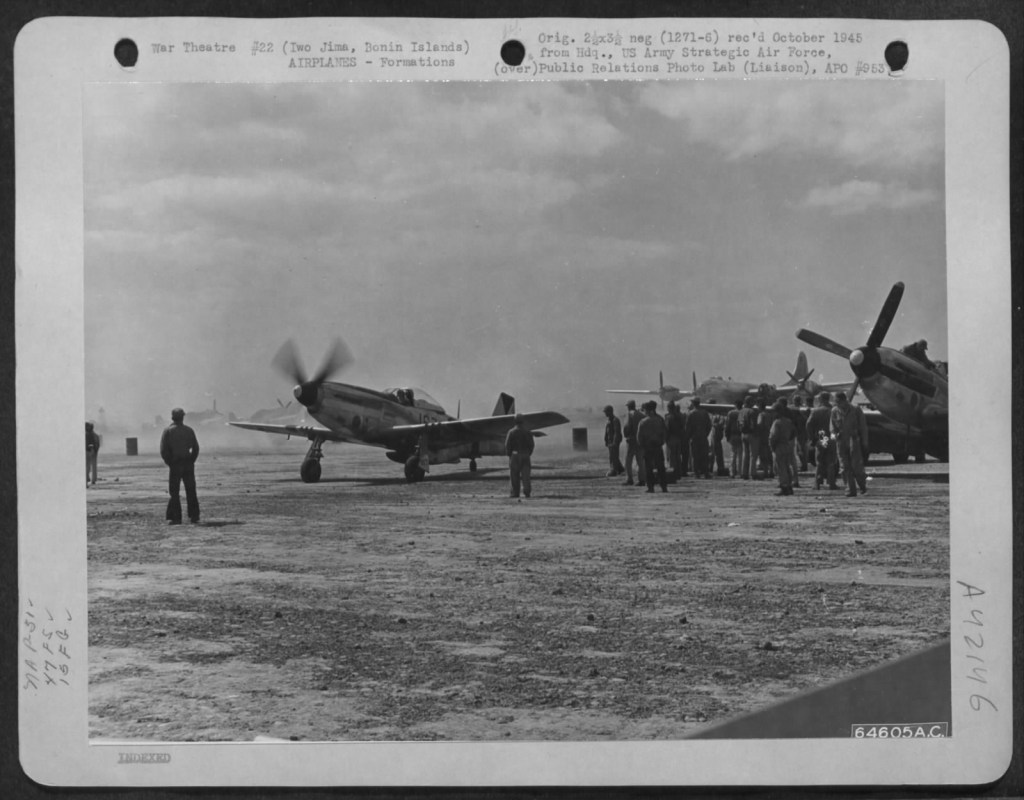
I really like the above photo. It shows 231 Tiny Gay Baba, 209 Three of a Kind and other 46th FS Mustangs parked on Central Field after their arrival on March 24th. Above Tiny Gay Baba you can see the main South Field runway and Mt. Suribachi.
USAAF/National Archives via Fold3
Taken on March 25th, the above photo shows a nice line up of 72nd FS Mustangs on Central Field. The closest Mustang in the photo is 250 Dede Lou, the mount of 72nd FS commander, Major Paul W. Imig. If you enlarge the photo, it appears that Dede Lou has the twin Uncle Dog antennae installed.
USAAF/National Archives via Fold3
The final photo shows 531st FS Mustangs in the foreground, with 46th and 72nd FS Mustangs in the background. This photo was also taken on March 25th, a day after the 46th and 531st FS Mustangs arrived on Iwo Jima.
The 15th Fighter Group wasted no time in getting into the thick of things after arriving on Iwo Jima. On March 8th, Major John Piper led two flights of 47th Fighter Squadron Mustangs to strafe Japanese positions in support of the Marines on the northern end of Iwo. Colonel James Beckwith and 45th Fighter Squadron got into the fight on the next day with three missions in support of the Marines. The photo below shows two 45th Mustangs loaded up with 500 pound bombs getting ready to take off on one of those missions. The 78th Fighter Squadron also flew 45 sorties in support of the Marines on March 10th.
USAAF/National Archives via Fold3
It would not take long for the 15th Fighter Group’s attention to be diverted elsewhere. On March 11th, the 47th FS would fly its first strike mission against Chichi Jima. I really like the photo below. Taken over the wing of a 47th FS Mustang, the photo below shows two bomb laden 47th FS Mustangs taxing into position to take off for their strike against Chichi Jima. I like how this photo shows the elegant lines of the Mustang’s nose.
USAAF/National Archives via Fold3
Chichi Jima was 147 miles north of Iwo Jima. A major communications center with radio and radar facilities, Chichi Jima had been occupied and fortified by the Japanese for decades. It had an airfield (Susaki Airfield), a deep water anchorage, and a seaplane base. Brig. General Moore and Colonel Beckwith in their Mustangs watched as seventeen 47th FS Mustangs bombed Chichi Jima.
USAAF/National Archives/via Fold3
The photo above shows a 47th FS Mustang landing on South Field upon its return from the March 11th strike mission against Chichi Jima as ground crew look on.
1st Lt. Robert Scamara in 167 Pappy Yochum 47th FS/15th FG (USAAF/National Archives via Fold3)
In the photo above, 1st Lt. Robert Scamara pulls his 47th FS Mustang 167Pappy Yochum into parking position after his return from the March 11th strike mission against Chichi Jima. Ground crew and other pilots clamor around the parked Mustangs anxious to hear about the results of the mission. Note the single antenna on Scamara’s Mustang.
References:
John W. Lambert, The Long Campaign: The History of the 15th Fighter Group in World War II, Schiffer Publishing Ltd. (2006)
Carl Molesworth, Very Long Range P-51 Mustang Units of the Pacific War, Osprey Publishing (2006)
On March 7th, a day after the 47th Fighter Squadron landed on Iwo Jima, Colonel James Beckwith, Commander of the 15th Fighter Group, led the 45th and 78th Fighter Squadrons from Saipan to Iwo Jima. With all three squadrons on Iwo Jima, the 15th Fighter Group would start flying missions in support of the Marines on Iwo and against other islands in the Bonins.
The photo below shows a 45th Fighter Squadron P-51D Mustang landing on South Field on March 7, 1945, as 47th Fighter Squadron pilots look on.
USAAF/National Archives via Fold3
The photo below, taken on March 10, 1945, is a beautiful shot of 78th Fighter Squadron P-51D Mustangs lined up on South Field. A few things are worthy of note. First is what looks like freshly painted squadron markings, most likely done on Saipan. Second is the 110 gallon drop tanks on the ground under the wings. These were most likely the drop tanks brought from Saipan by each plane. The 110 gallon drop tanks were used during VLR missions and on combat air patrols around Iwo Jima. Third, it appears that the first Mustang in the picture, 109 Pee Wee, has the SCR-695 IFF transmitter and twin Uncle Dog antennae installed which suggests that those field modifications began relatively soon after the 15th Fighter Group arrived on Iwo Jima.
USAAF/National Archives via Fold3
The last photo is another line up, but this time of 45th Fighter Squadron P-51D Mustangs on South Field with ground crew congregating on the flight line. This photo was also taken on March 10th.
USAAF/National Archives via Fold3
Nice group of photos of the 45th and 78th Fighter Squadrons’ first few days on Iwo Jima.




 Iwo Jima Models