On March 6, 1945, Brig. General Ernest M. “Mickey” Moore, commanding officer of the 7th Fighter Command, and 24 pilots of the 47th Fighter Squadron (FS) of the 15th Fighter Group (FG), landed their North American P-51D Mustangs on South Field (Motoyama #1) on Iwo Jima, just fifteen days after the United States Marines stormed Iwo’s black sand beaches. The battle for Iwo Jima continued to rage on for another twenty days as pockets of Japanese resistance were being eliminated.
USAAF/National Archives via Fold3
It is believed that the above photo is of Brig. General Moore landing an unmarked P-51D on South Field. Was he the first USAAF pilot to land a P-51 on Iwo Jima? None of the captions to the March 6th photos provide an answer, but squadron records indicate that Brig. General Moore was the first to land, with 47th Squadron Commander Major John Piper second.
USAAF/National Archives via Fold3
Another March 6th photo showing a 47th Fighter Squadron P-51D pulling into its parking spot just off of South Field. Note the single antenna in both photos. The twin Uncle Dog antennae were a field modification on Iwo Jima.
The image above is a United States Army Air Force photo taken on Iwo Jima on March 6, 1945, and shows Midnite Madness, a 548th Night Fighter Squadron Northrop P-61A-11 Black Widow (Serial No. 42-5610) landing on South Field with the tails of two 47th Fighter Squadron/15th Fighter Group Mustangs in the foreground.
On March 6th, Brigadier General Ernest M. “Mickey” Moore, commanding officer of the 7th Fighter Command, and 24 North American P-51D Mustangs landed on South Field. Shortly thereafter, 13 Northrop P-61A Black Widows of the 548th NFS landed on South Field in flights of four, the extra being a 6th NFS Black Widow “guide dog” with the first flight. Which P-61 Black Widow was the first to land on Iwo Jima?
According to the photo above, it was Midnite Madness. The official caption for the photo reads, “A Northrop P-61 ‘Black Widow’ taxies to the parking area at No.1 Airfield on Iwo Jima, Bonin Islands. This is the first night fighter to land at the field. 6 March 1945.” But that caption may not be accurate.
According to Eric Shulenberger, the author of Deny Them the Night Sky: A History of the 548th Night Fighter Squadron, the first P-61 Black Widow to land on Iwo Jima was most likely the 6th NFS “guide dog” P-61 on Temporary Additional Duty leading the 548th NFS’s A Flight from the Marianas to Iwo Jima. Piecing together written statements of 548th pilots and personnel, Dr. Shulenberger believes that Bat Out’A Hell (Serial No. 42-5609) was the first 548th P-61 to land on Iwo Jima. Midnite Madness landed with the second flight and was most likely the 7th P-61 to land on Iwo Jima.
I will review several decal sheets containing markings for 548th NFS Black Widows in the near future, in addition to reviewing Deny Them the Night Sky: A History of the 548th Night Fighter Squadron. Excellent book!
References:
Eric Shulenberger, PhD, JD; Deny Them the Night Sky: A History of the 548th Night Fighter Squadron, self published by Dr. Shulenberger (2005).
The image above is a United States Army Air Force photo taken on Iwo Jima in July, 1945. The official caption for this photo reads, “Men of the 21st Bomber Command gather around the American Red Cross truck to relax over a cup of coffee and doughnuts after returning from a raid over Japanese installations. July 1945”. If they landed on Iwo Jima, the return trip was not complete.
The strategic importance of Iwo Jima to both Japan and the United States could not be overstated. Iwo Jima, part of the Bonin Islands, was approximately half way between the Mariana Islands and the Japanese Home Islands. For Japan, it provided a base from which their air forces could intercept B-29 bomber formations heading from the Marianas to the Home Islands, and from which to bomb 20th Air Force B-29 bases on Guam, Tinian and Saipan, which Japan did with some success.
For the United States, it not only provided a base for the VLR Mustang groups to fly escort and strike missions to the Home Islands, but also provided combat damaged and fuel starved B-29s a safe haven during the long over-water flights back to the Marianas. Many crippled B-29s landed safely on Iwo Jima and avoided ditching in the vast Pacific Ocean somewhere between the Home Islands and the Marianas.
Boeing B-29A Superfortress “Dinah Might” on Iwo Jima (USAAF/National Archives via Fold3)
On March 4, 1945, Dinah Might was the first B-29 to make an emergency landing on Iwo Jima, just 13 days after the United States Marines stormed Iwo’s black sand beaches. With the battle still raging on between the Marines and Japanese forces, 1st Lt. Raymond F. Malo put his 1st BS/9th BG Superfortress down on South Field due to the inability to transfer fuel between tanks. As the picture above shows, Dinah Might was surrounded by hundreds of Marines and SeeBees. Mechanics made field repairs quickly, and after being refueled, 1st Lt. Malo lifted her off South Field while being fired at by Japanese forces.
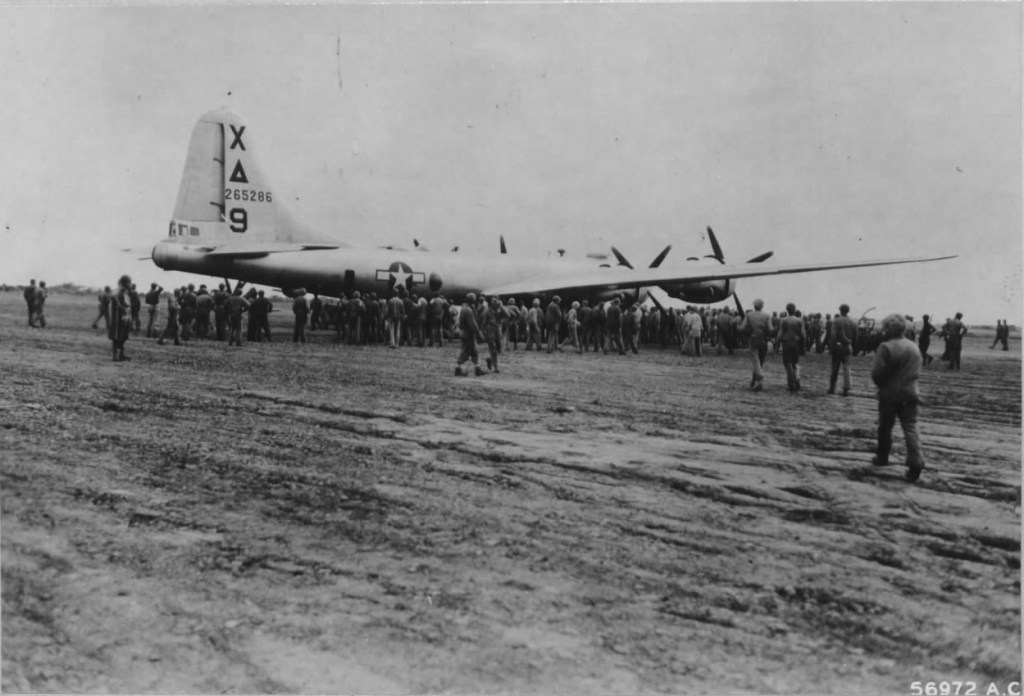
Dinah Might’s emergency landing was the first of 2,451 forced landings on Iwo Jima. On June 7, 1945, 102 B-29s landed on Iwo Jima, and on July 24, 1945, another 186 B-29s landed on South and North Fields. As the picture below testifies to, Iwo Jima at times looked like a B-29 base.
USAAF/Loomis Dean/National Archives via Fold3
Kits-World makes decals in 1/72nd scale for Dinah Might for anybody interested in building the Academy kit into this history making B-29.
The photo below shows a North American P-51D Mustang receiving extensive maintenance from no less than 7 ground crew members on Iwo Jima. Neat photo that could be used for the basis a very busy diorama. You can make out the plane’s serial in the photo, which is 44-63959. This was a P-51D-20NA Mustang assigned to 462nd Fighter Squadron, 506th Fighter Group. I received the photo from Richard Smith, who is the son of Captain Lawrence S. Smith. Captain Smith was one of pilots lost during the infamous June 1, 1945, “Black Friday” mission.
644 “Sandra Leigh” (Richard Smith)
The plane’s fuselage number was 644. Please note that the stubs for carrying 5-inch high velocity aircraft rockets (HVARs) have been installed on 644. These were a field modification as the stubs were not factory installed on Block 20 Mustangs.
644 “Sandra Leigh” (506th Fighter Group Association via Richard Smith)
644 was flown by Flight Officer Harry Reese who named the plane, “Sandra Leigh”. Flight Officer Reese was not credited with any aerial or ground victories.
644 “Sandra Leigh” (506th Fighter Group Association via Harry Reese)
Below is a nice photo of Flight Officer Reese with a 20 mission crush on his cap.
Flight Officer Harry Reese (506th FG Association via Harry Reese)
There are no aftermarket decals in any scale for 644 “Sandra Leigh”. Thanks to Richard Smith for providing me with the top photo.




 Iwo Jima Models