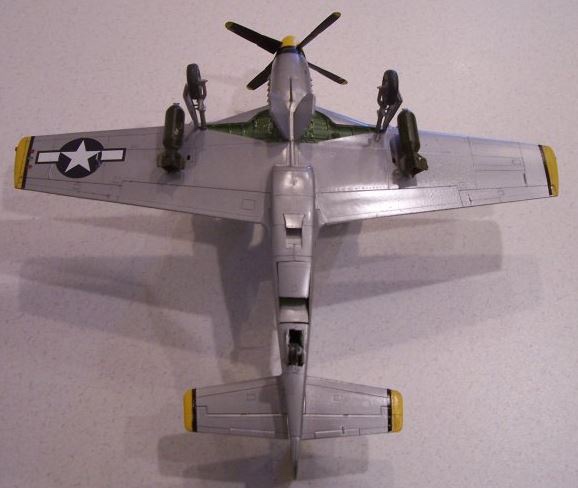
Mark L. Rossmann’s 1/48 Tamiya North American P-51D Mustang; 227 “Mary Alyce”/“My Miss Moe”; 46th Fighter Squadron, 21st Fighter Group

Mark L. Rossmann is back with another Iwo Jima VLR Mustang build. This time, a 1/48 Tamiya North American P-51D Mustang built with the markings for a 46th FS, 21st FG P-51D-20-NA, Serial No. 44-63451, 227 “Mary Alyce”/“My Miss Moe” flown by Lt. Robert J. Louwers and Lt. John E. Montgomery, III.

Mark L. Rossmann

While the 1/48th scale Tamiya kit does not have the necessary parts to build an accurate Iwo Jima VLR Mustang, it still builds into a very nice and accurate representation of a D model Mustang. Mark relocated the dorsal antenna to the correct position below the front fuselage just in front of the main wheel well covers. Mark used toothpicks to create the dual Uncle Dog antennae. Nice touch in light of the fact that actual antennae were made of wood.

Eduard

Mark used the AeroMaster Decal sheet 48-797, The Very Long Range Escorts, “The Iwo Jima Mustangs” Fancy Art Part 4. Unfortunately, this sheet does not provide the decal for My Miss Moe which appears on the right side of the nose, so Mark used the decal from the Eduard sheet contained in the limited edition Tales of Iwo Jima boxing.

Mark L. Rossmann

Below is the only photograph I can find for 227 “Mary Alyce”/My Miss Moe”. This photo appears in Carl Moleworth’s book Very Long Range Mustangs Units of the Pacific War which can be purchased from Osprey Publishing in a traditional softbound book format or in an ebook format. This title and many other aviation titles can be purchased at Osprey.

A few items to note from the photograph for the modeler. First, please note how weathered 227 “Mary Alynce”/“My Miss Moe” appears. While the Mustangs on Iwo Jima were well maintained, the conditions on Iwo Jima were harsh on planes from an appearance prespective. Second, the airfield dust shows that this Mustang was equipped with tires with a block tread pattern. Third, please note the right main landing gear leg, and how dark it is. I have seen color photos of 21st Fighter Group Mustangs while on Saipan in which the landing gear legs look like they have been painted bronze green.

227 “Mary Alyce”/“My Miss Moe” on Iwo Jima (Robert J. Louwers via Carl Molesworth)

Mary Alyce was Lt. Louwers’ wife’s name. It is not known if the pin-up art that adorns the left side of the fuselage below canopy is an attempted depiction of the actual Mary Alyce Louwers.

Mark L. Rossmann

Neither Lt. Louwers or Lt. Montgomery were credited with any aerial or ground victories. Lt. Louwers completed 9 VLR missions while on Iwo Jima.

Mark L. Rossmann

Mark achieved a very nice natural metal finish, and I like the light weathering that is achieved with a simple panel line wash. Thanks to Mark for sharing his build with us, and kudos on a very nice result. More to come from Mark.

References: Very Long Range P-51 Units of the Pacific War, Carl Molesworth, Osprey Publishing, 2006.
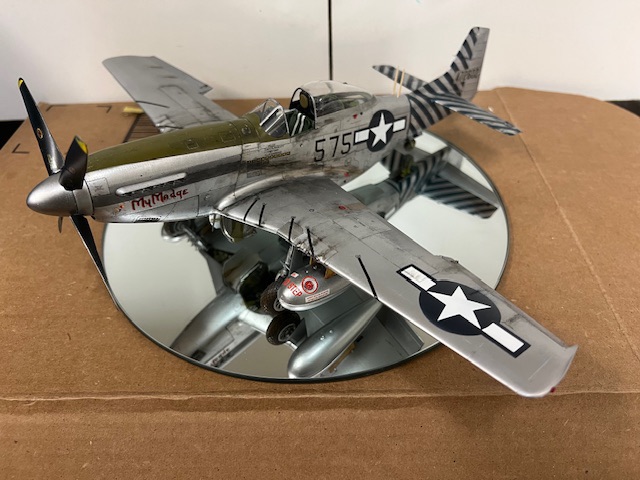
Andrew Willet’s Tamiya 1/32nd North American P-51D Mustang; 575 My Madge/‘Julia’ll Fool Yer’; 458th Fighter Squadron, 506th Fighter Group

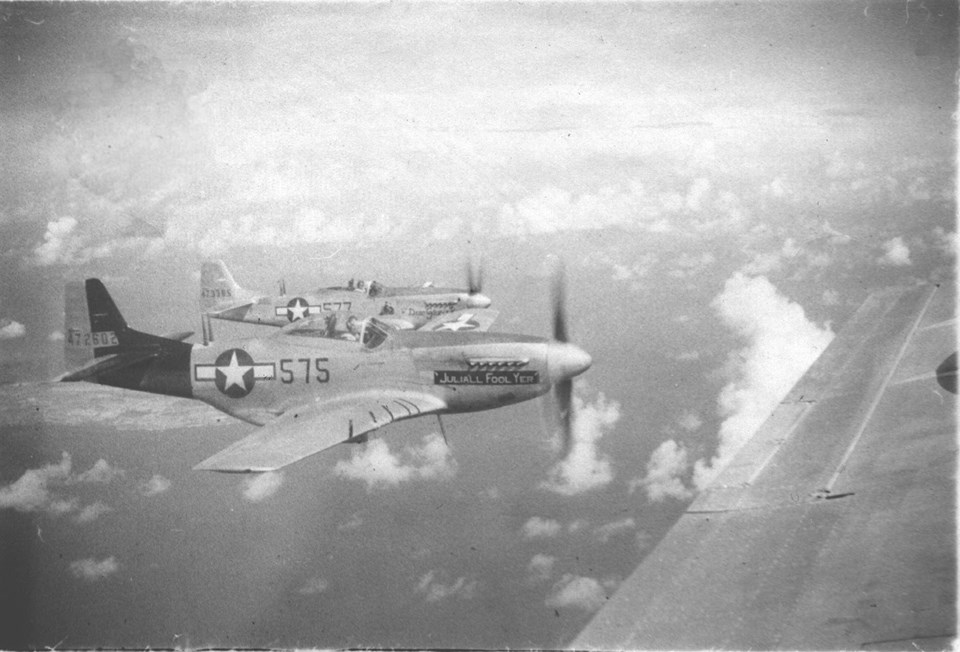
Andrew Willet has provided us with photos of his Tamiya 1/32nd North American P-51D-20-NA Mustang finished with the markings of 575 My Madge/‘Julia’ll Fool Yer’, a 458th Fighter Squadron, 506th Fighter Group Iwo Jima VLR Mustang.

Andrew Willet
Andrew Willet

Andrew used the original boxing of Tamiya’s superlative 1/32nd scale Mustang. This boxing has the parts for the SCR-695 IFF transmitter (multi-band airborne transponder which allowed a plane to be identified on friendly radars) which were installed in the VLR Mustangs, and the bracket which allows the battery to be moved to the engine compartment. Unfortunately, the boxing does not include either the 110 gallon or 165 gallon metal drop tanks used by Iwo Jima VLR Mustang groups.

Tamiya

575 My Madge/‘Julia’ll Fool Yer’ was flown by Captain Goldie Marcott. If there was another pilot assigned to fly 575, we have not been able to identify who that pilot was. Captain Marcott was not credit with any aerial victories. Below are photos of Captain Marcott and both sides of 575.

Captain Goldie Marcott (via Brian Walter)

I think this is a great photo. It shows the graceful and aerodynamic lines of the nose/cowling.

575 “My Madge/Julia’ll Fool Yer” (via Brian Walter)
575 “My Madge/Julia’ll Fool Yer” (via Dr. John Benbow)

Andrew’s original intent was to build 551 Delta Queen, another 458th FS/506th FG Mustang flown by Captain J.B. Baker, Jr. He had seen a build of Eduard’s 1/48th scale P-51D Mustang with Delta Queen’s markings and the striped blue tail. Unfortunately, there are no after market decals for 551 Delta Queen in 1/32nd scale. Wanting to build a 458th FS Mustang with a striped blue tail, Andrew purchased DK Decals’ P-51D/K Mustang over the Pacific and Australia (32022) with decals for 575.

DK Decals

My review of this decal sheet is found here.

DK Decals

The only other after market decal sheet that includes markings for a 458th FS Mustang in 1/32nd is Hussar Productions’ P-51 Over Pacific, Part 1, which has decals for 590 “Little Que” flown by 1st Lt. Quarterman Lee.

Andrew did a great job of painting and weathering the cockpit sidewalls, and adding additional detail.

Andrew Willet

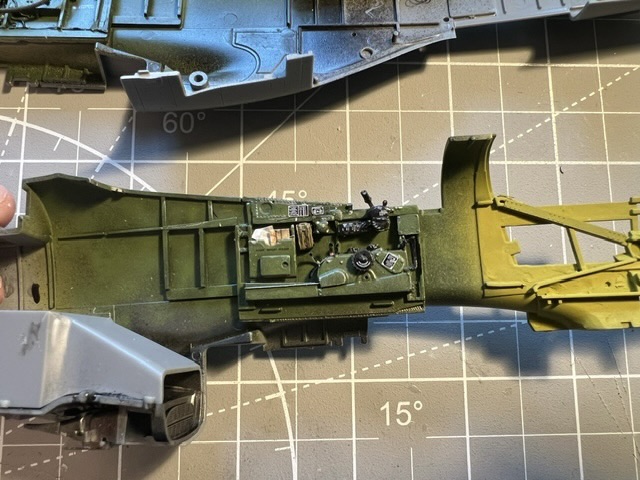
Andrew used Ammo of MiG’s Atom Acrylic Paint Zinc Chromate Green (Atom-20074) for the cockpit area, and Tamiya Yellow Green (XF-4) for all other interior areas. Tamiya’s Yellow Green is an excellent match for Zinc Chromate Yellow.

Andrew Willet

The photo below shows the assembled and painted cockpit components installed on the left side of the kit fuselage. Andrew did a really nice job of chipping the areas in front of the rudder pedals to simulate the wear of the black non-skid material down to the wood cockpit floor. Nice touch! The seat belts are from HGW.

Andrew Willet

The wheel wells of the D model of the Mustang looked like the photo below. The roof was unpainted Alclad aluminum, with the sides, ribs, stringers, other components painted primarily Zinc Chromate Yellow. As can be seen, a few parts were painted Zinc Chromate Green.

Andrew K. Carothers

Fundekals 🙂 produced a North American P-51D stencil data decal sheet that includes the red stencil markings on the unpainted Alclad aluminum.

Fundekals 🙂

Andrew used those stencils decals in the wheel wells. He first used Bare Metal Foil to simulate the unpainted aluminum, then applied the stencil decals to the Bare Metal Foil, and the added the remaining wheel well component. Very nice detail that increases the realism of the wheel wells.

Andrew Willet

Andrew also added fluid and electrical lines to the wheel wells to add more visual interest.

Andrew Willet
Andrew Willet

Andrew used various shades of Alclad II Metallics for his natural metal finish on 575. Unfortunately, there are no after market decals for the diagonal stripes on the tail in 1/32nd scale. You have to mask and paint them which most modelers shy away from in favor of a solid tail 506th FG Mustang.

Andrew Willet

The diagonal tail stripes on the actual 506th Fighter Group Mustangs were 4 inches wide. When scaling them down to 1/32nd, Andrew calculated that the diagonal tail stripes were approximately 3.1 mm. Andrew used Mr. Paint Sea Blue (MRP-237) for the stripes.

Andrew Willet

To finish the model, Andrew purchased Brengun Models resin 1/32nd 110 gallon drop tanks. They are a very accurate scaled down version of the real tanks.

Brengun Models

The tanks are not 3D printed, but cast resin. They come with cast resin sway braces, photo etched pieces, and decals.

Brengun Models

After applying the decals, Andrew completed the model by weathering it to reflect the actual look of the Mustangs due to the less than hospitable conditions on Iwo Jima.

Andrew Willet
Andrew Willet

Congrats to Andrew for an excellent build! He has also purchased the Revell 1/32nd P-51D Mustang in which he intends to finish using decals for 528 The Enchantress, a 457th Fighter Squadron, 506th Fighter Group Iwo Jima VLR Mustang. We look forward to updates as he builds another Iwo Jima VLR Mustang.

Andrew Willet is a CMDR in the Royal Australian Navy who specializes in logistics. In his more than 25years in the RAN, he has been all over the world, both at sea and ashore. Commander Willet has always had an interest in aviation especially in the Pacific. His preferred scale is 1/32nd.

Mark L. Rossmann’s 1/48 Tamiya and ICM P-51D Mustangs; 457th Fighter Squadron, 506th Fighter Group

Mark Rossmann is back with two 1/48 North American P-51D Mustangs from Tamiya and ICM. In this dual build, Mark covers both marking options for Mustangs of the 457th Fighter Squadron, 506th Fighter Group; the early striped tail and the later solid tail.

Mark L. Rossmann

Initially released in 1995, Tamiya’s 1/48 North American P-51D Mustang was a significant improvement over prior kits in the areas of accuracy, details, and engineering. Many of these kits have been built over the years and a lot show up on model forums. For beginners or novices with just basic skill sets, it can be built into a really nice kit worth sharing with the rest of the world. For those with advanced detailing or scratch building skills, the kit can be transformed into competition winning model. Even by today’s standards, it is still an excellent kit.

Mark L. Rossmann

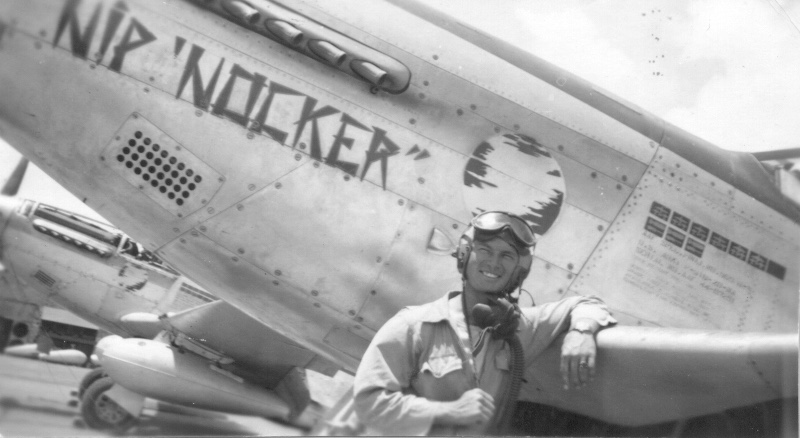
Mark has used the Tamiya kit to build 531 “Nip Nocker”, a P-51D-20-NA (Serial No. 44-63291) assigned to 1st Lieutenant Wesley A. Murphey, Jr. 1st Lt. Murphey shot down a Nakajima Ki-44 Shoki (Demon), and damaged a Mitsubishi A6M Zero on the July 16, 1945 VLR strike mission to the Nagoya/Bay of Ise area. It is not known if “Nip Nocker” was assigned to another pilot in addition to 1st Lt. Murphey. Unfortunately, official squadron and group records do not go into that level of detail.

1st Lt. Wesley A. Murphy, Jr. and 531 “Nip Nocker” (via 506th Fighter Group Association)

1st Lt. Murphey would continue his service to his country in the Air National Guard during which time he would attain the rank of Captain. He also served as a civilian instructor pilot for the United States Air Force, and ended his career at the Federal Aviation Administration. 1st Lt. Murphey passed away at the age of 89 on March 30, 2007 in Sioux Falls, South Dakota.

Mark L. Rossmann
This photo shows that the name “Nip Nocker” was on both sides of the nose (506th Fighter Group Association via John Benbow)

Mark used SuperScale Decals 1/48 “P-51D Mustangs 457th FS/506th FG, Iwo Jima” (48-1152) decal sheet for the markings. My review of this decal sheet can be found here: https://iwojimamodels.com/2020/08/22/decal-review-superscale-decals-1-48-p-51d-mustangs-457th-fs-506th-fg-iwo-jima-48-1152/ The tail stripes are on this decal sheet and were specifically designed for the Tamiya kit. If you are wanting to build an early striped tail 457th FS Mustang without having to do all of the tedious masking, this decal sheet is what you need.

Mark L. Rossmann

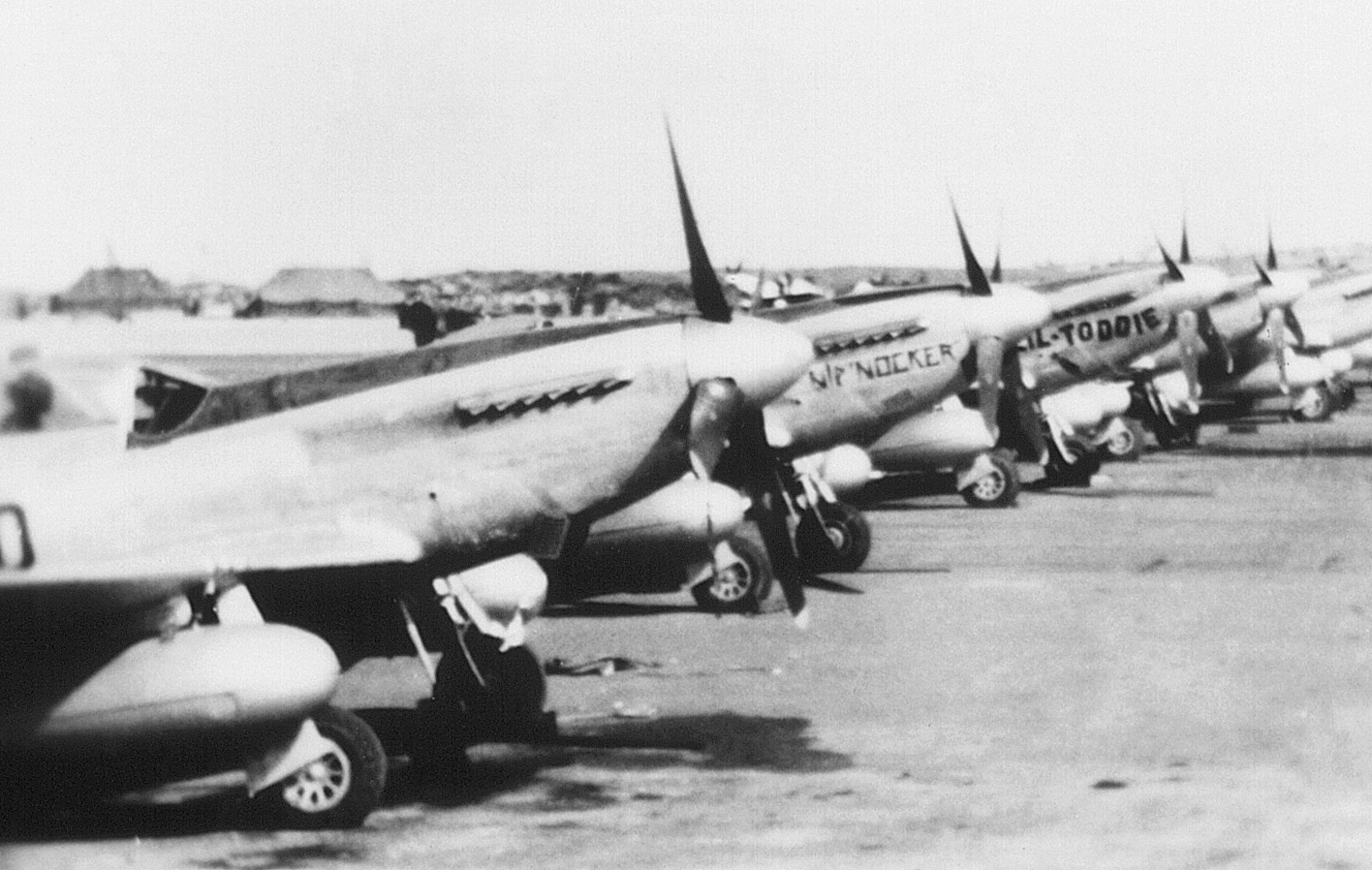
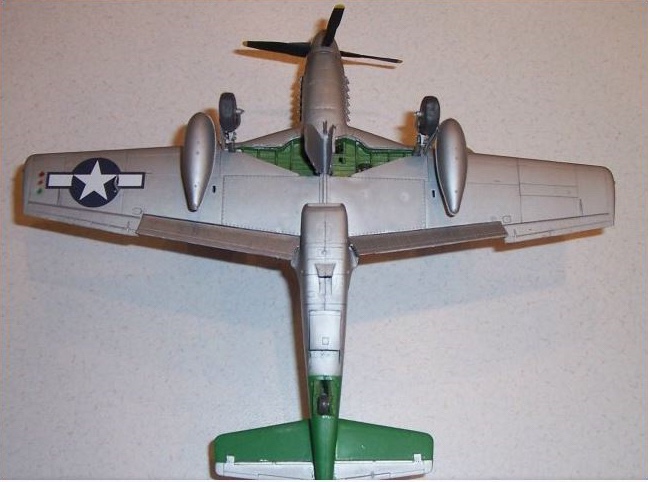
For his solid tail 457th FS Mustang, Mark used the ICM kit to build 527 “Hel-Eter/Lil-Toddie” (44-72557), a P-51D-20 NA. ICM’s 1/48 North American P-51D Mustang is basically the same kit as the Tamiya kit, and therefore, can be built into a very nice model.

Mark L. Rossmann

Mark used the decals from AeroMaster’s The Very Long Range Escorts “The Iwo Jima Mustangs” Fancy Art Part 2 (48-795) for this build. A nice decal sheet, and the only after market decals for 527 “Hel-Eter/Lil-Toddie”. No other kit, in any scale, contains decals for this Iwo Jima VLR Mustang.

AeroMaster Decals

While this decal sheet has been long out of production, you can still find it on eBay from time to time.

Mark L. Rossmann

“Hel-Eter/Lil Toddie” was first assigned to 1st Lt. John W. Winnen and 1st Lt. Philip G. Alston. The plane name “Hel-Eter” was a combination of shortened names of the 1st Lt. Winnen’s wife Helen and son Peter.

1st Lt. John W. Winnen in the cockpit of 527 “Hel-Eter/Lil Toddie” with Crew Chief Staff Sgt. Jaynes Gandy on the wing (506th Fighter Group Association via John Benbow)

Two other pilots are known to have flown 527 “Hel-Eter/Lil Toddie”; 1st Lt. Warren Clayton and 1st Lt. Denny O’Hearn. I have not been able to find any records regarding if, and when 1st Lts. Clayton and O’Hearn were assigned to fly 527 “Hel-Eter/Lil Toddie”, but there is good evidence to suggest that was the case.

1st Lt. Warren Clayton and Crew Chief Sgt. Simon sitting on the wing of 527 “Hel-Eter/Lil Toddie” (506th Fighter Group Association via John Benbow)

Warren Clayton wrote on the back of the above photo: “Hel-Eter, crew chief Sgt. Simon, and me. Good combination, Warren”. This strongly suggests that 1st Lt. Clayton was assigned to fly this plane.

Mark L. Rossmann

However, as was common in other theaters of operation, a pilot might fly a plane was he was not assigned due to the availability of planes for a mission. A good example of this was 1st Lt. Chauncey Newcomb. 1st Lt. Newcomb was assigned to 514 “Erma Lou” with 1st Lt. Francis Albrecht, but scored his two aerial victories in 522 “BuzzBuddy”.

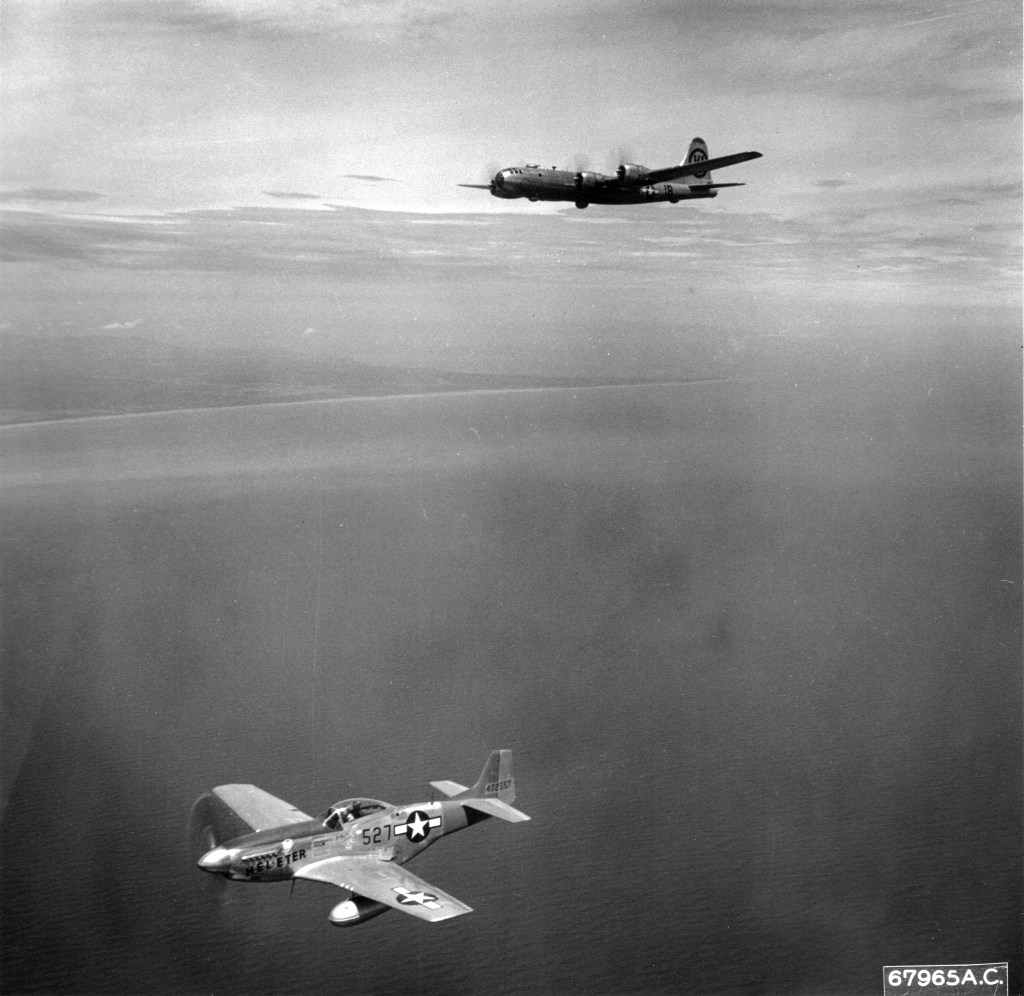
A 505th BG Boeing B-29 Superfortress escorted by 527 “Hel-Etr/Lil Toodie”, a 457th FS/506th FG North American P-51D-20NA Mustang, piloted by 1st Lt. Denny O’Hearn (USAAF/National Archives via Fold3)
Mark L. Rossmann

Thanks again to Mark Rossmann for sharing his dual 457th FS builds with us!

Mark L. Rossmann’s 1/48 Nichimo Kawasaki Ki-45 Toryu Kai Type Tei

Happy New Year! It is my prayer that you all have a prosperous and joyful 2022.

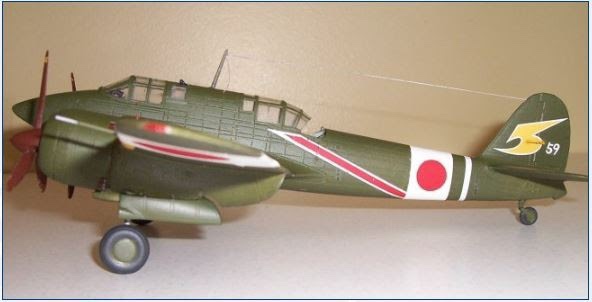
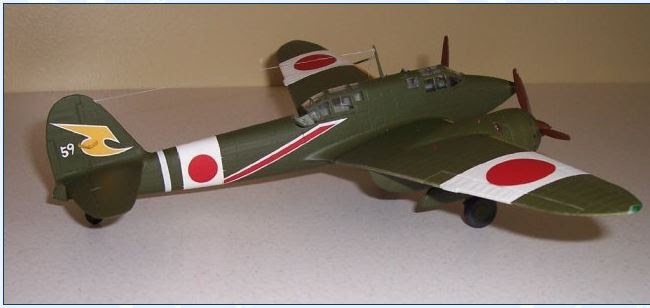
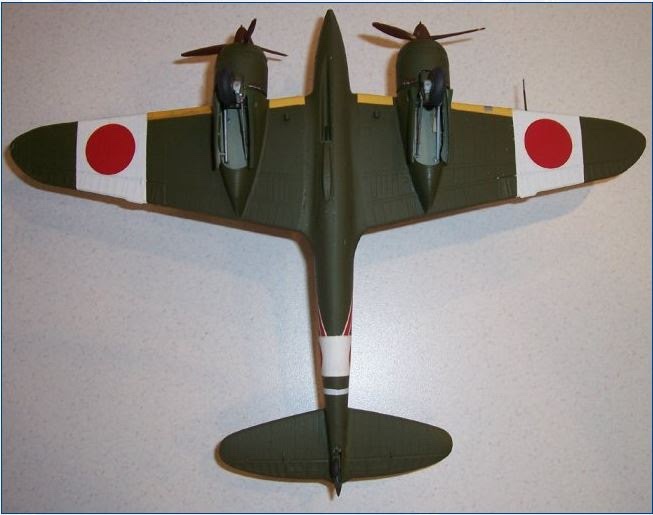
Mark Rossmann is back with his 1/48 Nichimo Kawasaki Ki-45 Toryu “Dragon Slayer” (Allied code name “Nick). Even though this kit was initially released in 1975, as you can see from the pictures provided by Mark, the kit is a very nice representation of the Ki-45. The kit’s cockpit detail is sparse, but it has very nice recessed panel lines and slightly over done rivet detail. Nice kit considering its age.

Mark L. Rossmann

The aircraft depicted in Mark’s build is a Ki-45 Kai type Tei of the 3rd Hikotai, 53rd Sentai. This variant of the Ki-45 was equipped with a 37 mm Ho-203 cannon in the nose, and two 20 mm Ho-5 cannons installed between the front and rear cockpit crew positions, fitted to fire upwards at a fixed angle of 32 degrees. This configuration allowed the Ki-45 night fighters to come from behind and below B-29 formations when making their attacks.

Mark L. Rossmann

Originally designed as a long range two seat heavy fighter, the Japanese learned, just like the Germans did with the Messerschmitt Bf 110, that heavier twin engine fighters did not fare well in aerial combat against the faster and more nimble single engine fighters. Like the Bf 110, the Ki-45 was adapted into the night fighter role to defend the Home Islands against the night time fire bombing raids being carried out by B-29s under the command of General Curtis LeMay. As part of the desperate defense of the Home Islands in the last few months of the Pacific War, the Ki-45 was also used in one-way ramming missions in an attempt to turn back the ever increasing B-29 bombing missions.

Below is a photo of the actual plane while the 53rd Sentai was stationed at Matsudo Air Base in 1945. Even more interesting is the plane in the foreground showing the installation of the two upward firing 20mm Ho-5 cannons.

53rd Sentai Ki-45s (WW2 Photo Archives)

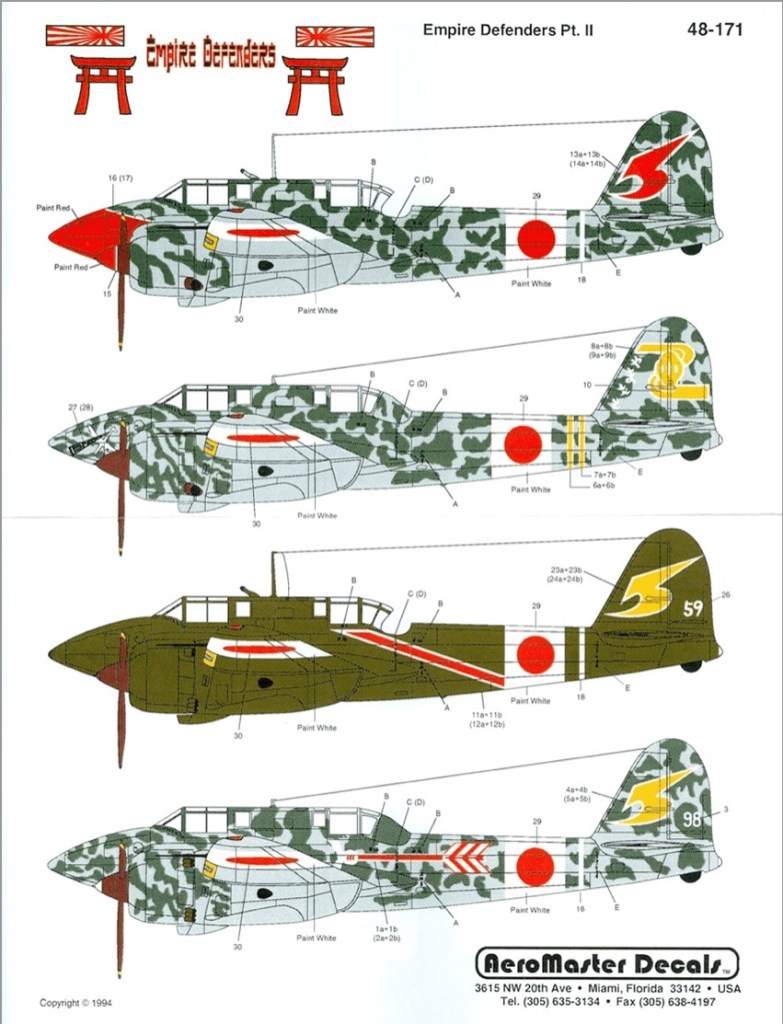
Mark used Aeromaster’s Empire Defenders Pt. II decal sheet (48-171) for the decals. This sheet was originally released in 1994 and is no longer in production, but it pops up on eBay every so often. As of the date of this post, Ultracast has one left in stock at an inflated price.

AeroMaster Decals

Tamiya AS-17 IJA Dark Green from a rattle can was used to paint the model along with Testor’s flat white for the home defense bands.

Mark L. Rossmann

Unfortunately, I was not able to determine who the pilot or pilots were that flew this plane in combat from my limited reference materials. If you follow this blog, and know the answer to this question, please share that information with us.

Mark L. Rossmann

The only aftermarket products for this kit are masks. Both Dead Design Models (VM48031 & VM48065) and Montex (MM48141) currently manufacture masks that can be used for this model. Dead Design Models can be found here: http://www.deaddesignmodels.com/en/. Montex can be found here: http://www.montex-mask.com/en/home. Check these companies out if you have this model.

Mark L. Rossmann

Thanks again to Mark Rossmann for sharing this build with us!

References:

1. “B-29 Hunter: Ki-45 Dragon Slayer”; Mark L. Rossmann.

2. B-29 Hunters of the JAAF; Komi Tataki & Henry Sakaida; Osprey Aviation Elite 5; Osprey Publishing Limited 2001.

3. Japanese Army Air Force Fighter Units and Their Aces, 1931-1945; Ikuhiko Hata, Yasuho Izawa & Christopher Shores; Grub Street 2002.

Mark L. Rossmann’s 1/48 15th Fighter Group VLR Mustang Builds

Mark Rossmann is back with three 1/48 VLR Mustang builds. This is a blast from the past as Mark built these 15th Fighter Group Mustangs back in 2007.

Mark L. Rossmann

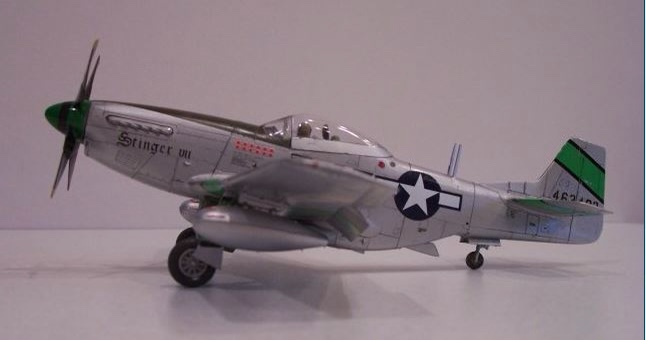
First up is the 45th Fighter Squadron’s P-51D-20NA (44-63483) 67 “Stinger VII”, flown by Major Robert W. “Todd” Moore. Major Moore was the highest scoring 7th Fighter Command ace with 12 aerial victories; 11 of those victories scored on VLR missions.

Mark L. Rossmann

Major Moore’s first victory came on an ambush mission over Arno Atoll on January 26, 1944, during which he shot down a Mitsubishi Zero. He did not score again until the 15th Fighter Group started flying VLR missions from Iwo Jima. His last victory came on a VLR escort mission to Tokyo on August 10, 1945, during which he shot down a Nakajima Ki-44 Shoki.

Major Robert W. Moore (USAAF/National Archives via Fold3)

In addition to the 12 aerial victories, Major Moore was credited with 3 ground victories. He ended the war as the commander of the 45th Fighter Squadron.

Mark L. Rossmann

Mark used the Tamiya kit along with decals from Aeromaster’s The Very Long Range Escorts “The Iwo Jima Mustangs” Fancy Art Part 4 sheet (48-797).

Mark L. Rossmann

An excellent article written by Tom Ivie on Major Moore’s service with the 15th Fighter Group during World War II can be found here: https://www.7thfighter.com/78th/moore/todd.htm

Next up is the 47th Fighter Squadron’s P-51D-20NA (44-63972) 185 “Black Rufe” flown by 1st Lt. William Hayden Sparks.

Mark L. Rossmann

1st Lt. Sparks scored an aerial victory over Kakamigahara Airdrome on July 19, 1945, and was also credited with a ground victory on August 3, 1945.

1st Lt. W. Hayden Sparks (via Mark W. Stevens/7th Fighter Command Association)
1st Lt. W. Hayden Sparks (W. Hayden Sparks)

185 “Black Rufe” was actually lost on the infamous June 1, 1945, Black Friday mission, but 1st Lt. Sparks was not assigned to fly that mission.

Mark L. Rossmann

Again, Mark used the Tamiya kit along with decals from Aeromaster’s The Very Long Range Escorts “The Iwo Jima Mustangs” Fancy Art Part 4 sheet (48-797).

Mark L. Rossmann

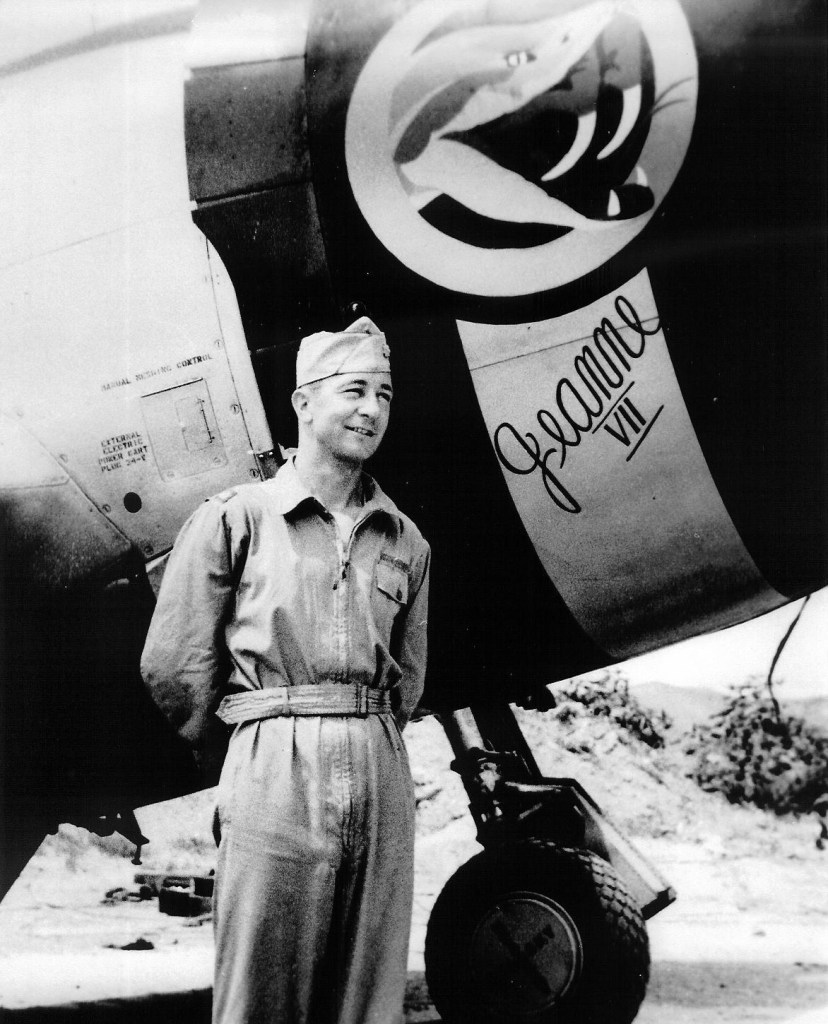
Mark’s third build is the 78th Fighter Squadron’s P-51D-20NA (44-63973) 100 “Jeanne VIII” flown by Major James M. Vande Hey. Major Vande Hey was a veteran 78th FS pilot who participated in all of the 78th FS campaigns in the Central Pacific, and was squadron commander when the 78th FS arrived on Iwo Jima.

Mark L. Rossmann

Major Vande Hey scored 4 aerial victories during his time with the 78th Fighter Squadron. His first two victories came on the January 26, 1944 ambush mission over Arno Atoll, during which he shot down two Mitsubishi Zeros.

Major James M. Vande Hey standing next to his Republic P-47D Thunderbolt “Jeanne VII” in Hawaii (James M. Vande Hey)

His third victory came on the first VLR escort mission to Tokyo on April 7, 1945, during which he shot down a Mitsubishi Ki-46 Dinah. Major Vande Hey’s last victory came on second VLR escort mission on April 12, 1945, again to Tokyo. Upon landing on Iwo Jima, his engine stopped for lack of fuel and had to be towed back to its hardstand. Major Vande Hey had been in the air for over 8 hours. This would be his last VLR mission. After spending 40 months in the Central Pacific, and after logging over 1,500 flight hours, Major Vande Hey rotated home and was reassigned to a Stateside position.

Major James M. Vande Hey (USAAF/National Archives via Fold3)

James Vande Hey would make a career out of serving his country in the United States Air Force obtaining the rank of Brigadier General. Brig. Gen. Vande Hey retired on July 1, 1971, and passed away on December 21, 2009.

Mark L. Rossmann

For this build, Mark used the Hasegawa kit along with decals from Aeromaster’s The Very Long Range Escorts “The Iwo Jima Mustangs” Fancy Art Part 2 sheet (48-795).

Mark L. Rossmann

Thanks again to Mark Rossmann for sharing his builds with us. More to come as Mark has done more VLR Mustang builds over the years. Very nice builds! Thanks also to Mark W. Stevens of the 7th Fighter Command Association for the photos of 1st Lt. W. Hayden Sparks.

References:

1. The Long Campaign: This History of the 15th Fighter Group in World War II; John W. Lambert; Schaffer Publishing Ltd. (2006)

2. 7th Fighter Command Association website/Mark W. Stevens. https://www.7thfighter.com/

As a condition of the use of materials from the 7th Fighter Command Association website, the following disclaimer is included: Permission to use, copy and distribute documents delivered from this Worldwide Web server and related graphics is hereby granted, provided 1) That the use of the data will not be used for obtaining a profit of any kind, and 2) That the above disclaimer notice appear in all copies and that both that disclaimer notice and this permission notice appear. All other rights reserved. The name of “7th Fighter Command Association” may not be used in advertising or publicity pertaining to distribution of this information without specific, written prior permission. Mark Stevens and the 7th Fighter Command Association makes no representations about the suitability of this information for any purpose. It is provided “as is” without express or implied warranty. Mark Stevens and the 7th Fighter Command Association disclaim all warranties with regard to this information, including all implied warranties of merchantability and fitness. In no event shall Mark Stevens or the 7th Fighter Command Association be liable for any special, indirect or consequential damages or any damages whatsoever resulting from loss of use, data or profits, whether in an action of contract, negligence or other action, arising out of or in connection with the use or performance of this information.