Back in October of 2024, Eduard announced the future release of a limited edition “Very Long Range: Tales of Iwo Jima” boxing of their excellent 1/72nd North American P-51D Mustang kit. They announced that kit would be released in the second quarter of 2025, and it would most likely contain the same decal options as their 1/48th limited edition “Very Long Range: Tales of Iwo Jima” boxing.
Eduard
The British on-line retailer Hannants now shows the kit as a limited edition dual combo boxing to be a July 2025 release. Hannants anticipates having it in stock in late June.
Eduard
As can be seen from the kit’s aircraft profiles above, it will similar to the 1/48th scale limited edition boxing in that it provides 12 decal options that cover all of the all nine of the Iwo Jima VLR Mustang squadrons. They will be the same decal options with one change. The 457th Fighter Squadron decals will be for 539 “Lil Ole Meanie II”, flown by 2nd Lt. William G. Hetland, instead of 542 “Fighting Lady” flown by 1st Lt. Ralph Gardner and 1st Lt. Chester Jatzcak. The decals for 542 “Fighting Lady” are included in the 1/72 Profipack boxing.
Kudos to Eduard for releasing the Very Long Range Tales of Iwo Jima in 1/72nd scale, and for making it a dual combo boxing.
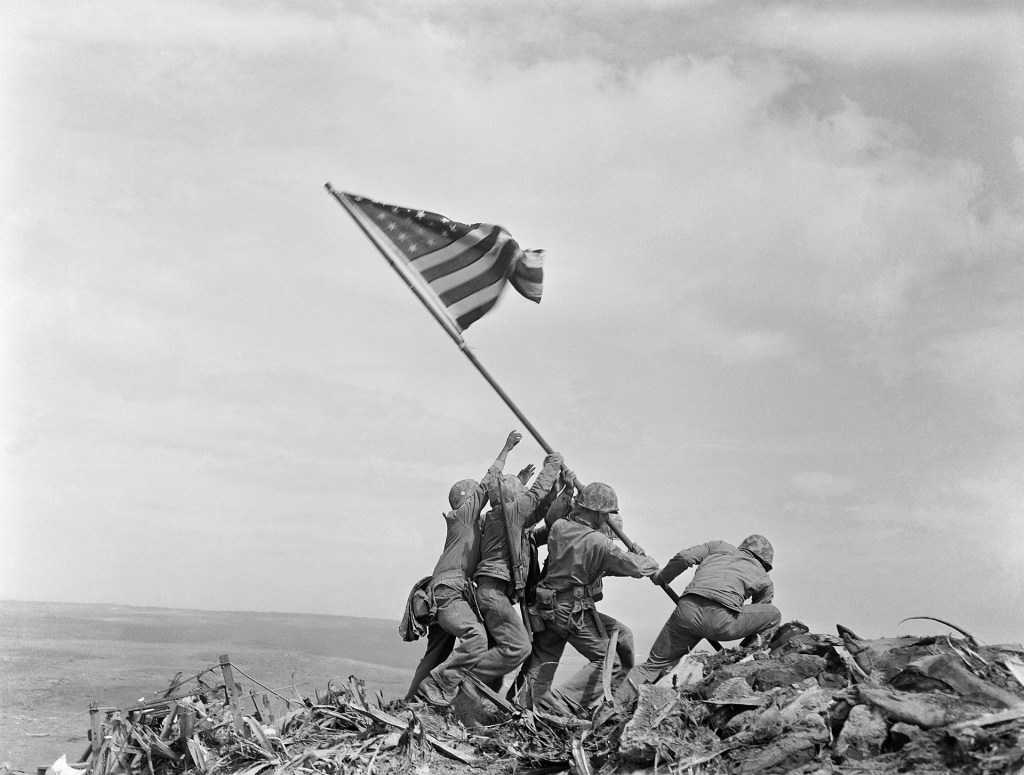
“Freedom is never more than one generation from extinction. We didn’t pass it to our children in the bloodstream. It must be fought for, protected, and handed on for them to do the same.” Ronald W. Reagan, 40th President of the United States of America
Joe Rosenthal/Associated Press via Fold3
This Memorial Day we have a chance to pause and honor the brave men and women who made the ultimate sacrifice for our country. We owe them such a tremendous debt, for the freedoms we enjoy today were paid for with an extremely high price! Their sacrifices ensures that our liberties and freedoms largely continue today – from the ability to gather with loved ones, to worship together, to speak as we see fit (and the companion right not to be forced to speak that which we know to be false), and to assemble and peacefully protest to effectuate change.
Captain John W.L. Benbow, 457th Fighter Squadron, 506th Fighter Group; Lost on the July 16, 1945 Strike Mission to Nagoya
The statue below is outside of the National Archives building in Washington D.C. It is of an ever watchful soldier holding his helmet, sword, and shield. The inscription below the statue reads “ETERNAL VIGILANCE IS THE PRICE OF LIBERTY”.
Guardianship Statute by James Fraser (Photo by Jeff Reed, National Archives)
Let us not be asleep at the wheel. We have forces from within that are intolerant, and this intolerance is being cultivated in our schools, colleges and universities. Speech which a few years ago was considered normal speech, is now being touted as hate speech. And we are now being told that we need to address certain individuals in ways that has no basis in reality.
Six thousand eight hundred twenty-one United States servicemen lost their lives securing in the battle for Iwo Jima. Many more, like Captain Benbow, lost their lives in bringing World War II to a close. If we do not protect our liberty and freedoms, the sacrifices made by them, and so many more, will have been in vain.
Soon after their arrival on Iwo Jima on March 6th and 7th, the Mustangs of the 45th, 47th and 78th Fighter Squadrons of the 15th Fighter Group began offensive bombing operations against the remaining Japanese troops on the island. Taking off from South Field, they made short bombing hops to the northern portion of the island in support of United States Army and Marine ground forces.
The photo below shows an armorer adjusting the braces supporting a 500 pound general purpose bomb on a 45th FS Mustang. The distinctive diagonal green bands with black borders of the 45th FS can be seen on the bottom of the wing and on the right main landing gear cover.
USAAF/National Archives via Fold3
The small L shaped supports can also be seen on the bottom of the wing. These supports were added on both sides of the bomb racks and were used to hold the sway braces in place for the 110 and 165 gallon drop tanks.
The official caption for this photo reads: Armorer adjusting braces on a North American P-51 “Mustang” for 500 pound bomb which will be dropped in first P-51 dive- bombing assault on Iwo Jima, Bonin Islands.
With VLR pilots spending so much time on missions over the vast expanse of the Pacific Ocean, every effort was made to reduce the amount of time a pilot spent in the water or on the water. Naval resources were stationed along the route to pluck pilots out of the Pacific. Submarines were stationed off of the coast of Japan to pick up pilots who were successful in reaching the Pacific before having to bail out or to ditch. Destroyers were stationed along the route, and PBY Catalinas were in the air.
The United States Army Air Force aircraft were also involved in air-sea rescues of their own pilots. Boeing B-17 Flying Fortresses (SB-17s) were modified to carry a motorized 27 foot A-1 Higgins boat to be dropped to downed pilots. North American P-51D Mustangs were also involved in these efforts.
15th Fighter Group members Major James B. Tapp and Captain Vic Mollan combined to develop a droppable rescue kit packaged into a 110 gallon metal drop tank while on Oahu. The picture below shows a life raft rescue kit installed on 15th Fighter Group commander Colonel James O. Beckwith’s P-51D Mustang 15 Squirt.
USAAF/National Archives via Fold3
The kit was contained within a zipper type kapok bag as shown in the photo below and consisted of a A-3 life raft, a Gibson Girl radio, a Naval kit of visual signal equipment, and rations.
Major James B. Tapp inspecting the results of a test of the life raft rescue kit (USAAF/National Archives via Fold3)
When the tank was released, it would separate and a static line would open a parachute that allowed the kit to descend slowly to the pilot in water. The life raft rescue kit was first tested by Major Tapp on December 11, 1944 as shown in the photo below.
Major James B. Tapp tests the life raft rescue kit while on Oahu prior to deploying to Iwo Jima (David Beyl via John W. Lambert)
On December 12, 1944, Major Tapp tested the kit again, this time with 2nd Lt. Charles C. Heil, the 78th Fighter Squadron’s resident swimming champion, in the water off Oahu. The concept and equipment worked so well that the Hickman Air Depot began assembling these kits.
During actual operations on Iwo Jima, the P-51D Mustangs carrying the life raft rescue kits were code named “Josephines”. In the picture below, three 462nd Fighter Squadron Mustangs are flying combat air patrol around Iwo Jima. The P-51D Mustang in the foreground of the photo, 628, is carrying a life raft rescue kits under its left wing and is being flown by Lt. Edward Linfante. The middle Mustang is 602 Metalball and is being flown by Lt. Edward Bahlhorn. The Mustang in the background isbelieved to be 603 Little Joe and most likely being flown by Lt. Jesse Sabin.
Three 462nd Fighter Squadron Mustangs flying Combat Air Patrol around Iwo Jima (506th Fighter Group Association via Ed Linfante)
References:
1. The Long Campaign: The History of the 15th Fighter Group in World War II, John W. Lambert, Schaffer Publishing Ltd. (2006).
Men of the 490th Armament Section, 386th Service Group, remove ammunition from the four 50 caliber machine guns in the dorsal turret on a 548th Night Fighter Squadron Northrop P-61A Black Widow. The removed turret cover can be seen on the wing just behind the cowl flaps of the left engine.
USAAF/National Archives via Fold3
With four 50 caliber machines in the dorsal turret, and four 20 millimeter cannons in the lower fuselage, the Black Widow was the most lethal United States fighter produced during World War II. It also holds the distinction of being the first operational United States warplane specifically designed as a night fighter.
Operationally, the dorsal turret was problematic as it buffeted considerably when not in the forward position. This led ground crews to fix the four 50 caliber machine guns in place in the forward firing position. While solving the buffeting problem, it negated the true purpose of a gun turret.
Although not built in great numbers, the Black Widow served effectively as a night fighter in the European, Mediterranean, China-Burma-India, and Pacific theaters of operation. It was extremely maneuverable aircraft for its size.
On August 14, 1945, a P-61B named Lady in the Dark of 548th NFS was unofficially credited with the last aerial victory of the war.
The official caption to this photo is Men of the 490th Armament Section, 386th Service Group removing ammunition from 50 cal machine guns on a Northrop P-61 “Black Widow”. They are left to right: Sgt. John Harvatick, 1522 Myrtle Avenue, Whiting Indiana; Sgt. Allen A. Ross, 4532 North Mobile Avenue, Chicago, Illinois; Sgt. Lawrence Schank, 900 East Main Street, Melville, New Jersey; and (on wing) T/Sgt. Warren A. Burr, 6887 North Overhill Avenue, Chicago, Illinois. Iwo Jima, Bonin Islands, 17 April 1945.




 Iwo Jima Models