Photo(s) of the Week; Life Raft Rescue Kit

With VLR pilots spending so much time on missions over the vast expanse of the Pacific Ocean, every effort was made to reduce the amount of time a pilot spent in the water or on the water. Naval resources were stationed along the route to pluck pilots out of the Pacific. Submarines were stationed off of the coast of Japan to pick up pilots who were successful in reaching the Pacific before having to bail out or to ditch. Destroyers were stationed along the route, and PBY Catalinas were in the air.

The United States Army Air Force aircraft were also involved in air-sea rescues of their own pilots. Boeing B-17 Flying Fortresses (SB-17s) were modified to carry a motorized 27 foot A-1 Higgins boat to be dropped to downed pilots. North American P-51D Mustangs were also involved in these efforts.

15th Fighter Group members Major James B. Tapp and Captain Vic Mollan combined to develop a droppable rescue kit packaged into a 110 gallon metal drop tank while on Oahu. The picture below shows a life raft rescue kit installed on 15th Fighter Group commander Colonel James O. Beckwith’s P-51D Mustang 15 Squirt.

USAAF/National Archives via Fold3

The kit was contained within a zipper type kapok bag as shown in the photo below and consisted of a A-3 life raft, a Gibson Girl radio, a Naval kit of visual signal equipment, and rations.

Major James B. Tapp inspecting the results of a test of the life raft rescue kit (USAAF/National Archives via Fold3)

When the tank was released, it would separate and a static line would open a parachute that allowed the kit to descend slowly to the pilot in water. The life raft rescue kit was first tested by Major Tapp on December 11, 1944 as shown in the photo below.

Major James B. Tapp tests the life raft rescue kit while on Oahu prior to deploying to Iwo Jima (David Beyl via John W. Lambert)

On December 12, 1944, Major Tapp tested the kit again, this time with 2nd Lt. Charles C. Heil, the 78th Fighter Squadron’s resident swimming champion, in the water off Oahu. The concept and equipment worked so well that the Hickman Air Depot began assembling these kits.

During actual operations on Iwo Jima, the P-51D Mustangs carrying the life raft rescue kits were code named “Josephines”. In the picture below, three 462nd Fighter Squadron Mustangs are flying combat air patrol around Iwo Jima. The P-51D Mustang in the foreground of the photo, 628, is carrying a life raft rescue kits under its left wing and is being flown by Lt. Edward Linfante. The middle Mustang is 602 Metalball and is being flown by Lt. Edward Bahlhorn. The Mustang in the background is believed to be 603 Little Joe and most likely being flown by Lt. Jesse Sabin.

Three 462nd Fighter Squadron Mustangs flying Combat Air Patrol around Iwo Jima (506th Fighter Group Association via Ed Linfante)

References:

1. The Long Campaign: The History of the 15th Fighter Group in World War II, John W. Lambert, Schaffer Publishing Ltd. (2006).
Photo(s) of the Week; Engine Removal

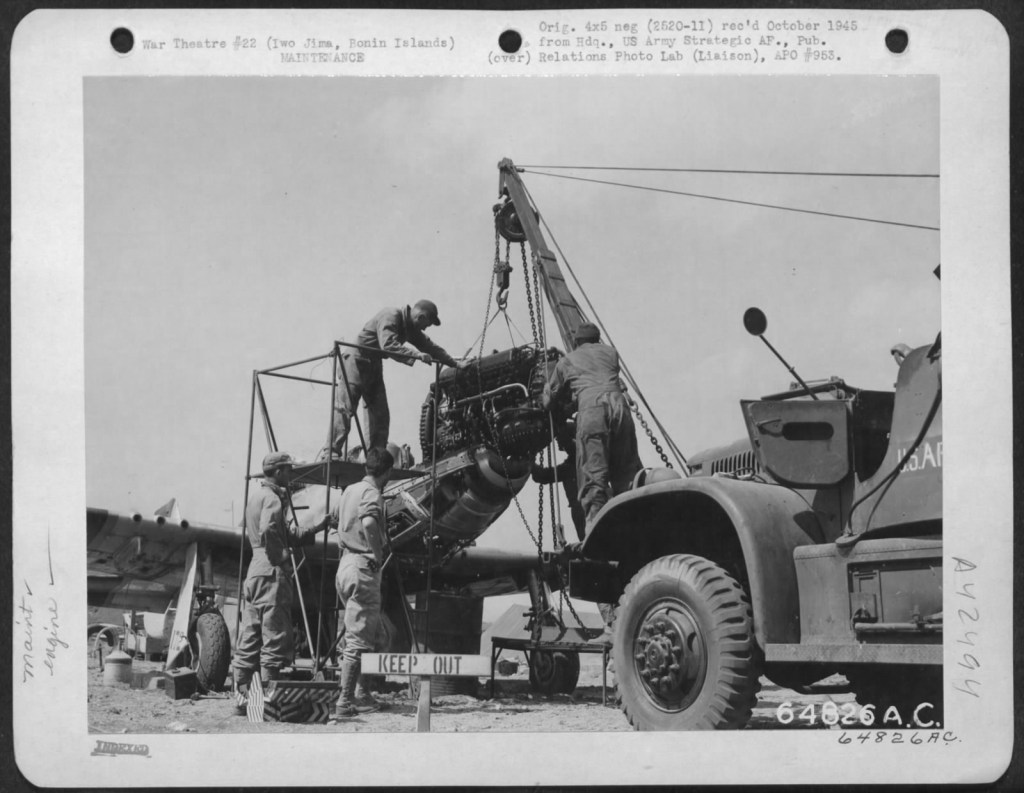
This photo is the companion photo to the last Photo(s) of the Week I posted recently; just taken from the right side of the plane. Ground crew have just hoisted the Packard built Rolls Royce Merlin engine after disconnecting it from the engine mounting framework and other connections. Very cool photo!

USAAF/National Archives via Fold3

This is 172, a 47th Fighter Squadron, 15th Fighter Group, P-51D Mustang. 7th Fighter Command ground crew worked under very challenging conditions. Just keeping the engine and machine guns clear of sand and the volcanic grit was a constant battle.

The official USAAF caption to this photo reads: Mechanics removing engine from a North American P-51 “Mustang”. Iwo Jima, Bonin Islands.

Photo(s) of the Week; Early Primitive Maintenance

A 47th Fighter Squadron P-51D Mustang, number 172, receives either engine maintenance or an engine replacement in an outdoor setting on Iwo Jima with another Mustang coming in for a landing in the background. This looks as if this may be a major periodic overall maintenance as engine work being done, the wing root fairing is removed, the machine guns are removed, the canopy is removed, and it appears that work is being done on the radiator as well.

USAAF/National Archives via Fold3

Early on, all maintenance and repairs were done outdoors. The construction of maintenance hangers would come later. The single antenna on this Mustang indicates that this maintenance was done shortly after 47th Fighter Squadron arrived on Iwo Jima as the twin Uncle Dog antennae have yet to be installed.

Please also note that the right tire has an oval tread pattern and the left tire has a diamond tread pattern. Different tread patterns were a fairly common occurrence, so important to check your photo references.

The official USAAF caption to this photo reads: A mobile repair unit of a 7th Fighter Command Service Group repairs a North American P-51 damaged in a landing on the rugged Iwo Jima airstrip. Soft spots, cross winds and roving clouds of volcanic dust make landings on Iwo Jima unusually hazardous. In the background another P-51 fighter comes in for a landing.

Photo(s) of the Week; All Important Maintenance

USAAF/National Archives via Fold3

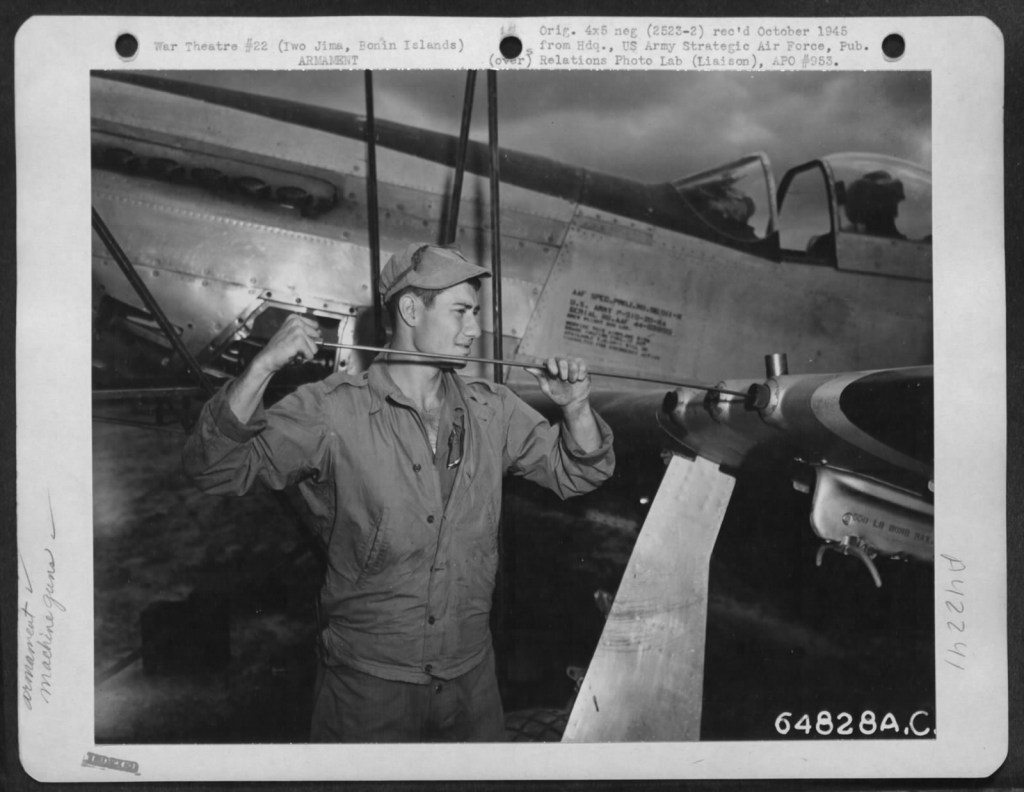
An armorer cleans the blast tubes on a 47th Fighter Squadron P-51D Mustang while other maintenance is being performed. The official United States Army Air Force caption to this photo reads: Armorers cleaning 50 cal machine guns on wing of North American P-51 “Mustang”. Iwo Jima, Bonin Islands.

The sand and volcanic grit was a constant problem for ground crew on Iwo Jima. With their pilots spending a majority of a very long mission over the vast expanse of the Pacific Ocean, 7th Fighter Command ground crew spent long hours maintaining their Mustangs to prevent a pilot from having to bail out over water due to engine failure. This post is dedicated to all the ground crewmen who served on Iwo Jima.

Thank You Veterans!

Today, November 11th, is the federal holiday in the United States to honor those who have served in the United States Armed Forces.

78th Fighter Squadron pilots pose for a picture with one of their Curtiss P-40K Warhawks while stationed on Midway Island in 1943 (Mark Stevens/7th Fighter Command Association)

Veterans Day coincides with other holidays, including Armistice Day and Remembrance Day, which are commemorated in other countries, marking the anniversary of the end of World War I. Major hostilities of World War I ended on the 11th hour of the 11th day of 11th month of 1918, when the armistice with Germany went into effect.

Ground crew and pilots assigned to 640 “The Shawnee Princess/Empire Commuter” pose for a picture in front of their 462nd Fighter Squadron P-51D Mustang. From left of right: Cpl. Sheetz (armorer), Cpl. Riley (radioman), 1st Lt. Seale (pilot), Capt. Zagorsky (pilot), and Sgt. Jackson (crew chief) (506th Fighter Group Association)

Originally known as Armistice Day in the United States, it was renamed Veterans Day in 1954 at the urging of the major organizations representing veterans in the United States.

Crew members of “Thumper” pose for a picture in front of their Boeing B-29 Superfortress on Tinian Island in 1945 (870th Bomb Squadron, 497th Bomb Group, 73rd Bombardment Wing)

Veterans Day is distinct from Memorial Day which is observed in May of each year. Veterans Day commemorates the service of all those who served in the United States Armed Forces, while Memorial Day specifically honors those who died in military service to our country.

457th Fighter Squadron pilots pose for a picture along side 642 “Fighting Lady” (506th Fighter Group Association)

Thank you to all veterans who have served in the United States Armed Forces. Your service and sacrifices to protect and preserve the freedoms we continue to enjoy are greatly appreciated!