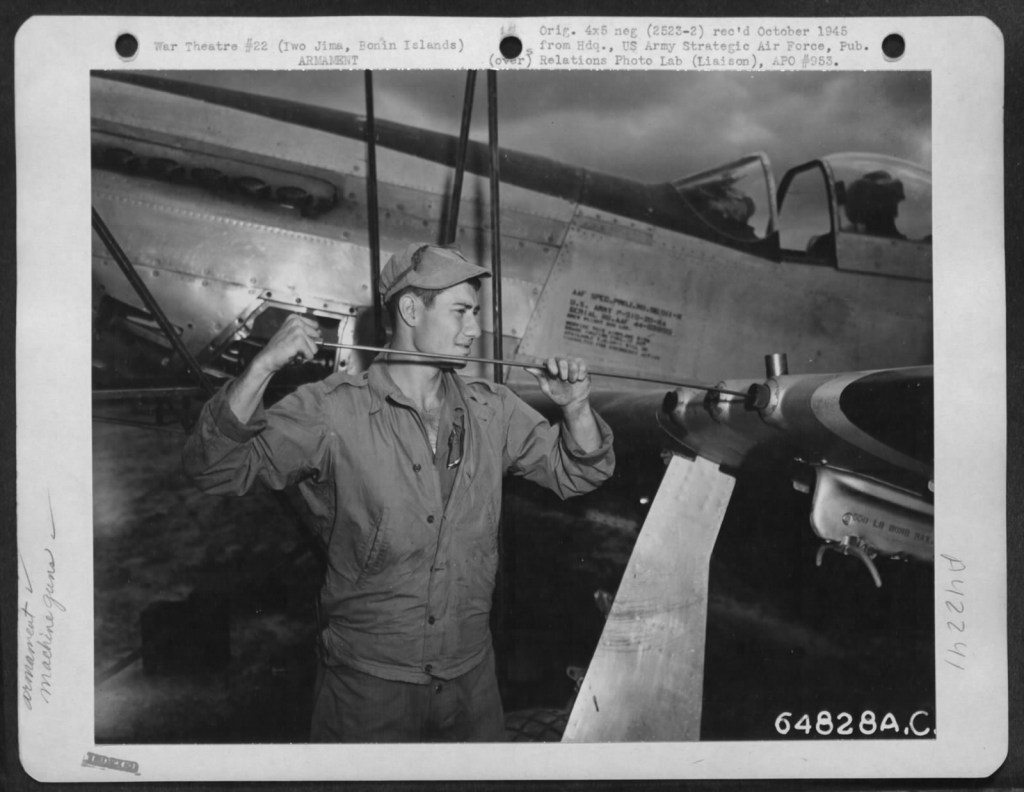
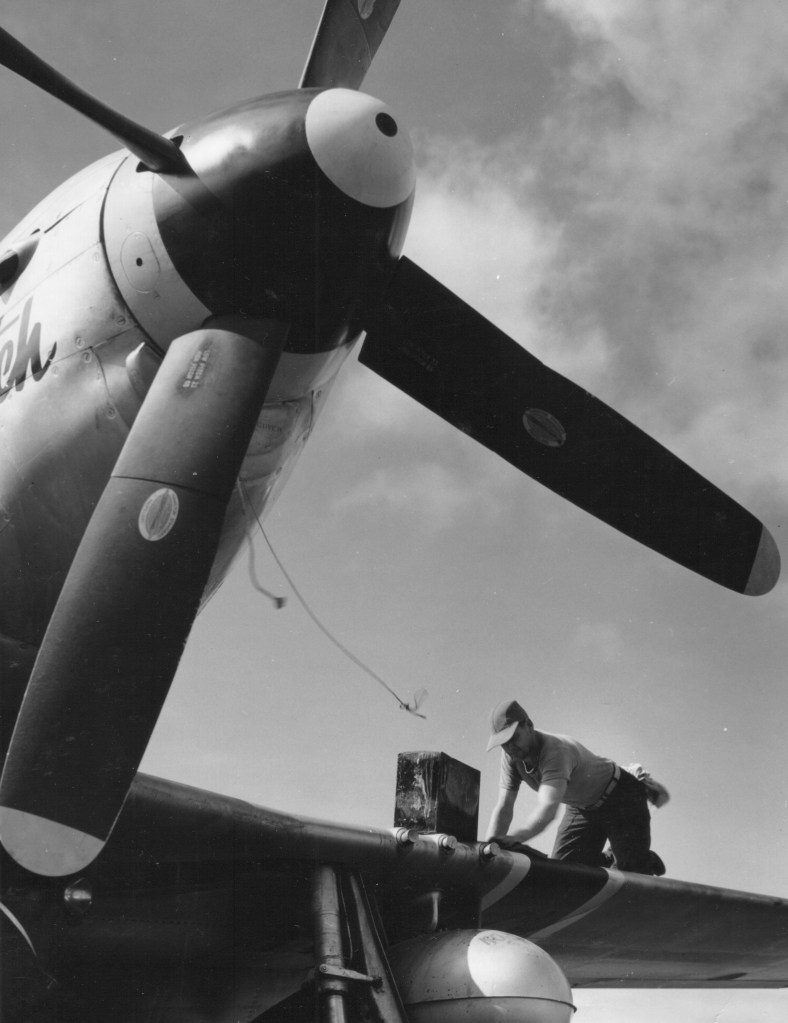
An armorer cleans the blast tubes on a 47th Fighter Squadron P-51D Mustang while other maintenance is being performed. The official United States Army Air Force caption to this photo reads: Armorers cleaning 50 cal machine guns on wing of North American P-51 “Mustang”. Iwo Jima, Bonin Islands.
The sand and volcanic grit was a constant problem for ground crew on Iwo Jima. With their pilots spending a majority of a very long mission over the vast expanse of the Pacific Ocean, 7th Fighter Command ground crew spent long hours maintaining their Mustangs to prevent a pilot from having to bail out over water due to engine failure. This post is dedicated to all the ground crewmen who served on Iwo Jima.
I am posting this edition of Photo(s) of the Week a day early to observe and commemorate a significant event in the history of Iwo Jima VLR Mustang Groups. Seventy-nine years ago today, 108 P-51D Mustangs of the 15th and 21st Fighter Groups flew their first very long range mission to the Japanese Home Islands escorting 107 B-29s of the 73rd Bomb Wing to Tokyo and back.
1st Lt. Jule Carnes Mitchell, Jr., 47th FS/15th FG, is ready to take off on the first VLR mission to the Japanese Home Islands (USAAF/National Archives via Fold3)
The target for the B-29s was the Nakajima aircraft engine factories on the west side of Tokyo. The B-29s approached the target at 15,000 feet with the P-51Ds several thousand feet above the bombers in combat formation with the 15th Fighter Group on the right and the 21st Fighter Group on the left of the bombers.
1st Lt. Eurich L. Bright being readied in the cockpit of 176 “Moonbeam McSwine” for the April 7, 1945 VLR escort mission (USAAF/National Archives via Fold3)
1st Lt. Eurich L. Bright of the 47th Fighter Squadron, shown in the picture above, was one of the top scorers of the mission being credited with shooting down a Kawasaki Ki-61 Hein (Tony), a Mitsubishi A6M Zero, and a Nakajima Ki-45 Toryu (Nick).
USAAF/National Archives via Fold3
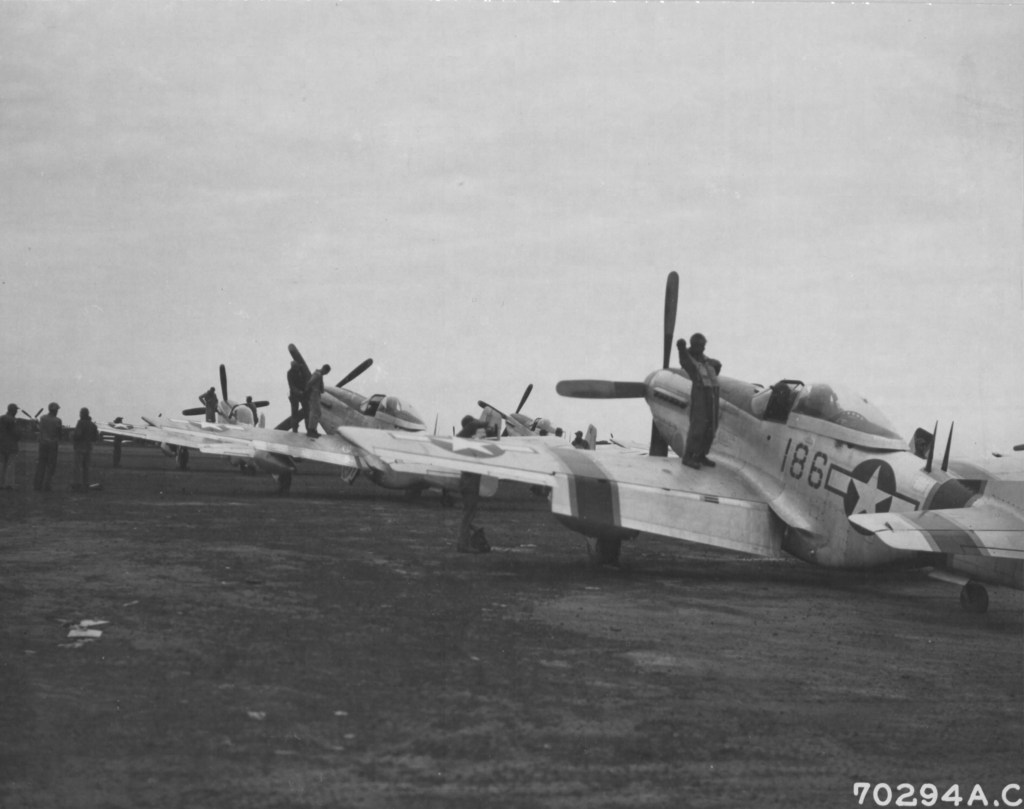
The photo above shows the 47th Fighter Squadron P-51D Mustangs being readied for the April 7, 1945, VLR escort mission to Tokyo. The 110 gallon metal drop tanks would have been mounted on the wings the day before, and filled the morning of the mission. Note the twin Uncle Dog antennae on 186. By the time of this mission, most, if not all the 15th and 21st Fighter Group Mustangs would have had them installed to help them form up with the B-29s on the trip to Japanese Home Islands, and to find their way back to Iwo Jima.
USAAF/National Archives via Fold3
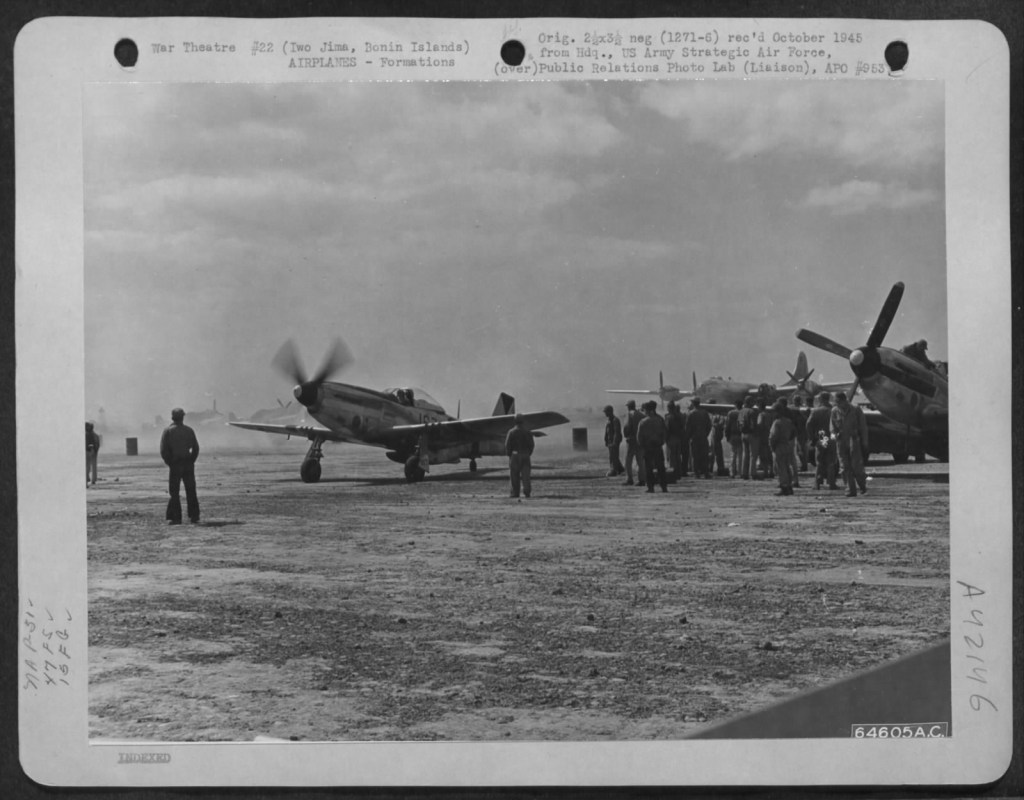
45th Fighter Squadron Mustangs warm up their engines in the photo above as part of the pre-flight preparation for the first VLR escort mission.
For the 7th Air Force Fighter Command, this mission was culmination of several years of being in the Central Pacific theater of operations and waiting to get into the fight on a larger scale. The 15th Fighter Group participated in the defense of Pearl Harbor on December 7, 1941, and then only saw sporadic combat until April 7, 1945. The 7th Fighter Command called themselves the “Sunsetters”, and their primary objective was to help bring the war in the Pacific to an end.
In the photo below, ground crew watch as 45th Fighter Squadron Mustangs move to begin taking off.
USAAF/National Archives via Fold3
Seventeen Mustangs had to abort and return to Iwo Jima, including Brig. General Ernest “Mickey” Moore and 15th Fighter Group commander Colonel James O. Beckwith. The Sunsetters were credited with twenty-six Japanese planes destroyed, one probably destroyed, and five damaged at the cost of two Mustangs and one pilot. Major James B. Tapp of the 78th Fighter Squadron was high scorer shooting down four Japanese defenders. More importantly, no B-29s were shot down by Japanese fighters. Two B-29s were lost to flak, and one to an aerial bomb dropped on the bomber formation.
If you have Eduard’s 1/48 “Very Long Range: Tales of Iwo Jima“ Limited Edition kit (No. 11142), it provides decals for the following pilots and planes that participated in the April 7, 1945 mission: Major Gilmore L. “Buck” Snipes’ 67 “Tom Kat” (45th FS/15th FG); Major James B. Tapp’s 101 Margaret -IV” (78th FS/15th FG); 1st Lt. Eurich L. Bright’s 176 “Moonbeam McSwine” (47th FS/15th FG); Major Paul W. Imig’s 250 “Dede Lou” (72nd FS/21st FG); and Major Harry C. Crim, Jr.’s 300 “My Achin! [Ass].
References:
1. The Long Campaign: The History of the 15th Fighter Group in World War II, John W. Lambert, Schaffer Publishing Ltd. (2006).
2. Very Long Range P-51 Mustang Units of the Pacific War; Carl Molesworth; Osprey Publishing Limited (2006).
The 15th Fighter Group wasted no time in getting into the thick of things after arriving on Iwo Jima. On March 8th, Major John Piper led two flights of 47th Fighter Squadron Mustangs to strafe Japanese positions in support of the Marines on the northern end of Iwo. Colonel James Beckwith and 45th Fighter Squadron got into the fight on the next day with three missions in support of the Marines. The photo below shows two 45th Mustangs loaded up with 500 pound bombs getting ready to take off on one of those missions. The 78th Fighter Squadron also flew 45 sorties in support of the Marines on March 10th.
USAAF/National Archives via Fold3
It would not take long for the 15th Fighter Group’s attention to be diverted elsewhere. On March 11th, the 47th FS would fly its first strike mission against Chichi Jima. I really like the photo below. Taken over the wing of a 47th FS Mustang, the photo below shows two bomb laden 47th FS Mustangs taxing into position to take off for their strike against Chichi Jima. I like how this photo shows the elegant lines of the Mustang’s nose.
USAAF/National Archives via Fold3
Chichi Jima was 147 miles north of Iwo Jima. A major communications center with radio and radar facilities, Chichi Jima had been occupied and fortified by the Japanese for decades. It had an airfield (Susaki Airfield), a deep water anchorage, and a seaplane base. Brig. General Moore and Colonel Beckwith in their Mustangs watched as seventeen 47th FS Mustangs bombed Chichi Jima.
USAAF/National Archives/via Fold3
The photo above shows a 47th FS Mustang landing on South Field upon its return from the March 11th strike mission against Chichi Jima as ground crew look on.
1st Lt. Robert Scamara in 167 Pappy Yochum 47th FS/15th FG (USAAF/National Archives via Fold3)
In the photo above, 1st Lt. Robert Scamara pulls his 47th FS Mustang 167Pappy Yochum into parking position after his return from the March 11th strike mission against Chichi Jima. Ground crew and other pilots clamor around the parked Mustangs anxious to hear about the results of the mission. Note the single antenna on Scamara’s Mustang.
References:
John W. Lambert, The Long Campaign: The History of the 15th Fighter Group in World War II, Schiffer Publishing Ltd. (2006)
Carl Molesworth, Very Long Range P-51 Mustang Units of the Pacific War, Osprey Publishing (2006)
On March 6, 1945, Brig. General Ernest M. “Mickey” Moore, commanding officer of the 7th Fighter Command, and 24 pilots of the 47th Fighter Squadron (FS) of the 15th Fighter Group (FG), landed their North American P-51D Mustangs on South Field (Motoyama #1) on Iwo Jima, just fifteen days after the United States Marines stormed Iwo’s black sand beaches. The battle for Iwo Jima continued to rage on for another twenty days as pockets of Japanese resistance were being eliminated.
USAAF/National Archives via Fold3
It is believed that the above photo is of Brig. General Moore landing an unmarked P-51D on South Field. Was he the first USAAF pilot to land a P-51 on Iwo Jima? None of the captions to the March 6th photos provide an answer, but squadron records indicate that Brig. General Moore was the first to land, with 47th Squadron Commander Major John Piper second.
USAAF/National Archives via Fold3
Another March 6th photo showing a 47th Fighter Squadron P-51D pulling into its parking spot just off of South Field. Note the single antenna in both photos. The twin Uncle Dog antennae were a field modification on Iwo Jima.
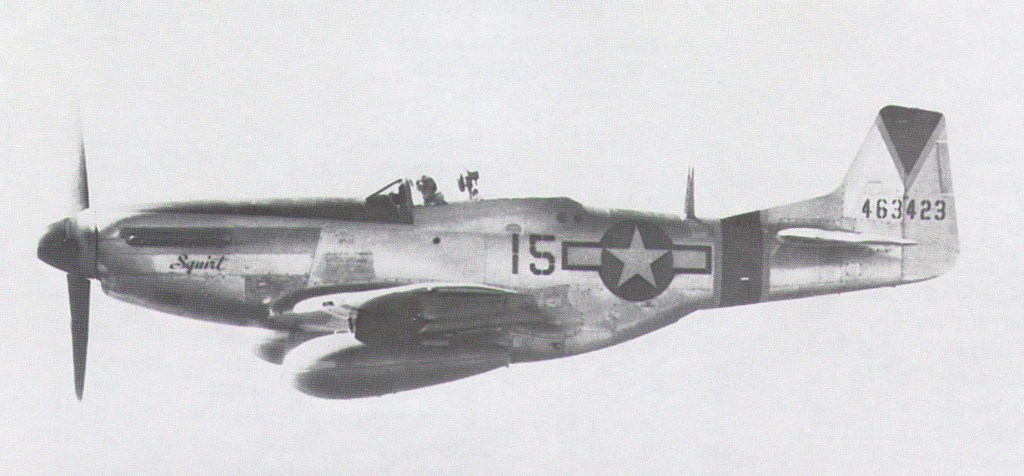
Colonel James O. Beckwith in 15 “Squirt” (James O. Beckwith)
This is the second part of a nine part series on the markings of the VLR Mustang squadrons. Six of the nine squadrons changed their markings during their time on Iwo Jima after the 7th Fighter Command ordered the VLR Fighter Groups to adopt more simplified markings. The 47th Fighter Squadron was one of those squadrons.
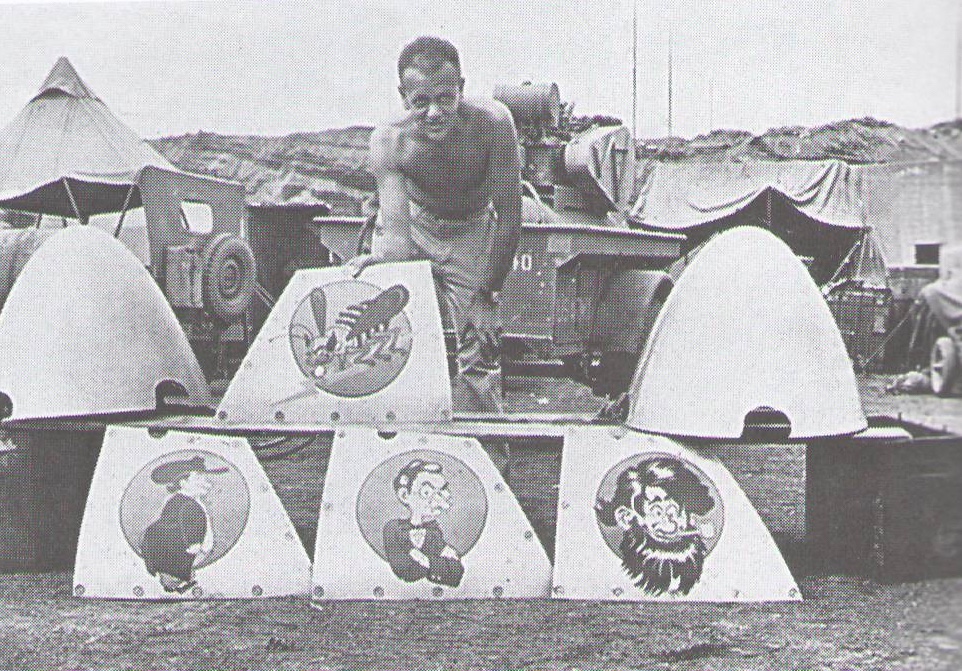
The fuselage numbers for the 47th Fighter Squadron Mustangs were 150 through 199. During their time in the Central Pacific, the 47th FS adopted the nickname the “Dogpatchers”, and began naming their aircraft for the characters of the then popular comic strip “Li’l Abner” by Al Capps. When the 47th received its Mustangs, the squadron emblem was painted on the left side of the cowl, and the comic strip character on the right side.
S/Sgt. James N. Lindsay – Painter of the squadron emblem and the Li’l Abner cartoon character nose art for the 47th Fighter Squadron (W.H. Sparks)
Early Squadron Markings. Most references indicate that the early squadron markings for 47th FS Mustangs were yellow bordered black bands on the fuselage, wings and elevators; tails that were adorned with a yellow bordered black chevron; and yellow/black/yellow spinners. Black and white photos would seem to confirm this belief, but this might not be entirely accurate.
Eduard
Please note that Eduard suggests that the bands and chevron were not actually black, but most probably very dark blue. I do not have any squadron records in my possession to either confirm or deny this suggestion. Eduard’s recommended paint for this very dark blue is GSI Creos (GUNZE) Aqueous H328 or GSI Creos (GUNZE) Mr. Hobby C328, which are Gunze’s water based acrylic and lacquer based paints for U.S. Navy Blue Angels Blue.
I would like to suggest some alternative colors for this “very dark blue”. The 47th Fighter Squadron’s initial Mustangs were painted while the squadron was stationed on Hawaii before being deployed to Iwo Jima. The darkest blue paints they most likely had access to on Hawaii were the U.S. Navy’s stores of either Semi-Gloss Sea Blue (ANA 606), Non-Specular Sea Blue (ANA 607), or Glossy Sea Blue (ANA 623). Below is a plastic spoon painted with Vallejo Model Air Glossy Sea Blue 71.300 (ANA 623/FS 15042). Now that’s a very dark blue.
Vallejo Model Air Glossy Sea Blue 71.300 (ANA 623/FS 15042)
An advantage of using these late-war U.S. Navy blues is that they are readily available to the modeler through most model paint manufacturers. AK Interactive, Ammo of MiG, GUNZE, Hataka Hobby Paints, Humbrol, Mission Model Paints, Mr. Paint, Tamiya and Vallejo all carry at least one or two of these colors.
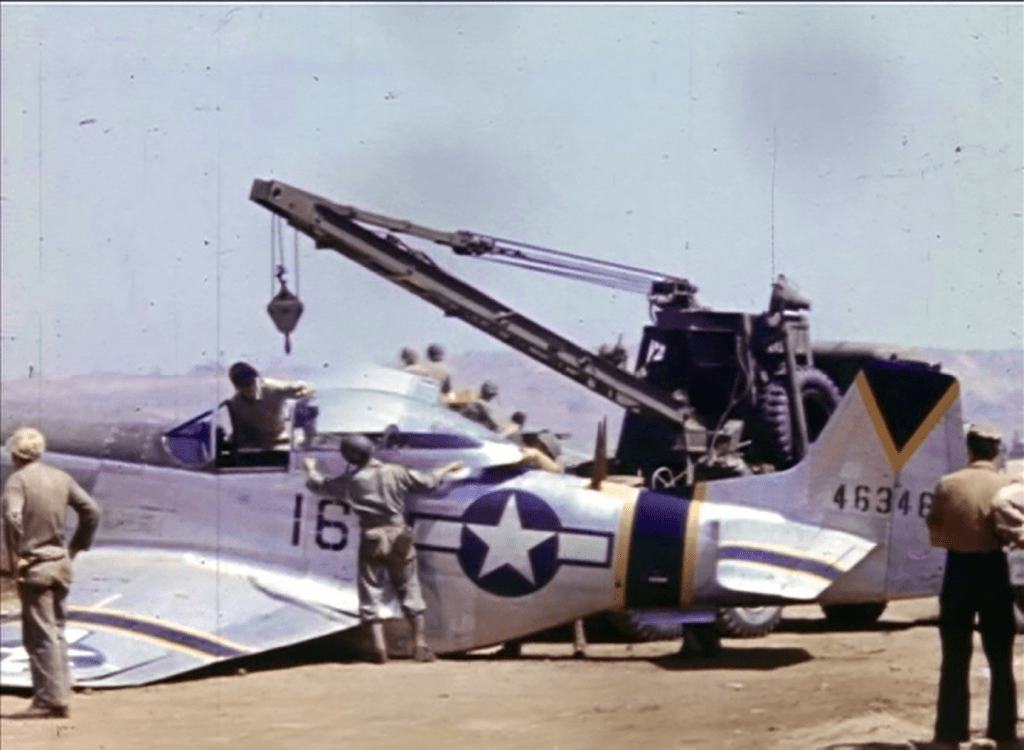
Now one more twist on the color of the bands: purple. What? Purple? Below is a still of color 16mm film taken on Iwo Jima after a 47th FS crash that Mark Stevens forwarded to me while I was doing research for this post. Mark stated that several members of the 47th FS indicated that the darker portion of the bands was either dark blue or purple. All very interesting; but not sure what to think about using purple.
7th Fighter Command Association via Mark Stevens
While I am not personally searching for a purple model paint, I would not question a modeler’s choice of purple based on what I see in the above photo and comments from veterans. I am really intrigued about using Glossy Sea Blue for the 47th FS bands and chevron.
Spinners: Under the early squadron markings, the spinners were either yellow at the very tip, then black (very dark blue or purple), and natural metal at the back; or yellow at the very tip, black (very dark blue or purple), and yellow at the back. Below are photos of 150 Li’l Butch and 167 Pappy Yochum clearly showing the back portion of the spinner being unpainted.
150 “Li’l Butch” (USAAF/National Archives via Fold3)Lt. Robert Scamara in 167 “Pappy Yokum” (USAAF/National Archives via Fold3)
The next two photos show the back portion of the spinner being painted. Always check reference photos for the markings of the particular plane you are modeling as there was a surprising lack of uniformity between planes in the same squadron.
USAAF/National Archives via Fold3
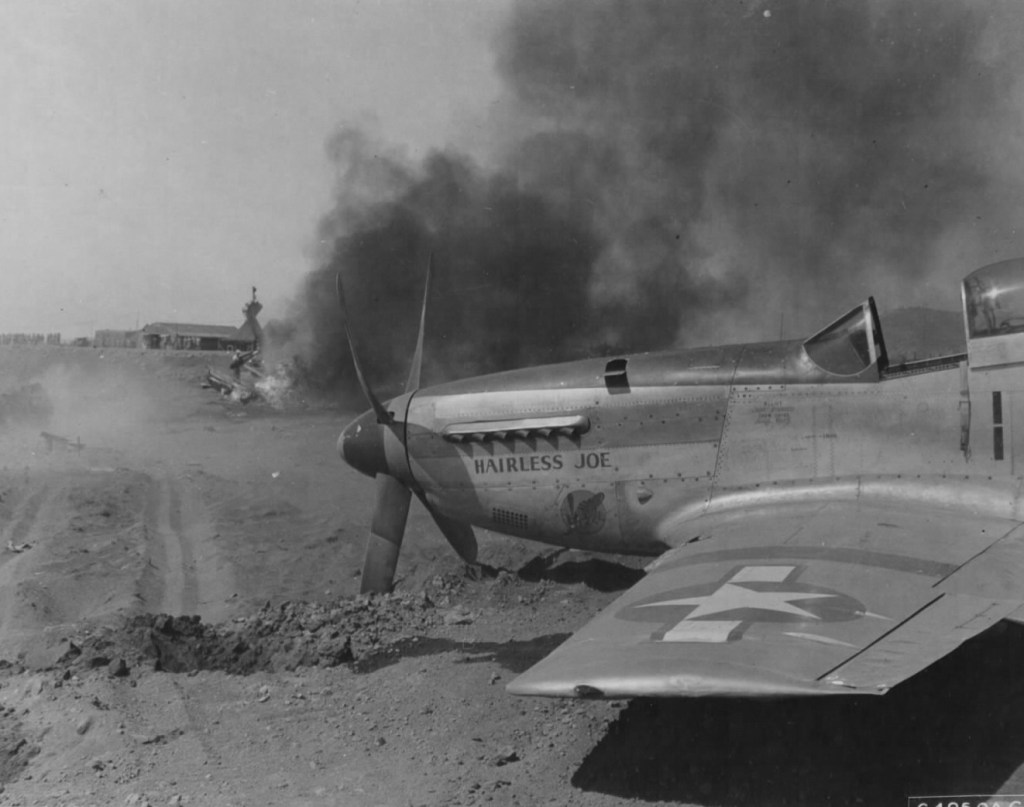
The front and back colors of the spinner on Hairless Joe appear to the be same color.
159 “Hairless Joe” (USAAF/National Archives via Fold3)
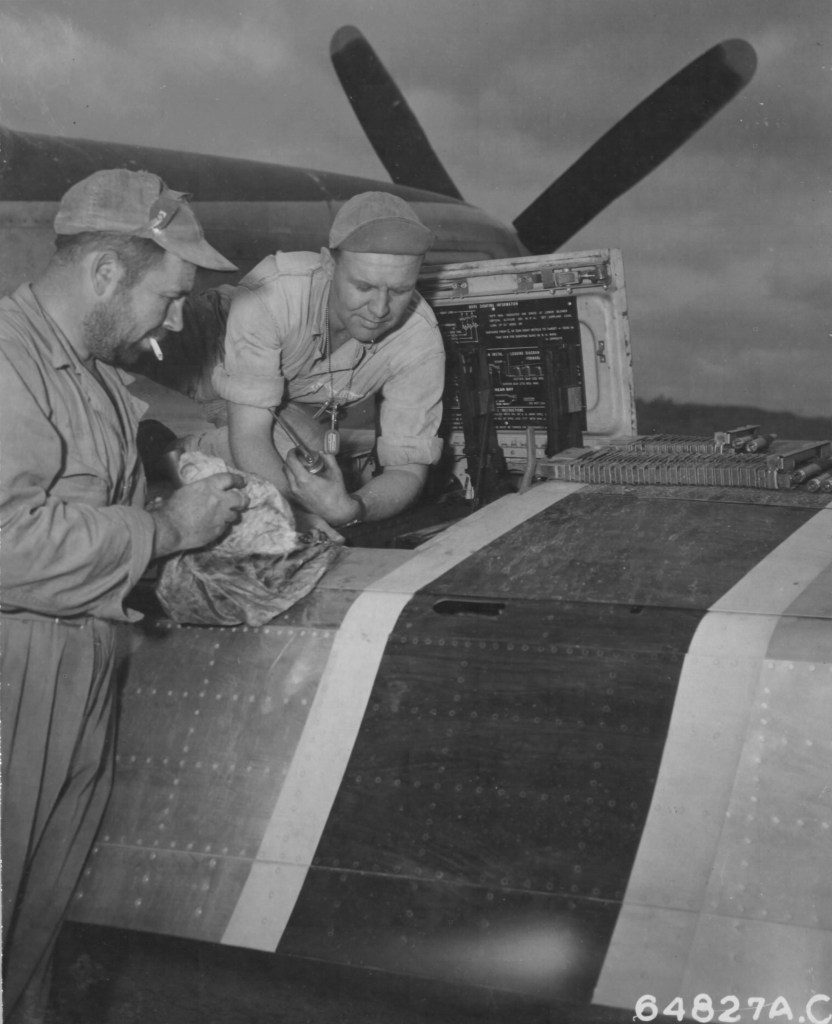
If you are going to build a 47th FS Mustang with the early markings and the flaps dropped, please note the two photos below. It appears that the 47th FS painted the bands on the wings with the flaps lowered.
USAAF/National Archives via Fold3USAAF/National Archives via Fold3
So, would it be wrong for you to use black for the bands, chevron and spinner? In my opinion, black is still an option. Other than the movie still above with what looks to be a purple fuselage band a tail chevron, the use of very dark blue or purple by the 47th FS appears mostly anecdotal. Therefore, I believe it is difficult to arrive at a definitive conclusion unless squadron records were to provide the answer. No criticism here if black were to be used.
Late Squadron Markings: The simplified squadron markings for the 47th FS were black tips on the wings, horizontal stabilizers, and tail, and an all black spinner. These squadron markings provide some credibility to the opinion that the bands and chevron of the early squadron markings might have been black.
Eduard
Below are two photos of 47th FS Mustangs with all black spinners. Note on the second photo that right landing gear leg and the inside of the landing gear door appear to have a dark band painted on them. Unfortunately, the ground crew are standing in front of the left landing gear.
7th Fighter Command Association via Mark Stevens7th Fighter Command Association via Mark Stevens
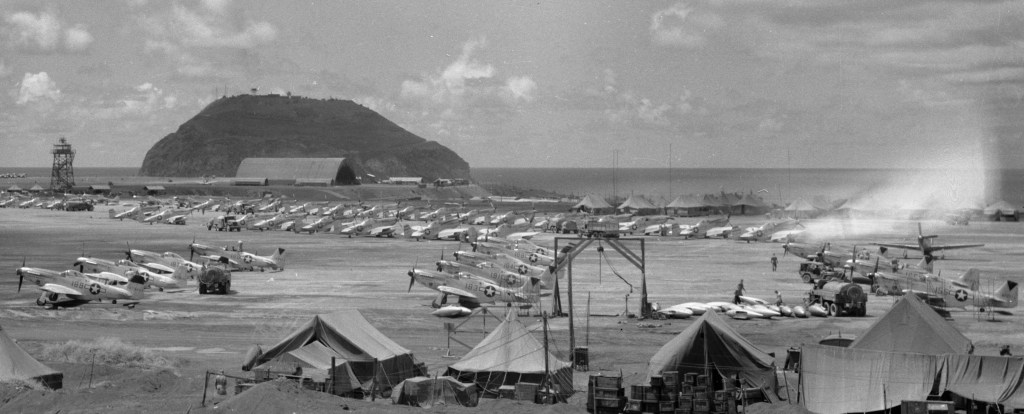
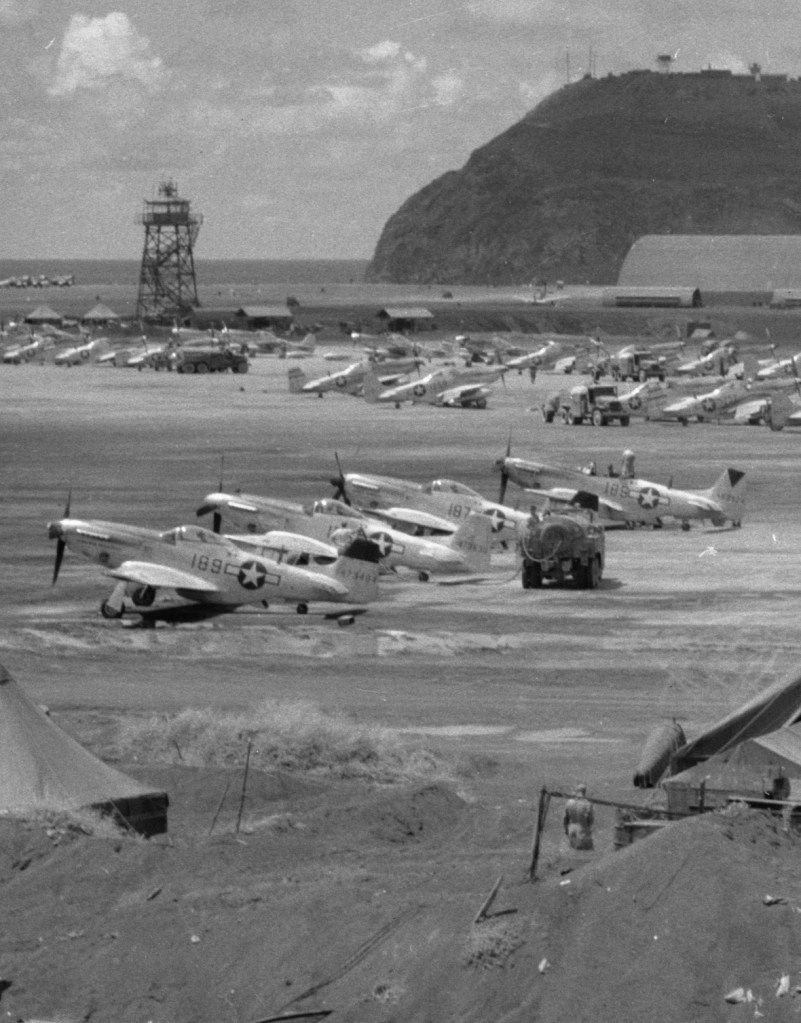
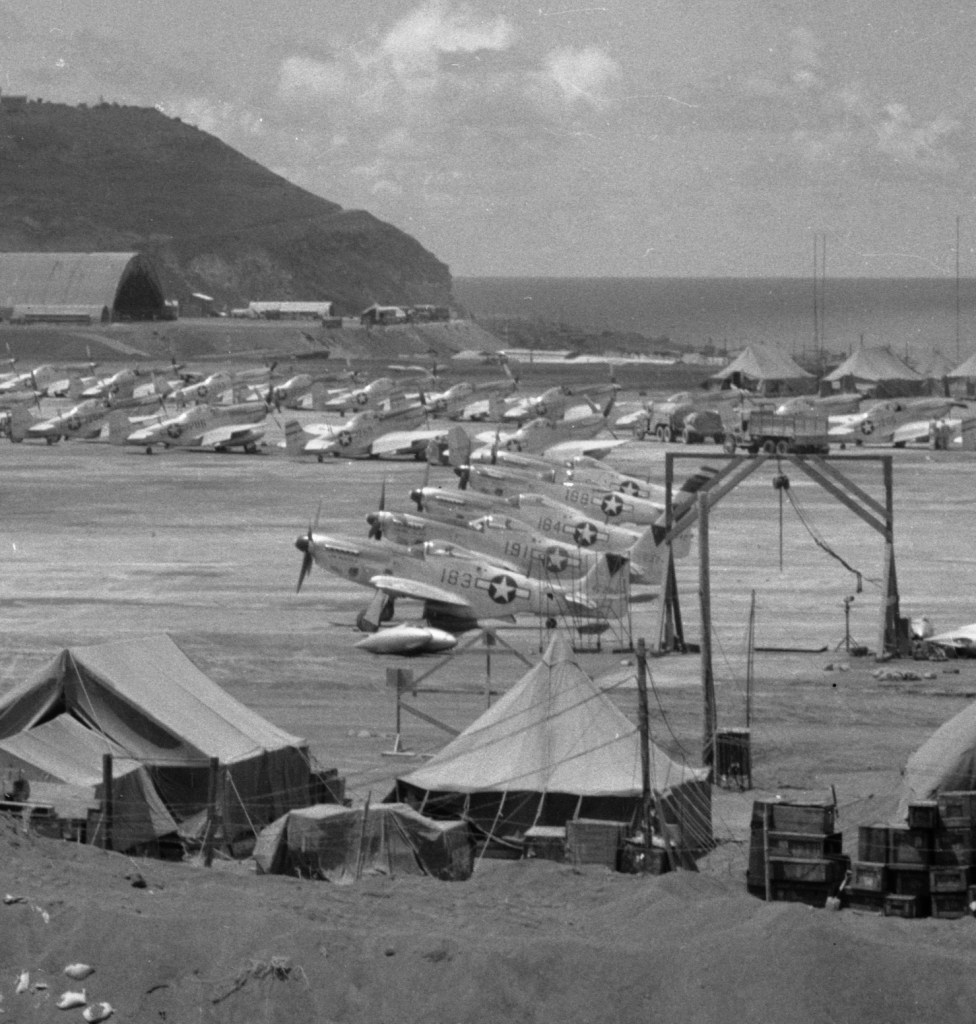
The photo below shows three rows of 47th FS Mustangs with Mt. Surbachi in the background. This is an interesting photo due to the varied markings on the planes. The drop tanks between the second and third rows are the 165 gallon P-38 type tanks.
7th Fighter Command Association via Mark Stevens
I have zoomed in on each row to show the period of transition between the early and late squadron markings. This first row has a Mustang with late squadron tail and wing tips, but with the early squadron black and yellow spinner; a Mustang with no markings except the squadron emblem; a Mustang with complete simplified late squadron markings; and a Mustang with the early squadron black and yellow spinner and chevron but with no fuselage or wing bands.
7th Fighter Command Association via Mark Stevens
The second row has three Mustangs with the early squadron black and yellow spinner and chevron but with no fuselage or wing bands, and a Mustang with the simplified late squadron markings. I cannot make out the markings on the last Mustang.
7th Fighter Command Association via Mark Stevens
The third row has three Mustangs with the early squadron black and yellow spinner and chevron but with no fuselage or wing bands, and a Mustang with no markings. Removing the early squadron markings had to be a tedious and unpleasant task.
7th Fighter Command Association via Mark Stevens
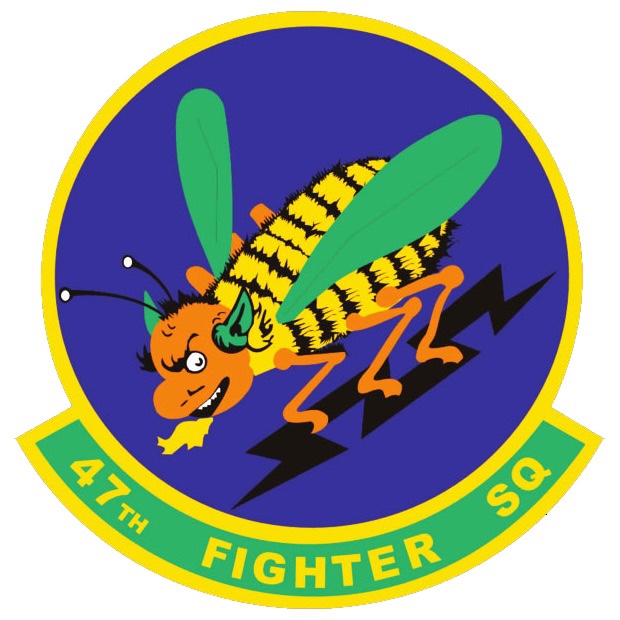
The squadron emblem was a devilish looking hornet breathing fire, riding a lightning bolt on a blue background.
47th Fighter Squadron Emblem
Below is a nice photo of 150 Li’l Butch showing the size and location of the squadron emblem.
Captain Robert R. Downs and Ground Crew with 150 “Li’l Butch” (7th Fighter Command Association via Mark Stevens)
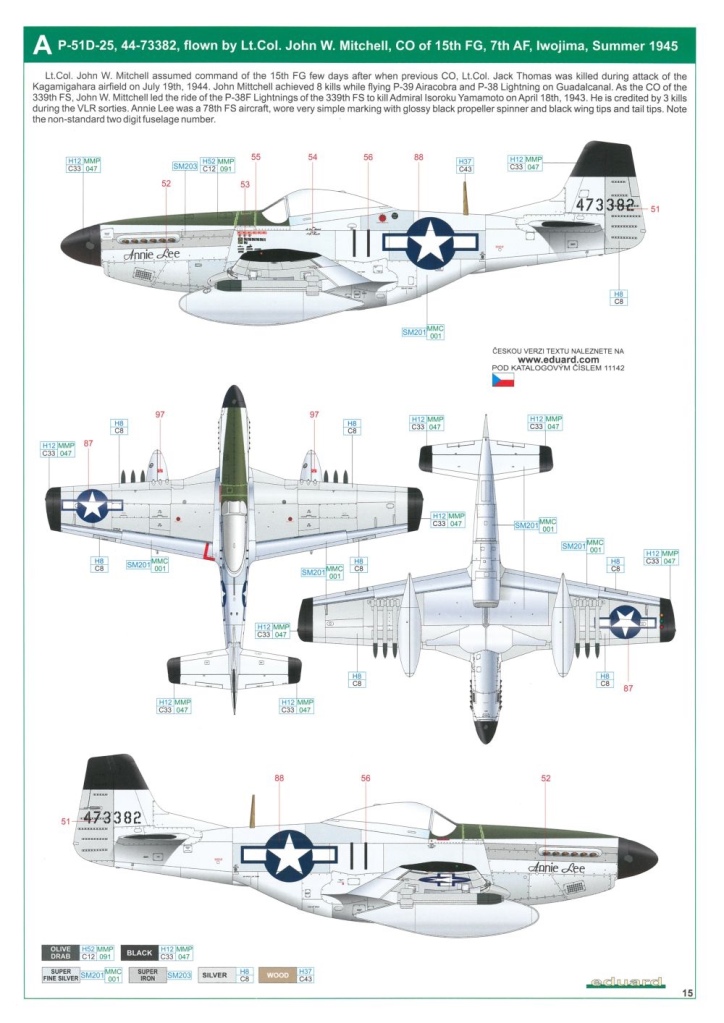
You may have noticed that the photo of Col. James O. Beckwith’s Squirt and Eduard’s profile of Lt. Col. John W. Mitchell’s Annie Lee have non-standard two digit fuselage numbers even though adorned with 47th FS markings. After Col. Beckwith became the commanding officer of the 15th Fighter Group, all of his planes had 15 for a fuselage number to signify his leadership of the group. Lt. Col. Mitchell became the commanding officer for the 15th Fighter Group after Col. Beckwith’s successor, Lt. Col. Jack Thomas, was killed in action on the July 19, 1945 strike mission. I am not aware of the reason or significance of the fuselage number “11” on Annie Lee.
As always, a big thank you to Mark Stevens of the 7th Fighter Command Association for all of his assistance.
References:
1. The Long Campaign: The History of the 15th Fighter Group in World War II, John W. Lambert, Schaffer Publishing Ltd. (2006).
2. The Pineapple Air Force: Pearl Harbor to Tokyo; John W. Lambert; Schaffer Publishing Ltd (2006).
3. Very Long Range P-51 Mustang Units of the Pacific War; Carl Molesworth; Osprey Publishing Limited (2006).
Next up: A comparison of Eduard instrument panels.
As a condition of the use of materials from the 7th Fighter Command Association website, the following disclaimer is included: Permission to use, copy and distribute documents delivered from this Worldwide Web server and related graphics is hereby granted, provided 1) That the use of the data will not be used for obtaining a profit of any kind, and 2) That the above disclaimer notice appear in all copies and that both that disclaimer notice and this permission notice appear. All other rights reserved. The name of “7th Fighter Command Association” may not be used in advertising or publicity pertaining to distribution of this information without specific, written prior permission. Mark Stevens and the 7th Fighter Command Association makes no representations about the suitability of this information for any purpose. It is provided “as is” without express or implied warranty. Mark Stevens and the 7th Fighter Command Association disclaim all warranties with regard to this information, including all implied warranties of merchantability and fitness. In no event shall Mark Stevens or the 7th Fighter Command Association be liable for any special, indirect or consequential damages or any damages whatsoever resulting from loss of use, data or profits, whether in an action of contract, negligence or other action, arising out of or in connection with the use or performance of this information.













 Iwo Jima Models