In their special Eday 2024 edition of Info Eduard e-magazine, Eduard announced the future release of a limited edition “Very Long Range: Tales of Iwo Jima” boxing of their excellent 1/72nd North American P-51D Mustang kit. The kit will be released in the second quarter of 2025, and will most likely contain the same decal options as their 1/48th limited edition “Very Long Range: Tales of Iwo Jima” boxing.
Eduard
Nice to see Eduard providing those who model in 1/72nd scale with 12 different decal options covering all three Iwo Jima VLR Mustang groups. Consistent with their other limited edition boxings, it is anticipated that Eduard will include a photo etch cockpit detail set, Brassin 3D printed parts (seats, exhaust stacks, wheels, etc . . .), and a lapel pin. If you are reading this Eduard, it would be nice if the lapel pin has the 7th Air Force logo on it.
In other exciting news, Eduard is getting back into the 1/32nd scale market and has announced the future release of a 1/32nd North American P-51B Mustang. Nice to see Eduard announce the future release of a quality 1/32nd P-51B. While the Trumpeter 1/32nd P-51B kit is a decent kit, it has a large number of inaccuracies.
This is the third part of a nine part series on the markings of the VLR Mustang squadrons. Six of the nine squadrons changed their markings during their time on Iwo Jima after the 7th Fighter Command ordered the VLR Fighter Groups to adopt more simplified markings. The 78th Fighter Squadron was one of those squadrons.
The fuselage numbers for the 78th Fighter Squadron Mustangs were 100 through 149. During their time in the Central Pacific, the 78th FS adopted the nickname the “Bushmasters” after the largest venomous pit viper in the world. When the 78th received its Mustangs, the squadron emblem was applied to both sides of the nose in front and below of the windscreen.
78th Fighter Squadron “Bushmaster” Emblem
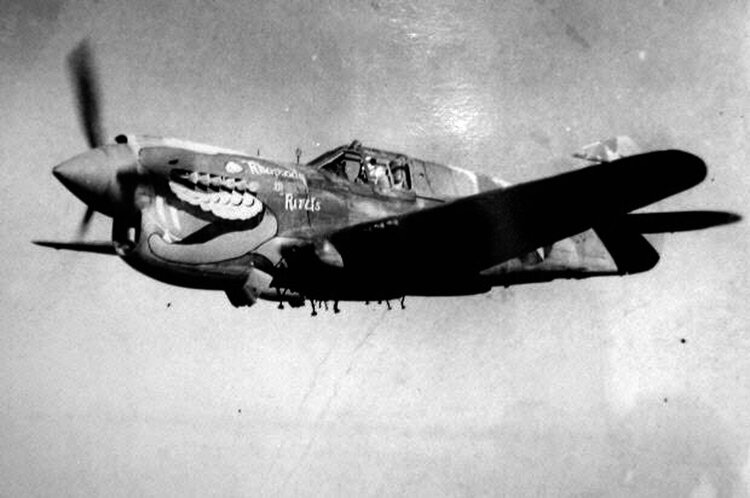
The first iteration of the Bushmaster squadron emblem appeared after the 78th FS began receiving Curtiss P-40K Warhawks while on Hawaii. The Bushmaster snake head was painted on almost all of front fuselage/cowling on both sides.
Major Gordon R. Hyde, Commander of the 78th Fighter Squadron, next to his Curtiss P-40K Warhawk “Hyde’s Harlot” (Robert W. Moore)
Below is a great in-flight photo of the 78th Fighter Squadron’s P-40K “Rhapsody in Rivets” showing the squadron’s Bushmaster nose art. The hours that ground crew spent painting the Bushmaster head on their P-40Ks had to be incredibly high.
“Rhapsody in Rivets”, 78th Fighter Squadron Curtiss P-40K Warhawk (Robert W. Moore)
The 78th Fighter Squadron would eventually transition to the Republic P-47D Thunderbolt. Delivered to the 78th Fighter Squadron on Hawaii unpainted except for the anti-glare panel and national insignias, the 78th Thunderbolts’ cowlings would be completely covered with wide black/yellow/black bands. In addition, a yellow band above a black band adorned the vertical tails, while yellow tips outboard of black bands were painted on the wings and tailplanes.
A formation of 78th Fighter Squadron Republic P-47D Thunderbolts over Hawaii (Robert W. Moore)
The second iteration of the 78th Fighter Squadron Bushmaster emblem is shown nicely in the color photo below. This time around the Bushmaster’s head was painted on a black and yellow circular background with a narrower black border centered on the Thunderbolt’s large cowling. Note the fuselage numbers on the 78th’s Thunderbolt in the above photo – in the 200s instead of the 100s.
78th Fighter Squadron Pilot Robert W. “Todd” Moore standing on the wing of his Republic P-47D Thunderbolt “Stinger V” (Robert W. Moore)
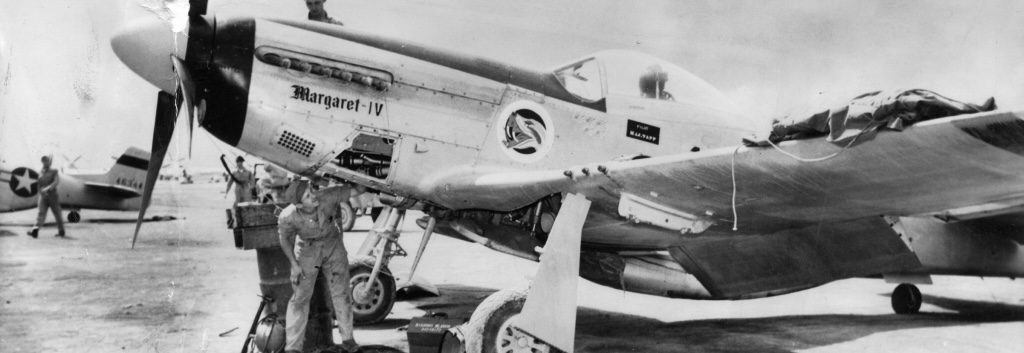
Prior to being stationed on Iwo Jima, the 78th Fighter Squadron would transition to the long range North American P-51D Mustang. While retaining the yellow and black bands on the vertical tail and the tips of the wings and the tailplanes, the spinner was painted yellow and black with 6 inch black band on the nose behind the spinner as shown on Eduard’s excellent aircraft profiles of Major James B. Tapp’s 101 “Margaret – IV”
Eduard
The last iteration of the 78th Fighter Squadron’s Bushmaster emblem during World War II was the Bushmaster’s head on a circular blue and yellow background with no border as shown at the top of this post.
Major James B. Tapp’s North American P-51D Mustang 101 “Margaret IV” on Iwo Jima (Mark W. Stevens/7th Fighter Command Association)
It is interesting to note that some 78th Fighter Squadron Mustangs had their plane number painted on their main landing gear covers, but others did not. As shown in the above photo, Major James B. Tapp’s 101 “Margaret – IV” did not have the plane number on the main landing gear covers, while the photo below shows the plane number (or a plane number) on the main landing gear cover. I say in parentheses “or a plane number” because the plane number on the main landing gear cover does not appear to match the plane number on the fuselage. Always check your references!
USAAF/National Archives via Fold3
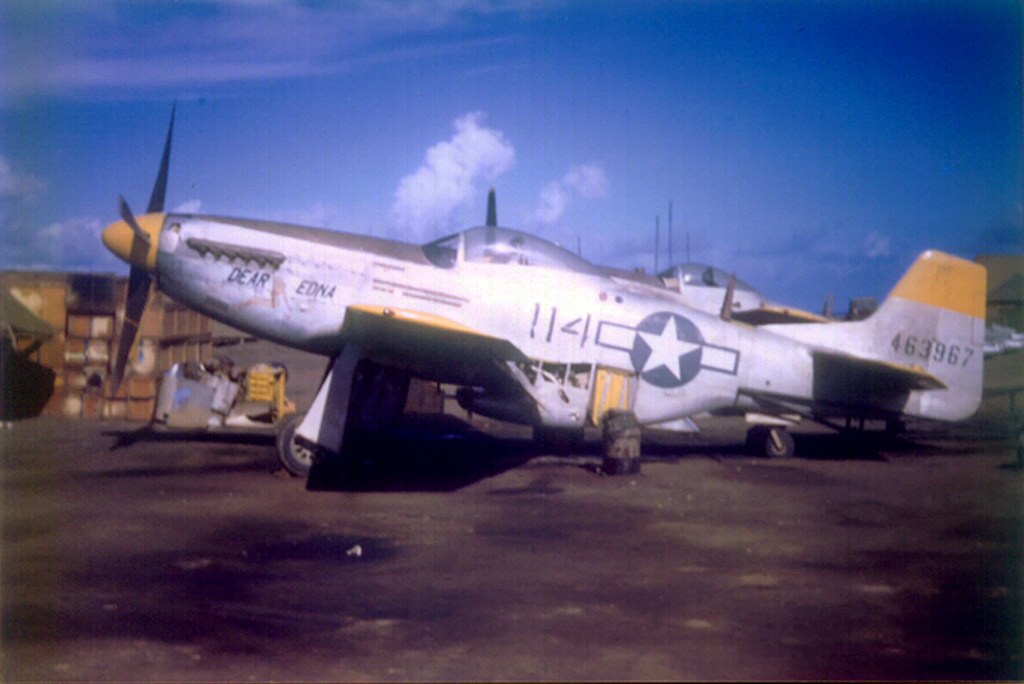
When the 78th Fighter Squadron transitioned to more simplified markings while on Iwo Jima, the spinner was painted all yellow, the black band on the nose behind the spinner was removed except where it crossed the anti-glare panel, and the black bands on the vertical tail, wing tips and tailplanes were overpainted with yellow as shown in the color photo of 1st Lieutenant Frederick A. Bauman’s 114 “Dear Edna”.
1st Lieutenant Frederick A. Bauman’s North American P-51D Mustang 114 “Dear Edna” on Iwo Jima (Mark W. Stevens/7th Fighter Command Association)
In the close-up color photo below of 114 “Dear Edna”, you can see where the black nose band was not removed where it crossed over the anti-glare panel.
1st Lieutenant Frederick A. Bauman’s North American P-51D Mustang 114 “Dear Edna” on Iwo Jima (Mark W. Stevens/7th Fighter Command Association)
Thanks again to Mark W. Stevens of the 7th Fighter Command Association for providing photos which illustrate the 78th Fighter Squadron’s markings during World War II.
References:
1. The Long Campaign: The History of the 15th Fighter Group in World War II, John W. Lambert, Schaffer Publishing Ltd. (2006).
2. The Pineapple Air Force: Pearl Harbor to Tokyo; John W. Lambert; Schaffer Publishing Ltd (2006).
3. Very Long Range P-51 Mustang Units of the Pacific War; Carl Molesworth; Osprey Publishing Limited (2006).
As a condition of the use of materials from the 7th Fighter Command Association website, the following disclaimer is included: Permission to use, copy and distribute documents delivered from this Worldwide Web server and related graphics is hereby granted, provided 1) That the use of the data will not be used for obtaining a profit of any kind, and 2) That the above disclaimer notice appear in all copies and that both that disclaimer notice and this permission notice appear. All other rights reserved. The name of “7th Fighter Command Association” may not be used in advertising or publicity pertaining to distribution of this information without specific, written prior permission. Mark Stevens and the 7th Fighter Command Association makes no representations about the suitability of this information for any purpose. It is provided “as is” without express or implied warranty. Mark Stevens and the 7th Fighter Command Association disclaim all warranties with regard to this information, including all implied warranties of merchantability and fitness. In no event shall Mark Stevens or the 7th Fighter Command Association be liable for any special, indirect or consequential damages or any damages whatsoever resulting from loss of use, data or profits, whether in an action of contract, negligence or other action, arising out of or in connection with the use or performance of this information.
Ground crews were anxious for the return of their pilots and planes from the first VLR escort mission to the Japanese Home Islands. The 7th Fighter Command lost only two Mustangs and one pilot (1st Lt. Robert G. Anderson, 531st FS/21st FG) on the April 7th mission.
USAAF/National Archives via Fold3
In the photo above, ground crew watch on as a P-51D Mustang lands on Iwo Jima. If you enlarge the photo, on the other side of the runway are two C-46 Commandos, a C-47 Dakota, a P-51D Mustang, four PB4Y-1 Liberator patrol bombers, and a PB4Y-2 Privateer patrol bomber.
USAAF/National Archives via Fold3
P-51D Mustangs were not the only planes to land on Iwo Jima on April 7th. In the photo above, a damaged B-29 Superfortress lands on the same field. If you enlarge the photo, the prop on the right outside engine has been feathered. It appears that the first two photos were taken by the same 7th Air Force Combat Camera photographer. In this photo, he standing next to the tail of the damaged PV-1 Ventura shown in the first photograph.
USAAF/National Archives via Fold3
In the photo above, ground crew and support personnel clamor around 68 “Victory Belle”, a 45th FS/15th FG Mustang, as the pilot waits to exit the cockpit while discussing the mission with his ground crew. A couple of things to note. First, it does not appear that the twin Uncle Dog antennae have been installed on Victory Belle yet. Second is the wear on the backside of the propeller blade. Only the cuff at the bottom of the propeller blade has retained its color because it was made of a hard rubber composition. The volcanic grit on Iwo Jima took its toll on painted surfaces. I am unaware of any after market decals for Victory Belle.
Major James B. Tapp, 78th FS/15th FG (USAAF/National Archives via Fold3)
In the photo above, Major James B. Tapp, enjoys a sandwich and a cup of coffee after the April 7th mission. Major Tapp was the top scorer on the April 7th mission downing four Japanese fighters that were attacking the B-29 Superfortress formations.
References:
1. The Long Campaign: The History of the 15th Fighter Group in World War II, John W. Lambert, Schaffer Publishing Ltd. (2006).
2. Very Long Range P-51 Mustang Units of the Pacific War; Carl Molesworth; Osprey Publishing Limited (2006).
I am posting this edition of Photo(s) of the Week a day early to observe and commemorate a significant event in the history of Iwo Jima VLR Mustang Groups. Seventy-nine years ago today, 108 P-51D Mustangs of the 15th and 21st Fighter Groups flew their first very long range mission to the Japanese Home Islands escorting 107 B-29s of the 73rd Bomb Wing to Tokyo and back.
1st Lt. Jule Carnes Mitchell, Jr., 47th FS/15th FG, is ready to take off on the first VLR mission to the Japanese Home Islands (USAAF/National Archives via Fold3)
The target for the B-29s was the Nakajima aircraft engine factories on the west side of Tokyo. The B-29s approached the target at 15,000 feet with the P-51Ds several thousand feet above the bombers in combat formation with the 15th Fighter Group on the right and the 21st Fighter Group on the left of the bombers.
1st Lt. Eurich L. Bright being readied in the cockpit of 176 “Moonbeam McSwine” for the April 7, 1945 VLR escort mission (USAAF/National Archives via Fold3)
1st Lt. Eurich L. Bright of the 47th Fighter Squadron, shown in the picture above, was one of the top scorers of the mission being credited with shooting down a Kawasaki Ki-61 Hein (Tony), a Mitsubishi A6M Zero, and a Nakajima Ki-45 Toryu (Nick).
USAAF/National Archives via Fold3
The photo above shows the 47th Fighter Squadron P-51D Mustangs being readied for the April 7, 1945, VLR escort mission to Tokyo. The 110 gallon metal drop tanks would have been mounted on the wings the day before, and filled the morning of the mission. Note the twin Uncle Dog antennae on 186. By the time of this mission, most, if not all the 15th and 21st Fighter Group Mustangs would have had them installed to help them form up with the B-29s on the trip to Japanese Home Islands, and to find their way back to Iwo Jima.
USAAF/National Archives via Fold3
45th Fighter Squadron Mustangs warm up their engines in the photo above as part of the pre-flight preparation for the first VLR escort mission.
For the 7th Air Force Fighter Command, this mission was culmination of several years of being in the Central Pacific theater of operations and waiting to get into the fight on a larger scale. The 15th Fighter Group participated in the defense of Pearl Harbor on December 7, 1941, and then only saw sporadic combat until April 7, 1945. The 7th Fighter Command called themselves the “Sunsetters”, and their primary objective was to help bring the war in the Pacific to an end.
In the photo below, ground crew watch as 45th Fighter Squadron Mustangs move to begin taking off.
USAAF/National Archives via Fold3
Seventeen Mustangs had to abort and return to Iwo Jima, including Brig. General Ernest “Mickey” Moore and 15th Fighter Group commander Colonel James O. Beckwith. The Sunsetters were credited with twenty-six Japanese planes destroyed, one probably destroyed, and five damaged at the cost of two Mustangs and one pilot. Major James B. Tapp of the 78th Fighter Squadron was high scorer shooting down four Japanese defenders. More importantly, no B-29s were shot down by Japanese fighters. Two B-29s were lost to flak, and one to an aerial bomb dropped on the bomber formation.
If you have Eduard’s 1/48 “Very Long Range: Tales of Iwo Jima“ Limited Edition kit (No. 11142), it provides decals for the following pilots and planes that participated in the April 7, 1945 mission: Major Gilmore L. “Buck” Snipes’ 67 “Tom Kat” (45th FS/15th FG); Major James B. Tapp’s 101 Margaret -IV” (78th FS/15th FG); 1st Lt. Eurich L. Bright’s 176 “Moonbeam McSwine” (47th FS/15th FG); Major Paul W. Imig’s 250 “Dede Lou” (72nd FS/21st FG); and Major Harry C. Crim, Jr.’s 300 “My Achin! [Ass].
References:
1. The Long Campaign: The History of the 15th Fighter Group in World War II, John W. Lambert, Schaffer Publishing Ltd. (2006).
2. Very Long Range P-51 Mustang Units of the Pacific War; Carl Molesworth; Osprey Publishing Limited (2006).
After the 31st CB (SeaBees) and the 2nd Separate Engineer Battalion completely reconstructed Central Field (Motoyama #2), the 72nd FS of the 21st FG arrived on Iwo Jima on March 22nd. The remaining two squadrons of the 21st FG, the 46th and 531st, arrived on March 24th.
USAAF/National Archives via Fold3
I really like the above photo. It shows 231 Tiny Gay Baba, 209 Three of a Kind and other 46th FS Mustangs parked on Central Field after their arrival on March 24th. Above Tiny Gay Baba you can see the main South Field runway and Mt. Suribachi.
USAAF/National Archives via Fold3
Taken on March 25th, the above photo shows a nice line up of 72nd FS Mustangs on Central Field. The closest Mustang in the photo is 250 Dede Lou, the mount of 72nd FS commander, Major Paul W. Imig. If you enlarge the photo, it appears that Dede Lou has the twin Uncle Dog antennae installed.
USAAF/National Archives via Fold3
The final photo shows 531st FS Mustangs in the foreground, with 46th and 72nd FS Mustangs in the background. This photo was also taken on March 25th, a day after the 46th and 531st FS Mustangs arrived on Iwo Jima.







 Iwo Jima Models