Photo(s) of the Week: The 7th Air Force Bombing Campaign II

Below are two photos of 819th Bomb Squadron, 30th Bomb Group Consolidated B-24J Liberators heading back for the long trip to the Marianas after bombing Iwo Jima. The 7th Air Force’s Liberators bombed Iwo Jima, Chichi Jima, and Haha Jima on a frequent basis between August 10, 1944, and February 19, 1945.

USAAF/National Archives via Fold3

The official United States Army Air Force caption for the above photo reads: “SOUTH PACIFIC – Bomb scarred Iwo Jima Island only 650 miles from the Japanese homeland is a regular target for the 7th AAF heavies – show clearly the necessity for the famous pin point precision bombing of the 7th AAF Liberators.” No matter how accurate the precision bombing of 7th AAF Liberators was, it would only take a short amount of time for the Japanese troops to repair the damage and return the airfields to operational status, much to the ire of bomber crews.

USAAF/National Archives via Fold3

Notwithstanding, during the period between August 10, 1944 and February 19, 1945, the Japanese air forces on Iwo Jima were greatly disrupted by constant bombardment of 7th AAF Liberators, and never became much of an offensive threat to American air bases in the Marianas.

I am assuming both pictures were taken during the same bombing mission, but there is nothing in the captions for the photos to confirm is assumption.

Photo(s) of the Week; No Time to Waste

The 15th Fighter Group wasted no time in getting into the thick of things after arriving on Iwo Jima. On March 8th, Major John Piper led two flights of 47th Fighter Squadron Mustangs to strafe Japanese positions in support of the Marines on the northern end of Iwo. Colonel James Beckwith and 45th Fighter Squadron got into the fight on the next day with three missions in support of the Marines. The photo below shows two 45th Mustangs loaded up with 500 pound bombs getting ready to take off on one of those missions. The 78th Fighter Squadron also flew 45 sorties in support of the Marines on March 10th.

USAAF/National Archives via Fold3

It would not take long for the 15th Fighter Group’s attention to be diverted elsewhere. On March 11th, the 47th FS would fly its first strike mission against Chichi Jima. I really like the photo below. Taken over the wing of a 47th FS Mustang, the photo below shows two bomb laden 47th FS Mustangs taxing into position to take off for their strike against Chichi Jima. I like how this photo shows the elegant lines of the Mustang’s nose.

USAAF/National Archives via Fold3

Chichi Jima was 147 miles north of Iwo Jima. A major communications center with radio and radar facilities, Chichi Jima had been occupied and fortified by the Japanese for decades. It had an airfield (Susaki Airfield), a deep water anchorage, and a seaplane base. Brig. General Moore and Colonel Beckwith in their Mustangs watched as seventeen 47th FS Mustangs bombed Chichi Jima.

USAAF/National Archives/via Fold3

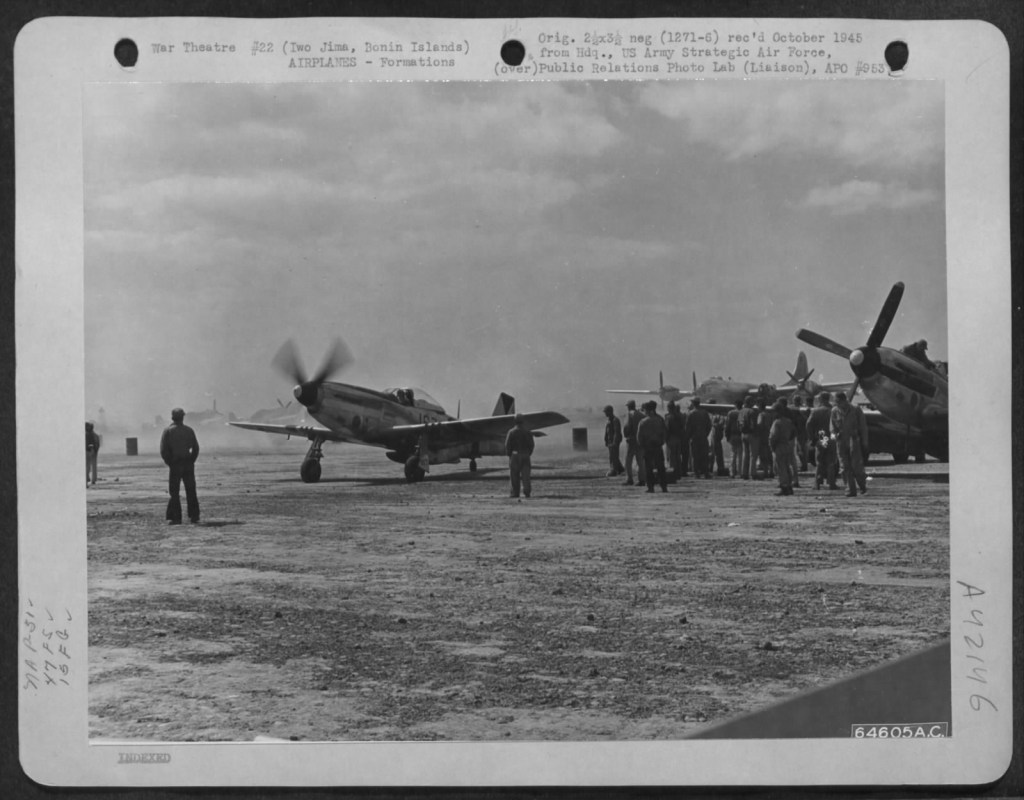
The photo above shows a 47th FS Mustang landing on South Field upon its return from the March 11th strike mission against Chichi Jima as ground crew look on.

1st Lt. Robert Scamara in 167 Pappy Yochum 47th FS/15th FG (USAAF/National Archives via Fold3)

In the photo above, 1st Lt. Robert Scamara pulls his 47th FS Mustang 167 Pappy Yochum into parking position after his return from the March 11th strike mission against Chichi Jima. Ground crew and other pilots clamor around the parked Mustangs anxious to hear about the results of the mission. Note the single antenna on Scamara’s Mustang.

References:

John W. Lambert, The Long Campaign: The History of the 15th Fighter Group in World War II, Schiffer Publishing Ltd. (2006)

Carl Molesworth, Very Long Range P-51 Mustang Units of the Pacific War, Osprey Publishing (2006)