Iwo Jima VLR Mustang Squadron Markings Part IV: 46th Fighter Squadron, 21st Fighter Group

This is the fourth part of a nine part series on the markings of the VLR Mustang squadrons. Six of the nine squadrons changed their markings during their time on Iwo Jima after the 7th Fighter Command ordered the VLR Fighter Groups to adopt more simplified markings. The 46th Fighter Squadron was not one of those squadrons.

The fuselage numbers for the 46th Fighter Squadron Mustangs were 200 through 249. The standard squadron markings for 46th Fighter Squadron Mustangs was an all blue spinner with an adjacent narrow black band on the nose, a blue band outlined in black on the vertical tail surface, and blue wing and horizontal tail tips outlined in black as shown on Eduard’s excellent profile of Lt. Robert J. Louwers and Lt. John E. Montgomery III’s 227 Mary Alice/My Miss Moe.
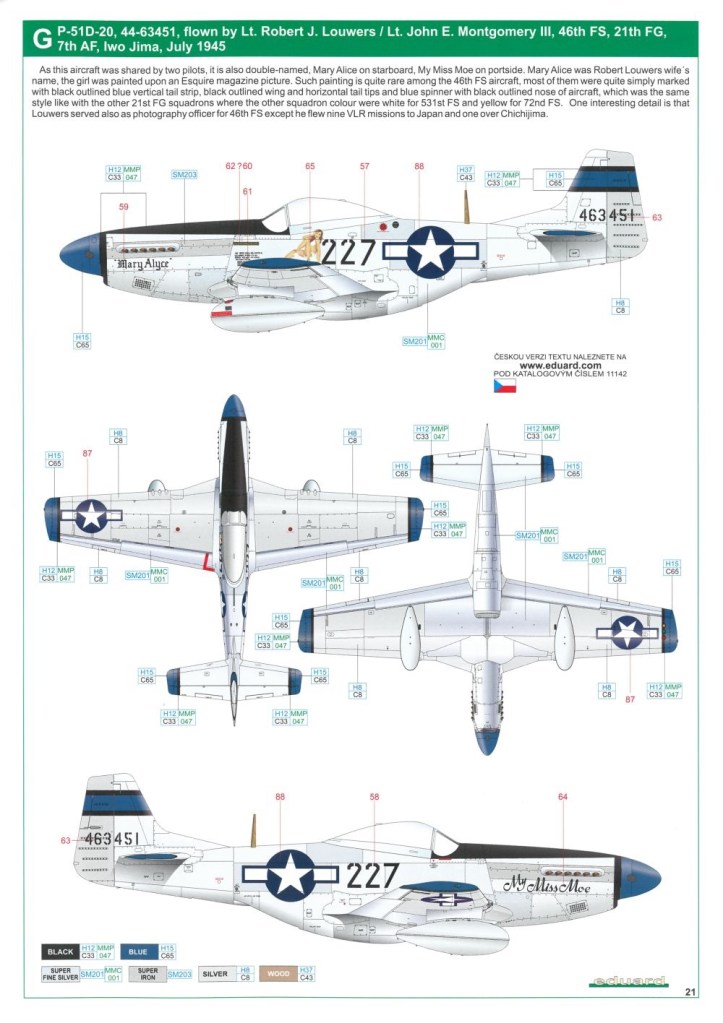
Eduard

These were pretty simple markings that did not change while the 46th Fighter Squadron was on Iwo Jima. Below is a nice color photograph of 46th Fighter Squadron Mustangs during their brief stay on Saipan prior to their arrival on Iwo Jima.
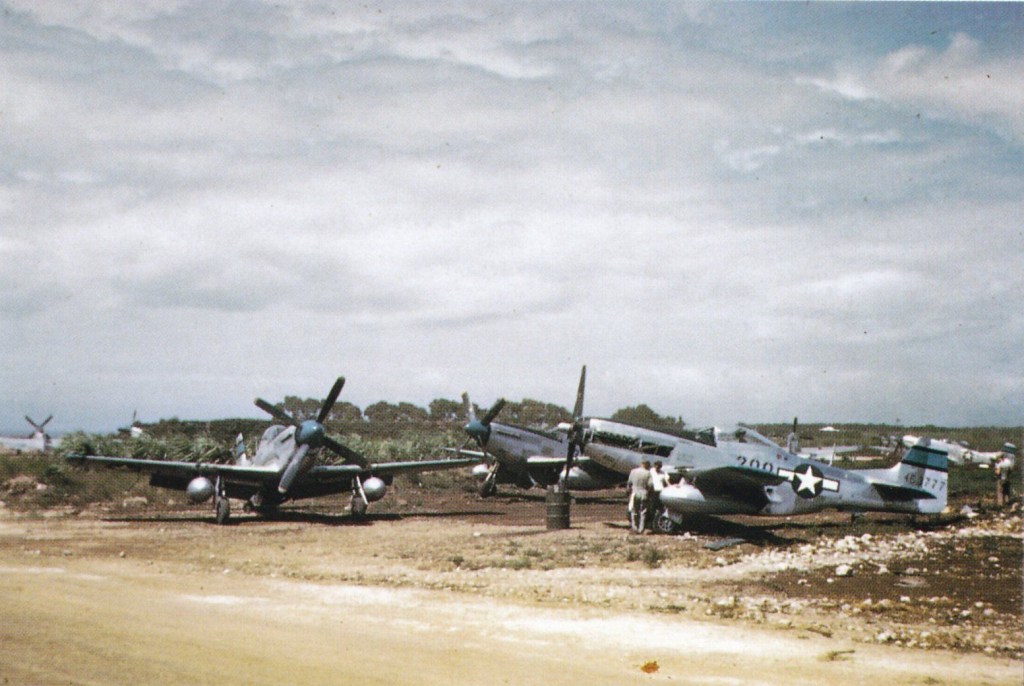
46th Fighter Squadron Mustangs on Saipan

One interesting note is that it appears that a lot of 46th Fighter Squadron Mustangs had black anti-glare paint on the top of the nose instead of the standard olive drab color. Most 46th Fighter Squadron Mustangs were Block 20s, and it is not known if the black anti-glare paint was factory applied or field applied. However, as the photo below shows, it was not uniform on all 46th Fighter Squadron Mustangs.
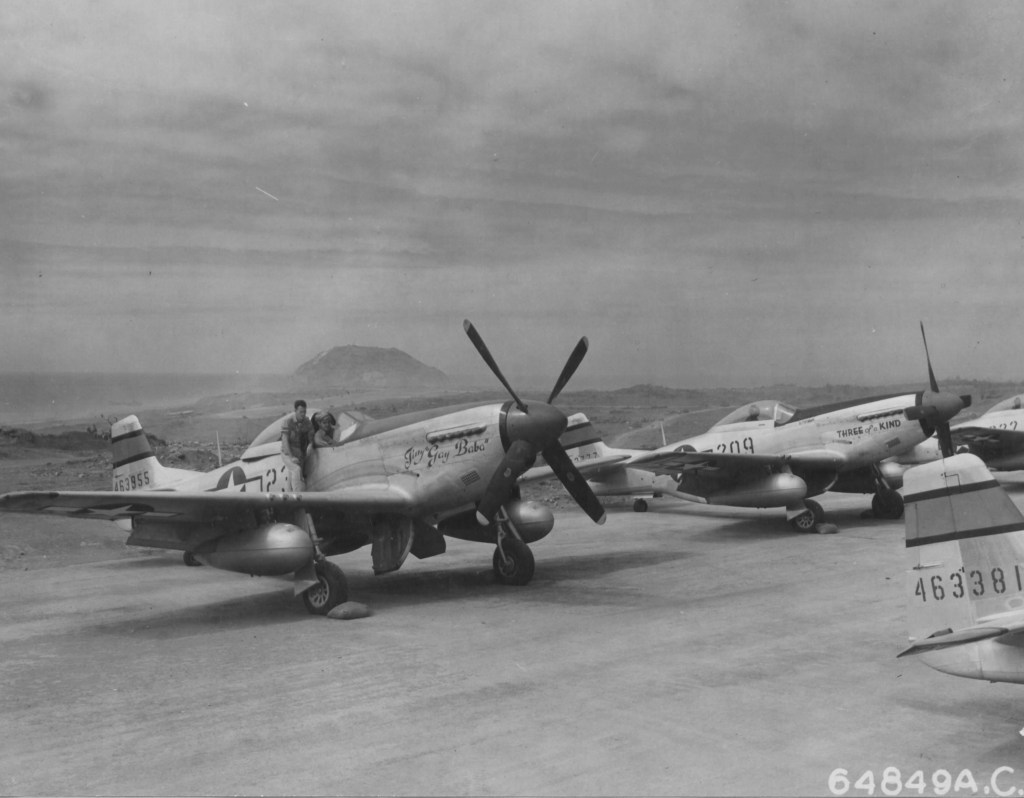
USAAF/National Archives via Fold3

The photo above shows several 46th Fighter Squadron Mustangs on a Central Field hard stand shortly after their arrival on Iwo Jima. I love this photograph as you can see South Field and Mount Suribachi in the background. 231 Tiny “Gay Baba” appears to have the standard olive drab anti-glare paint, and it appears to have been applied on the windshield framing as well which was not customary. The plane next to it, 209 Three of a Kind, appears to have black anti-glare paint. So, it is always important to check your references prior to starting a build.

Mark L. Rossmann’s 1/48 Tamiya North American P-51D Mustang; 227 “Mary Alyce”/“My Miss Moe”; 46th Fighter Squadron, 21st Fighter Group

Mark L. Rossmann is back with another Iwo Jima VLR Mustang build. This time, a 1/48 Tamiya North American P-51D Mustang built with the markings for a 46th FS, 21st FG P-51D-20-NA, Serial No. 44-63451, 227 “Mary Alyce”/“My Miss Moe” flown by Lt. Robert J. Louwers and Lt. John E. Montgomery, III.

Mark L. Rossmann

While the 1/48th scale Tamiya kit does not have the necessary parts to build an accurate Iwo Jima VLR Mustang, it still builds into a very nice and accurate representation of a D model Mustang. Mark relocated the dorsal antenna to the correct position below the front fuselage just in front of the main wheel well covers. Mark used toothpicks to create the dual Uncle Dog antennae. Nice touch in light of the fact that actual antennae were made of wood.

Eduard

Mark used the AeroMaster Decal sheet 48-797, The Very Long Range Escorts, “The Iwo Jima Mustangs” Fancy Art Part 4. Unfortunately, this sheet does not provide the decal for My Miss Moe which appears on the right side of the nose, so Mark used the decal from the Eduard sheet contained in the limited edition Tales of Iwo Jima boxing.

Mark L. Rossmann

Below is the only photograph I can find for 227 “Mary Alyce”/My Miss Moe”. This photo appears in Carl Moleworth’s book Very Long Range Mustangs Units of the Pacific War which can be purchased from Osprey Publishing in a traditional softbound book format or in an ebook format. This title and many other aviation titles can be purchased at Osprey.

A few items to note from the photograph for the modeler. First, please note how weathered 227 “Mary Alynce”/“My Miss Moe” appears. While the Mustangs on Iwo Jima were well maintained, the conditions on Iwo Jima were harsh on planes from an appearance prespective. Second, the airfield dust shows that this Mustang was equipped with tires with a block tread pattern. Third, please note the right main landing gear leg, and how dark it is. I have seen color photos of 21st Fighter Group Mustangs while on Saipan in which the landing gear legs look like they have been painted bronze green.

227 “Mary Alyce”/“My Miss Moe” on Iwo Jima (Robert J. Louwers via Carl Molesworth)

Mary Alyce was Lt. Louwers’ wife’s name. It is not known if the pin-up art that adorns the left side of the fuselage below canopy is an attempted depiction of the actual Mary Alyce Louwers.

Mark L. Rossmann

Neither Lt. Louwers or Lt. Montgomery were credited with any aerial or ground victories. Lt. Louwers completed 9 VLR missions while on Iwo Jima.

Mark L. Rossmann

Mark achieved a very nice natural metal finish, and I like the light weathering that is achieved with a simple panel line wash. Thanks to Mark for sharing his build with us, and kudos on a very nice result. More to come from Mark.

References: Very Long Range P-51 Units of the Pacific War, Carl Molesworth, Osprey Publishing, 2006.