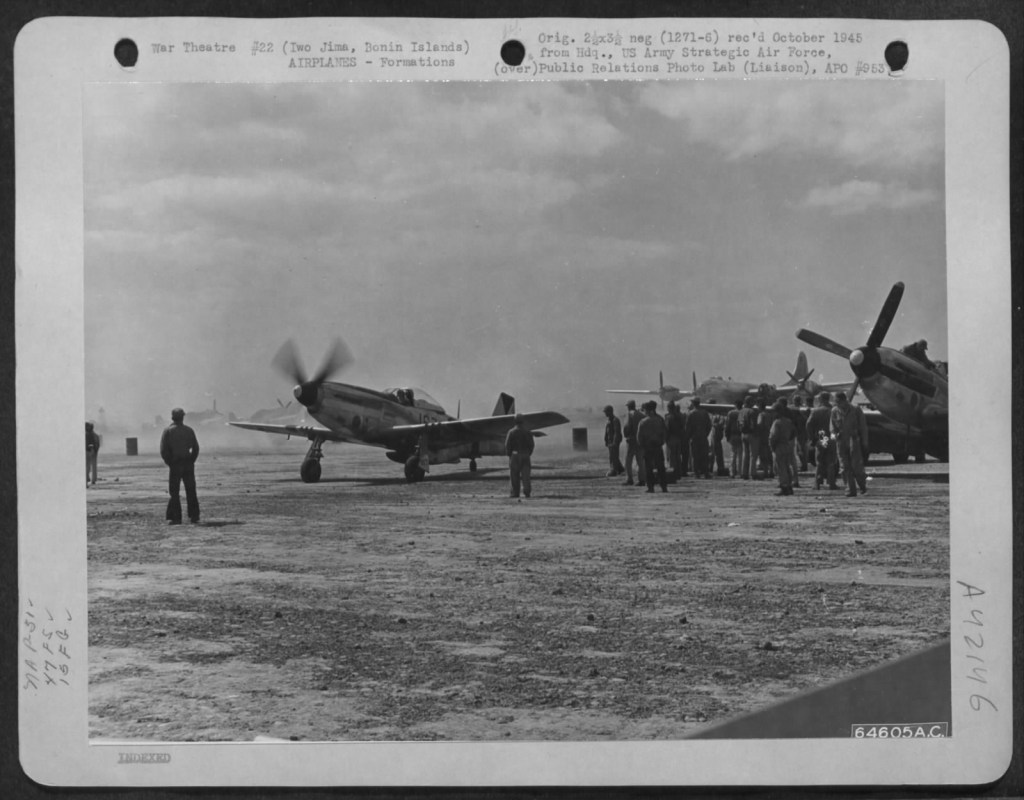
Iwo Jima VLR Mustang Squadron Markings Part III; 78th Fighter Squadron, 15th Fighter Group

This is the third part of a nine part series on the markings of the VLR Mustang squadrons. Six of the nine squadrons changed their markings during their time on Iwo Jima after the 7th Fighter Command ordered the VLR Fighter Groups to adopt more simplified markings. The 78th Fighter Squadron was one of those squadrons.

The fuselage numbers for the 78th Fighter Squadron Mustangs were 100 through 149. During their time in the Central Pacific, the 78th FS adopted the nickname the “Bushmasters” after the largest venomous pit viper in the world. When the 78th received its Mustangs, the squadron emblem was applied to both sides of the nose in front and below of the windscreen.

78th Fighter Squadron “Bushmaster” Emblem

The first iteration of the Bushmaster squadron emblem appeared after the 78th FS began receiving Curtiss P-40K Warhawks while on Hawaii. The Bushmaster snake head was painted on almost all of front fuselage/cowling on both sides.

Major Gordon R. Hyde, Commander of the 78th Fighter Squadron, next to his Curtiss P-40K Warhawk “Hyde’s Harlot” (Robert W. Moore)

Below is a great in-flight photo of the 78th Fighter Squadron’s P-40K “Rhapsody in Rivets” showing the squadron’s Bushmaster nose art. The hours that ground crew spent painting the Bushmaster head on their P-40Ks had to be incredibly high.
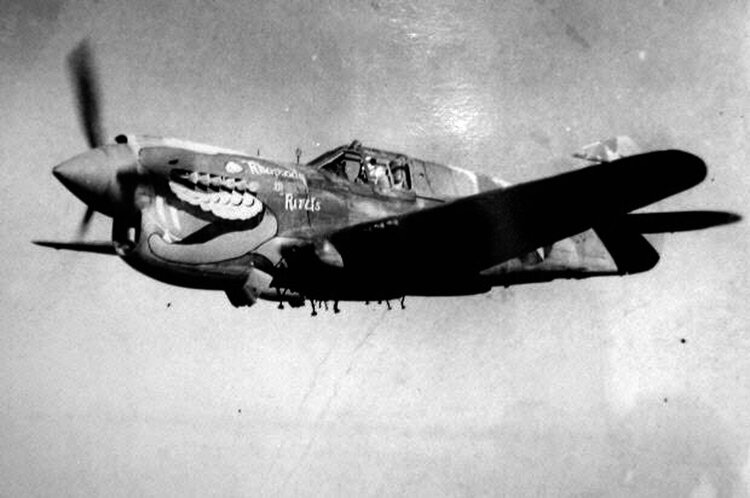
“Rhapsody in Rivets”, 78th Fighter Squadron Curtiss P-40K Warhawk (Robert W. Moore)

The 78th Fighter Squadron would eventually transition to the Republic P-47D Thunderbolt. Delivered to the 78th Fighter Squadron on Hawaii unpainted except for the anti-glare panel and national insignias, the 78th Thunderbolts’ cowlings would be completely covered with wide black/yellow/black bands. In addition, a yellow band above a black band adorned the vertical tails, while yellow tips outboard of black bands were painted on the wings and tailplanes.

A formation of 78th Fighter Squadron Republic P-47D Thunderbolts over Hawaii (Robert W. Moore)

The second iteration of the 78th Fighter Squadron Bushmaster emblem is shown nicely in the color photo below. This time around the Bushmaster’s head was painted on a black and yellow circular background with a narrower black border centered on the Thunderbolt’s large cowling. Note the fuselage numbers on the 78th’s Thunderbolt in the above photo – in the 200s instead of the 100s.

78th Fighter Squadron Pilot Robert W. “Todd” Moore standing on the wing of his Republic P-47D Thunderbolt “Stinger V” (Robert W. Moore)

Prior to being stationed on Iwo Jima, the 78th Fighter Squadron would transition to the long range North American P-51D Mustang. While retaining the yellow and black bands on the vertical tail and the tips of the wings and the tailplanes, the spinner was painted yellow and black with 6 inch black band on the nose behind the spinner as shown on Eduard’s excellent aircraft profiles of Major James B. Tapp’s 101 “Margaret – IV”

Eduard

The last iteration of the 78th Fighter Squadron’s Bushmaster emblem during World War II was the Bushmaster’s head on a circular blue and yellow background with no border as shown at the top of this post.
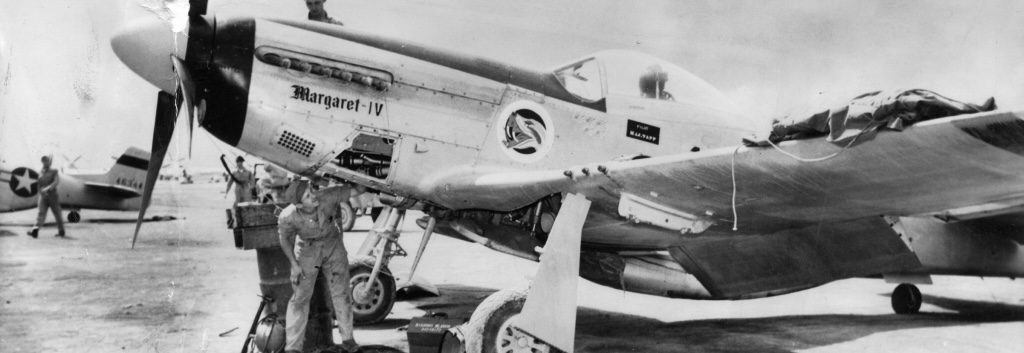
Major James B. Tapp’s North American P-51D Mustang 101 “Margaret IV” on Iwo Jima (Mark W. Stevens/7th Fighter Command Association)

It is interesting to note that some 78th Fighter Squadron Mustangs had their plane number painted on their main landing gear covers, but others did not. As shown in the above photo, Major James B. Tapp’s 101 “Margaret – IV” did not have the plane number on the main landing gear covers, while the photo below shows the plane number (or a plane number) on the main landing gear cover. I say in parentheses “or a plane number” because the plane number on the main landing gear cover does not appear to match the plane number on the fuselage. Always check your references!

USAAF/National Archives via Fold3

When the 78th Fighter Squadron transitioned to more simplified markings while on Iwo Jima, the spinner was painted all yellow, the black band on the nose behind the spinner was removed except where it crossed the anti-glare panel, and the black bands on the vertical tail, wing tips and tailplanes were overpainted with yellow as shown in the color photo of 1st Lieutenant Frederick A. Bauman’s 114 “Dear Edna”.
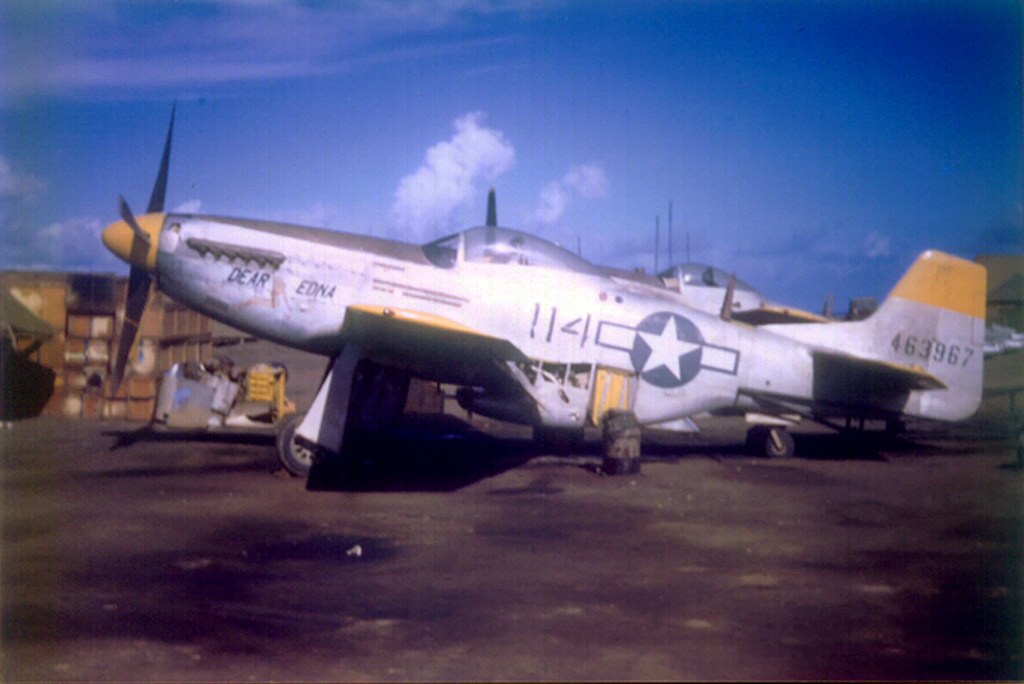
1st Lieutenant Frederick A. Bauman’s North American P-51D Mustang 114 “Dear Edna” on Iwo Jima (Mark W. Stevens/7th Fighter Command Association)

In the close-up color photo below of 114 “Dear Edna”, you can see where the black nose band was not removed where it crossed over the anti-glare panel.

1st Lieutenant Frederick A. Bauman’s North American P-51D Mustang 114 “Dear Edna” on Iwo Jima (Mark W. Stevens/7th Fighter Command Association)

Thanks again to Mark W. Stevens of the 7th Fighter Command Association for providing photos which illustrate the 78th Fighter Squadron’s markings during World War II.

References:

1. The Long Campaign: The History of the 15th Fighter Group in World War II, John W. Lambert, Schaffer Publishing Ltd. (2006).

2. The Pineapple Air Force: Pearl Harbor to Tokyo; John W. Lambert; Schaffer Publishing Ltd (2006).

3. Very Long Range P-51 Mustang Units of the Pacific War; Carl Molesworth; Osprey Publishing Limited (2006).

As a condition of the use of materials from the 7th Fighter Command Association website, the following disclaimer is included: Permission to use, copy and distribute documents delivered from this Worldwide Web server and related graphics is hereby granted, provided 1) That the use of the data will not be used for obtaining a profit of any kind, and 2) That the above disclaimer notice appear in all copies and that both that disclaimer notice and this permission notice appear. All other rights reserved. The name of “7th Fighter Command Association” may not be used in advertising or publicity pertaining to distribution of this information without specific, written prior permission. Mark Stevens and the 7th Fighter Command Association makes no representations about the suitability of this information for any purpose. It is provided “as is” without express or implied warranty. Mark Stevens and the 7th Fighter Command Association disclaim all warranties with regard to this information, including all implied warranties of merchantability and fitness. In no event shall Mark Stevens or the 7th Fighter Command Association be liable for any special, indirect or consequential damages or any damages whatsoever resulting from loss of use, data or profits, whether in an action of contract, negligence or other action, arising out of or in connection with the use or performance of this information.
Photo(s) of the Week; Iconic Iwo Jima VLR Mustang Photo

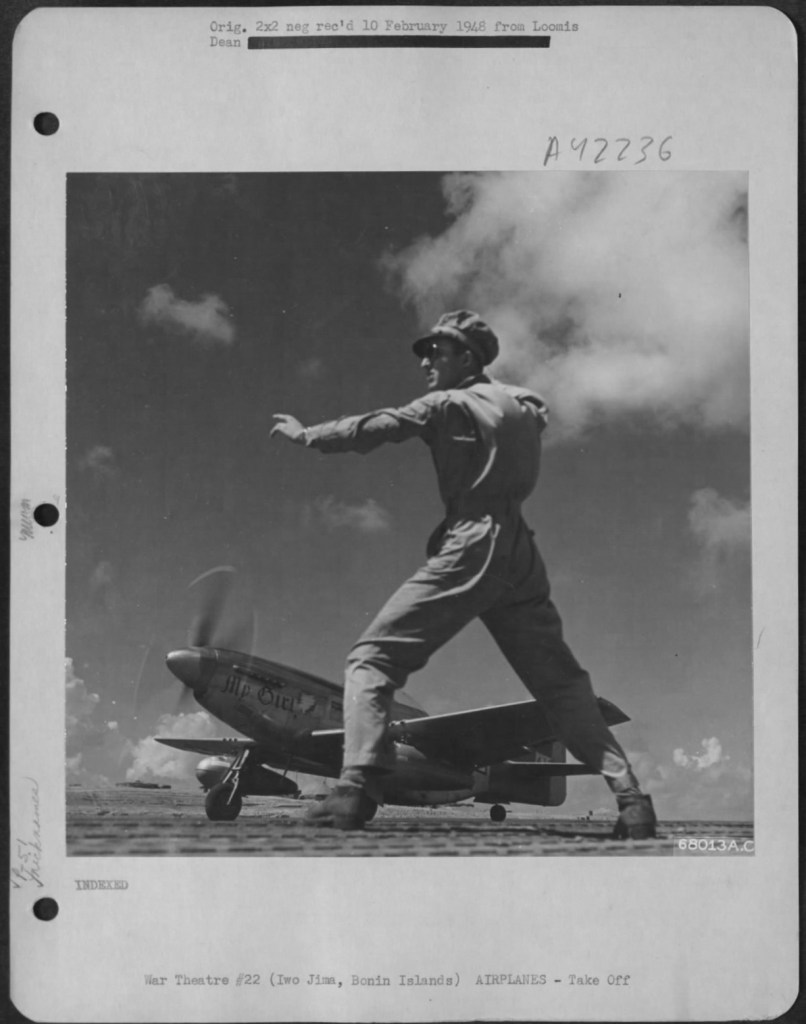
516 “My Girl”, a 457th Fighter Squadron, 506th Fighter Group P-51D-20-NA Mustang (Serial No. 44-72580) loaded with 110 gallon drop tanks awaits a signal from a ground crewman to take off from North Field on another VLR mission. This is a well known photo taken by Loomis Dean who was known for taking photos from unique angles during his time as a USAAF photographer.

USAAF/Loomis Dean/National Archives via Fold3

While the photo is well known, it is unknown who was assigned to fly “My Girl”. One would think that either 457th Fighter Squadron or 506th Fighter Group records would document who flew a particular plane, but often that is not the case. Most of what we know about who was assigned to fly a particular plane is based on photographs and recollections of pilots and ground crew. If those recollections were not written down, they are now lost as there are no surviving 457th FS pilots or ground crew.

I am unaware of any decals which were produced for “My Girl”.

Photo(s) of the Week; Mission Prep for April 19, 1945 VLR Strike Mission

USAAF/National Archives via Fold3

Armorers unpack 50 caliber ammunition from cases to be loaded into a 46th Fighter Squadron, 21st Fighter Group Mustang in preparation for the April 19, 1945 VLR strike mission against Atsugi Naval Airfield near Tokyo. Two Consolidated PB4Y-2 Privateer patrol bombers are in the background on Central Field.

Photo(s) of the Week; No Time to Waste

The 15th Fighter Group wasted no time in getting into the thick of things after arriving on Iwo Jima. On March 8th, Major John Piper led two flights of 47th Fighter Squadron Mustangs to strafe Japanese positions in support of the Marines on the northern end of Iwo. Colonel James Beckwith and 45th Fighter Squadron got into the fight on the next day with three missions in support of the Marines. The photo below shows two 45th Mustangs loaded up with 500 pound bombs getting ready to take off on one of those missions. The 78th Fighter Squadron also flew 45 sorties in support of the Marines on March 10th.

USAAF/National Archives via Fold3

It would not take long for the 15th Fighter Group’s attention to be diverted elsewhere. On March 11th, the 47th FS would fly its first strike mission against Chichi Jima. I really like the photo below. Taken over the wing of a 47th FS Mustang, the photo below shows two bomb laden 47th FS Mustangs taxing into position to take off for their strike against Chichi Jima. I like how this photo shows the elegant lines of the Mustang’s nose.

USAAF/National Archives via Fold3

Chichi Jima was 147 miles north of Iwo Jima. A major communications center with radio and radar facilities, Chichi Jima had been occupied and fortified by the Japanese for decades. It had an airfield (Susaki Airfield), a deep water anchorage, and a seaplane base. Brig. General Moore and Colonel Beckwith in their Mustangs watched as seventeen 47th FS Mustangs bombed Chichi Jima.

USAAF/National Archives/via Fold3

The photo above shows a 47th FS Mustang landing on South Field upon its return from the March 11th strike mission against Chichi Jima as ground crew look on.

1st Lt. Robert Scamara in 167 Pappy Yochum 47th FS/15th FG (USAAF/National Archives via Fold3)

In the photo above, 1st Lt. Robert Scamara pulls his 47th FS Mustang 167 Pappy Yochum into parking position after his return from the March 11th strike mission against Chichi Jima. Ground crew and other pilots clamor around the parked Mustangs anxious to hear about the results of the mission. Note the single antenna on Scamara’s Mustang.

References:

John W. Lambert, The Long Campaign: The History of the 15th Fighter Group in World War II, Schiffer Publishing Ltd. (2006)

Carl Molesworth, Very Long Range P-51 Mustang Units of the Pacific War, Osprey Publishing (2006)

Photo(s) of the Week; 45th and 78th Fighter Squadrons Arrive on Iwo Jima

On March 7th, a day after the 47th Fighter Squadron landed on Iwo Jima, Colonel James Beckwith, Commander of the 15th Fighter Group, led the 45th and 78th Fighter Squadrons from Saipan to Iwo Jima. With all three squadrons on Iwo Jima, the 15th Fighter Group would start flying missions in support of the Marines on Iwo and against other islands in the Bonins.

The photo below shows a 45th Fighter Squadron P-51D Mustang landing on South Field on March 7, 1945, as 47th Fighter Squadron pilots look on.

USAAF/National Archives via Fold3

The photo below, taken on March 10, 1945, is a beautiful shot of 78th Fighter Squadron P-51D Mustangs lined up on South Field. A few things are worthy of note. First is what looks like freshly painted squadron markings, most likely done on Saipan. Second is the 110 gallon drop tanks on the ground under the wings. These were most likely the drop tanks brought from Saipan by each plane. The 110 gallon drop tanks were used during VLR missions and on combat air patrols around Iwo Jima. Third, it appears that the first Mustang in the picture, 109 Pee Wee, has the SCR-695 IFF transmitter and twin Uncle Dog antennae installed which suggests that those field modifications began relatively soon after the 15th Fighter Group arrived on Iwo Jima.

USAAF/National Archives via Fold3

The last photo is another line up, but this time of 45th Fighter Squadron P-51D Mustangs on South Field with ground crew congregating on the flight line. This photo was also taken on March 10th.

USAAF/National Archives via Fold3

Nice group of photos of the 45th and 78th Fighter Squadrons’ first few days on Iwo Jima.