In this month’s edition of INFO Eduard, Eduard announced that their next release of their P-51D Mustang kit will be a Weekend Edition focusing on the Block 20 Mustang. The decal options include two European theater Mustangs and two Pacific theater Mustangs. The first Pacific theater Mustang is the widely recognizable The Flying Undertaker, flown by Major William A. Shomo of the 82nd TRS, 71st TRG. The other Pacific Mustang is the 458th FS, 506th FG Iwo Jima VLR Mustang, The Boll Weevil/A Neat Package, flown by 2nd Lt. Bennett C. Commer and 2nd Lt. Henry C. Seegers, Jr.
Eduard
All three VLR groups were initially equipped with Block 20 D models. As losses and attrition took its toll, Block 25 D models were used as replacement aircraft. The distinctive equipment used on VLR Mustangs, the SCR-695 IFF transmitter set, the AN/ARA-8 homing adapter and twin Uncle Dog antennae, were field modifications on Iwo Jima for both Block 20 and 25 models.
Eduard
Due to the fact that the 506th Fighter Group assigned two pilots to each plane, the markings on certain planes provide for interesting decal options. The Boll Weevil/A Neat Package is a nice example of this.
556 The Boll Weevil/A Neat Package (Bennett C. Commer via Dr. John Benbow)556 The Boll Weevil/A Neat Package (Charles Barr via Dr. John Benbow)
Kudos to Eduard for providing a multitude of 1/48th scale P-51D Mustang kits which cover blocks 5 to 25 with so many decal options. Something for everyone.
Albert Arthur Sharke was born on March 13, 1921, in New York City. He entered into Columbia University as a first generation college student. Like many others of his generation, his post-secondary education was put on hold during the time he served his country in World War II.
1st Lt. Albert A. Sharke on Iwo Jima (via Dr. John Benbow)
The 457th Squadron Unit History indicates that 2nd Lt. Albert A. Sharke was assigned to the squadron on December 18, 1944, as Armament Officer, replacing 2nd Lt. McCallick who was transferred out of the squadron. 2nd Lieutenant Sharke, and the rest of the ground echelon of the 457th Fighter Squadron, took a troop train from Lakeland Army Air Field to Seattle, Washington. They arrived on Iwo Jima onboard the H.M.S Bloemfontein, a converted Swedish hospital ship. The long overseas journey started in Seattle with stops at Hawaii, Eniwetok Atoll, Tinian, and finally Iwo Jima.
Lt. Lawrence Brennan (Supply), Maj. George Flemming (457th Squadron XO), and Lt. Albert Sharke (Armament) (Mary Ellen Ramsden via Dr. John Benbow)
It appears that Lt. Sharke may have been the armorer for the P-51D Mustang flown by 1st Lieutenant Larry Grennan, although that cannot be confirmed. Squadron histories just do not go into that amount of detail, and we do not have any good photos of Lt. Grennan’s P-51D to see if Lt. Sharke’s name appears on the plane. Without either the pilot(s) or ground crew providing that information, that piece of information is lost forever.
Lt. Lawrence Brennan and Lt. Albert Sharke along side a Consolidated PB4Y-2 Privateer on Iwo Jima (Mary Ellen Ramsden via Dr. John Benbow)
Albert Sharke was promoted to 1st Lieutenant while on Iwo Jima. After being honorably discharged after the war, Albert graduated in 1947 from Columbia University with a degree in metallurgical engineering. After working briefly at Air Reduction Laboratories, he spent the duration of his career in chemical and refinery operations at Standard Oil of New Jersey.
On July 16, 2021, we lost another member of the Greatest Generation. Thanks to Mark Stevens of the 7th Fighter Command Association for bringing to our attention Albert’s passing.
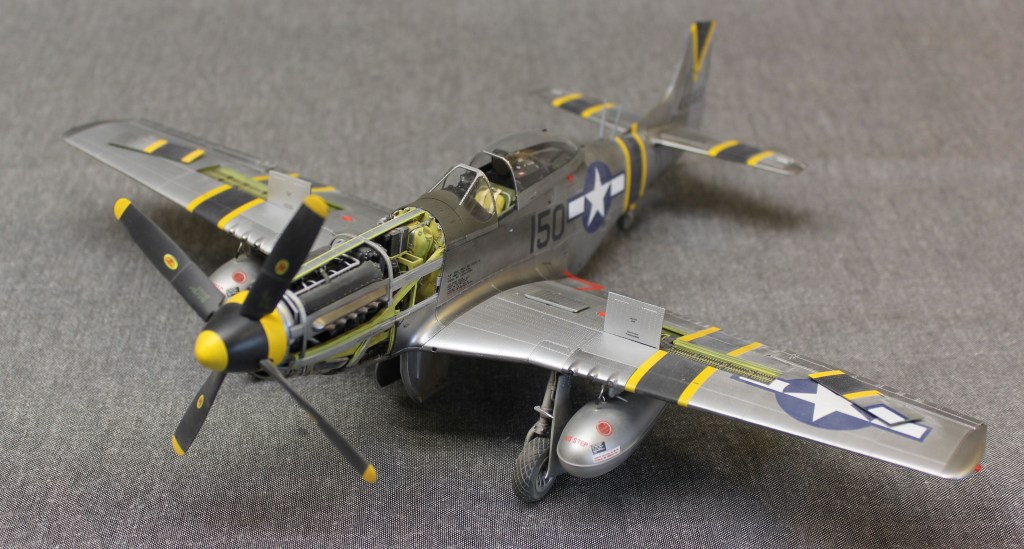
Alex Parker built Tamiya’s Pacific Theater 1/32 North American P-51D/K Mustang kit into the 15th Fighter Group, 47th Fighter Squadron’s “Lil Butch”.
Alex Parker
Alex’s focus for this build was on a plane involved in the first VLR escort mission to Japan on April 7, 1945. Using the narrative of that mission from Carl Molesworth’s book Very Long Range P-51Mustang Units of the Pacific War, Alex decided on the Mustang flown by Captain Robert R. Down, who along with 1st Lt. Dick Hintermeier, shot down a Kawasaki Ki-45 Toryu (Nick). This is considered the first aerial victory over the Japanese Home Islands by a 7th Fighter Command Mustang. Captain Down would later shoot down a Nakajima Ki-44 Shoki (Tojo) on the same mission.
Captain Robert R. Down of 47th FS/15th FG with ground crew (Mark Stevens/7th Fighter Command Association)
Alex used Barracuda Studios resin tires to replace those unique rubber wheels that come with the Tamiya kit, RB Productions seat belts, and the brass replacement barrels for the Zoukei Mura P-51D Mustang kit (produced by Aber) to enhance the build.
Alex Parker
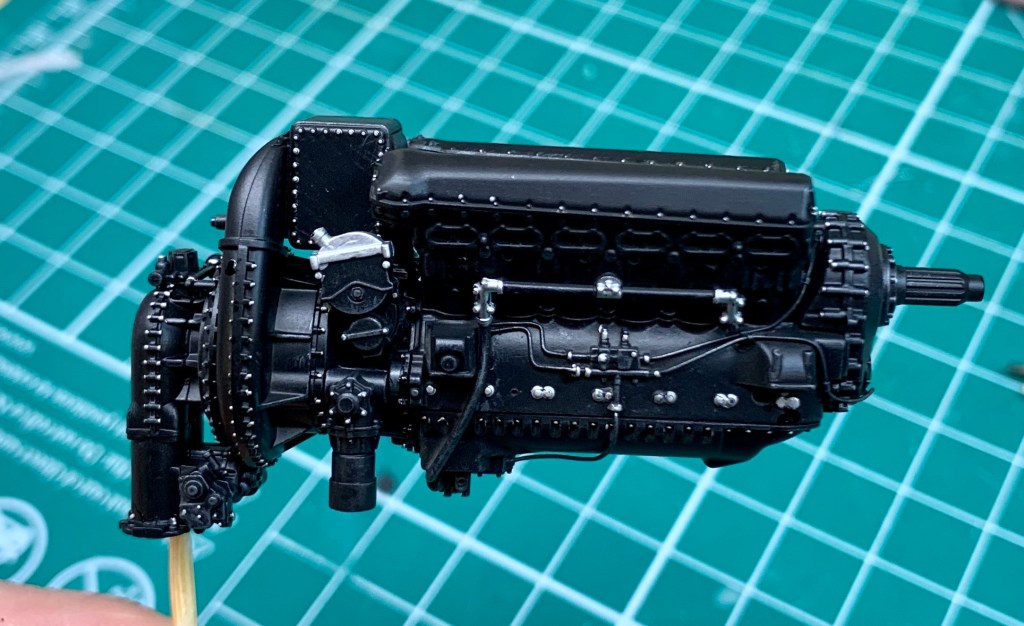
In addition to adding the wiring harness’ and spark plug wires, Alex incorporated other wires and hoses to detail Tamiya’s excellent rendition of the Mustang’s Packard built Rolls Royce Merlin engine.
Alex Parker
Alex added a seat back cushion seen in wartime Mustangs, and seat belts from RB Productions. Extremely nice additions to an already nice cockpit.
Alex Parker
The picture below shows just how busy the detailed engine compartment and cockpit look after the fuselage halves have been joined.
Alex Parker
Wire was added to the wheel wells to simulate hydraulic and electrical lines.
Alex Parker
In addition to the brass barrels, wire was added to the guns bays, and Alex did a great job of painting the 50 caliber ammunition.
Alex Parker
Alex used Alclad II lacquers for the natural metal finish. All of the squadron markings, national insignias, fuselage numbers, and the serial numbers were painted on. Since there are no commercially available decals for 150 “Lil Butch” in 1/32nd scale, Alex made masks for the national insignias, fuselage numbers, serial numbers, and the plane name “Lil Butch” using a Silhouette Cameo mask cutter. Mr. Color and MRP lacquer paints were used for the markings.
Having the ability to create your own paint masks opens the door to almost unlimited possibilities as far as markings. The good folks over at Large Scale Planes have created a new website/forum for those interested in creating their own paint masks called Scale Model Paint Masks. Check it out here: https://www.scalemodelpaintmasks.com/
Alex Parker
Alex used pastels extensively in the cockpit, engine compartment, wheel wells, and on the exterior to weather the model. I like how the pastels along with clear coats do nice job in knocking down the semi-gloss appearance of markings and shine of the Alclad II natural metal finishes.






 Iwo Jima Models