
This is the third part of a nine part series on the markings of the VLR Mustang squadrons. Six of the nine squadrons changed their markings during their time on Iwo Jima after the 7th Fighter Command ordered the VLR Fighter Groups to adopt more simplified markings. The 78th Fighter Squadron was one of those squadrons.
The fuselage numbers for the 78th Fighter Squadron Mustangs were 100 through 149. During their time in the Central Pacific, the 78th FS adopted the nickname the “Bushmasters” after the largest venomous pit viper in the world. When the 78th received its Mustangs, the squadron emblem was applied to both sides of the nose in front and below of the windscreen.

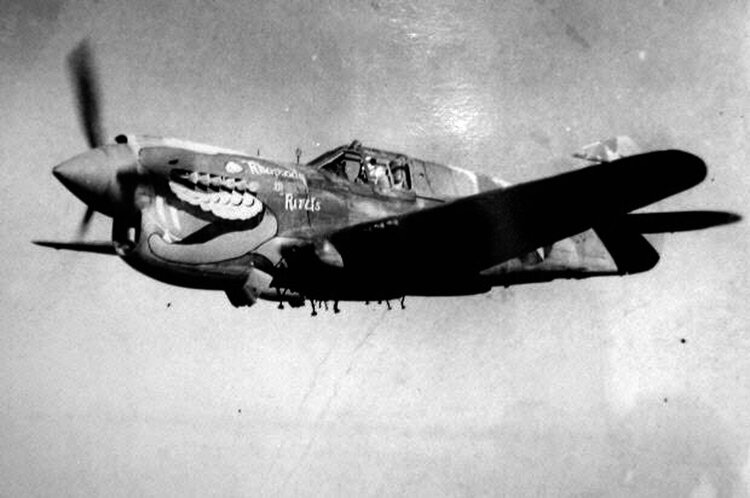
The first iteration of the Bushmaster squadron emblem appeared after the 78th FS began receiving Curtiss P-40K Warhawks while on Hawaii. The Bushmaster snake head was painted on almost all of front fuselage/cowling on both sides.

Below is a great in-flight photo of the 78th Fighter Squadron’s P-40K “Rhapsody in Rivets” showing the squadron’s Bushmaster nose art. The hours that ground crew spent painting the Bushmaster head on their P-40Ks had to be incredibly high.
The 78th Fighter Squadron would eventually transition to the Republic P-47D Thunderbolt. Delivered to the 78th Fighter Squadron on Hawaii unpainted except for the anti-glare panel and national insignias, the 78th Thunderbolts’ cowlings would be completely covered with wide black/yellow/black bands. In addition, a yellow band above a black band adorned the vertical tails, while yellow tips outboard of black bands were painted on the wings and tailplanes.

The second iteration of the 78th Fighter Squadron Bushmaster emblem is shown nicely in the color photo below. This time around the Bushmaster’s head was painted on a black and yellow circular background with a narrower black border centered on the Thunderbolt’s large cowling. Note the fuselage numbers on the 78th’s Thunderbolt in the above photo – in the 200s instead of the 100s.

Prior to being stationed on Iwo Jima, the 78th Fighter Squadron would transition to the long range North American P-51D Mustang. While retaining the yellow and black bands on the vertical tail and the tips of the wings and the tailplanes, the spinner was painted yellow and black with 6 inch black band on the nose behind the spinner as shown on Eduard’s excellent aircraft profiles of Major James B. Tapp’s 101 “Margaret – IV”

The last iteration of the 78th Fighter Squadron’s Bushmaster emblem during World War II was the Bushmaster’s head on a circular blue and yellow background with no border as shown at the top of this post.
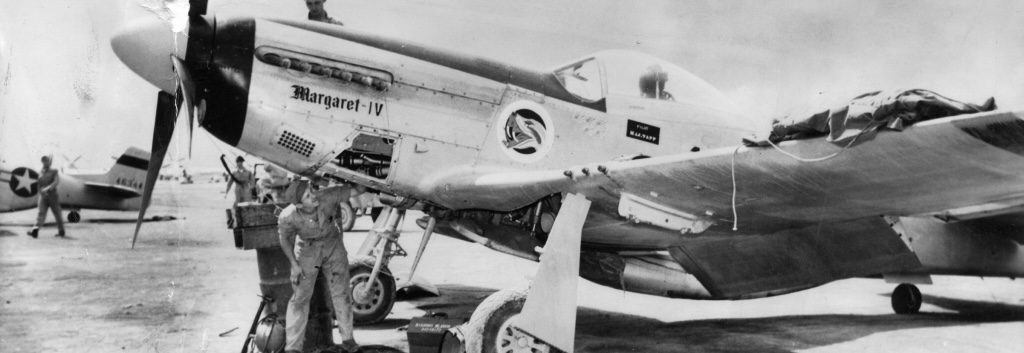
It is interesting to note that some 78th Fighter Squadron Mustangs had their plane number painted on their main landing gear covers, but others did not. As shown in the above photo, Major James B. Tapp’s 101 “Margaret – IV” did not have the plane number on the main landing gear covers, while the photo below shows the plane number (or a plane number) on the main landing gear cover. I say in parentheses “or a plane number” because the plane number on the main landing gear cover does not appear to match the plane number on the fuselage. Always check your references!

When the 78th Fighter Squadron transitioned to more simplified markings while on Iwo Jima, the spinner was painted all yellow, the black band on the nose behind the spinner was removed except where it crossed the anti-glare panel, and the black bands on the vertical tail, wing tips and tailplanes were overpainted with yellow as shown in the color photo of 1st Lieutenant Frederick A. Bauman’s 114 “Dear Edna”.
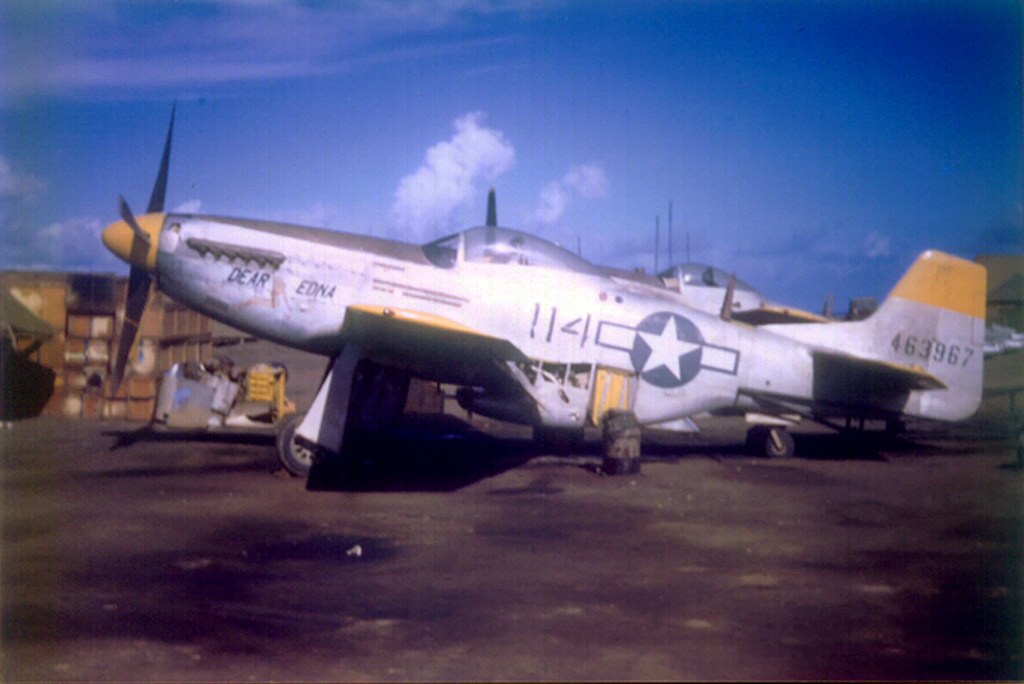
In the close-up color photo below of 114 “Dear Edna”, you can see where the black nose band was not removed where it crossed over the anti-glare panel.

Thanks again to Mark W. Stevens of the 7th Fighter Command Association for providing photos which illustrate the 78th Fighter Squadron’s markings during World War II.
References:
1. The Long Campaign: The History of the 15th Fighter Group in World War II, John W. Lambert, Schaffer Publishing Ltd. (2006).
2. The Pineapple Air Force: Pearl Harbor to Tokyo; John W. Lambert; Schaffer Publishing Ltd (2006).
3. Very Long Range P-51 Mustang Units of the Pacific War; Carl Molesworth; Osprey Publishing Limited (2006).
As a condition of the use of materials from the 7th Fighter Command Association website, the following disclaimer is included: Permission to use, copy and distribute documents delivered from this Worldwide Web server and related graphics is hereby granted, provided 1) That the use of the data will not be used for obtaining a profit of any kind, and 2) That the above disclaimer notice appear in all copies and that both that disclaimer notice and this permission notice appear. All other rights reserved. The name of “7th Fighter Command Association” may not be used in advertising or publicity pertaining to distribution of this information without specific, written prior permission. Mark Stevens and the 7th Fighter Command Association makes no representations about the suitability of this information for any purpose. It is provided “as is” without express or implied warranty. Mark Stevens and the 7th Fighter Command Association disclaim all warranties with regard to this information, including all implied warranties of merchantability and fitness. In no event shall Mark Stevens or the 7th Fighter Command Association be liable for any special, indirect or consequential damages or any damages whatsoever resulting from loss of use, data or profits, whether in an action of contract, negligence or other action, arising out of or in connection with the use or performance of this information.
 Iwo Jima Models