While the Mustang had long legs, to get from Iwo Jima to the Japanese Home Islands and back required more than the standard 75 gallon drop tanks used in the European Theatre. In the two photos below, ground crewmen are seen unloading 110 gallon metal drop tanks in preparation for a VLR mission to Japan. On the trip to Japan, pilots would expend the aviation fuel from the drop tanks first, and then switch to the 85 gallon fuselage fuel tank which was situated right behind the pilot seat. Once that was expended, it was the fuel tanks in wings that would bring the Mustang home to Iwo Jima.
I love the photo below of the 335 “Is This Trip Necessary?”, a 531st Fighter Squadron, 21st Fighter Group P-51D-20 NA Mustang (Serial No. 44-63289). It captures the eloquent and graceful lines of the P-51D’s nose.
USAAF/National Archives via Fold3
Please note in the photograph below that the “plumbing” between the drop tanks and the wings has already been installed before the tanks are attached to the underwing ordinance racks. Just from the numbers on the photographs, we know that top photo was taken before the bottom photo. The assumption here is that 7th Fighter Command became more efficient over time in how they prepared their fighters for VLR missions. Or it could have been just how a particular squadron installed their drop tanks. Either way, the photos show some possibilities for some interesting diorama settings.
USAAF/National Archives via Fold3
In addition, the second photo provides information regarding the proper placement of kit decals on the drop tanks. Very neat.
The official captions to the two photos below are: “North American P-51 Mustangs [sic] fighters escort Boeing B-29 Superfortresses. Iwo Jima.” In actuality, the B-29s in these photos were serving as navigational aircraft in escorting the P-51s from Iwo Jima to Japan and back.
A B-29 navigational aircraft escorts 45th FS 15th FG P-51D Mustangs on a VLR mission (USAAF/National Archives via Fold3)
The 1,500 mile round trip flights over a vast expanse of ocean with minimal landmarks made navigating in a single engine fighter an extremely difficult task. Only a few fighter pilots with sufficient experience would feel confident to take on that task. To take that burden off of the VLR fighter pilots, six B-29 navigation planes in three pairs led the Mustangs on each mission. Upon reaching a designated point off the Japanese coast, the B-29s would circle while the Mustangs would venture inland either escorting the main bomber stream or striking their intended targets.
A B-29 navigational aircraft escorts 45th FS 15th FG P-51D Mustangs on a VLR mission (USAAF/National Archives via Fold3)
When the Mustangs began to retreat to the designated rendezvous point, the first pair of B-29s would wait until about half of the fighters had arrived, then set course for Iwo Jima. The other two pairs of bombers departed the coast at approximately ten minute intervals to allow latecomers to join up with them for the long flight back to Iwo Jima. The last pair of B-29s to depart transmitted the Morse Code letters for U and D on the Uncle Dog radio frequency so late departing Mustangs could hone in on those bombers until they were close enough to Iwo Jima to hone in on the signals sent from Brother Agate.
This system worked extremely well and gave VLR Mustang pilots the confidence that they would return safely to Iwo Jima even if they got separated from their squadron or group.
References:The Mustangs of Iwo, Barrett Tillman, Air & Space Forces Magazine, April 1, 2013.
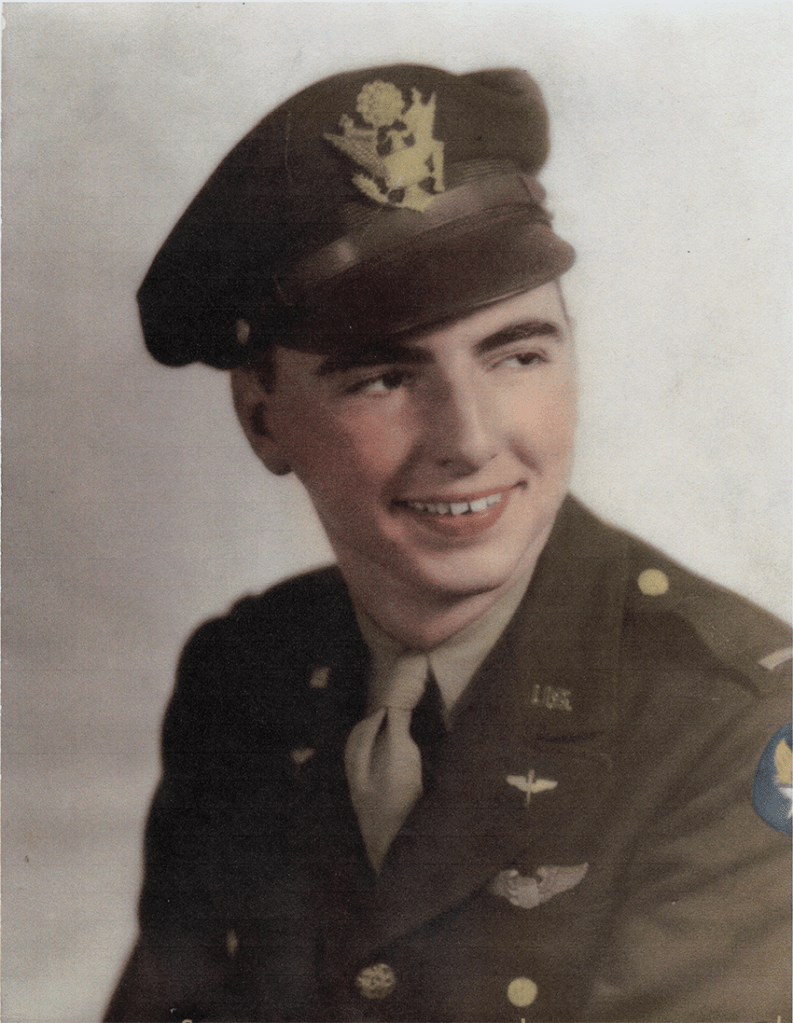
Robert A. Gourley was born on December 14, 1924, in Greer, South Carolina. Bob graduated from Marion High School in 1940, and entered into Davidson College in 1941 as part of the ROTC program. Like many others of his generation, his post-secondary education was put on hold during the time he served his country in World War II.
2nd Lieutenant Robert A. Gourley
Not wanting to be placed into the infantry, Bob enlisted in the United States Army Air Corps. He earned wings and was commissioned a 2nd Lieutenant at Luke Field in Phoenix, Arizona in 1944. In October of that year, 2nd Lieutenant Gourley was assigned to the 462nd Fighter Squadron of the 506th Fighter Group shortly after the group’s activation at Lakeland Army Air Field. At Lakeland, the 506th FG was trained specifically to fly very long range missions.
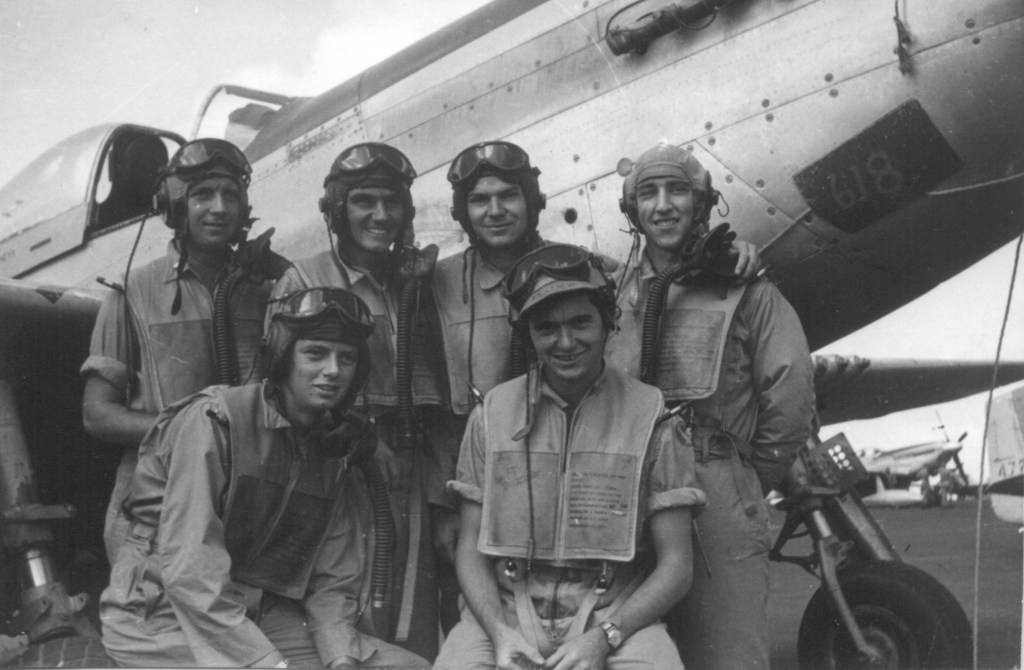
Front row, left to right: 1st Lt. Robert Gourley, 1st Lt. Frank Buzze; Back row, left to right: 1st Lt. Bernie Comfort, 1st Lt. Jack Rice, 1st Lt. Thomas McNall, and 1st Lt. Harold Stewart (via Dr. John Benbow)
When deployed to Iwo Jima, half of the squadron’s fighter pilots ferried their brand new P-51D Mustangs to San Francisco, where they were loaded on the escort carrier Kalinin Bay and set out for Tinian. The other half of the pilots, which included 2nd Lieutenant Gourley, took a troop train to Seattle, and then boarded the converted Swedish hospital ship, the Bloemfontein. They sailed from Seattle to Hawaii, Eniwetok Atoll, Tinian, and then finally to Iwo Jima.
1st Lts. Robert Gourley and Jack Rice on the nose of a P-51D Mustang (via Dr. John Benbow)
Lieutenant Gourley would fly a total of 11 VLR missions to Japan, and would be promoted to the rank of Capitan before being honorably discharged. Upon returning home, Bob re-enrolled in Davidson College and graduated in 1948 with a Bachelor of Arts in Music.
Bob was a recognized community member faithfully contributing to his community in many ways. He was a member of First Presbyterian Church and served as choir director for over three decades. He was also active in the local Kiwanis Club and the Masonic Lodge. Bob played in a community band well into into eighties, and enjoyed playing golf.
Robert A. Gourley
On September 4, 2021, we lost another member of the Greatest Generation. Bob was 96, and was the last living fighter pilot of the 462nd Fighter Squadron.
In 2014, Bob gave a video interview as part of the McDowell Legacy Program, “Reflections of the Past”. In his interview, Bob speaks of his entry into the United States Army Air Force, and missions flown from Iwo Jima to Japan. The YouTube video of Bob’s interview can be found here: https://youtu.be/P-HsME_vCKI.
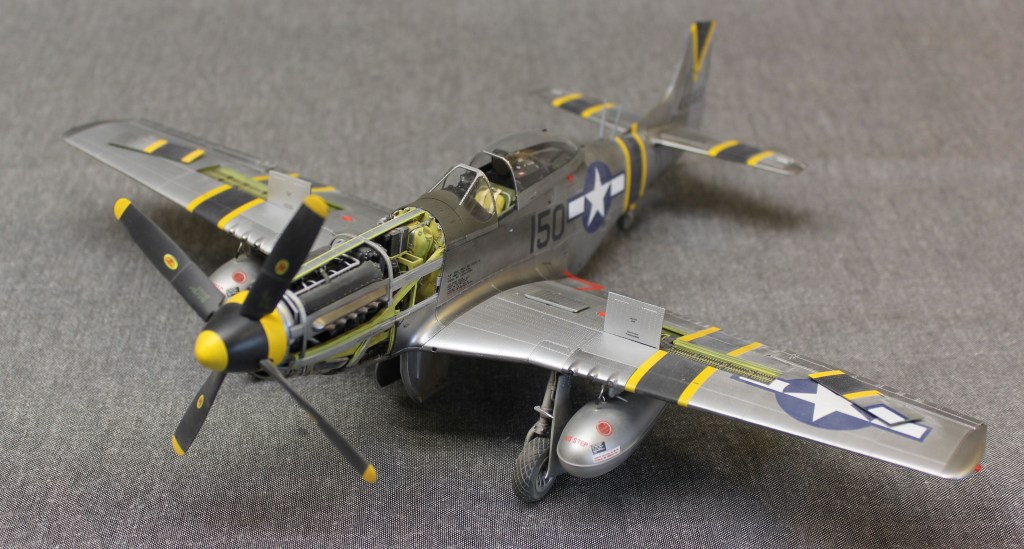
Alex Parker built Tamiya’s Pacific Theater 1/32 North American P-51D/K Mustang kit into the 15th Fighter Group, 47th Fighter Squadron’s “Lil Butch”.
Alex Parker
Alex’s focus for this build was on a plane involved in the first VLR escort mission to Japan on April 7, 1945. Using the narrative of that mission from Carl Molesworth’s book Very Long Range P-51Mustang Units of the Pacific War, Alex decided on the Mustang flown by Captain Robert R. Down, who along with 1st Lt. Dick Hintermeier, shot down a Kawasaki Ki-45 Toryu (Nick). This is considered the first aerial victory over the Japanese Home Islands by a 7th Fighter Command Mustang. Captain Down would later shoot down a Nakajima Ki-44 Shoki (Tojo) on the same mission.
Captain Robert R. Down of 47th FS/15th FG with ground crew (Mark Stevens/7th Fighter Command Association)
Alex used Barracuda Studios resin tires to replace those unique rubber wheels that come with the Tamiya kit, RB Productions seat belts, and the brass replacement barrels for the Zoukei Mura P-51D Mustang kit (produced by Aber) to enhance the build.
Alex Parker
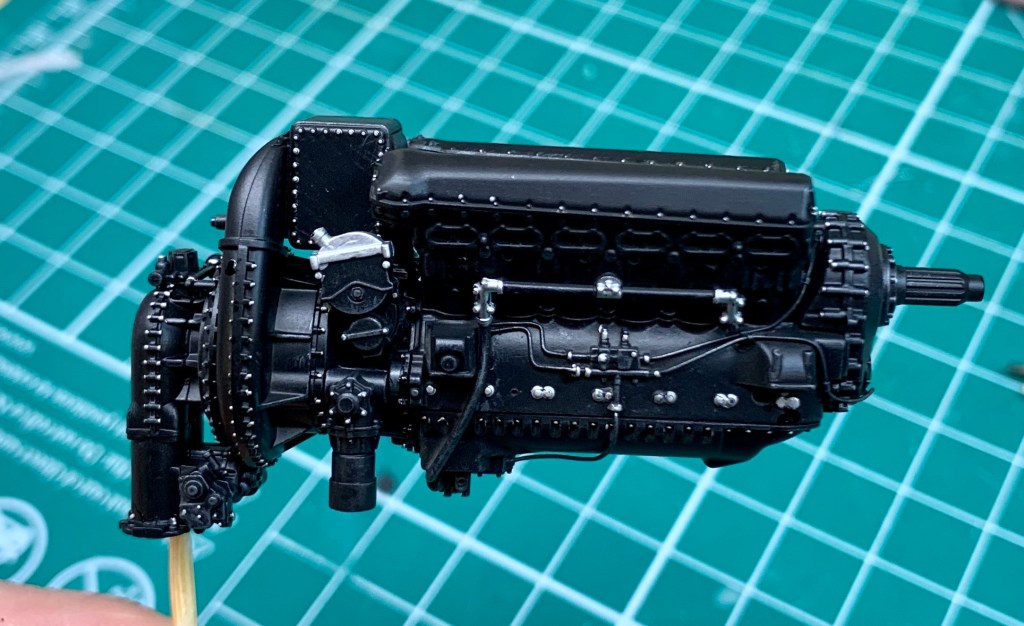
In addition to adding the wiring harness’ and spark plug wires, Alex incorporated other wires and hoses to detail Tamiya’s excellent rendition of the Mustang’s Packard built Rolls Royce Merlin engine.
Alex Parker
Alex added a seat back cushion seen in wartime Mustangs, and seat belts from RB Productions. Extremely nice additions to an already nice cockpit.
Alex Parker
The picture below shows just how busy the detailed engine compartment and cockpit look after the fuselage halves have been joined.
Alex Parker
Wire was added to the wheel wells to simulate hydraulic and electrical lines.
Alex Parker
In addition to the brass barrels, wire was added to the guns bays, and Alex did a great job of painting the 50 caliber ammunition.
Alex Parker
Alex used Alclad II lacquers for the natural metal finish. All of the squadron markings, national insignias, fuselage numbers, and the serial numbers were painted on. Since there are no commercially available decals for 150 “Lil Butch” in 1/32nd scale, Alex made masks for the national insignias, fuselage numbers, serial numbers, and the plane name “Lil Butch” using a Silhouette Cameo mask cutter. Mr. Color and MRP lacquer paints were used for the markings.
Having the ability to create your own paint masks opens the door to almost unlimited possibilities as far as markings. The good folks over at Large Scale Planes have created a new website/forum for those interested in creating their own paint masks called Scale Model Paint Masks. Check it out here: https://www.scalemodelpaintmasks.com/
Alex Parker
Alex used pastels extensively in the cockpit, engine compartment, wheel wells, and on the exterior to weather the model. I like how the pastels along with clear coats do nice job in knocking down the semi-gloss appearance of markings and shine of the Alclad II natural metal finishes.






 Iwo Jima Models