Today, November 11th, is the federal holiday in the United States to honor those who have served in the United States Armed Forces.
78th Fighter Squadron pilots pose for a picture with one of their Curtiss P-40K Warhawks while stationed on Midway Island in 1943 (Mark Stevens/7th Fighter Command Association)
Veterans Day coincides with other holidays, including Armistice Day and Remembrance Day, which are commemorated in other countries, marking the anniversary of the end of World War I. Major hostilities of World War I ended on the 11th hour of the 11th day of 11th month of 1918, when the armistice with Germany went into effect.
Ground crew and pilots assigned to 640 “The Shawnee Princess/Empire Commuter” pose for a picture in front of their 462nd Fighter Squadron P-51D Mustang. From left of right: Cpl. Sheetz (armorer), Cpl. Riley (radioman), 1st Lt. Seale (pilot), Capt. Zagorsky (pilot), and Sgt. Jackson (crew chief) (506th Fighter Group Association)
Originally known as Armistice Day in the United States, it was renamed Veterans Day in 1954 at the urging of the major organizations representing veterans in the United States.
Crew members of “Thumper” pose for a picture in front of their Boeing B-29 Superfortress on Tinian Island in 1945 (870th Bomb Squadron, 497th BombGroup, 73rd Bombardment Wing)
Veterans Day is distinct from Memorial Day which is observed in May of each year. Veterans Day commemorates the service of all those who served in the United States Armed Forces, while Memorial Day specifically honors those who died in military service to our country.
457th Fighter Squadron pilots pose for a picture along side 642 “Fighting Lady” (506th Fighter Group Association)
Thank you to all veterans who have served in the United States Armed Forces. Your service and sacrifices to protect and preserve the freedoms we continue to enjoy are greatly appreciated!
The official captions to the two photos below are: “North American P-51 Mustangs [sic] fighters escort Boeing B-29 Superfortresses. Iwo Jima.” In actuality, the B-29s in these photos were serving as navigational aircraft in escorting the P-51s from Iwo Jima to Japan and back.
A B-29 navigational aircraft escorts 45th FS 15th FG P-51D Mustangs on a VLR mission (USAAF/National Archives via Fold3)
The 1,500 mile round trip flights over a vast expanse of ocean with minimal landmarks made navigating in a single engine fighter an extremely difficult task. Only a few fighter pilots with sufficient experience would feel confident to take on that task. To take that burden off of the VLR fighter pilots, six B-29 navigation planes in three pairs led the Mustangs on each mission. Upon reaching a designated point off the Japanese coast, the B-29s would circle while the Mustangs would venture inland either escorting the main bomber stream or striking their intended targets.
A B-29 navigational aircraft escorts 45th FS 15th FG P-51D Mustangs on a VLR mission (USAAF/National Archives via Fold3)
When the Mustangs began to retreat to the designated rendezvous point, the first pair of B-29s would wait until about half of the fighters had arrived, then set course for Iwo Jima. The other two pairs of bombers departed the coast at approximately ten minute intervals to allow latecomers to join up with them for the long flight back to Iwo Jima. The last pair of B-29s to depart transmitted the Morse Code letters for U and D on the Uncle Dog radio frequency so late departing Mustangs could hone in on those bombers until they were close enough to Iwo Jima to hone in on the signals sent from Brother Agate.
This system worked extremely well and gave VLR Mustang pilots the confidence that they would return safely to Iwo Jima even if they got separated from their squadron or group.
References:The Mustangs of Iwo, Barrett Tillman, Air & Space Forces Magazine, April 1, 2013.
In their special Eday 2024 edition of Info Eduard e-magazine, Eduard announced the future release of a limited edition “Very Long Range: Tales of Iwo Jima” boxing of their excellent 1/72nd North American P-51D Mustang kit. The kit will be released in the second quarter of 2025, and will most likely contain the same decal options as their 1/48th limited edition “Very Long Range: Tales of Iwo Jima” boxing.
Eduard
Nice to see Eduard providing those who model in 1/72nd scale with 12 different decal options covering all three Iwo Jima VLR Mustang groups. Consistent with their other limited edition boxings, it is anticipated that Eduard will include a photo etch cockpit detail set, Brassin 3D printed parts (seats, exhaust stacks, wheels, etc . . .), and a lapel pin. If you are reading this Eduard, it would be nice if the lapel pin has the 7th Air Force logo on it.
In other exciting news, Eduard is getting back into the 1/32nd scale market and has announced the future release of a 1/32nd North American P-51B Mustang. Nice to see Eduard announce the future release of a quality 1/32nd P-51B. While the Trumpeter 1/32nd P-51B kit is a decent kit, it has a large number of inaccuracies.
This post and the pictures are somewhat off topic because they have nothing to do with aviation, but the story is so neat I could not ignore sharing it with everyone.
Back on November 8, 2020, the Omaha World-Herald ran a story about a 103 year old Marine veteran who lived in Omaha and commanded the 6th Marine War Dog Platoon. The 6th Marine War Dog Platoon consisted of 32 German Shepards and Doberman Pinschers and their handlers. Lt. Robert Worth commanded the 6th Marine War Dog Platoon and trained many of the dogs in the platoon. Their first deployment was on Iwo Jima. The dogs were trained to sniff out enemy combatants in caves, and to carry messages through battlegrounds.
USAAF/National Archives via Fold3
The official caption for the above photo reads: “Pfc. Ricky, half collie, half shepard, is shown crawling into the mouth of a cave. He is a member of the 6th War Dog Platoon. Ricky is considered the most obedient dogs in the platoon and will carry out orders regardless of interference of other dogs or personnel, IWO JIMA”.
USAAF/National Archives via Fold3
The official caption for the above photo reads: “Looking out from inside of the cave is a Jap[anese] eye view of Pfc. Karl and his handler, Roy L. Jackson, also a Pfc., of Jack Horn, Ky. Roy was a veternarian in civilian life. Of the thirty-two dogs in his platoon, Roy knows the name, rank and serial number of them by heart. He knows which dogs like him best and those that like him the least. IWO JIMA”.
Lt. Worth and a friend enlisted in the United States Marines shortly after the December 7, 1941, attack on Pearl Harbor. He was assigned 2nd Marine Regiment and participated in the battle for Guadalcanal in the Soloman Islands. In 1943, then Sergeant Worth was selected to become an officer. Upon completion of his training, he was commissioned as a 2nd Lieutenant in February 1944. He took command of the 6th Marine War Dog Platoon which trained their dogs at Camp Lejeune, North Carolina. Lt. Worth personally witnessed the flag raising on Mt. Surbachi captured by Associated Press photographer Joe Rosenthal.
Robert Worth passed away on August 14, 2024 at the age of 106 years.
References:
Omaha Vet, 103, trained Marine war dogs at Iwo Jima, Steve Liewer; Omaha World-Herald, November 8, 2020.
Marine dog handler dies at 106, Steve Liewer; Omaha World-Herald, August 29, 2024.
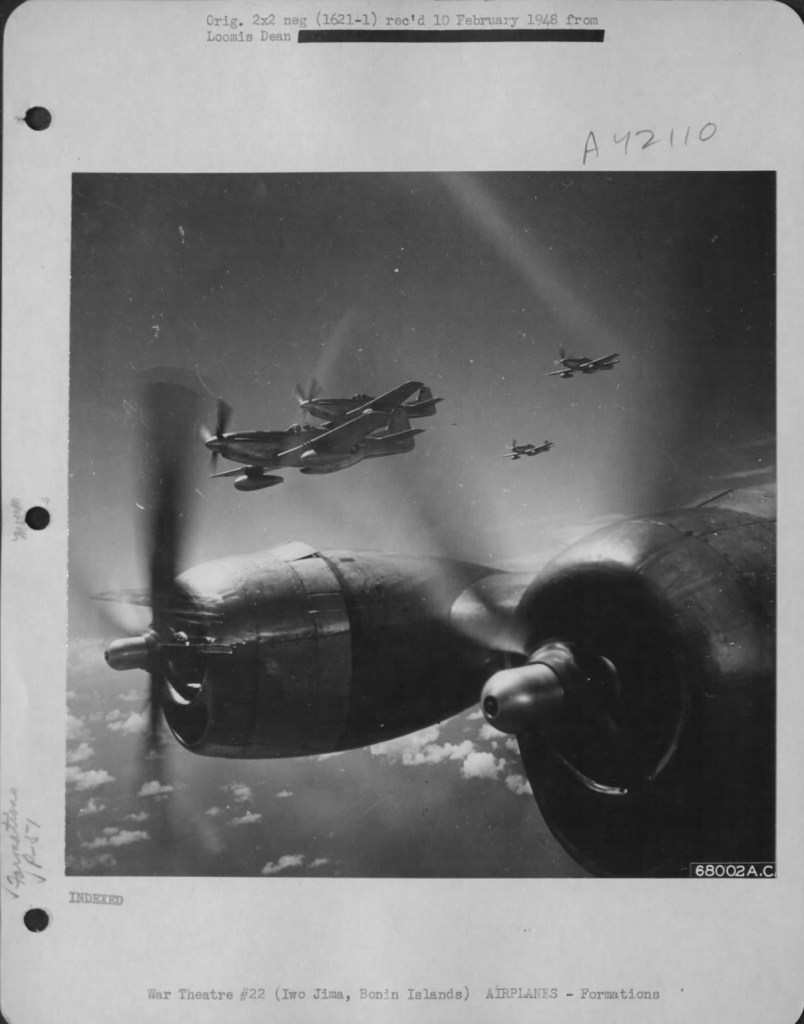
The three photos in this post were taken by United States Army Air Force photographer, Loomis Dean, while aboard a Boeing B-29 Superfortress. Whether these pictures were taken during an VLR mission to the Japanese Home Islands, or during a staged photo shoot is not known.
USAAF/Loomis Dean/National Archives via Fold3
All three photos were taken on the same flight, and what is interesting is that the P-51D Mustangs have no identifying squadron markings, and if there are any plane numbers, you cannot see them due to them being blocked by the wings. In addition, it appears that the twin Uncle Dog antennae have not been installed because the normal antenna has not been moved to the bottom of the fuselage in front of the wheel wells. The twin Uncle Dog antennae were installed in the field on Iwo Jima, and did not become factory installed until Block 30s.
USAAF/Loomis Dean/National Archives via Fold3
These Mustangs are replacements planes that have arrived on Iwo Jima and no squadron markings have been applied yet or field modifications made.
USAAF/Loomis Dean/National Archives via Fold3
All of this considered, these photos are most likely the result of a staged photo op.




 Iwo Jima Models