Today, November 11th, is the federal holiday in the United States to honor those who have served in the United States Armed Forces.
78th Fighter Squadron pilots pose for a picture with one of their Curtiss P-40K Warhawks while stationed on Midway Island in 1943 (Mark Stevens/7th Fighter Command Association)
Veterans Day coincides with other holidays, including Armistice Day and Remembrance Day, which are commemorated in other countries, marking the anniversary of the end of World War I. Major hostilities of World War I ended on the 11th hour of the 11th day of 11th month of 1918, when the armistice with Germany went into effect.
Ground crew and pilots assigned to 640 “The Shawnee Princess/Empire Commuter” pose for a picture in front of their 462nd Fighter Squadron P-51D Mustang. From left of right: Cpl. Sheetz (armorer), Cpl. Riley (radioman), 1st Lt. Seale (pilot), Capt. Zagorsky (pilot), and Sgt. Jackson (crew chief) (506th Fighter Group Association)
Originally known as Armistice Day in the United States, it was renamed Veterans Day in 1954 at the urging of the major organizations representing veterans in the United States.
Crew members of “Thumper” pose for a picture in front of their Boeing B-29 Superfortress on Tinian Island in 1945 (870th Bomb Squadron, 497th BombGroup, 73rd Bombardment Wing)
Veterans Day is distinct from Memorial Day which is observed in May of each year. Veterans Day commemorates the service of all those who served in the United States Armed Forces, while Memorial Day specifically honors those who died in military service to our country.
457th Fighter Squadron pilots pose for a picture along side 642 “Fighting Lady” (506th Fighter Group Association)
Thank you to all veterans who have served in the United States Armed Forces. Your service and sacrifices to protect and preserve the freedoms we continue to enjoy are greatly appreciated!
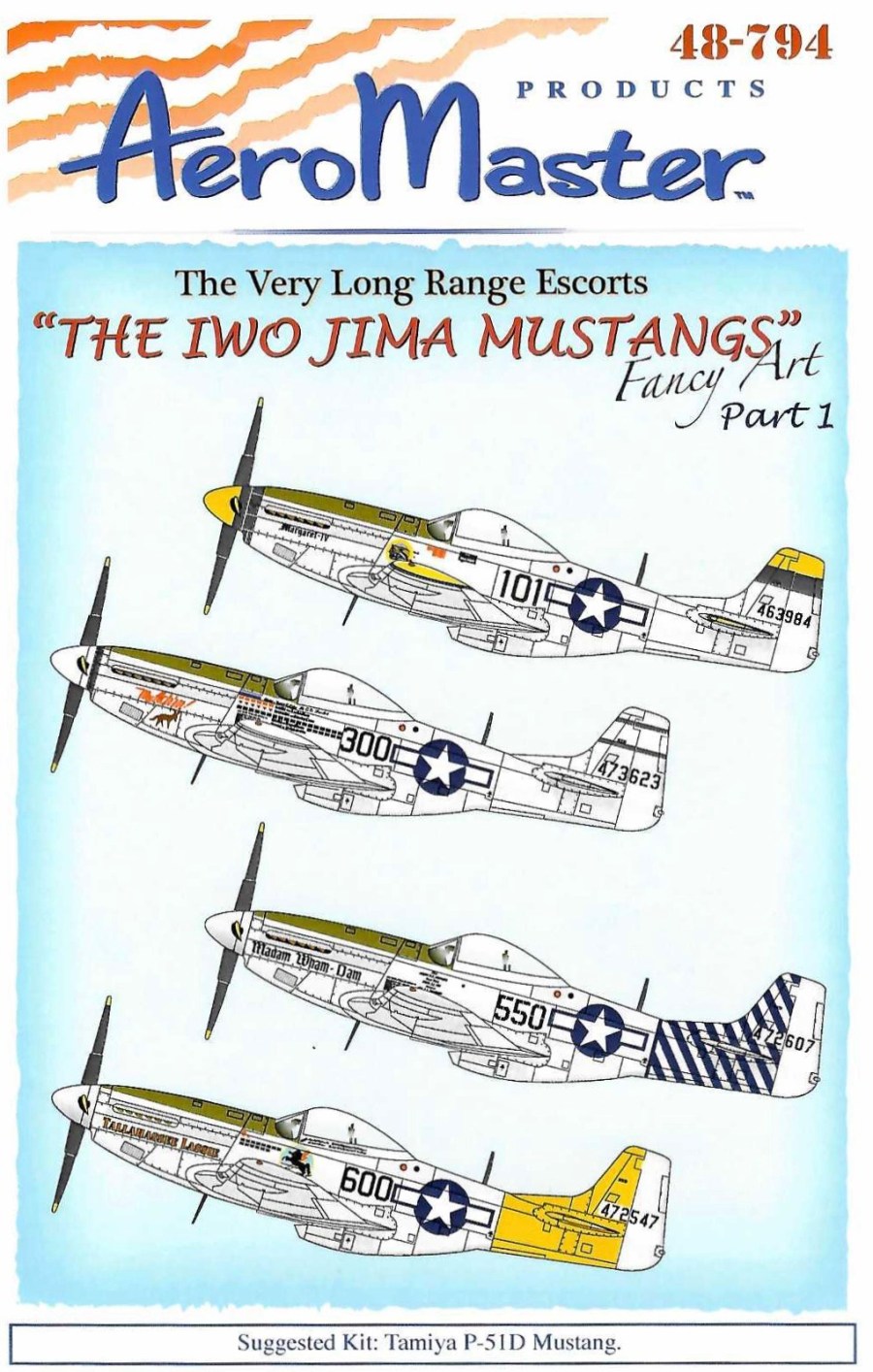
This is AeroMaster’s second decal sheet dedicated solely to Iwo Jima VLR Mustangs. Three additional sheets on Iwo Jima VLR Mustangs would be subsequently issued by AeroMaster under the series “The Very Long Range Escorts ‘The Iwo Jima Mustangs’ Fancy Art.”
AeroMaster Decals
This sheet provides markings for the planes of two VLR aces: Major James B. Tapp’s 101 “Margaret – IV” (8 aerial victories), and Major Harry C. Crim, Jr.’s 300 “My Achin! [Ass]” (6 aerial victories).
AeroMaster Decals
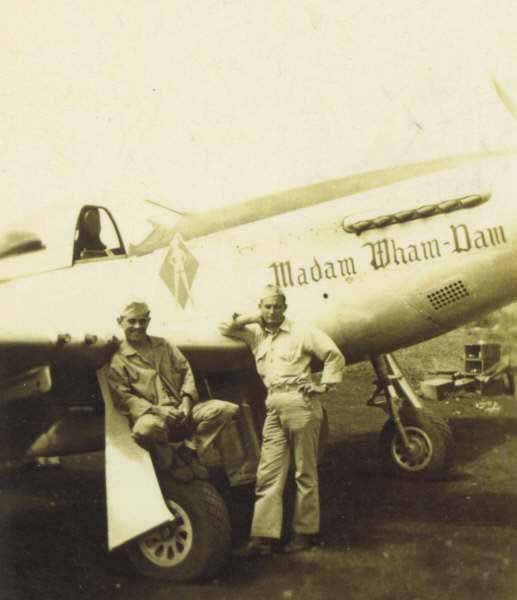
The sheet also provides markings for the planes of two 506th FG squadron commanders: Major Harrison E. Shipman’s 550 “Madam Wham-Dam” (458th FS), and Major Thomas D. DeJarnette’s 600 “Tallahassee Lassie” (462nd FG).
AeroMaster Decals
Originally issued in 2005, the decals look good, are in register and are for the most part accurate. Photo documentation that has recently emerged shows there are a few omissions and errors on this sheet, but this is still a very nice decal sheet.
AeroMaster Decals
Major James B. Tapp (78thFS/15th FG) – Major Tapp was the second highest scoring VLR Mustang ace with 8 aerial victories. All eight victories were scored in 101 “Margaret – IV” (44-63984), a P-51D-20NA. Major Tapp scored 4 aerial victories on the first VLR mission on April 7, 1945. He scored another victory on April 12, 1945, which represents the 5 victories on the decal sheet.
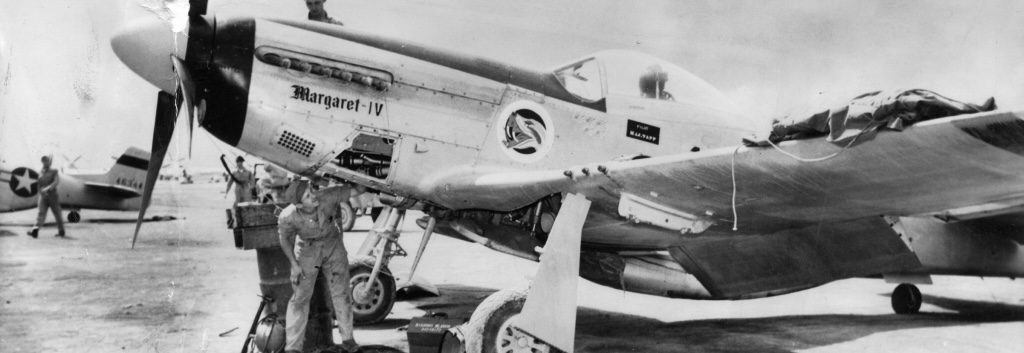
Major James B. Tapp’s 101 Margaret-IV (7th Fighter Command Association/Mark W. Stevens)
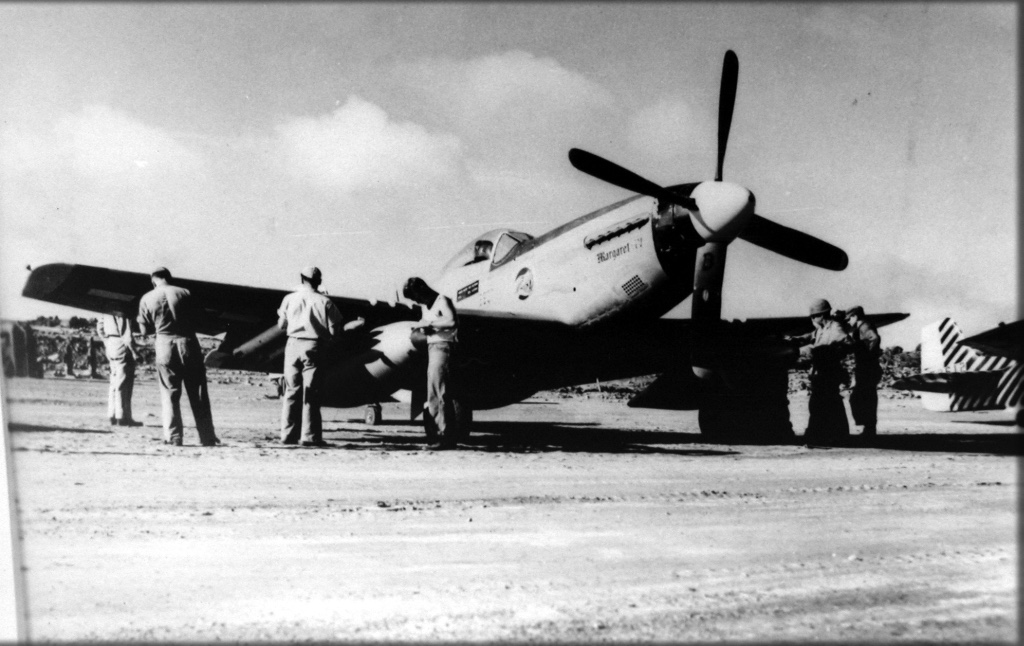
As can be seen from the photo above and the photo below, the name “Margaret – IV” and the Bushmaster squadron emblem are on both sides of the nose. The photo below shows that there are additional markings on the right side of the fuselage below the canopy.
Major James B. Tapp’s 101 Margaret-IV (7th Fighter Command Association/Mark W. Stevens)
This last photo shows the markings on the right side of the fuselage which includes kill and mission markings. In addition to the name of the Crew Chief Sergeant Blanco, there is the name of another ground crew member which is undiscernable from the photo. This photo also shows that the 0 in the fuselage number is broken rather than solid.
Crew Chief Sgt. Blanco on the wing of Major James B. Tapp’s 101 “Margaret-IV” with unknown crew member in cockpit (Brian Walter)
Unfortunately, the kill and mission markings on the right side of Major Tapp’s Mustang are not contained on this decal sheet. The most accurate and complete decals for 101 “Margaret – IV” are found in the Eduard kits.
Major Harry C. Crim, Jr. (531st FS/21st FG) – Major Crim was the 3rd highest scoring VLR ace with six confirmed victories, and the only fighter ace of the 21st FG. He joined the 21st FG in August, 1944, after serving with the 14th Fighter Group in Tunisia flying the Lockheed P-38 Lightning. Unable to score any aerials victories with 14th FG, he scored his first two victories, a Kawasaki Ki-61 “Tony” and a Kawasaki Ki-45 “Nick” on April 7, 1945, the first VLR mission flown by the 7th Fighter Command Mustangs. His last victory, a Mitsubishi A6M Zero, came on July 6, 1945 during a strike mission against Atsugi airfield. Major Crim was also credited with six ground victories.
Assistant Crew Chief Sergeant Stanley McCarro in the cockpit of Major Crim’s 300 “My Achin! [Ass]” (Harry Crim via Tom Ivie/Carl Molesworth)
44-73623 was a P-51D-25NA, and Major Crim’s second VLR Mustang. The kill markings, mission markings, and ground crews’ names appear to be very good on the decal sheet except for Asst. Crew Chief Stanley McCarro’s name being misspelled. The only other deficiency in these decals is the artwork for the donkey/ass.
Major Harry C. Crim Jr.’s 300 “My Achin! [Ass]”
The photo above shows a portion of the canvas wheel well covers which were a standard production feature that were discarded by European Theater Mustang groups, but were maintained in place by the Iwo Jima Mustang groups as a means of keeping sand and volcanic grit out of the wheel wells.
After Major Crim rotated home, “My Achin! [Ass]” was assigned to Flight Officer Theo Gruici, who had Major Crim’s kill and mission markings and the names of the ground crew removed, and had a reclining nude painted on the fuselage. Most decal manufacturers have a nude on the left landing gear cover for Major Crim’s markings, but I have yet to see a photo confirming this. The nude on the left landing gear cover is mostly obscured by the 110 gallon drop tank in the photo below, and it raises the question whether there was a nude also on the right landing gear cover. After inquiring of others who have more extensive photo collections than I do, there does not appear to be any photos of the right side of the plane. Some questions will never be answered.
Flight Officer Theo Gruici’s 300 “My Achin! [Ass]” (7th Fighter Command Association/Mark W. Stevens)
Major Harrison E. Shipman (458th FS/506th FG) – 550 “Madam Wham-Dam”, a P-51D-25NA, 44-72607, was assigned to Major Harrison E. Shipman, commander of the 458th FS. Major Shipman served as the 458th’s commander during the squadron’s time on Iwo Jima, and was not credited with any aerial victories.
Major Harrison E. Shipman in 550 “Madam Wham-Dam” (Harrison E. Shipman via 506th Fighter Group Association)
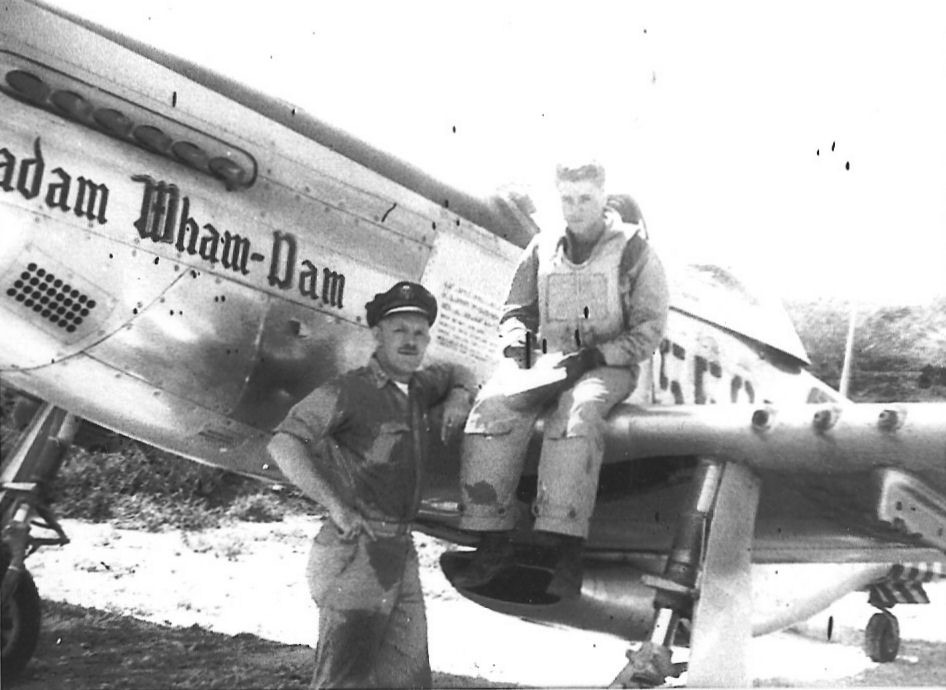
The actual color of the background for the nude nose art on the right side of the fuselage in front of the cockpit is unknown. AeroMaster provides you with three options; red, blue and yellow. My preference would be blue, but it could be red as well. It appears to be a little too dark for yellow.
Major Harrison E. Shipman sitting on the wing of 550 “Madam Wham-Dam” with Captain Pete Nowick(Harrison E. Shipman via 506th Fighter Group Association)
“Madam Wham-Dam’s” time on Iwo Jima was short lived. She arrived on either May 11th or the 13th and was lost on the disastrous June 1, 1945, Black Friday mission with 506th FG Deputy Commander Lt. Col. Harvey J. Scandrett at the controls.
Major Harrison E. Shipman and Lt. Col. Harvey J. Scandrett with “Madam Wham-Dam” (Harrison E. Shipman via 506th Fighter Group Association)
Please note the last two photos of “Madam Wham-Dam” and the color of the main landing gear legs. They are considerably darker than the main landing gear legs on either Major Tapp’s “Margaret – IV” or Major Crim’s “My Achin! [Ass]” which suggests that they have been painted. I have also seen what appears to painted landing gear legs in pictures of 21st Fighter Group Mustangs.
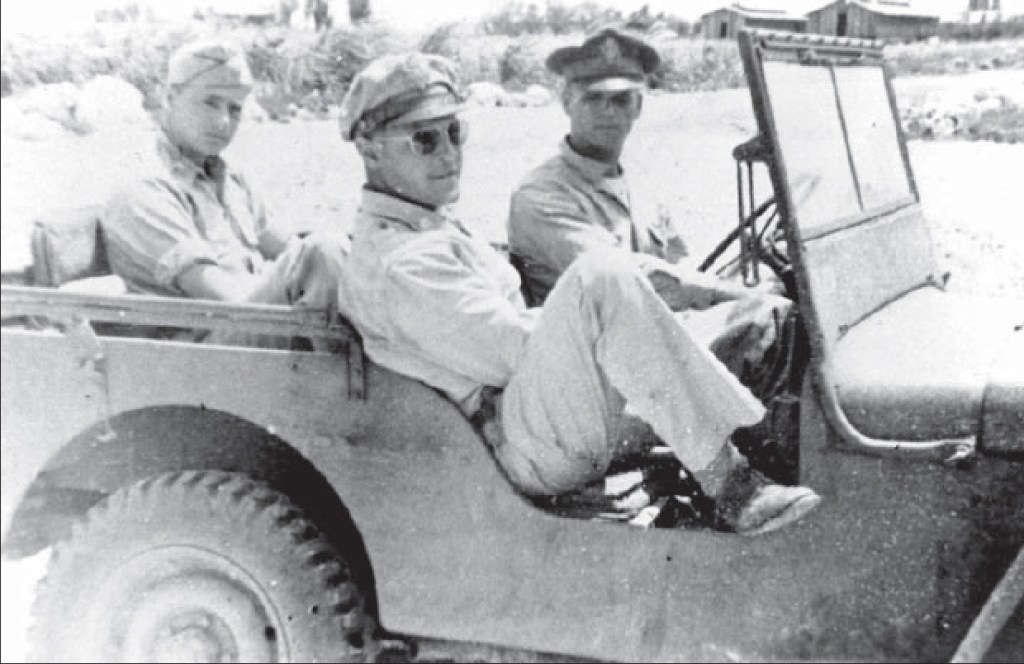
506th Fighter Group Squadron Commanders from left to right: Major Harrison E. Shipman (458th), Major Thomas D. DeJarnette (462nd), and Major Malcolm C. “Muddy” Waters (457th) (Harrison E. Shipman via James Shipman)600 “Tallahassee Lassie” (Curt Gwaltney via Carl Molesworth)
Major Thomas D. DeJarnette (462nd FS/506th FG) – 600 “Tallahassee Lassie”, a P-51D-20NA, 44-72547, was also flown by Lt. Col. Harley Brown, Deputy Commander of the 506th Fighter Group. DeJarnette and Brown were well acquainted with each other having flown Bell P-39 Airacobras in combat with in 80th Fighter Squadron, 8th Fighter Group in New Guinea earlier in the war. Major DeJarnette is in the back row of the photo above, second from the left. Lt. Col. Brown is to Major DeJarnette’s left.
Major DeJarnette was credited with shooting down a Kawasaki Ki-61 ‘Tony’ on the June 10, 1945 escort mission to the Tokyo area. Lt. Col. Brown was credited with damaging a Nakajima Ki-84 ‘Frank’ on the July 19, 1945 fighter strike mission against targets in the Nagoya and Osaka areas. Both men survived the war.
This decal sheet has been long out of production but you can still find it on eBay with the other sheets in the series. Although there are a few inaccuracies and omissions, it is still a quality decal sheet.
If you are wanting to purchase a more recently produced decal sheet for some of these planes, DK Decals has produced a 1/72 scale sheet containing markings for “My Achin! [Ass] and “Madam Wham-Dam”. My review of this sheet is found here:
Very Long Range P-51 Mustang Units of the Pacific War; Carl Molesworth; Osprey Publishing Limited (2006).
As a condition of the use of materials from the 7th Fighter Command Association website, the following disclaimer is included: Permission to use, copy and distribute documents delivered from this Worldwide Web server and related graphics is hereby granted, provided 1) That the use of the data will not be used for obtaining a profit of any kind, and 2) That the above disclaimer notice appear in all copies and that both that disclaimer notice and this permission notice appear. All other rights reserved. The name of “7th Fighter Command Association” may not be used in advertising or publicity pertaining to distribution of this information without specific, written prior permission. Mark Stevens and the 7th Fighter Command Association makes no representations about the suitability of this information for any purpose. It is provided “as is” without express or implied warranty. Mark Stevens and the 7th Fighter Command Association disclaim all warranties with regard to this information, including all implied warranties of merchantability and fitness. In no event shall Mark Stevens or the 7th Fighter Command Association be liable for any special, indirect or consequential damages or any damages whatsoever resulting from loss of use, data or profits, whether in an action of contract, negligence or other action, arising out of or in connection with the use or performance of this information.
The photo below shows a North American P-51D Mustang receiving extensive maintenance from no less than 7 ground crew members on Iwo Jima. Neat photo that could be used for the basis a very busy diorama. You can make out the plane’s serial in the photo, which is 44-63959. This was a P-51D-20NA Mustang assigned to 462nd Fighter Squadron, 506th Fighter Group. I received the photo from Richard Smith, who is the son of Captain Lawrence S. Smith. Captain Smith was one of pilots lost during the infamous June 1, 1945, “Black Friday” mission.
644 “Sandra Leigh” (Richard Smith)
The plane’s fuselage number was 644. Please note that the stubs for carrying 5-inch high velocity aircraft rockets (HVARs) have been installed on 644. These were a field modification as the stubs were not factory installed on Block 20 Mustangs.
644 “Sandra Leigh” (506th Fighter Group Association via Richard Smith)
644 was flown by Flight Officer Harry Reese who named the plane, “Sandra Leigh”. Flight Officer Reese was not credited with any aerial or ground victories.
644 “Sandra Leigh” (506th Fighter Group Association via Harry Reese)
Below is a nice photo of Flight Officer Reese with a 20 mission crush on his cap.
Flight Officer Harry Reese (506th FG Association via Harry Reese)
There are no aftermarket decals in any scale for 644 “Sandra Leigh”. Thanks to Richard Smith for providing me with the top photo.
Robert A. Gourley was born on December 14, 1924, in Greer, South Carolina. Bob graduated from Marion High School in 1940, and entered into Davidson College in 1941 as part of the ROTC program. Like many others of his generation, his post-secondary education was put on hold during the time he served his country in World War II.
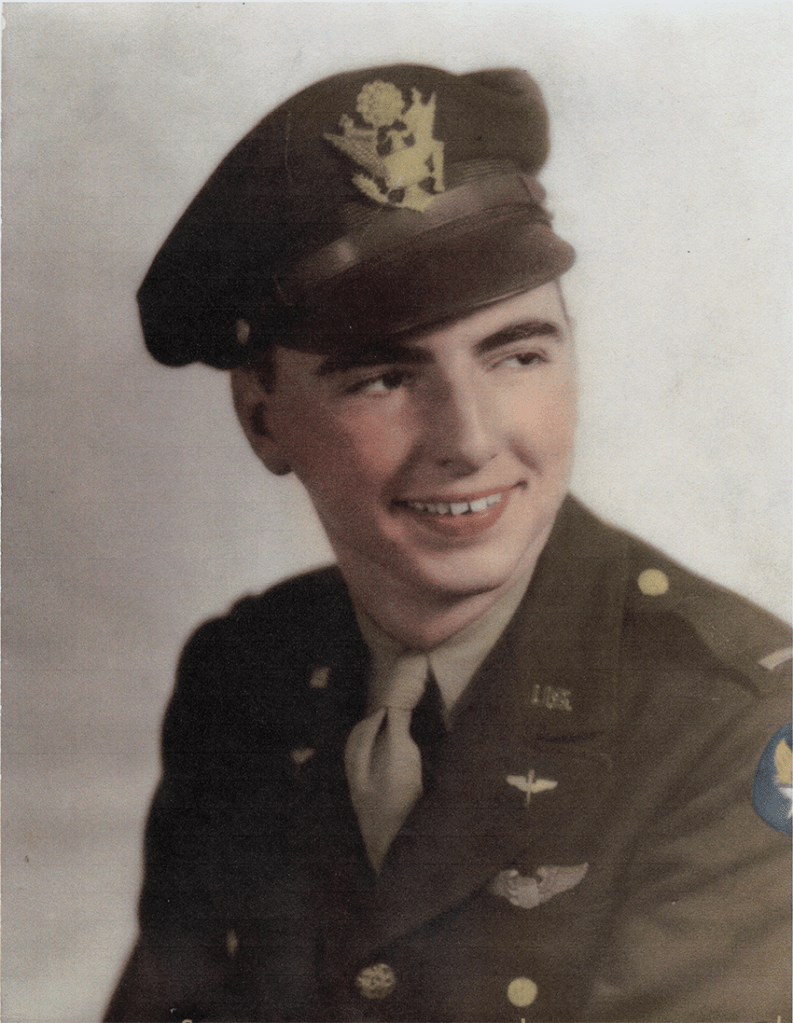
2nd Lieutenant Robert A. Gourley
Not wanting to be placed into the infantry, Bob enlisted in the United States Army Air Corps. He earned wings and was commissioned a 2nd Lieutenant at Luke Field in Phoenix, Arizona in 1944. In October of that year, 2nd Lieutenant Gourley was assigned to the 462nd Fighter Squadron of the 506th Fighter Group shortly after the group’s activation at Lakeland Army Air Field. At Lakeland, the 506th FG was trained specifically to fly very long range missions.
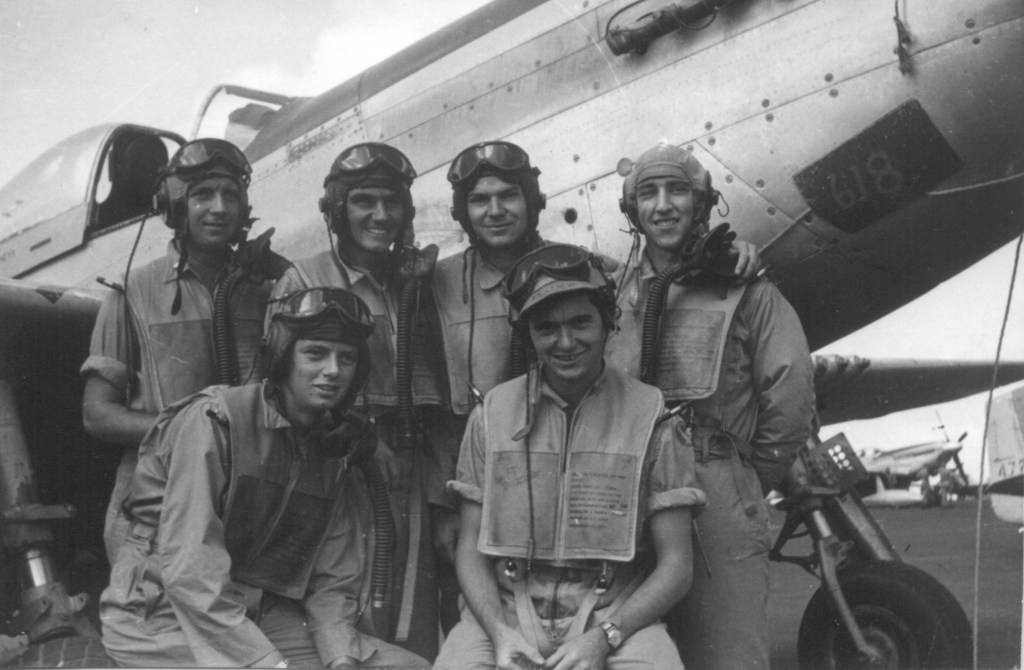
Front row, left to right: 1st Lt. Robert Gourley, 1st Lt. Frank Buzze; Back row, left to right: 1st Lt. Bernie Comfort, 1st Lt. Jack Rice, 1st Lt. Thomas McNall, and 1st Lt. Harold Stewart (via Dr. John Benbow)
When deployed to Iwo Jima, half of the squadron’s fighter pilots ferried their brand new P-51D Mustangs to San Francisco, where they were loaded on the escort carrier Kalinin Bay and set out for Tinian. The other half of the pilots, which included 2nd Lieutenant Gourley, took a troop train to Seattle, and then boarded the converted Swedish hospital ship, the Bloemfontein. They sailed from Seattle to Hawaii, Eniwetok Atoll, Tinian, and then finally to Iwo Jima.
1st Lts. Robert Gourley and Jack Rice on the nose of a P-51D Mustang (via Dr. John Benbow)
Lieutenant Gourley would fly a total of 11 VLR missions to Japan, and would be promoted to the rank of Capitan before being honorably discharged. Upon returning home, Bob re-enrolled in Davidson College and graduated in 1948 with a Bachelor of Arts in Music.
Bob was a recognized community member faithfully contributing to his community in many ways. He was a member of First Presbyterian Church and served as choir director for over three decades. He was also active in the local Kiwanis Club and the Masonic Lodge. Bob played in a community band well into into eighties, and enjoyed playing golf.
Robert A. Gourley
On September 4, 2021, we lost another member of the Greatest Generation. Bob was 96, and was the last living fighter pilot of the 462nd Fighter Squadron.
In 2014, Bob gave a video interview as part of the McDowell Legacy Program, “Reflections of the Past”. In his interview, Bob speaks of his entry into the United States Army Air Force, and missions flown from Iwo Jima to Japan. The YouTube video of Bob’s interview can be found here: https://youtu.be/P-HsME_vCKI.
William Glenn Ebersole was born on September 30, 1924, in Arcadia, Florida. Upon graduation from high school, he entered the University of Florida in Gainesville, as a freshman in September, 1942. Wanting to control his entry into active service in the armed forces, he enlisted in the Air Corps Reserve on October 31, 1942, shortly after turning 18. The thought that he might have two years of college before being called up was short lived as he was ordered to report for active duty on February 24, 1943, in Miami Beach, Florida. On his way to earning his wings, Bill flew in Stearman PT-17s, BT-13s, and AT-6s. He received his wings and a 2nd Lieutenant’s commission on April 15, 1944, at Craig Field in Selma, Alabama, as part of class 44-D. During his training as a fighter pilot, Bill flew the Curtiss P-40N Warhawk, and the A, B, C and D models of the North American P-51 Mustang.
Loomis Dean/USAAF/National Archives via Fold3
Bill was assigned to the 462nd Fighter Squadron of the 506th Fighter Group in early January of 1945. When deployed to Iwo Jima, half of the squadron’s fighter pilots ferried their brand new P-51D Mustangs to San Francisco, where they were loaded on the escort carrier Kalinin Bay and set out for Tinian. The other half of the pilots, which included 2nd Lieutenant Ebersole, took a troop train to Seattle, and then boarded the converted Swedish hospital ship, the Bloemfontein. They sailed from Seattle to Hawaii, Eniwetok Atoll, Tinian, and then finally to Iwo Jima.
William G. Ebersole via Brian Walter
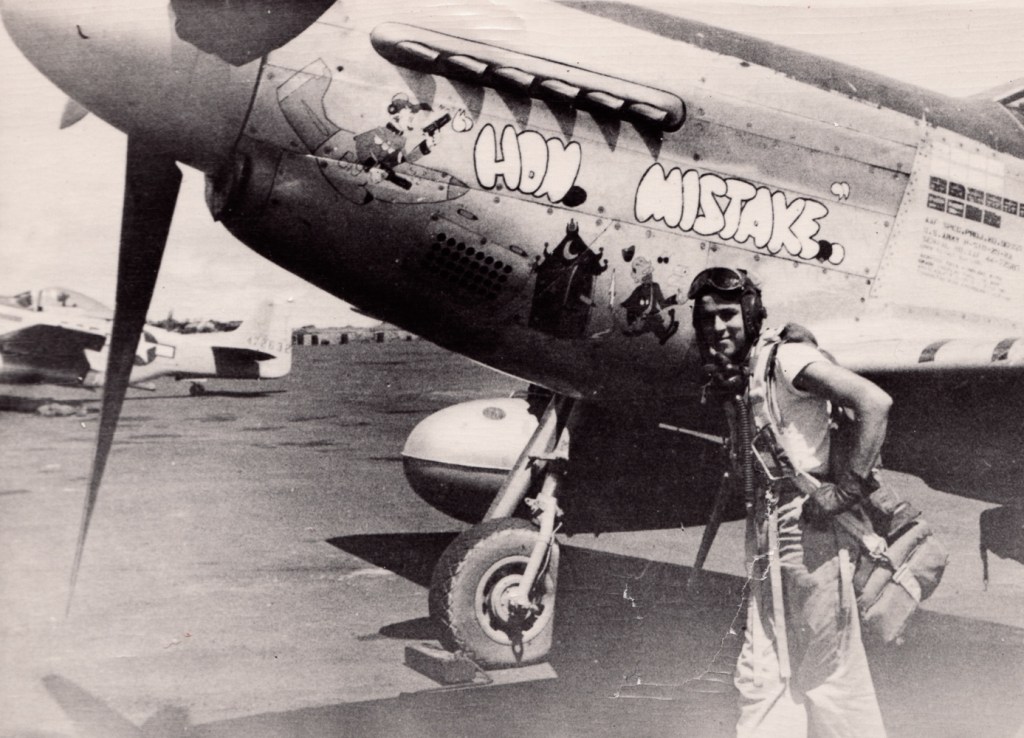
Bill was the youngest pilot in the 462nd Squadron at the ripe old age of 20 years while on Iwo Jima, and flew a total of 10 VLR missions, the first being on June 7, 1945 to Osaka, and the last being on August 5, 1945, to Tachikawa. He was assigned to fly 619 “Hon. Mistake”, a North American P-51D-20-NA Mustang (Serial # 44-72587) with 2nd Lt. James Bercaw. While on Iwo Jima, he was promoted to 1st Lieutenant, and was credited with destroying a twin engine bomber on the ground during a strafing mission. Bill took his last flight in a P-51D Mustang on December 4, 1945, when he led a flight of 4 planes from Guam to Isley Field on Saipan. From there, he took a ship for the long trip back to the United States.
Bill Ebersole re-enrolled at the University of Florida, and received a Bachelor of Arts in Journalism. At the pinnacle of his career, he was the publisher of The Gainesville Sun.
Bill was scheduled to take a return trip to Iwo Jima with his wife Anna in March of 2020 as part of veterans’ flight, but never took that trip due to the COVID-19 pandemic.
Brad McClenny/Gainesville Sun
Bill was a frequent attendee at 506th Fighter Group reunions. I first met Bill at the Iwo Jima VLR Symposium at the Planes of Fame Air Museum in 2012. Bill graciously spent several hours answering all of my questions, and I was fortunate to get to know Bill during several 506th Fighter Group reunions. His daughter, Glenda Ebersole Potts, said “I never met a man as good as my father . . . they don’t make’em like that anymore.” Anybody who knew Bill would heartily concur.
Bill Ebersole with the author during the Iwo Jima VLR Symposium at the Planes of Fame Air Museum, Chino California (July 7, 2012)












 Iwo Jima Models