506th Fighter Group ground crewmen push a North American P-51D-20-NA Mustang (Serial No. 44-72560) across Marsden matting in the 462nd Fighter Squadron dispersal area on North Field. While it is not known who was assigned to fly this Mustang, members of the 506th Fighter Group Association believe the plane was named Little Joe.
USAAF/Loomis Dean/National Archives via Fold3
Several things to note about this picture for modelers. First is the wear on the backside of the propeller blades from the sand and volcanic grit on Iwo Jima. The cuff at the bottom of the blade was made of a hardened rubber so it does not show the wear that the metal portion of the blade does. Second is the light color and the pattern of the exhaust staining down the side of the fuselage. Third is the wooden twin Uncle Dog antennae, and their location and spacing on the spine. Fourth is the AN/APS-13 rear warning radar installed on the tail.
The official caption to this photo is 7th Fighter Command personnel push a North American P-51 “Mustang” toward the dispersal area at an airfield on Iwo Jima. July 1945.
Eduard recently released the 2nd ProfiPACK boxing of its popular 1/72nd North American P-51D Mustang kit. Most of decal options are of fighter aces; Lt. Col. John D. Landers’ Big Beautiful Doll, Lt. Col. John C. Meyer’s Petie 3rd, Maj. Leonard K. Carson’s Nooky Booky III, Lt. Col. Glenn T. Eagleston’s P-51D-20-NA, and Capt. Fredie F. Ohr’s “Marie”.
Eduard
But it also includes decals for 542 Fighting Lady, a P-51D-20-NA assigned to the 457th Fighter Squadron, 506th Fighter Group. Neither of the pilots assigned to fly Fighting Lady were aces.
Eduard
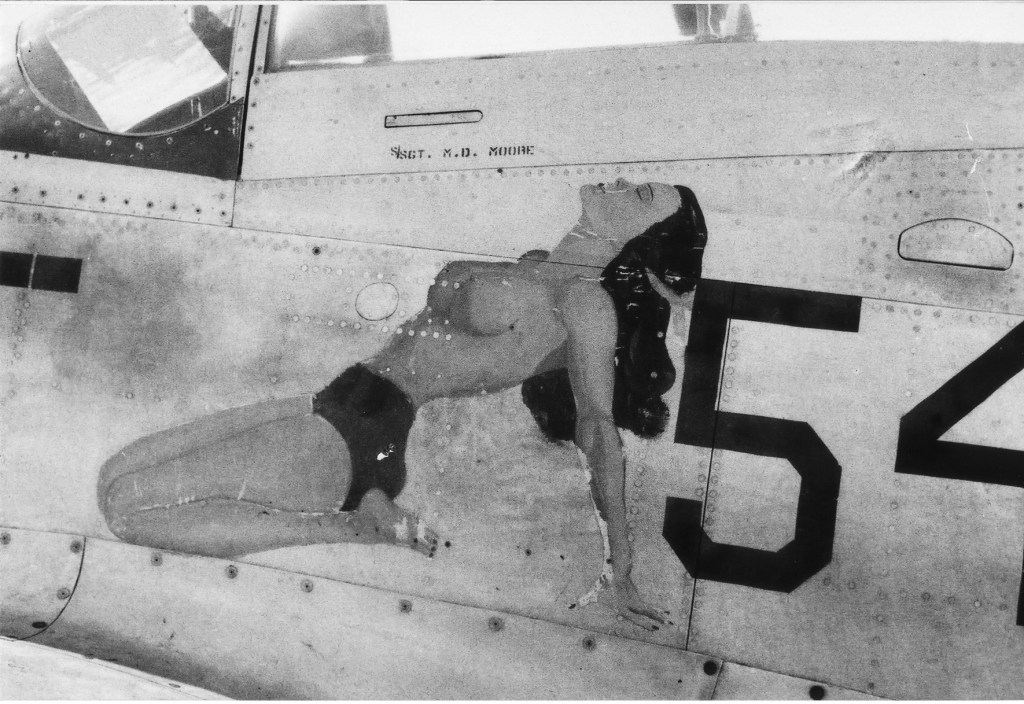
542 Fighting Lady was assigned to 1st Lt. Ralph Gardner and 2nd Lt. Chester Jatzcak. Below is a nice close up picture of the pin up art that adorned the fuselage.
542 Fighting Lady (506th Fighter Group Association/Dr. John Benbow)
While the quality of the below photo is not the best, it does clearly shows the position of the name Fighting Lady on the nose below the engine exhaust stacks and the elegant design of the Mustang’s nose.
Unknown ground crew member lying on the wing of Fighting Lady (506th Fighter Group Association/Dr. John Benbow)
Norma Jatczak, 2nd Lt. Chester Jatczak’s wife, was of the belief that the plane’s name was “Broadway Gal”. Unfortunately, the 506th Fighter Group Association does not have a photo to substantiate her belief. Eduard suggests in its instructions that the name of the plane was changed from Fighting Lady to “Broadway Gal” at a later date.
2nd Lt. Chester Jatczak crouched on the wing of “Fighting Lady” (506th Fighter Group Association via Norma Jatczak)
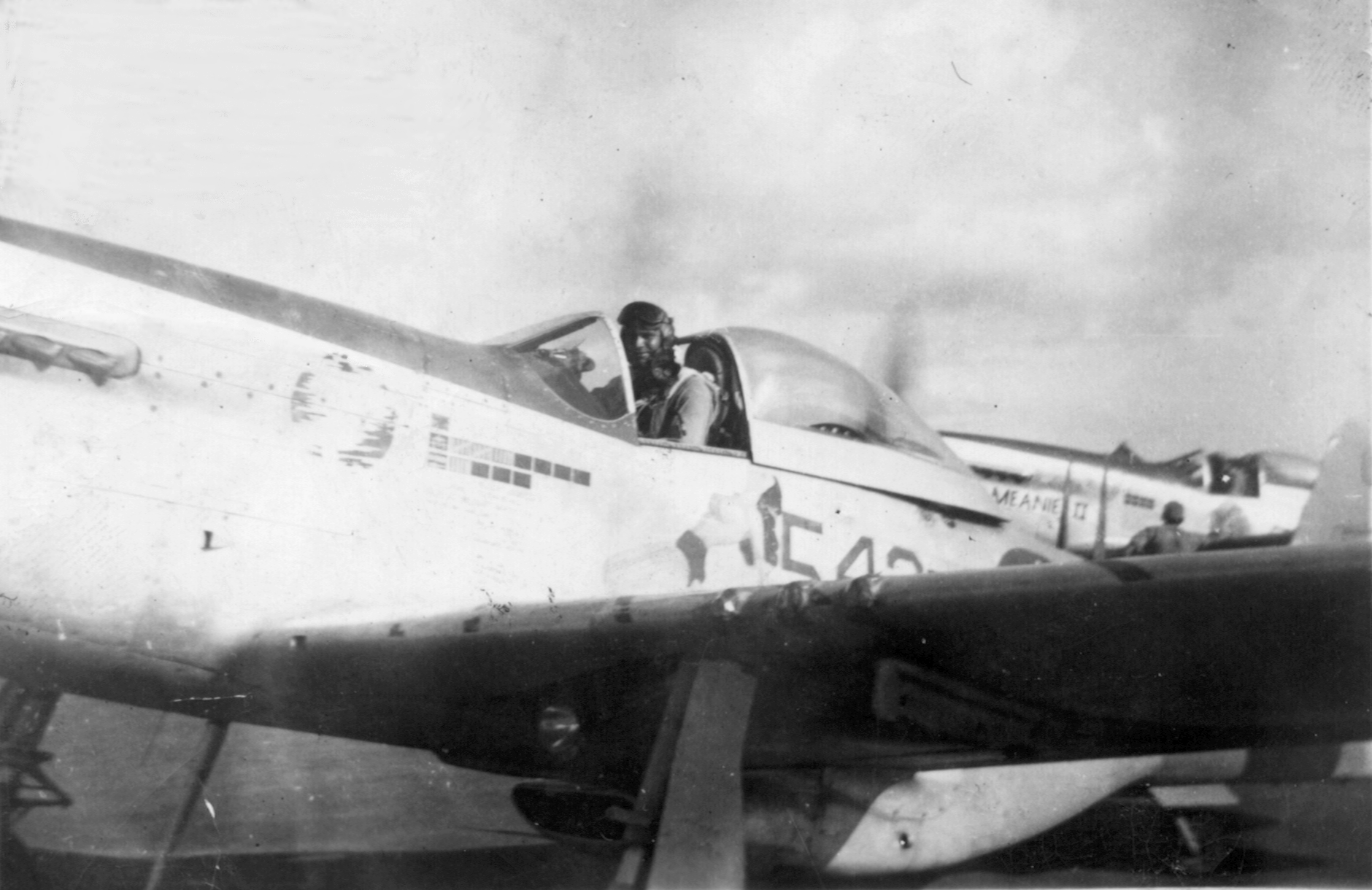
Please note the photo below does not have the name Fighting Lady on the nose yet. This photo was most likely taken in June of 1945 as the plane has a solid green tail instead of the initial squadron markings of diagonal green stripes on the tail.
1st Lt. Ralph Gardner in the cockpit of Fighting Lady (506th Fighter Group Association/Dr. John Benbow)
I interviewed Ralph Gardner at the 2013 506th Fighter Group Reunion in Chino, California, but did not think to inquire about whether the plane had the name of “Broadway Gal” at one point in time, or whether the name was on the right side of the nose. The photo below appears to dispel the notion that “Broadway Gal” appeared on the right side of the nose.
1st Lt. Ralph Gardner flying Fighting Lady (506th Fighter Group Association/Dr. John Benbow)457th Fighter Pilots in front of Fighting Lady – Front row left to right; Lts. Alan Kinvig and George Hetland; Back row left to right; Lts. Ray Miller, Martin Ganschow, Ralph Gardner and Larry Grennan (506th Fighter Group Association via Ralph Gardner)
1st Lt. Gardner was credited with an aerial victory on June 10, 1945.
Thanks to Eduard for including decals for an Iwo Jima VLR Mustang in this boxing!
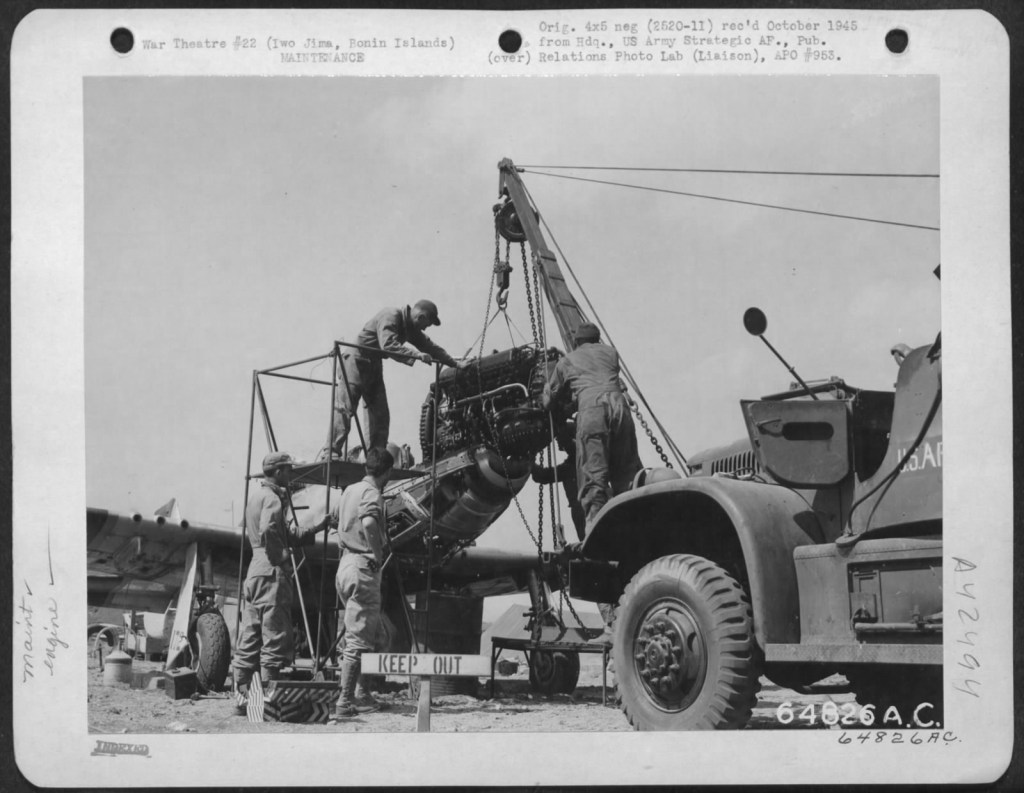
This photo is the companion photo to the last Photo(s) of the Week I posted recently; just taken from the right side of the plane. Ground crew have just hoisted the Packard built Rolls Royce Merlin engine after disconnecting it from the engine mounting framework and other connections. Very cool photo!
USAAF/National Archives via Fold3
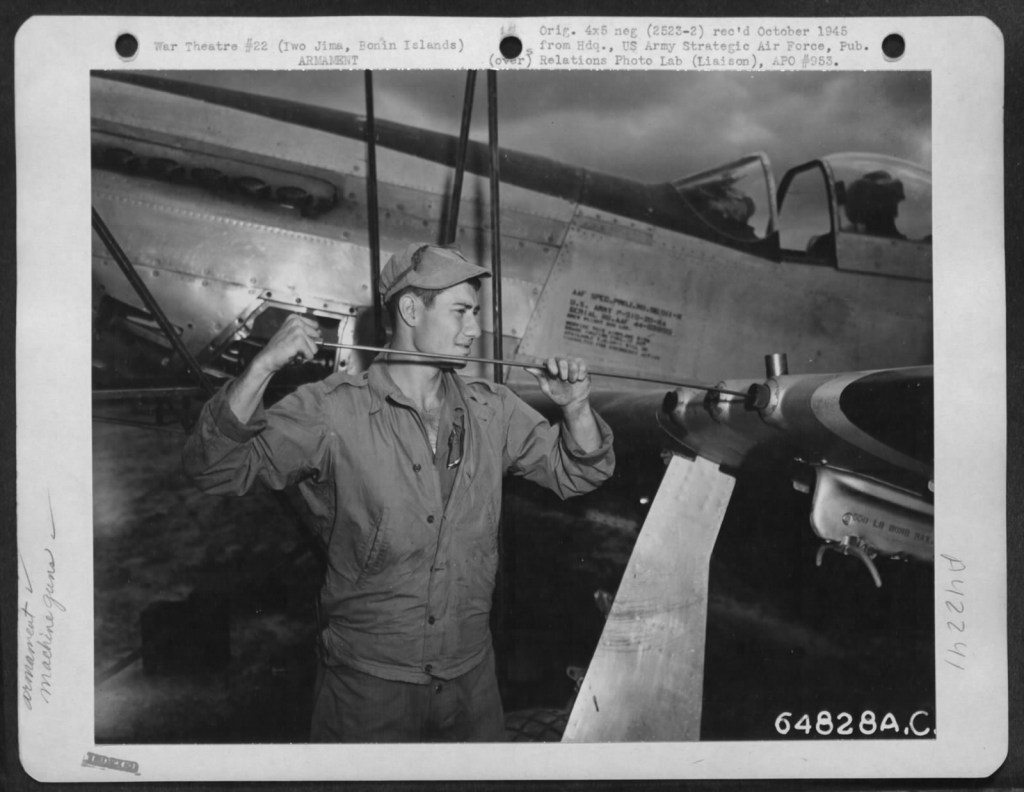
This is 172, a 47th Fighter Squadron, 15th Fighter Group, P-51D Mustang. 7th Fighter Command ground crew worked under very challenging conditions. Just keeping the engine and machine guns clear of sand and the volcanic grit was a constant battle.
The official USAAF caption to this photo reads: Mechanics removing engine from a North American P-51 “Mustang”. Iwo Jima, Bonin Islands.
An armorer cleans the blast tubes on a 47th Fighter Squadron P-51D Mustang while other maintenance is being performed. The official United States Army Air Force caption to this photo reads: Armorers cleaning 50 cal machine guns on wing of North American P-51 “Mustang”. Iwo Jima, Bonin Islands.
The sand and volcanic grit was a constant problem for ground crew on Iwo Jima. With their pilots spending a majority of a very long mission over the vast expanse of the Pacific Ocean, 7th Fighter Command ground crew spent long hours maintaining their Mustangs to prevent a pilot from having to bail out over water due to engine failure. This post is dedicated to all the ground crewmen who served on Iwo Jima.
Funny Face was a 462nd Fighter Squadron, 506th Fighter Group P-51D NA-20 Mustang (44-72623) assigned to 1st Lieutenant John “Jack” G. Rice.
627 “Funny Face” on Iwo Jima (506th Fighter Group Association via Dr. John Benbow)
A few things to note from the above picture. First, is that the black paint on the back sides of the propeller blades below the cuffs are showing wear from being on Iwo Jima. The sand and black volcanic grit were tough on paint. This wear was more pronounced on the back sides of the propeller blades than the front sides. Second, please note that the openings to the engine compartment are covered. The air intake on the lower cowl is covered, and there are small “boots” covering the exhaust stacks. The carburetor intake below the spinner and gun openings on the wings were also covered. These measures were taken to prevent the sand and black volcanic grit from entering the engine compartment and gun bays where it could fowl the engine and machine guns. In addition, the factory installed canvas covers in the wheel wells were retained for the same reason.
1st Lieutenant Jack Rice in the cockpit of 627 “Funny Face” (506th Fighter Group Association via Dr. John Benbow)
As the photo above suggests, there might have been another pilot assigned to fly 627 “Funny Face”, but I am unaware of any photos or squadron/group records to indicate who that pilot was. All of the photos I have in my collection of 627 “Funny Face” do not show any pilot names on the lower canopy framing.
1st Lieutenant Rice was a replacement pilot and not assigned to the 506th Fighter Group when it was formed in October of 1944 at Lakeland Army Air Force base in Florida. He was initially assigned to 53rd Fighter Group at Fort Meyers, Florida, where he underwent replacement training in anticipation of going oversees. 1st Lt. Rice would join the 506th FG by January of 1945 as he appears in a photo of 462nd FS officers taken at that time at Lakeland.
1st Lieutenant Rice was not credited with any aerial or ground victories during his time with the 506th FG. By the time the 506th FG arrived on Iwo Jima in May of 1945, the opportunities to engage their Japanese counterparts in the air had dwindled considerably.
Jack Rice would devote 32 years of his life to the United States Army Air Corps/Air Force and retired as a Lieutenant Colonel. He would also serve in the Korean Conflict and the Vietnam Nam War as a Civil and Electrical Engineer. Lt. Colonel Rice passed away on July 19, 2015 at the age of 93.
I had the honor and pleasure to interview Jack Rice at the 506th Fighter Group Reunion in Chino, California in 2013. A very kind, knowledgeable, and enthusiastic individual, he sat for more than an hour with me answering all of my questions. Definitely part of the Greatest Generation.
There are no aftermarket decals for 627 “Funny Face” in any scale.








 Iwo Jima Models