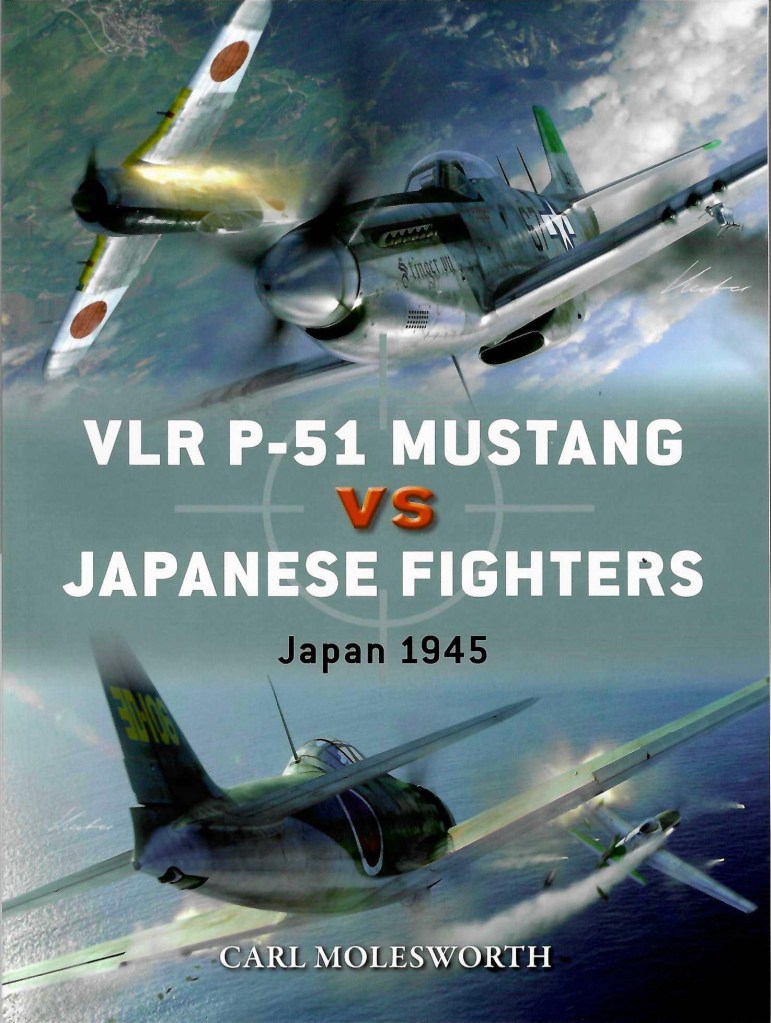
Book Review: VLR P-51 Mustang vs Japanese Fighters, Japan 1945 by Carl Molesworth

Gareth Hector/Osprey Publishing

Published in 2025 by Osprey Publishing as part of their Duel Series (#147), this softbound book has 80 pages. Written by noted aviation historian and author, Carl Molesworth, the book focuses on the air war over Japan as fought by United States and Japanese pilots from April 7, 1945 through the end of World War II, and covers combat between the North American P-51D Mustang and the following Japanese fighters: Mitsubishi A6M5 Reisen (Zeke), Mitsubishi J2M3 Raiden (Jack), Kawanishi N1K2-J Shiden-Kai (George), Nakajima Ki-44 Shoki (Tojo), Kawasaki Ki-61 Hein (Tony), Nakajima Ki-84 Hayate (Frank), and Kawasak Ki-100 Goshikisen.

The stunning cover artwork above and the battle scene artwork below were created by Scottish digital artist, Gareth Hector.

Gareth Hector/Osprey Publishing

As is customary with Osprey aviation titles, airplane profiles and cockpit and armament views by Jim Laurier are included. The profiles and cockpit and armament views are all very nicely done as can be seen from the profile of the Nakajima Ki-84-I Hayate (Frank).
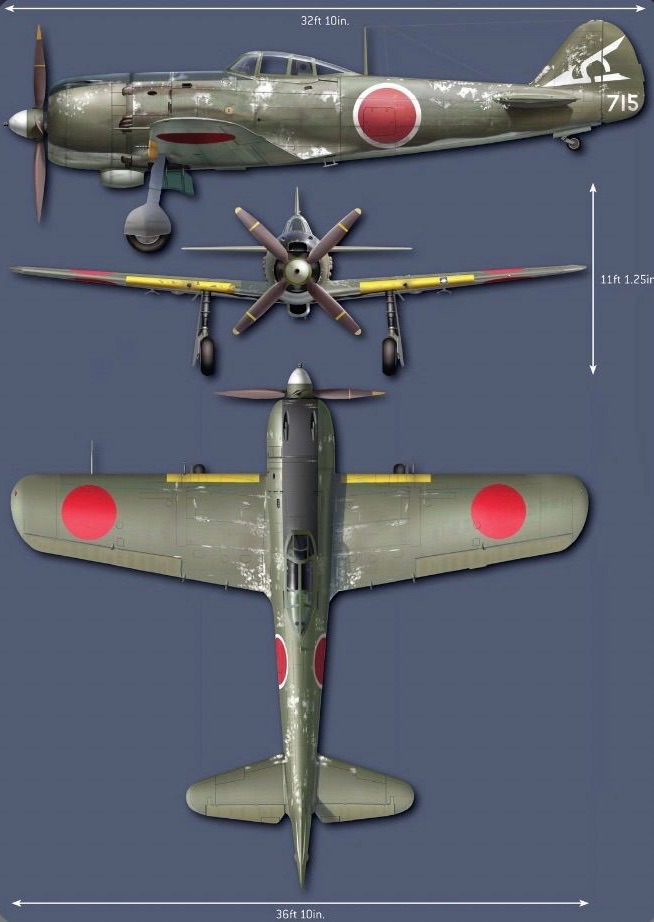
The text is supplemented with numerous photographs, many from the private collections of combatants who dueled over the skies of Japan.

Airplane profiles are provided for the North American P-51D Mustang and the Nakajima Ki-84-I Hayate (Frank). Cockpit views are provided for the Mustang and the Nakajima Ki-44 Shoki (Tojo). Armament views are provided for the Mustang, the Mitsubishi A6M5 Reisen (Zeke), Kawanishi N1K2-J Shiden-Kai (George), Nakajima Ki-44-IIb Shoki (Tojo), and Kawasaki Ki-61-Ia Hein (Tony).

After an introductory chapter, Chapter 2 addresses the design and development of each fighter aircraft. Right before this chapter, is a nice three page chronology spanning from 1939 to 1945 which touches upon the significant dates in the development of each plane. Chapter 3 discusses the technical specifications for each plane with the armament views for the planes identified above.

Chapter 4 discusses the strategic situation in 1945 including the build up of the United States Army Air Force’s B-29s on the Mariana Islands and the establishment of airstrips on Iwo Jima for the three VLR Mustang groups. Chapter 5 focuses on the combatants and contrasts the effectiveness of pilot training between the United States and Japan at that point in the war, and the organization and tactics of each air force.

Chapter 6 is where everything comes together and Mr. Molesworth discusses the actual aerial combats over the Japanese homeland. Specifically discussed are the escort or strike missions on the following dates: April 7, 1945, April 12, 1945, April 19, 1945, May 29, 1945, June 10, 1945, June 23, 1945, July 9, 1945, July 16, 1945, August 3, 1945, and August 10, 1945.

Chapter 7 discusses statistics and gives a brief analysis, and Chapter 8 gives an aftermath discussing the Japanese fighter planes that survived the war and where they are located.

If you are interested in the air war in the Pacific Theater of Operations or the air war over Japan in the closing months of the war, this book is highly recommended. Kudos to Carl Molesworth and Osprey Publishing!

Kit Review: Eduard’s 1/72nd P-51D Mustang “Tales of Iwo Jima” Limited Edition Dual Combo Boxing

Eduard recently released its 1/72nd P-51D Mustang “Tales of Iwo Jima” Limited Edition Dual Combo boxing. The box art is very appealing.

Eduard

As can be seen from the kit’s aircraft profiles below, the decal options are similar to the 1/48th scale limited edition boxing in that it provides 12 decal options that cover all nine Iwo Jima VLR Mustang squadrons. They will be the same decal options with one change. The 457th Fighter Squadron decals will be for 539 “Lil Ole Meanie II”, flown by 2nd Lt. William G. Hetland and Lt. Hinkle, instead of 542 “Fighting Lady” flown by 1st Lt. Ralph Gardner and 1st Lt. Chester Jatzcak. The decals for 542 “Fighting Lady” are included in the 1/72 P-51D Mustang Profipack boxing.

Eduard

Below is a large aircraft profile of 539 Li’l Ole Meanie II. I am assuming it was included due to the pin-up art below the canopy of the beautiful woman in state of being partially undressed.

Eduard

I am not going to review the actual plastic parts as I have done that previously. You can find that review here. It is a beautiful and well engineered kit with exquisite rivet detail for a 1/72nd scale kit.

Eduard

No resin parts are included in this limited edition dual combo boxing. Customary of Eduard for limited edition boxings, a color photo etched fret is included for each kit that consists of cockpit components and scribing templates (Parts PE7 and PE19) to create accurate panel lines for the VLR Mustangs. The photo etched frets also contain the scribing and placement template, and parts (PE22-25) for the AN/APS-13 rear warning radar installed on the tail of late model Mustangs. Nice touch on Eduard’s part.

Some of Block 20(NA), and all of Block 25(NA) produced P-51Ds had the AN/APS-13 rear warning radar installed. The AN/APS-13 was a low power UHF tail warning radar transmitter/receiver which was used to detect aircraft approaching from the rear. Below 1500 feet it would have to be turned off, otherwise it would receive false readings from the ground. Its effective range against small fighter sized targets was 280 – 320 meters. When it detected an aircraft, a small red light would come on and a bell would ring. Below is a photo of a 462nd FS Mustang showing the location of the AN/APS-13 radar antennae on the tail.

Loomis Dean/USAAF/National Archives via Fold3

The AN/APS-13 radar was seen as somewhat of a blessing and a curse by pilots. Some 506th FG pilots that I have interviewed indicated it was an annoyance during formation flying because it would keep going off when a threat was not present unless you were the tail end Charlie. 1st Lt. William G. Ebersole of the 462nd FS indicated that it was common practice for pilots on VLR missions to turn the radar off during the long over water approach to Japan, and the long return trip back to Iwo Jima, only switching it on upon reaching the Japanese home islands.

There is a minor error on the assembly instructions that warrants pointing out. The avionics transmitters were different on Iwo Jima VLR Mustangs due to the addition of the SCR-695 IFF transmitter which was located right behind the SCR-522 radio transmitter. This addition necessitated moving the battery to the rear of engine compartment. Below is a nice computer generated image of how this set up looked.

John Terrell

Eduard has accurately produced the SCR-522 radio transmitter and SCR-695 IFF transmitter as one part (E3). Eduard also provides the normal configuration of the SCR-522 radio transmitter and battery as part E2. Below is page 3 of Eduard’s instructions (Step A) showing the assembly of the cockpit parts. Please note that the instructions indicate the correct part (E3), but the assembly drawing is of the SCR-522 radio transmitter/battery part (E2). Do not be confused by the wrong pairing of the part number and drawing. If you are building an Iwo Jima VLR Mustang, use part E3.

Eduard

Kudos to Eduard for putting out a 1/72nd Dual Combo Limited Edition boxing that provides decals for all 9 Iwo Jima VLR Mustang squadron. Nice to not to have to rely on the aftermarket decal industry to supply those options. If you want to build an Iwo Jima VLR Mustang in 1/72nd scale, this is the kit and the boxing to buy.

Photo(s) of the Week; Mission Prep

While the Mustang had long legs, to get from Iwo Jima to the Japanese Home Islands and back required more than the standard 75 gallon drop tanks used in the European Theatre. In the two photos below, ground crewmen are seen unloading 110 gallon metal drop tanks in preparation for a VLR mission to Japan. On the trip to Japan, pilots would expend the aviation fuel from the drop tanks first, and then switch to the 85 gallon fuselage fuel tank which was situated right behind the pilot seat. Once that was expended, it was the fuel tanks in wings that would bring the Mustang home to Iwo Jima.

I love the photo below of the 335 “Is This Trip Necessary?”, a 531st Fighter Squadron, 21st Fighter Group P-51D-20 NA Mustang (Serial No. 44-63289). It captures the eloquent and graceful lines of the P-51D’s nose.

USAAF/National Archives via Fold3

Please note in the photograph below that the “plumbing” between the drop tanks and the wings has already been installed before the tanks are attached to the underwing ordinance racks. Just from the numbers on the photographs, we know that top photo was taken before the bottom photo. The assumption here is that 7th Fighter Command became more efficient over time in how they prepared their fighters for VLR missions. Or it could have been just how a particular squadron installed their drop tanks. Either way, the photos show some possibilities for some interesting diorama settings.

USAAF/National Archives via Fold3

In addition, the second photo provides information regarding the proper placement of kit decals on the drop tanks. Very neat.

Kits News; Eduard’s 1/72nd Very Long Range Tales of Iwo Jima to be a Limited Edition Dual Combo Boxing

Back in October of 2024, Eduard announced the future release of a limited edition “Very Long Range: Tales of Iwo Jima” boxing of their excellent 1/72nd North American P-51D Mustang kit. They announced that kit would be released in the second quarter of 2025, and it would most likely contain the same decal options as their 1/48th limited edition “Very Long Range: Tales of Iwo Jima” boxing.

Eduard

The British on-line retailer Hannants now shows the kit as a limited edition dual combo boxing to be a July 2025 release. Hannants anticipates having it in stock in late June.

Eduard

As can be seen from the kit’s aircraft profiles above, it will similar to the 1/48th scale limited edition boxing in that it provides 12 decal options that cover all of the all nine of the Iwo Jima VLR Mustang squadrons. They will be the same decal options with one change. The 457th Fighter Squadron decals will be for 539 “Lil Ole Meanie II”, flown by 2nd Lt. William G. Hetland, instead of 542 “Fighting Lady” flown by 1st Lt. Ralph Gardner and 1st Lt. Chester Jatzcak. The decals for 542 “Fighting Lady” are included in the 1/72 Profipack boxing.

Kudos to Eduard for releasing the Very Long Range Tales of Iwo Jima in 1/72nd scale, and for making it a dual combo boxing.

Memorial Day 2025; Honor Those Who Have Served to Protect Our Liberty and Freedoms

“Freedom is never more than one generation from extinction. We didn’t pass it to our children in the bloodstream. It must be fought for, protected, and handed on for them to do the same.” Ronald W. Reagan, 40th President of the United States of America

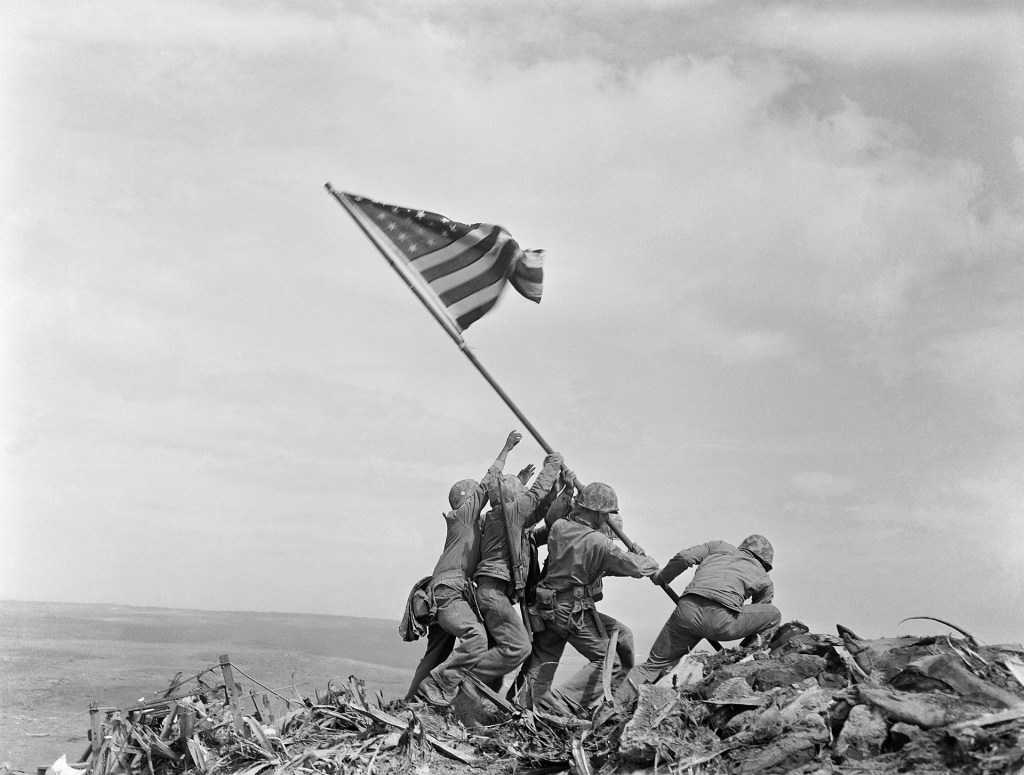
Joe Rosenthal/Associated Press via Fold3

This Memorial Day we have a chance to pause and honor the brave men and women who made the ultimate sacrifice for our country. We owe them such a tremendous debt, for the freedoms we enjoy today were paid for with an extremely high price! Their sacrifices ensures that our liberties and freedoms largely continue today – from the ability to gather with loved ones, to worship together, to speak as we see fit (and the companion right not to be forced to speak that which we know to be false), and to assemble and peacefully protest to effectuate change.

Captain John W.L. Benbow, 457th Fighter Squadron, 506th Fighter Group; Lost on the July 16, 1945 Strike Mission to Nagoya

The statue below is outside of the National Archives building in Washington D.C. It is of an ever watchful soldier holding his helmet, sword, and shield. The inscription below the statue reads “ETERNAL VIGILANCE IS THE PRICE OF LIBERTY”.

Guardianship Statute by James Fraser (Photo by Jeff Reed, National Archives)

Let us not be asleep at the wheel. We have forces from within that are intolerant, and this intolerance is being cultivated in our schools, colleges and universities. Speech which a few years ago was considered normal speech, is now being touted as hate speech. And we are now being told that we need to address certain individuals in ways that has no basis in reality.

Six thousand eight hundred twenty-one United States servicemen lost their lives securing in the battle for Iwo Jima. Many more, like Captain Benbow, lost their lives in bringing World War II to a close. If we do not protect our liberty and freedoms, the sacrifices made by them, and so many more, will have been in vain.