Photo(s) of the Week; Return from the Empire

Ground crews were anxious for the return of their pilots and planes from the first VLR escort mission to the Japanese Home Islands. The 7th Fighter Command lost only two Mustangs and one pilot (1st Lt. Robert G. Anderson, 531st FS/21st FG) on the April 7th mission.

USAAF/National Archives via Fold3

In the photo above, ground crew watch on as a P-51D Mustang lands on Iwo Jima. If you enlarge the photo, on the other side of the runway are two C-46 Commandos, a C-47 Dakota, a P-51D Mustang, four PB4Y-1 Liberator patrol bombers, and a PB4Y-2 Privateer patrol bomber.

USAAF/National Archives via Fold3

P-51D Mustangs were not the only planes to land on Iwo Jima on April 7th. In the photo above, a damaged B-29 Superfortress lands on the same field. If you enlarge the photo, the prop on the right outside engine has been feathered. It appears that the first two photos were taken by the same 7th Air Force Combat Camera photographer. In this photo, he standing next to the tail of the damaged PV-1 Ventura shown in the first photograph.

USAAF/National Archives via Fold3

In the photo above, ground crew and support personnel clamor around 68 “Victory Belle”, a 45th FS/15th FG Mustang, as the pilot waits to exit the cockpit while discussing the mission with his ground crew. A couple of things to note. First, it does not appear that the twin Uncle Dog antennae have been installed on Victory Belle yet. Second is the wear on the backside of the propeller blade. Only the cuff at the bottom of the propeller blade has retained its color because it was made of a hard rubber composition. The volcanic grit on Iwo Jima took its toll on painted surfaces. I am unaware of any after market decals for Victory Belle.

Major James B. Tapp, 78th FS/15th FG (USAAF/National Archives via Fold3)

In the photo above, Major James B. Tapp, enjoys a sandwich and a cup of coffee after the April 7th mission. Major Tapp was the top scorer on the April 7th mission downing four Japanese fighters that were attacking the B-29 Superfortress formations.

References:

1. The Long Campaign: The History of the 15th Fighter Group in World War II, John W. Lambert, Schaffer Publishing Ltd. (2006).

2. Very Long Range P-51 Mustang Units of the Pacific War; Carl Molesworth; Osprey Publishing Limited (2006).

Photo(s) of the Week; Wright R-3350 Duplex- Cyclone Radial Engine

The Boeing B-29 Superfortress was powered by four Wright R-3350 Duplex-Cyclone engines. An air cooled engine with eighteen cylinders arranged in two rows, the R-3350 was the most advanced and powerful radial engine produced by the United States during World War II.

USAAF/National Archives via Fold3

This photo shows a ground crew in India replacing an R-3350 on a B-29 with the new engine waiting on the hoist. I think this is a fantastic photo because it shows all of the front detail of the engine before the exhaust piping is added and all of that detail is being hidden behind the cowling. The photo also provides some interesting diorama opportunities for modelers.

If you have the Monogram 1/48 Boeing B-29 Superfortress kit, there are some very nice after market resin engine upgrades sets that will allow modelers to really super detail the kit. I will be reviewing some of the engine upgrade kits in the coming weeks.

Decal Review: Kits-World War Birds 1/72 Boeing B-29 Superfortress KW172225 (Dinah Might & Bad Medicine)

If you have the 1/72nd Academy Boeing B-29A Superfortress kit, and would like to build Dinah Might, the first B-29 to make an emergency landing on Iwo Jima, you are in luck. https://iwojimamodels.com/2024/02/12/photos-of-the-week-the-safe-haven-of-iwo-jima/

Kits-World Decals

Kits-World produces a decal sheet (KW172225) which includes the markings for Dinah Might. The other markings included on the decal sheet are for a 482nd BS/505th BG B-29 Bad Medicine.

Kits-World Decals

As you can see, the art work for both sets of markings is excellent and consistent with photos of each plane. In addition, the printing of the decal sheet is very well done and in register. A complete set of national insignia are provided for one plane.

Kits-World Decals

Kits-World has produced some excellent decals for B-29s in both 1/72nd and 1/48th scale. Check them out at: https://www.kitsworld.co.uk/index.php?JSTONE=1. You can purchase the decals directly from Kits-World or from many fine on-line retailers. Kudos to Kits-World!

Photo(s) of the Week; The Safe Haven of Iwo Jima

USAAF/Loomis Dean/National Archives via Fold3

The image above is a United States Army Air Force photo taken on Iwo Jima in July, 1945. The official caption for this photo reads, “Men of the 21st Bomber Command gather around the American Red Cross truck to relax over a cup of coffee and doughnuts after returning from a raid over Japanese installations. July 1945”. If they landed on Iwo Jima, the return trip was not complete.

The strategic importance of Iwo Jima to both Japan and the United States could not be overstated. Iwo Jima, part of the Bonin Islands, was approximately half way between the Mariana Islands and the Japanese Home Islands. For Japan, it provided a base from which their air forces could intercept B-29 bomber formations heading from the Marianas to the Home Islands, and from which to bomb 20th Air Force B-29 bases on Guam, Tinian and Saipan, which Japan did with some success.

For the United States, it not only provided a base for the VLR Mustang groups to fly escort and strike missions to the Home Islands, but also provided combat damaged and fuel starved B-29s a safe haven during the long over-water flights back to the Marianas. Many crippled B-29s landed safely on Iwo Jima and avoided ditching in the vast Pacific Ocean somewhere between the Home Islands and the Marianas.

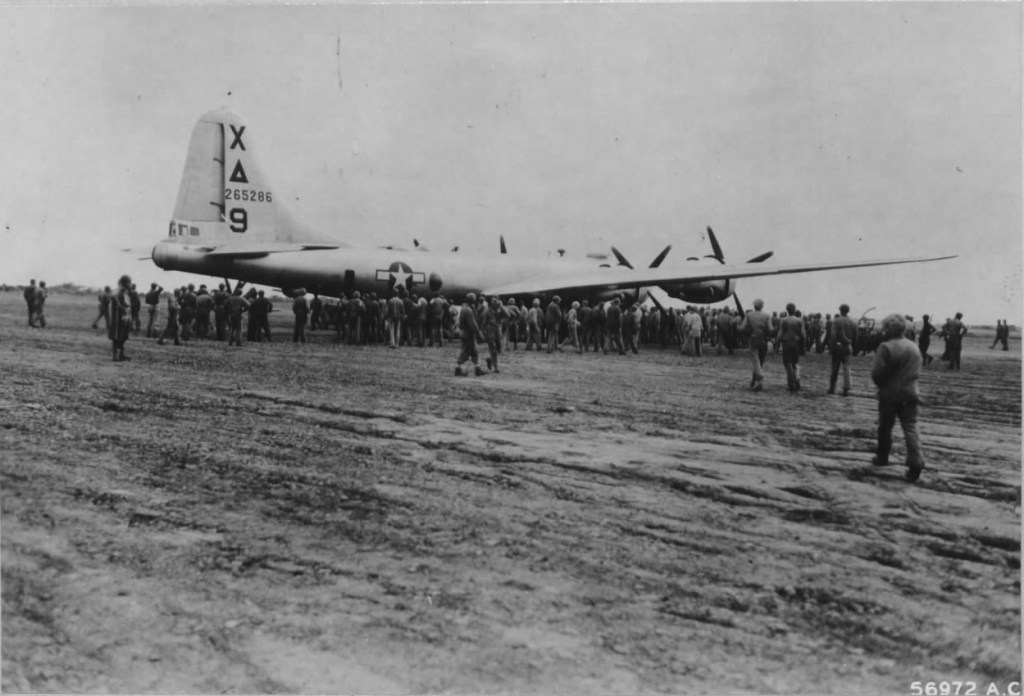
Boeing B-29A Superfortress “Dinah Might” on Iwo Jima (USAAF/National Archives via Fold3)

On March 4, 1945, Dinah Might was the first B-29 to make an emergency landing on Iwo Jima, just 13 days after the United States Marines stormed Iwo’s black sand beaches. With the battle still raging on between the Marines and Japanese forces, 1st Lt. Raymond F. Malo put his 1st BS/9th BG Superfortress down on South Field due to the inability to transfer fuel between tanks. As the picture above shows, Dinah Might was surrounded by hundreds of Marines and SeeBees. Mechanics made field repairs quickly, and after being refueled, 1st Lt. Malo lifted her off South Field while being fired at by Japanese forces.

Dinah Might’s emergency landing was the first of 2,451 forced landings on Iwo Jima. On June 7, 1945, 102 B-29s landed on Iwo Jima, and on July 24, 1945, another 186 B-29s landed on South and North Fields. As the picture below testifies to, Iwo Jima at times looked like a B-29 base.

USAAF/Loomis Dean/National Archives via Fold3

Kits-World makes decals in 1/72nd scale for Dinah Might for anybody interested in building the Academy kit into this history making B-29.

References:

Capt. Timothy Lundberg, Remembering Iwo Jima and Its Importance to Strategic Airpower, March 3, 2010. https://www.andersen.af.mil/News/Article-Display/Article/415598/remembering-iwo-jima-and-its-importance-to-strategic-airpower/