A 47th Fighter Squadron P-51D Mustang, number 172, receives either engine maintenance or an engine replacement in an outdoor setting on Iwo Jima with another Mustang coming in for a landing in the background. This looks as if this may be a major periodic overall maintenance as engine work being done, the wing root fairing is removed, the machine guns are removed, the canopy is removed, and it appears that work is being done on the radiator as well.
USAAF/National Archives via Fold3
Early on, all maintenance and repairs were done outdoors. The construction of maintenance hangers would come later. The single antenna on this Mustang indicates that this maintenance was done shortly after 47th Fighter Squadron arrived on Iwo Jima as the twin Uncle Dog antennae have yet to be installed.
Please also note that the right tire has an oval tread pattern and the left tire has a diamond tread pattern. Different tread patterns were a fairly common occurrence, so important to check your photo references.
The official USAAF caption to this photo reads: A mobile repair unit of a 7th Fighter Command Service Group repairs a North American P-51 damaged in a landing on the rugged Iwo Jima airstrip. Soft spots, cross winds and roving clouds of volcanic dust make landings on Iwo Jima unusually hazardous. In the background another P-51 fighter comes in for a landing.
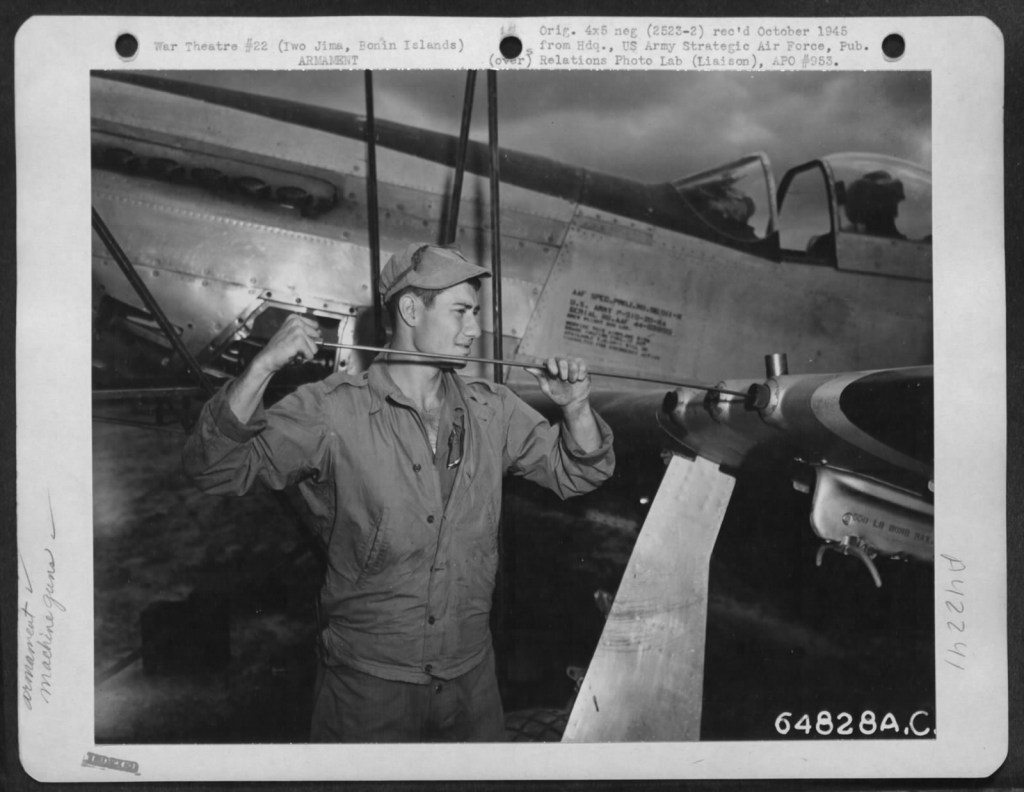
An armorer cleans the blast tubes on a 47th Fighter Squadron P-51D Mustang while other maintenance is being performed. The official United States Army Air Force caption to this photo reads: Armorers cleaning 50 cal machine guns on wing of North American P-51 “Mustang”. Iwo Jima, Bonin Islands.
The sand and volcanic grit was a constant problem for ground crew on Iwo Jima. With their pilots spending a majority of a very long mission over the vast expanse of the Pacific Ocean, 7th Fighter Command ground crew spent long hours maintaining their Mustangs to prevent a pilot from having to bail out over water due to engine failure. This post is dedicated to all the ground crewmen who served on Iwo Jima.
All three Iwo Jima VLR Mustang Groups were tasked with flying combat air patrols around Iwo Jima to protect the island against attacks by the Japanese. The photo below shows three 462nd Fighter Squadron, 506th Fighter Group Mustangs on combat air patrol around Iwo Jima. The closest Mustang, 626, is being flown by 1st Lt. Edward Linfante. The middle Mustang, 602 “Meatball” is being flown by 1st Lt. Edward Bahlhorn, and third Mustang, “Little Joe”, is being flown by 2nd Lt. Jesse Sabin. Really nice photo.
Three 462nd Fighter Squadron Mustangs flying Combat Air Patrol around Iwo Jima (506th Fighter Group Association via Ed Linfante)
Mt. Suribachi was the central orbit for all CAPs. Starting with North and every 45 degrees clockwise around the compass 10 miles is an orbit point each with a code name as shown on the diagram below.
Combat Air Patrol Diagram from 506th Fighter Group Indoctrination Handbook
In the event of an air raid during the time the CAP flights were airborne, they would join their respective squadrons at the designated orbit points when Agate Base on Mt. Suribachi announced “All flights Kalamazoo”. When Agate Base announced “All flights fluorescent”, all flights except the CAPs would return to Iwo Jima.
Funny Face was a 462nd Fighter Squadron, 506th Fighter Group P-51D NA-20 Mustang (44-72623) assigned to 1st Lieutenant John “Jack” G. Rice.
627 “Funny Face” on Iwo Jima (506th Fighter Group Association via Dr. John Benbow)
A few things to note from the above picture. First, is that the black paint on the back sides of the propeller blades below the cuffs are showing wear from being on Iwo Jima. The sand and black volcanic grit were tough on paint. This wear was more pronounced on the back sides of the propeller blades than the front sides. Second, please note that the openings to the engine compartment are covered. The air intake on the lower cowl is covered, and there are small “boots” covering the exhaust stacks. The carburetor intake below the spinner and gun openings on the wings were also covered. These measures were taken to prevent the sand and black volcanic grit from entering the engine compartment and gun bays where it could fowl the engine and machine guns. In addition, the factory installed canvas covers in the wheel wells were retained for the same reason.
1st Lieutenant Jack Rice in the cockpit of 627 “Funny Face” (506th Fighter Group Association via Dr. John Benbow)
As the photo above suggests, there might have been another pilot assigned to fly 627 “Funny Face”, but I am unaware of any photos or squadron/group records to indicate who that pilot was. All of the photos I have in my collection of 627 “Funny Face” do not show any pilot names on the lower canopy framing.
1st Lieutenant Rice was a replacement pilot and not assigned to the 506th Fighter Group when it was formed in October of 1944 at Lakeland Army Air Force base in Florida. He was initially assigned to 53rd Fighter Group at Fort Meyers, Florida, where he underwent replacement training in anticipation of going oversees. 1st Lt. Rice would join the 506th FG by January of 1945 as he appears in a photo of 462nd FS officers taken at that time at Lakeland.
1st Lieutenant Rice was not credited with any aerial or ground victories during his time with the 506th FG. By the time the 506th FG arrived on Iwo Jima in May of 1945, the opportunities to engage their Japanese counterparts in the air had dwindled considerably.
Jack Rice would devote 32 years of his life to the United States Army Air Corps/Air Force and retired as a Lieutenant Colonel. He would also serve in the Korean Conflict and the Vietnam Nam War as a Civil and Electrical Engineer. Lt. Colonel Rice passed away on July 19, 2015 at the age of 93.
I had the honor and pleasure to interview Jack Rice at the 506th Fighter Group Reunion in Chino, California in 2013. A very kind, knowledgeable, and enthusiastic individual, he sat for more than an hour with me answering all of my questions. Definitely part of the Greatest Generation.
There are no aftermarket decals for 627 “Funny Face” in any scale.
The official captions to the two photos below are: “North American P-51 Mustangs [sic] fighters escort Boeing B-29 Superfortresses. Iwo Jima.” In actuality, the B-29s in these photos were serving as navigational aircraft in escorting the P-51s from Iwo Jima to Japan and back.
A B-29 navigational aircraft escorts 45th FS 15th FG P-51D Mustangs on a VLR mission (USAAF/National Archives via Fold3)
The 1,500 mile round trip flights over a vast expanse of ocean with minimal landmarks made navigating in a single engine fighter an extremely difficult task. Only a few fighter pilots with sufficient experience would feel confident to take on that task. To take that burden off of the VLR fighter pilots, six B-29 navigation planes in three pairs led the Mustangs on each mission. Upon reaching a designated point off the Japanese coast, the B-29s would circle while the Mustangs would venture inland either escorting the main bomber stream or striking their intended targets.
A B-29 navigational aircraft escorts 45th FS 15th FG P-51D Mustangs on a VLR mission (USAAF/National Archives via Fold3)
When the Mustangs began to retreat to the designated rendezvous point, the first pair of B-29s would wait until about half of the fighters had arrived, then set course for Iwo Jima. The other two pairs of bombers departed the coast at approximately ten minute intervals to allow latecomers to join up with them for the long flight back to Iwo Jima. The last pair of B-29s to depart transmitted the Morse Code letters for U and D on the Uncle Dog radio frequency so late departing Mustangs could hone in on those bombers until they were close enough to Iwo Jima to hone in on the signals sent from Brother Agate.
This system worked extremely well and gave VLR Mustang pilots the confidence that they would return safely to Iwo Jima even if they got separated from their squadron or group.
References:The Mustangs of Iwo, Barrett Tillman, Air & Space Forces Magazine, April 1, 2013.




 Iwo Jima Models