Photo(s) of the Week; Iconic Iwo Jima VLR Mustang Photo

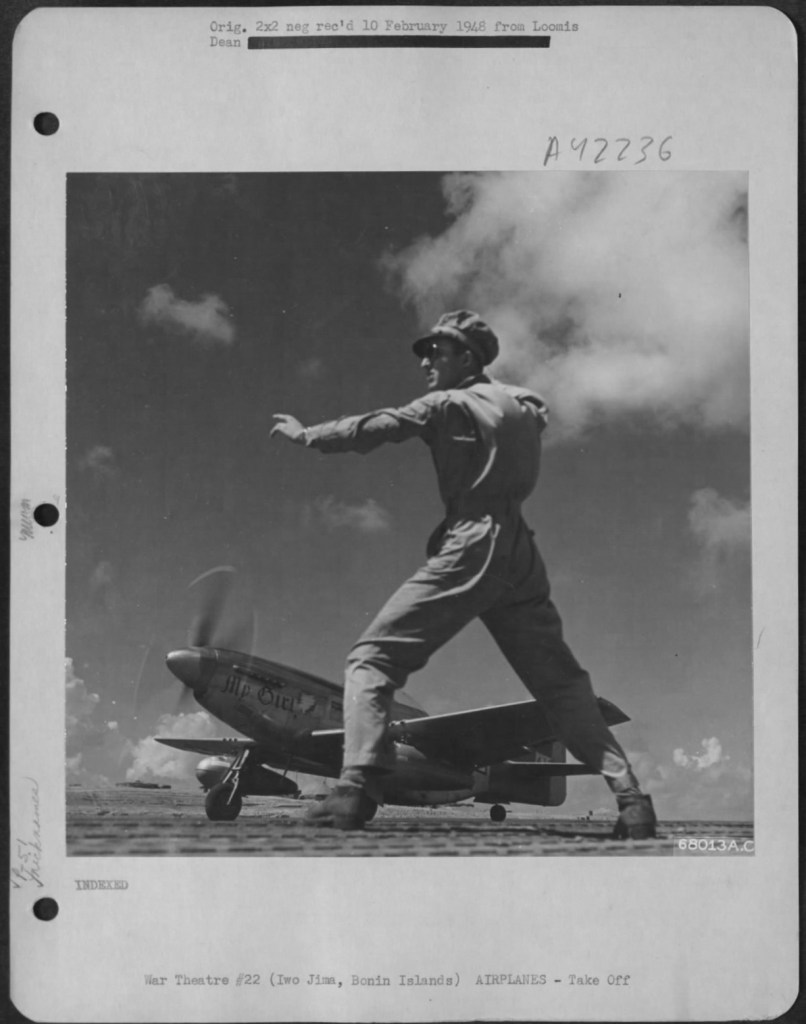
516 “My Girl”, a 457th Fighter Squadron, 506th Fighter Group P-51D-20-NA Mustang (Serial No. 44-72580) loaded with 110 gallon drop tanks awaits a signal from a ground crewman to take off from North Field on another VLR mission. This is a well known photo taken by Loomis Dean who was known for taking photos from unique angles during his time as a USAAF photographer.

USAAF/Loomis Dean/National Archives via Fold3

While the photo is well known, it is unknown who was assigned to fly “My Girl”. One would think that either 457th Fighter Squadron or 506th Fighter Group records would document who flew a particular plane, but often that is not the case. Most of what we know about who was assigned to fly a particular plane is based on photographs and recollections of pilots and ground crew. If those recollections were not written down, they are now lost as there are no surviving 457th FS pilots or ground crew.

I am unaware of any decals which were produced for “My Girl”.

Photo(s) of the Week; Mission Prep for April 19, 1945 VLR Strike Mission

USAAF/National Archives via Fold3

Armorers unpack 50 caliber ammunition from cases to be loaded into a 46th Fighter Squadron, 21st Fighter Group Mustang in preparation for the April 19, 1945 VLR strike mission against Atsugi Naval Airfield near Tokyo. Two Consolidated PB4Y-2 Privateer patrol bombers are in the background on Central Field.

Kit News: Eduard Now Taking Pre-Orders on Their New Royal Class 1/72 North American P-51D Mustang Dual Combo Boxing

Yesterday, I received an email from Eduard that they are now accepting pre-orders on their new Royal Class 1/72 North American P-51D Mustang Dual Combo boxing. From the CAD drawings and the information posted on Eduard’s website, it appears they have done an excellent job of scaling down their 1/48th scale kit to 1/72nd scale.

Eduard

The box art for the 1/72nd Royal Class Dual Combo boxing is similar to what it was for the 1/48th Royal Class Dual Combo boxing except for the orientation of the Mustang drawing and the color of the background. Like the 1/48th Royal Class Dual Combo boxing, the 1/72nd Royal Class Dual Combo boxing includes the exact same 14 decal options, which means that decals for two Iwo Jima VLR Mustangs are included, both from the 506th Fighter Group.

Iwo Jima VLR Mustang Decals: The first set of VLR markings is for 555 “The Ole Lady/Little Anne/My Darlin Betty Ann” (P-51D-25-NA, 44-72628), a 458th FS Mustang flown by 2nd Lts. James E. Coleman and Ralph R. Coltman, Jr.

Eduard

The second set of markings is for 528 “The Enchantress” (P-51D-25-NA, 44-72671), a 457th FS Mustang flown by 2nd Lt. William E. Saks. 2nd Lt. Saks was one of the pilots lost on the June 1, 1945 “Black Friday” mission, but he was not flying 528 on that day. “The Enchantress” is popular amongst modelers because the nose art and pin-up girl that adorns the fuselage.

Eduard

Like its bigger brother, you can build any variant of the D model from a D-5 to a D-25 with this kit. All the parts to make an accurate Iwo Jima VLR Mustang are present. I have included drawings of two sprues for the kit that Eduard posted on its website. It appears that the fuselage floor and fuel tank (Part E24) will be one piece, and the SCR-522 radio transmitter, SCR-695 IFF transmitter, and the rack they sit on are one piece as well (Part E27).

Eduard

A major difference from their 1/48th kit is that all of the different drop tanks that Mustangs carried (75 gallon, 108 gallon, 110 gallon, and 165 gallon) are included on one sprue. In the 1/48th kit, the 110 gallon and 165 gallon drop tanks carried by Iwo Jima VLR Mustangs and their sway braces were produced on a separate sprue, and only included in the Royal Class Dual Combo and Limited Edition Tales of Iwo Jima boxings. Now, as shown below on the drawing of sprue F, they will be included no matter what boxing of the kit you purchase. Nice touch on Eduard’s part.

Eduard

As is customary, Eduard includes a lot of goodies in their Royal Class Dual Combo boxings. This boxing is no exception and will include two sets of resin cast main wheels and tail wells, 3D printed shrouded exhaust stacks, un-shrouded exhaust stacks, and seats. While there are no photos yet, the information on Eduard’s website about this boxing indicates there will be two color photo etch cockpit sets included.

Eduard

In addition, Eduard will included a set to solid masks for painting around the wheel wells. They appear to made of some form of a foam material, and are designed to be placed into the wheel wells to protect your already painted wheel wells when you are painting the bottom of the wings. Again, a very nice touch on Eduard’s part. They appear to be doing that for their 1/48 kits as similar solid masks are included in their P-51B Mustang Royal Class Dual Combo boxing.

Eduard

According to Eduard’s website, pre-orders will be accepted between April 26th and May 8th, and kits will ship in the second half of June.

Kudos to Eduard for producing a 1/72 P-51D Mustang kit with all the necessary parts to build an accurate Iwo Jima VLR Mustang. Let’s hope that they follow suit and release a limited edition boxing dedicated solely to the Iwo Jima VLR Mustang groups in 1/72nd scale.

Here is a link to the 1/72nd Royal Class Dual Combo boxing: https://www.eduard.com/eduard/p-51d-mustang-dual-combo-1-72.html?cur=2&&force_sid=fcq1jtinhf1a75u1rb33jsl6so4dups8

Photo(s) of the Week; Return from the Empire

Ground crews were anxious for the return of their pilots and planes from the first VLR escort mission to the Japanese Home Islands. The 7th Fighter Command lost only two Mustangs and one pilot (1st Lt. Robert G. Anderson, 531st FS/21st FG) on the April 7th mission.

USAAF/National Archives via Fold3

In the photo above, ground crew watch on as a P-51D Mustang lands on Iwo Jima. If you enlarge the photo, on the other side of the runway are two C-46 Commandos, a C-47 Dakota, a P-51D Mustang, four PB4Y-1 Liberator patrol bombers, and a PB4Y-2 Privateer patrol bomber.

USAAF/National Archives via Fold3

P-51D Mustangs were not the only planes to land on Iwo Jima on April 7th. In the photo above, a damaged B-29 Superfortress lands on the same field. If you enlarge the photo, the prop on the right outside engine has been feathered. It appears that the first two photos were taken by the same 7th Air Force Combat Camera photographer. In this photo, he standing next to the tail of the damaged PV-1 Ventura shown in the first photograph.

USAAF/National Archives via Fold3

In the photo above, ground crew and support personnel clamor around 68 “Victory Belle”, a 45th FS/15th FG Mustang, as the pilot waits to exit the cockpit while discussing the mission with his ground crew. A couple of things to note. First, it does not appear that the twin Uncle Dog antennae have been installed on Victory Belle yet. Second is the wear on the backside of the propeller blade. Only the cuff at the bottom of the propeller blade has retained its color because it was made of a hard rubber composition. The volcanic grit on Iwo Jima took its toll on painted surfaces. I am unaware of any after market decals for Victory Belle.

Major James B. Tapp, 78th FS/15th FG (USAAF/National Archives via Fold3)

In the photo above, Major James B. Tapp, enjoys a sandwich and a cup of coffee after the April 7th mission. Major Tapp was the top scorer on the April 7th mission downing four Japanese fighters that were attacking the B-29 Superfortress formations.

References:

1. The Long Campaign: The History of the 15th Fighter Group in World War II, John W. Lambert, Schaffer Publishing Ltd. (2006).

2. Very Long Range P-51 Mustang Units of the Pacific War; Carl Molesworth; Osprey Publishing Limited (2006).

Photo(s) of the Week; April 7, 1945 – First Trip to the Empire

I am posting this edition of Photo(s) of the Week a day early to observe and commemorate a significant event in the history of Iwo Jima VLR Mustang Groups. Seventy-nine years ago today, 108 P-51D Mustangs of the 15th and 21st Fighter Groups flew their first very long range mission to the Japanese Home Islands escorting 107 B-29s of the 73rd Bomb Wing to Tokyo and back.

1st Lt. Jule Carnes Mitchell, Jr., 47th FS/15th FG, is ready to take off on the first VLR mission to the Japanese Home Islands (USAAF/National Archives via Fold3)

The target for the B-29s was the Nakajima aircraft engine factories on the west side of Tokyo. The B-29s approached the target at 15,000 feet with the P-51Ds several thousand feet above the bombers in combat formation with the 15th Fighter Group on the right and the 21st Fighter Group on the left of the bombers.

1st Lt. Eurich L. Bright being readied in the cockpit of 176 “Moonbeam McSwine” for the April 7, 1945 VLR escort mission (USAAF/National Archives via Fold3)

1st Lt. Eurich L. Bright of the 47th Fighter Squadron, shown in the picture above, was one of the top scorers of the mission being credited with shooting down a Kawasaki Ki-61 Hein (Tony), a Mitsubishi A6M Zero, and a Nakajima Ki-45 Toryu (Nick).

USAAF/National Archives via Fold3

The photo above shows the 47th Fighter Squadron P-51D Mustangs being readied for the April 7, 1945, VLR escort mission to Tokyo. The 110 gallon metal drop tanks would have been mounted on the wings the day before, and filled the morning of the mission. Note the twin Uncle Dog antennae on 186. By the time of this mission, most, if not all the 15th and 21st Fighter Group Mustangs would have had them installed to help them form up with the B-29s on the trip to Japanese Home Islands, and to find their way back to Iwo Jima.

USAAF/National Archives via Fold3

45th Fighter Squadron Mustangs warm up their engines in the photo above as part of the pre-flight preparation for the first VLR escort mission.

For the 7th Air Force Fighter Command, this mission was culmination of several years of being in the Central Pacific theater of operations and waiting to get into the fight on a larger scale. The 15th Fighter Group participated in the defense of Pearl Harbor on December 7, 1941, and then only saw sporadic combat until April 7, 1945. The 7th Fighter Command called themselves the “Sunsetters”, and their primary objective was to help bring the war in the Pacific to an end.

In the photo below, ground crew watch as 45th Fighter Squadron Mustangs move to begin taking off.

USAAF/National Archives via Fold3

Seventeen Mustangs had to abort and return to Iwo Jima, including Brig. General Ernest “Mickey” Moore and 15th Fighter Group commander Colonel James O. Beckwith. The Sunsetters were credited with twenty-six Japanese planes destroyed, one probably destroyed, and five damaged at the cost of two Mustangs and one pilot. Major James B. Tapp of the 78th Fighter Squadron was high scorer shooting down four Japanese defenders. More importantly, no B-29s were shot down by Japanese fighters. Two B-29s were lost to flak, and one to an aerial bomb dropped on the bomber formation.

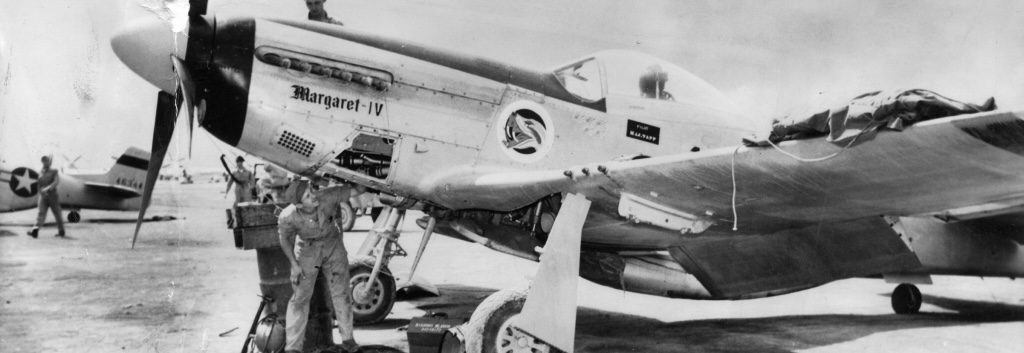
If you have Eduard’s 1/48 “Very Long Range: Tales of Iwo Jima“ Limited Edition kit (No. 11142), it provides decals for the following pilots and planes that participated in the April 7, 1945 mission: Major Gilmore L. “Buck” Snipes’ 67 “Tom Kat” (45th FS/15th FG); Major James B. Tapp’s 101 Margaret -IV” (78th FS/15th FG); 1st Lt. Eurich L. Bright’s 176 “Moonbeam McSwine” (47th FS/15th FG); Major Paul W. Imig’s 250 “Dede Lou” (72nd FS/21st FG); and Major Harry C. Crim, Jr.’s 300 “My Achin! [Ass].

References:

1. The Long Campaign: The History of the 15th Fighter Group in World War II, John W. Lambert, Schaffer Publishing Ltd. (2006).

2. Very Long Range P-51 Mustang Units of the Pacific War; Carl Molesworth; Osprey Publishing Limited (2006).