Our good friends in the Czech Republic at DK Decals have been busy producing new decal sheets, and one of the recent 1/32 releases focuses on P-51D/K Mustangs over the Pacific and Australia.
DK Decals
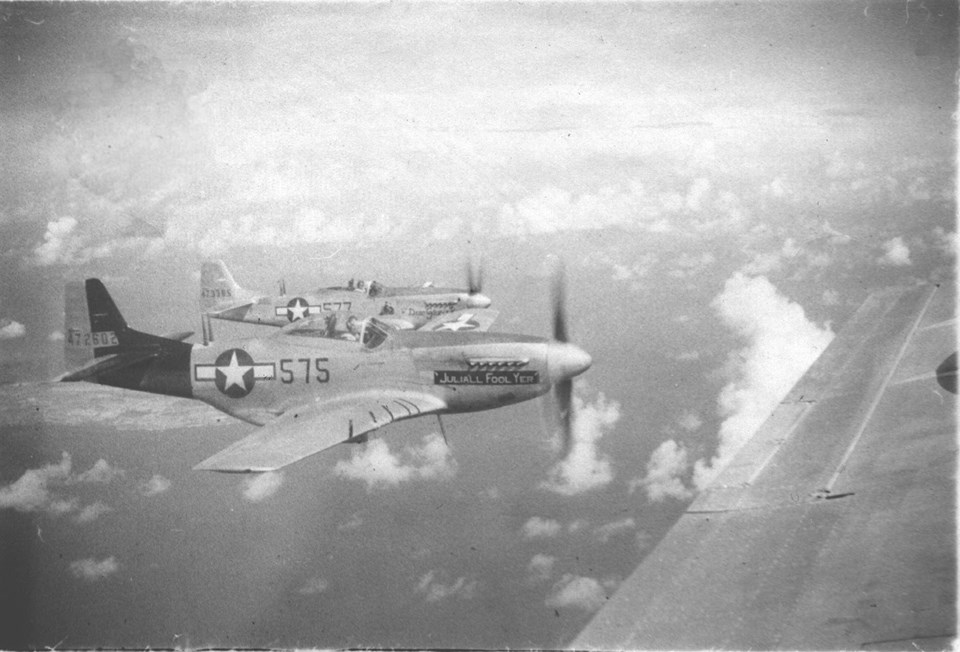
This decal sheet provides markings for a 458th Fighter Squadron, 506th Fighter Group P-51D-20-NA Mustang (44-72602) 575 “My Madge/Julia’ll Fool Yer” flown by Captain Goldie Marcott.
DK Decals
Below is a very nice color photo of Captain Marcott kneeling on the wing of “My Madge/Julia’ll Fool Yer”. The photo shows the twin wooden Uncle Dog antenna on the rear fuselage.
Captain Goldie Marcott (via Brian Walter)
The fact that there are 20 mission markings and another name (“Julia’ll Fool Yer”) on the right side of the nose, suggests that another pilot was assigned to fly 575, but there are no records that I can find to either confirm or dispel this thought.
DK Decals
Below is a wonderful photo of the left side of the nose of 575. It not only shows the beautiful and graceful lines of the Mustang, but shows the small pin-up art in front of the name “My Madge” which is very nicely reproduced on this decal sheet.
575 “My Madge/Julia’ll Fool Yer” (via Brian Walter)DK Decals
Captain Marcott was the flight leader of “C” Flight of the 458th Fighter Squadron. His Crew Chief was Staff Sergeant Francis R. Sundbergh, and his Armourer was Master Sergeant Amil V. Wittenberger. He was not credited with any aerial victories or ground victories.
575 “My Madge/Julia’ll Fool Yer” (via Dr. John Benbow)
There is not a tremendous amount of information on Captain Marcott that can be gleaned from the internet. In looking through the 458th FS records, I was able to determine that Captain Marcott’s hometown was Crete, Nebraska, which is less than an hours drive from the author’s residence in Beatrice, Nebraska. The next step in my research will be to determine if there are any of Captain Marcott’s relatives in the Crete area.
DK Decals
I have also reached out to Master Sergeant Amil Wittenberger’s son, Robert, to gather additional information and photos on Captain Marcott, Staff Sergeant Sundbergh, and Master Sergeant Wittenberger. I really enjoy researching the pilots and their ground crew.
Captain Goldie Marcott with his Crew Chief, Staff Sergeant Francis R. Sundbergh (via Brian Walter)
This is an very nice decal sheet and kudos to DK Decals for including the markings for Captain Marcott’s 575 “My Madge/Julia’ll Fool Yer” on the sheet. If you are not interested in the markings for Captain Marcott’s Iwo Jima VLR Mustang, the sheet provides markings for several other Pacific Theater Mustangs such as Major William Shomo’s The Flying Undertaker/Snooks 6th”, and Lieutenant L. E. Curdes’ “Bad Angel”. This decal sheet is highly recommended for anyone interested in Pacific Theater Mustangs.
DK Decals
All of DK Decals’ sheets are very well researched, and they are quality decals that are easy to use. My hope is that they release a 1/32 decal sheet that is solely devoted to Iwo Jima VLR Mustangs, just as they did in 1/72nd and 1/48th scales.
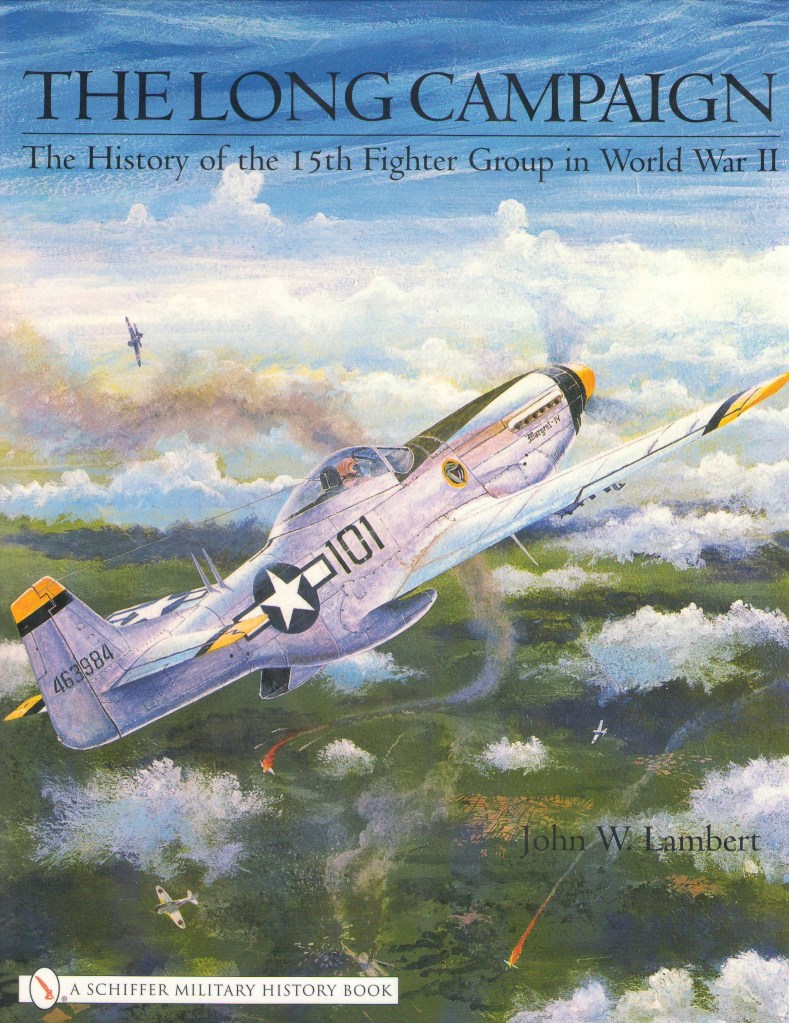
Published in 2006 by Schiffer Publishing Ltd., John W. Lambert chronicles the 15th Fighter Group starting with its activation in December of 1940 as part of the Hawaiian Air Force, to its baptism of fire in the defense of Pearl Harbor during the Japanese surprise attack on December 7, 1941, and ending with its sun setting VLR missions against the Japanese Home Islands from Iwo Jima in the last months of the war.
James O. Beckwith
One hundred fifty two pages of text tells the story of the truly “Long Campaign” of the 15th Fighter Group, which was activated on December 1, 1940, in Hawaii, and ended the war on Iwo Jima in August, 1945. While the 15th FG got an early taste of aerial combat defending against the surprise attack on Pearl Harbor, the next 15 months would be spent on Hawaii defending against an anticipated second attack that never materialized.
USAAF/National Archives via Fold3
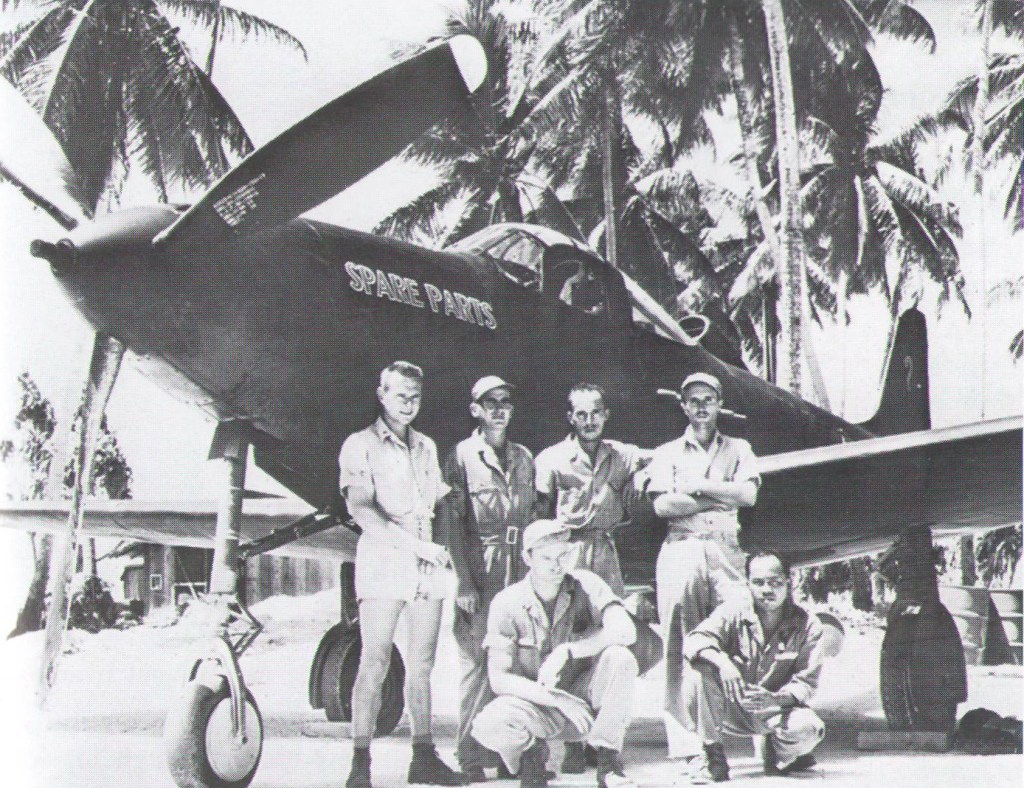
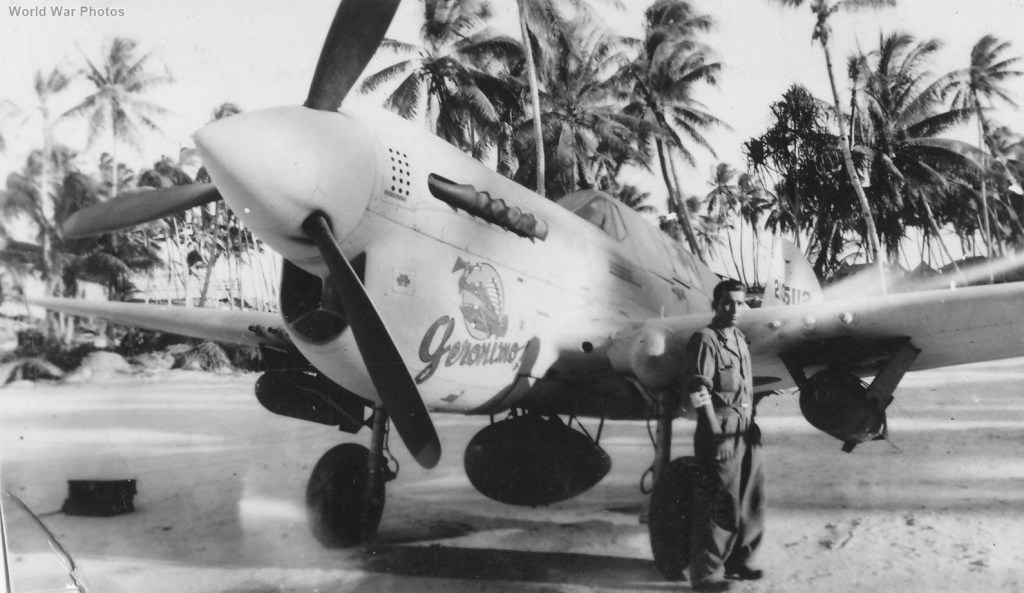
The 15th FG’s opportunity to engage the enemy came again in March of 1943 when the group moved to Canton Island, and Lambert does a very nice job of describing the 15th’s moves across the Central Pacific (Baker, Makin, Milli, Jaluit, Abemama and Nanumea Atolls) , and their sporadic engagements with Japanese Naval Air Forces.
World War Photos
The book goes on to detail the Group’s return to Hawaii to transition into the Republic P-47D Thunderbolts in April of 1944. At this point in time, many of the pilots who had been in the Central Pacific forward areas had not got the opportunity of fire a single shot in combat. Lambert does a very nice job of capturing the frustrations of the pilots in not seeing any combat, and their eagerness to finally get in the fight.
78th FS Republic P-47D Thunderbolts (James M. Vande Hey)
That opportunity would come soon when the Group transitioned into the North American P-51D Mustang in November of 1944, and began training for VLR missions. The book really picks up during the Group’s transition to Iwo Jima, and finally their opportunity to engage Japanese Army and Navy fighters over the Japanese Home Islands.
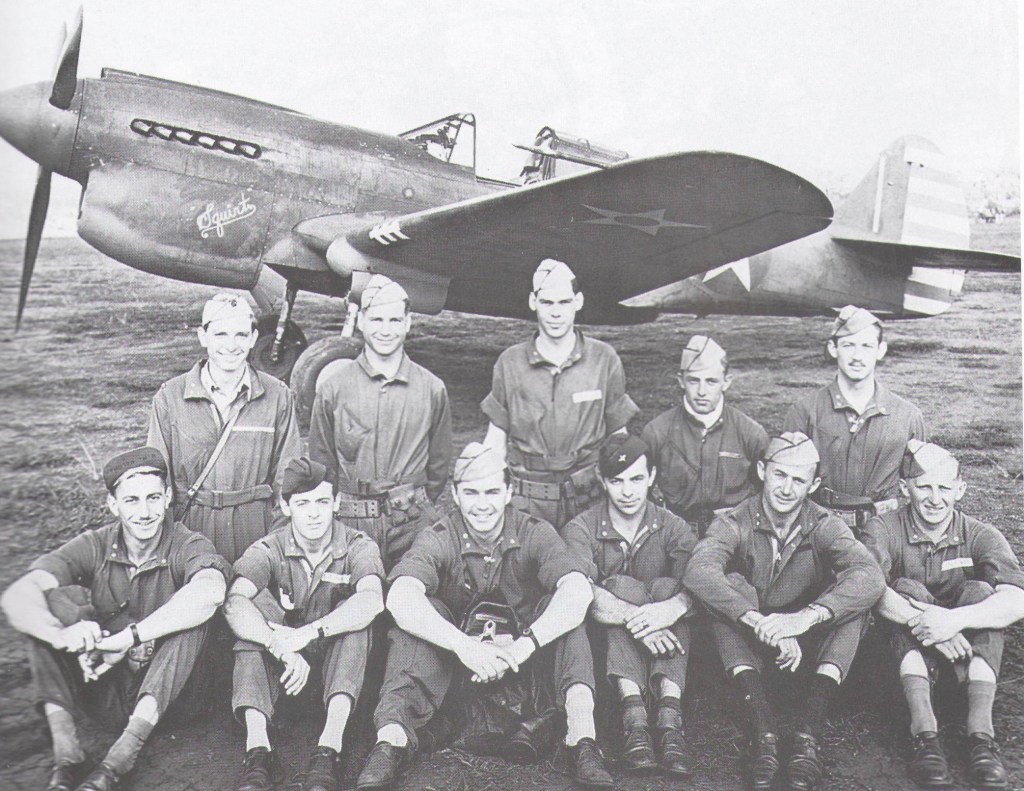
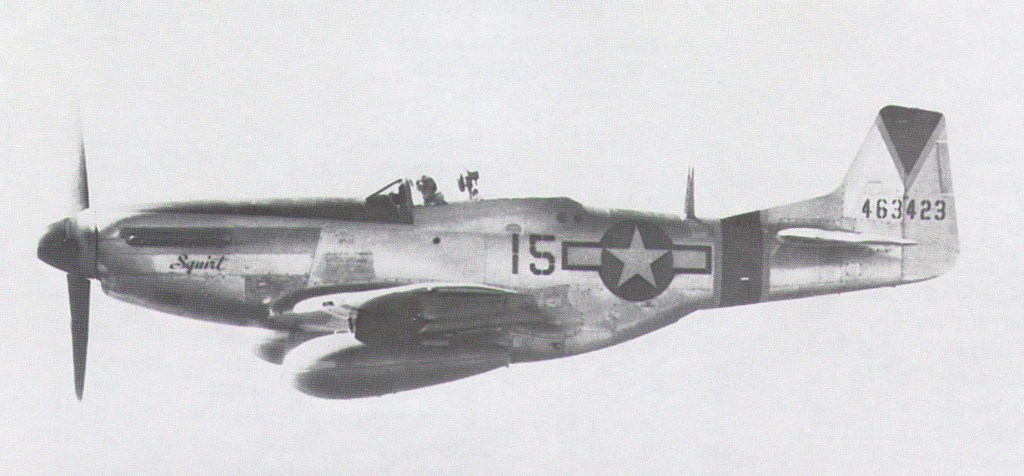
Colonel James O. Beckwith in 15 “Squirt” (James O. Beckwith)
This is a very well researched book, and Lambert does an excellent job in the early to mid chapters of the book setting forth the Group’s history when not a lot of combat is occurring. The appendices at the end of the book are very nice and helpful for those wanting to dig deeper into the individual members of the Group and their accomplishments. The only criticism I have of the book is that it does not have any aircraft profiles, color or otherwise. It would have been a nice touch to include color profiles of the Curtiss P-40 Warhawks, Bell P-39 Airacobras, Republic P-47D Thunderbolts, and North American P-51D Mustangs flown by the 15th FG, and their markings.
I would highly recommend this book to anyone interested in the 15th Fighter Group and the 7th Air Force/7th Fighter Command’s contributions in ending the war in the Pacific.
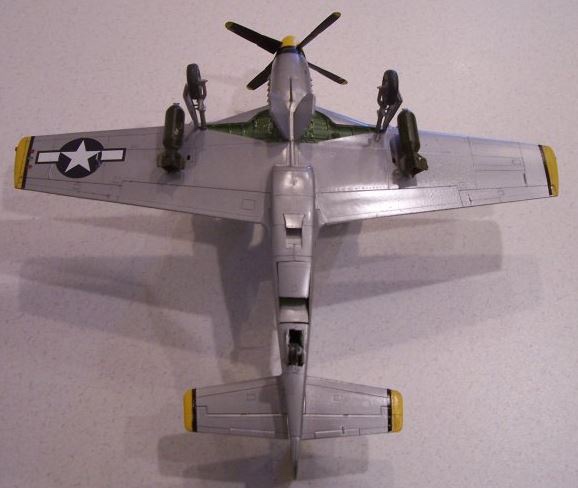
Mark Rossmann is back with three 1/48 VLR Mustang builds. This is a blast from the past as Mark built these 15th Fighter Group Mustangs back in 2007.
Mark L. Rossmann
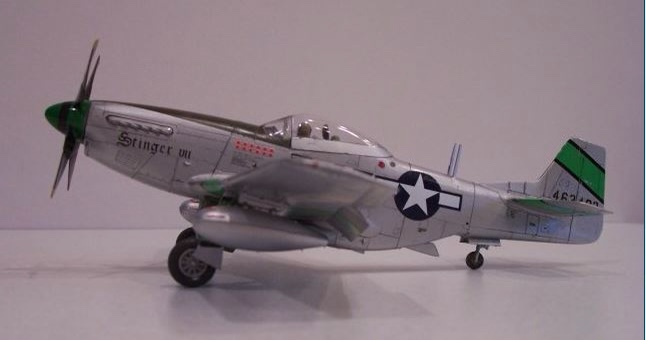
First up is the 45th Fighter Squadron’s P-51D-20NA (44-63483) 67 “Stinger VII”, flown by Major Robert W. “Todd” Moore. Major Moore was the highest scoring 7th Fighter Command ace with 12 aerial victories; 11 of those victories scored on VLR missions.
Mark L. Rossmann
Major Moore’s first victory came on an ambush mission over Arno Atoll on January 26, 1944, during which he shot down a Mitsubishi Zero. He did not score again until the 15th Fighter Group started flying VLR missions from Iwo Jima. His last victory came on a VLR escort mission to Tokyo on August 10, 1945, during which he shot down a Nakajima Ki-44 Shoki.
Major Robert W. Moore (USAAF/National Archives via Fold3)
In addition to the 12 aerial victories, Major Moore was credited with 3 ground victories. He ended the war as the commander of the 45th Fighter Squadron.
Mark L. Rossmann
Mark used the Tamiya kit along with decals from Aeromaster’s The Very Long Range Escorts “The Iwo Jima Mustangs” Fancy Art Part 4 sheet (48-797).
Next up is the 47th Fighter Squadron’s P-51D-20NA (44-63972) 185 “Black Rufe” flown by 1st Lt. William Hayden Sparks.
Mark L. Rossmann
1st Lt. Sparks scored an aerial victory over Kakamigahara Airdrome on July 19, 1945, and was also credited with a ground victory on August 3, 1945.
1st Lt. W. Hayden Sparks (via Mark W. Stevens/7th Fighter Command Association)1st Lt. W. Hayden Sparks (W. Hayden Sparks)
185 “Black Rufe” was actually lost on the infamous June 1, 1945, Black Friday mission, but 1st Lt. Sparks was not assigned to fly that mission.
Mark L. Rossmann
Again, Mark used the Tamiya kit along with decals from Aeromaster’s The Very Long Range Escorts “The Iwo Jima Mustangs” Fancy Art Part 4 sheet (48-797).
Mark L. Rossmann
Mark’s third build is the 78th Fighter Squadron’s P-51D-20NA (44-63973) 100 “Jeanne VIII” flown by Major James M. Vande Hey. Major Vande Hey was a veteran 78th FS pilot who participated in all of the 78th FS campaigns in the Central Pacific, and was squadron commander when the 78th FS arrived on Iwo Jima.
Mark L. Rossmann
Major Vande Hey scored 4 aerial victories during his time with the 78th Fighter Squadron. His first two victories came on the January 26, 1944 ambush mission over Arno Atoll, during which he shot down two Mitsubishi Zeros.
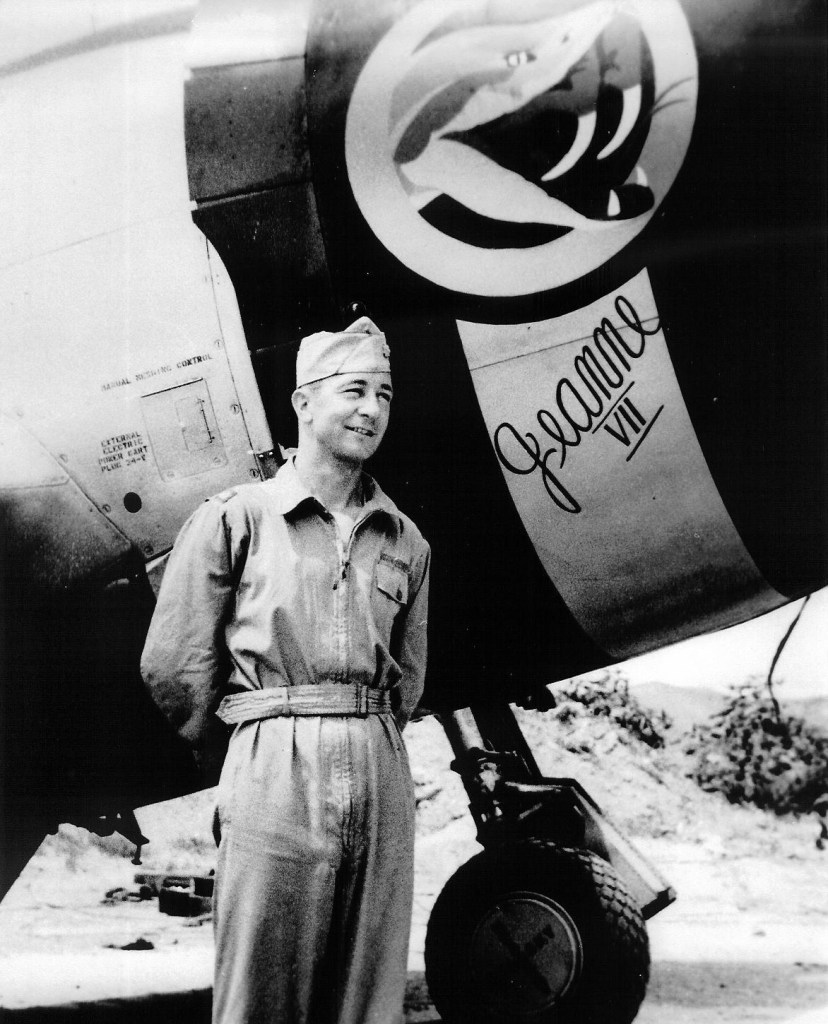
Major James M. Vande Hey standing next to his Republic P-47D Thunderbolt “Jeanne VII” in Hawaii (James M. Vande Hey)
His third victory came on the first VLR escort mission to Tokyo on April 7, 1945, during which he shot down a Mitsubishi Ki-46 Dinah. Major Vande Hey’s last victory came on second VLR escort mission on April 12, 1945, again to Tokyo. Upon landing on Iwo Jima, his engine stopped for lack of fuel and had to be towed back to its hardstand. Major Vande Hey had been in the air for over 8 hours. This would be his last VLR mission. After spending 40 months in the Central Pacific, and after logging over 1,500 flight hours, Major Vande Hey rotated home and was reassigned to a Stateside position.
Major James M. Vande Hey (USAAF/National Archives via Fold3)
James Vande Hey would make a career out of serving his country in the United States Air Force obtaining the rank of Brigadier General. Brig. Gen. Vande Hey retired on July 1, 1971, and passed away on December 21, 2009.
Mark L. Rossmann
For this build, Mark used the Hasegawa kit along with decals from Aeromaster’s The Very Long Range Escorts “The Iwo Jima Mustangs” Fancy Art Part 2 sheet (48-795).
Mark L. Rossmann
Thanks again to Mark Rossmann for sharing his builds with us. More to come as Mark has done more VLR Mustang builds over the years. Very nice builds! Thanks also to Mark W. Stevens of the 7th Fighter Command Association for the photos of 1st Lt. W. Hayden Sparks.
References:
1. The Long Campaign: This History of the 15th Fighter Group in World War II; John W. Lambert; Schaffer Publishing Ltd. (2006)
As a condition of the use of materials from the 7th Fighter Command Association website, the following disclaimer is included: Permission to use, copy and distribute documents delivered from this Worldwide Web server and related graphics is hereby granted, provided 1) That the use of the data will not be used for obtaining a profit of any kind, and 2) That the above disclaimer notice appear in all copies and that both that disclaimer notice and this permission notice appear. All other rights reserved. The name of “7th Fighter Command Association” may not be used in advertising or publicity pertaining to distribution of this information without specific, written prior permission. Mark Stevens and the 7th Fighter Command Association makes no representations about the suitability of this information for any purpose. It is provided “as is” without express or implied warranty. Mark Stevens and the 7th Fighter Command Association disclaim all warranties with regard to this information, including all implied warranties of merchantability and fitness. In no event shall Mark Stevens or the 7th Fighter Command Association be liable for any special, indirect or consequential damages or any damages whatsoever resulting from loss of use, data or profits, whether in an action of contract, negligence or other action, arising out of or in connection with the use or performance of this information.











 Iwo Jima Models