Photo(s) of the Week: XXI Bomber Command B-29s Bomb Iwo Jima

On October 12, 1944, Joltin’ Josie, The Pacific Pioneer, a 873rd Bomb Squadron, 498th Bomb Group B-29, landed on Isely Field, Saipan with Brig. General Haywood S. “Possum” Hansell, Jr. at the controls. Joltin’ Josie was the first B-29 to reach the Mariana Islands. The 498th Bomb Group was assigned to the 73rd Bombardment Wing, which was commanded by Brig. General Emmett “Rosy” O’Donnell. The 497th, 499th and 500th Bomb Groups were also assigned to the 73rd BW.

A total of six “shakedown” missions were flown by the B-29s of the 73rd BW against Truk and Iwo Jima prior to any missions being flown against targets in the Japanese Homeland. Two retaliatory strikes against Motoyama Airfiled #1 and Motoyama Airfield #2 were carried out on November 5th and 11th after Japanese aircraft on Iwo Jima staged a low-level raid on Isely Field on November 2nd damaging several B-29s.

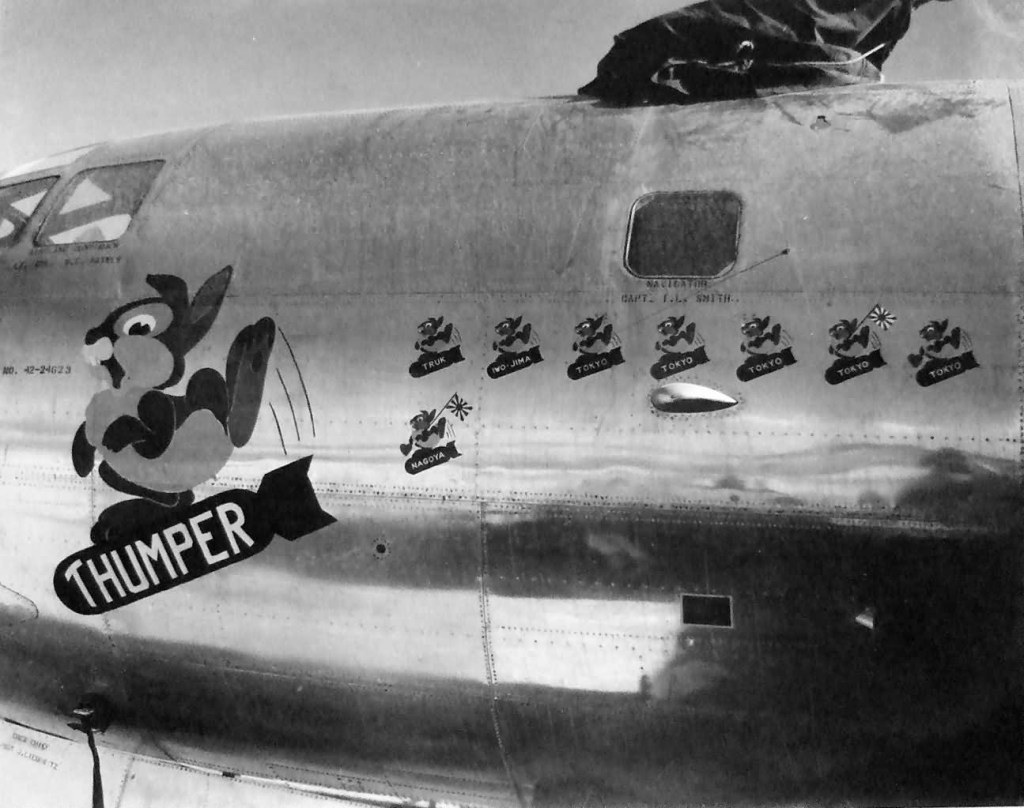
“Thumper”, 870th Bomb Squadron, 497th Bomb Group, 73rd Bombardment Wing, 21st Bomber Command, 20th Army Air Force

Thumper, a 870th BS/497th BG B-29, participated in one of the bombing missions against Iwo Jima. The Iwo Jima bombing mission was the second mission flown by Thumper; Truk being the first. At the time this photo was taken, Thumper had also flown five missions against targets in Tokyo, and one mission against targets in Nagoya.

As can be seen from the photo above, its mission symbols were a smaller version of its cartoon nose art with the name of the target location printed on the bomb. Aerial victories were noted by a Japanese flag carried by cartoon character.

References:

How the Superfortress Paced the Attack Against Japan, Major James M. Boyle, USAF, Air Force Magazine, December, 1964.

Photo(s) of the Week: 7th Air Force Bombing Campaign III

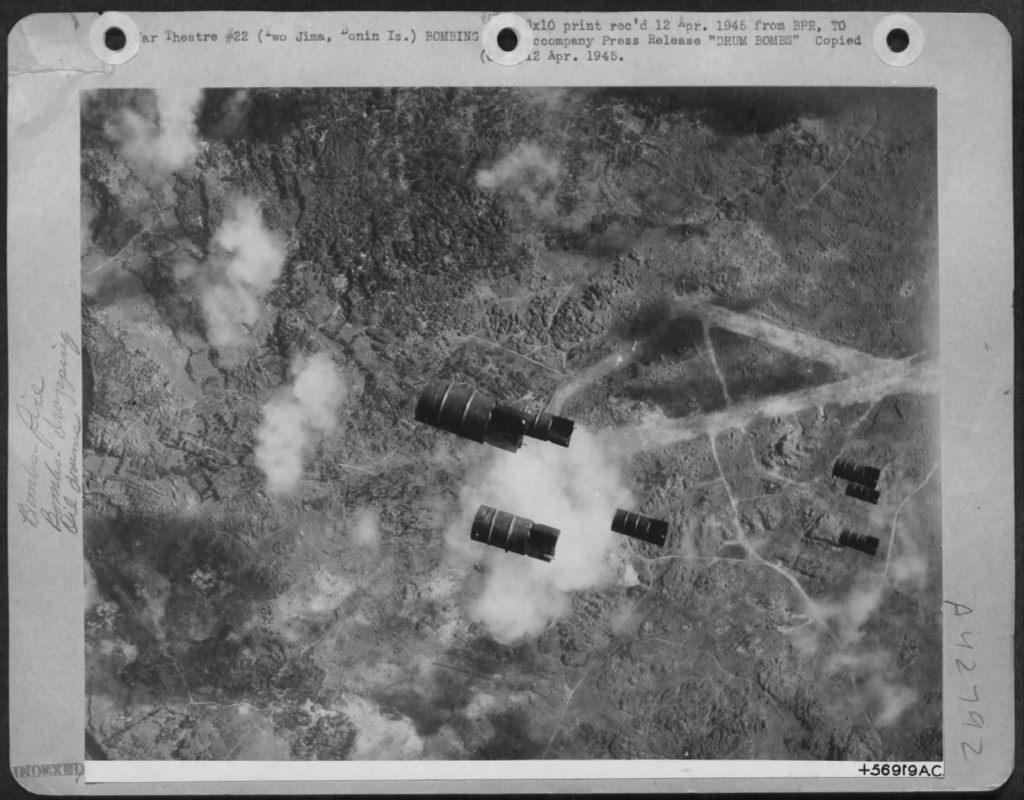
Yes, you are seeing that right. Those are 55 gallon drums falling toward Motoyama Airfield #2 (Central Field). During the 7th Air Force bombing campaign of Iwo Jima, B-24J Liberators flew a number of missions in which they dropped 55 gallon drums filled with naplam in an attempt to burn off foliage leading up to the invasion.

USAAF/National Archives via Fold3

The official caption for the photo reads: “DRUM BOMBS – Seven of the 55-gallon drum fire bombs released by U.S. Army 7th Air Force just above Airstrip No. 2 on Iwo Jima on Feb. 1, 1945 head for the wooded area near the boat basin where the invasion took place. Chemical officers recommended heavy strikes of several thousand of the drum bombs to prelude the Iwo invasion. The bombs are fitted with plywood fins designed to take the place of unavailable metal fins.”

It looks as if the fins provided stability for the 55 gallon drums as they plummet uniformly to their intended target.

This photo also provides a nice diorama idea. Several aftermarket manufacturers produce resin 55 gallon drums for dioramas in both 1/72nd and 1/48 scales. It would be a neat diorama showing on Consolidated B-24J Liberator being loaded with the 55 gallon drum bombs.

Photo(s) of the Week: The 7th Air Force Bombing Campaign II

Below are two photos of 819th Bomb Squadron, 30th Bomb Group Consolidated B-24J Liberators heading back for the long trip to the Marianas after bombing Iwo Jima. The 7th Air Force’s Liberators bombed Iwo Jima, Chichi Jima, and Haha Jima on a frequent basis between August 10, 1944, and February 19, 1945.

USAAF/National Archives via Fold3

The official United States Army Air Force caption for the above photo reads: “SOUTH PACIFIC – Bomb scarred Iwo Jima Island only 650 miles from the Japanese homeland is a regular target for the 7th AAF heavies – show clearly the necessity for the famous pin point precision bombing of the 7th AAF Liberators.” No matter how accurate the precision bombing of 7th AAF Liberators was, it would only take a short amount of time for the Japanese troops to repair the damage and return the airfields to operational status, much to the ire of bomber crews.

USAAF/National Archives via Fold3

Notwithstanding, during the period between August 10, 1944 and February 19, 1945, the Japanese air forces on Iwo Jima were greatly disrupted by constant bombardment of 7th AAF Liberators, and never became much of an offensive threat to American air bases in the Marianas.

I am assuming both pictures were taken during the same bombing mission, but there is nothing in the captions for the photos to confirm is assumption.

Memorial Day 2024; Honor Those Who Have Served to Protect Our Liberty and Freedoms

“Freedom is never more than one generation from extinction. We didn’t pass it to our children in the bloodstream. It must be fought for, protected, and handed on for them to do the same.” Ronald W. Reagan, 40th President of the United States of America

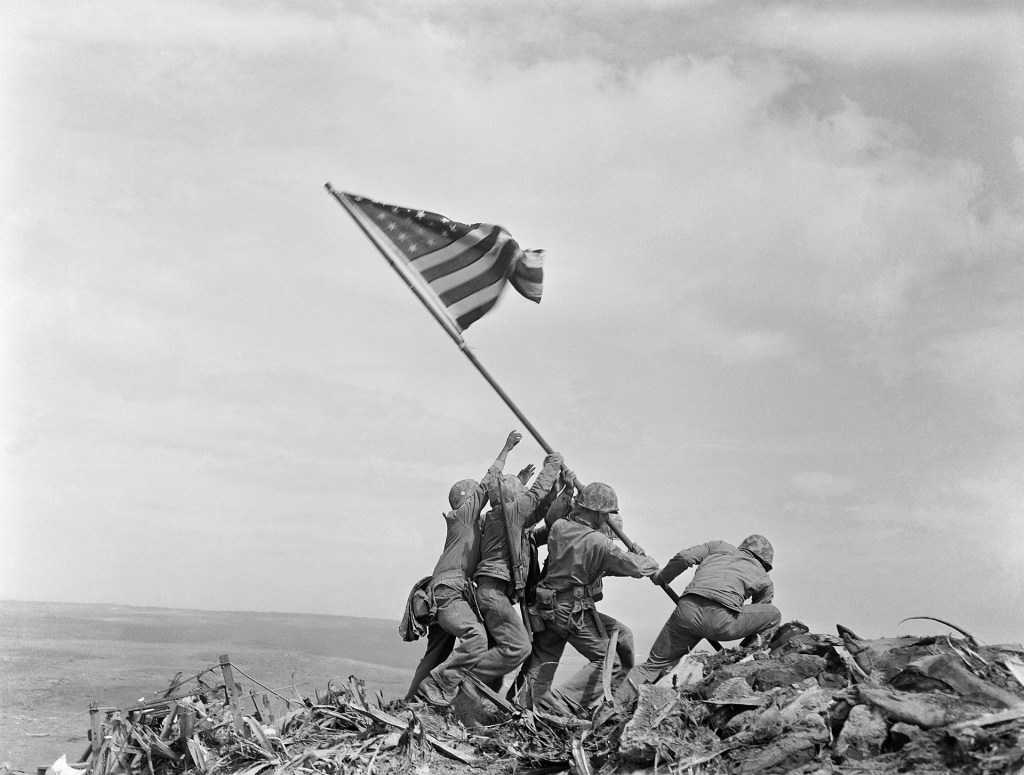
Joe Rosenthal/Associated Press via Fold3

This Memorial Day we have a chance to pause and honor the brave men and women who made the ultimate sacrifice for our country. We owe them such a tremendous debt, for the freedoms we enjoy today were paid for with an extremely high price! Their sacrifices ensured our liberty largely continues today – from the ability to gather with loved ones, to worship together, to speak as we see fit (and the companion right not to be forced to speak that which we know to be false), and to assemble and peacefully protest to effectuate change.

The statue below is outside of the National Archives building in Washington D.C. It is of an ever watchful soldier holding his helmet, sword, and shield. The inscription below the statue reads “ETERNAL VIGILANCE IS THE PRICE OF LIBERTY”.

Guardianship Statute by James Fraser (Photo by Jeff Reed, National Archives)

Let us not be asleep at the wheel. We have forces from within that are intolerant, and this intolerance is being cultivated in our schools, colleges and universities. Speech which a few years ago was considered normal speech, is now being touted as hate speech. And we are now being told that we need to address certain individuals in ways that has no basis in reality.

Six thousand eight hundred twenty-one United States servicemen lost their lives on Iwo Jima. If we do not protect our liberty and freedoms, the sacrifices made by them, and so many more, will have been in vain.

Photo(s) of the Week; The 7th Air Force Bombing Campaign I

Starting on August 10, 1944, the 7th Air Force B-24 Liberators bombed the airfields and troops on Iwo Jima continuously up to the invasion. The goal was not necessarily to bomb the Japanese forces on Iwo Jima into submission, but to disrupt and neutralize the Japanese ability to strike American airfields in the Marianas from Iwo Jima.

USAAF/National Archives via Fold3

Above is a nice photo of a 392nd Bomb Squadron, 30th Bomb Group Consolidated B-24J Liberator after its bomb run with Mount Suribachi in the background. Note the Japanese use of smoke pots in an attempt to obscure the location of the airfields from the bombers. The photo below shows a 42nd Bomb Squadron, 11th Bomb Group B-24J Liberator on its way back to the Marianas after bombing Iwo Jima.

USAAF/National Archives via Fold3

While the 7th Air Force B-24 crews were very accurate in placing their bombs within the target areas, it did not take very long for the Japanese forces to repair the bomb cratered runaways to get the airfields back in service.

Reference:

Strike and Return: American Air Power and the Fight for Iwo Jima, Cory Graff, Specialty Press (2006)