With VLR pilots spending so much time on missions over the vast expanse of the Pacific Ocean, every effort was made to reduce the amount of time a pilot spent in the water or on the water. Naval resources were stationed along the route to pluck pilots out of the Pacific. Submarines were stationed off of the coast of Japan to pick up pilots who were successful in reaching the Pacific before having to bail out or to ditch. Destroyers were stationed along the route, and PBY Catalinas were in the air.
The United States Army Air Force aircraft were also involved in air-sea rescues of their own pilots. Boeing B-17 Flying Fortresses (SB-17s) were modified to carry a motorized 27 foot A-1 Higgins boat to be dropped to downed pilots. North American P-51D Mustangs were also involved in these efforts.
15th Fighter Group members Major James B. Tapp and Captain Vic Mollan combined to develop a droppable rescue kit packaged into a 110 gallon metal drop tank while on Oahu. The picture below shows a life raft rescue kit installed on 15th Fighter Group commander Colonel James O. Beckwith’s P-51D Mustang 15 Squirt.
USAAF/National Archives via Fold3
The kit was contained within a zipper type kapok bag as shown in the photo below and consisted of a A-3 life raft, a Gibson Girl radio, a Naval kit of visual signal equipment, and rations.
Major James B. Tapp inspecting the results of a test of the life raft rescue kit (USAAF/National Archives via Fold3)
When the tank was released, it would separate and a static line would open a parachute that allowed the kit to descend slowly to the pilot in water. The life raft rescue kit was first tested by Major Tapp on December 11, 1944 as shown in the photo below.
Major James B. Tapp tests the life raft rescue kit while on Oahu prior to deploying to Iwo Jima (David Beyl via John W. Lambert)
On December 12, 1944, Major Tapp tested the kit again, this time with 2nd Lt. Charles C. Heil, the 78th Fighter Squadron’s resident swimming champion, in the water off Oahu. The concept and equipment worked so well that the Hickman Air Depot began assembling these kits.
During actual operations on Iwo Jima, the P-51D Mustangs carrying the life raft rescue kits were code named “Josephines”. In the picture below, three 462nd Fighter Squadron Mustangs are flying combat air patrol around Iwo Jima. The P-51D Mustang in the foreground of the photo, 628, is carrying a life raft rescue kits under its left wing and is being flown by Lt. Edward Linfante. The middle Mustang is 602 Metalball and is being flown by Lt. Edward Bahlhorn. The Mustang in the background isbelieved to be 603 Little Joe and most likely being flown by Lt. Jesse Sabin.
Three 462nd Fighter Squadron Mustangs flying Combat Air Patrol around Iwo Jima (506th Fighter Group Association via Ed Linfante)
References:
1. The Long Campaign: The History of the 15th Fighter Group in World War II, John W. Lambert, Schaffer Publishing Ltd. (2006).
Ground crews were anxious for the return of their pilots and planes from the first VLR escort mission to the Japanese Home Islands. The 7th Fighter Command lost only two Mustangs and one pilot (1st Lt. Robert G. Anderson, 531st FS/21st FG) on the April 7th mission.
USAAF/National Archives via Fold3
In the photo above, ground crew watch on as a P-51D Mustang lands on Iwo Jima. If you enlarge the photo, on the other side of the runway are two C-46 Commandos, a C-47 Dakota, a P-51D Mustang, four PB4Y-1 Liberator patrol bombers, and a PB4Y-2 Privateer patrol bomber.
USAAF/National Archives via Fold3
P-51D Mustangs were not the only planes to land on Iwo Jima on April 7th. In the photo above, a damaged B-29 Superfortress lands on the same field. If you enlarge the photo, the prop on the right outside engine has been feathered. It appears that the first two photos were taken by the same 7th Air Force Combat Camera photographer. In this photo, he standing next to the tail of the damaged PV-1 Ventura shown in the first photograph.
USAAF/National Archives via Fold3
In the photo above, ground crew and support personnel clamor around 68 “Victory Belle”, a 45th FS/15th FG Mustang, as the pilot waits to exit the cockpit while discussing the mission with his ground crew. A couple of things to note. First, it does not appear that the twin Uncle Dog antennae have been installed on Victory Belle yet. Second is the wear on the backside of the propeller blade. Only the cuff at the bottom of the propeller blade has retained its color because it was made of a hard rubber composition. The volcanic grit on Iwo Jima took its toll on painted surfaces. I am unaware of any after market decals for Victory Belle.
Major James B. Tapp, 78th FS/15th FG (USAAF/National Archives via Fold3)
In the photo above, Major James B. Tapp, enjoys a sandwich and a cup of coffee after the April 7th mission. Major Tapp was the top scorer on the April 7th mission downing four Japanese fighters that were attacking the B-29 Superfortress formations.
References:
1. The Long Campaign: The History of the 15th Fighter Group in World War II, John W. Lambert, Schaffer Publishing Ltd. (2006).
2. Very Long Range P-51 Mustang Units of the Pacific War; Carl Molesworth; Osprey Publishing Limited (2006).
I am posting this edition of Photo(s) of the Week a day early to observe and commemorate a significant event in the history of Iwo Jima VLR Mustang Groups. Seventy-nine years ago today, 108 P-51D Mustangs of the 15th and 21st Fighter Groups flew their first very long range mission to the Japanese Home Islands escorting 107 B-29s of the 73rd Bomb Wing to Tokyo and back.
1st Lt. Jule Carnes Mitchell, Jr., 47th FS/15th FG, is ready to take off on the first VLR mission to the Japanese Home Islands (USAAF/National Archives via Fold3)
The target for the B-29s was the Nakajima aircraft engine factories on the west side of Tokyo. The B-29s approached the target at 15,000 feet with the P-51Ds several thousand feet above the bombers in combat formation with the 15th Fighter Group on the right and the 21st Fighter Group on the left of the bombers.
1st Lt. Eurich L. Bright being readied in the cockpit of 176 “Moonbeam McSwine” for the April 7, 1945 VLR escort mission (USAAF/National Archives via Fold3)
1st Lt. Eurich L. Bright of the 47th Fighter Squadron, shown in the picture above, was one of the top scorers of the mission being credited with shooting down a Kawasaki Ki-61 Hein (Tony), a Mitsubishi A6M Zero, and a Nakajima Ki-45 Toryu (Nick).
USAAF/National Archives via Fold3
The photo above shows the 47th Fighter Squadron P-51D Mustangs being readied for the April 7, 1945, VLR escort mission to Tokyo. The 110 gallon metal drop tanks would have been mounted on the wings the day before, and filled the morning of the mission. Note the twin Uncle Dog antennae on 186. By the time of this mission, most, if not all the 15th and 21st Fighter Group Mustangs would have had them installed to help them form up with the B-29s on the trip to Japanese Home Islands, and to find their way back to Iwo Jima.
USAAF/National Archives via Fold3
45th Fighter Squadron Mustangs warm up their engines in the photo above as part of the pre-flight preparation for the first VLR escort mission.
For the 7th Air Force Fighter Command, this mission was culmination of several years of being in the Central Pacific theater of operations and waiting to get into the fight on a larger scale. The 15th Fighter Group participated in the defense of Pearl Harbor on December 7, 1941, and then only saw sporadic combat until April 7, 1945. The 7th Fighter Command called themselves the “Sunsetters”, and their primary objective was to help bring the war in the Pacific to an end.
In the photo below, ground crew watch as 45th Fighter Squadron Mustangs move to begin taking off.
USAAF/National Archives via Fold3
Seventeen Mustangs had to abort and return to Iwo Jima, including Brig. General Ernest “Mickey” Moore and 15th Fighter Group commander Colonel James O. Beckwith. The Sunsetters were credited with twenty-six Japanese planes destroyed, one probably destroyed, and five damaged at the cost of two Mustangs and one pilot. Major James B. Tapp of the 78th Fighter Squadron was high scorer shooting down four Japanese defenders. More importantly, no B-29s were shot down by Japanese fighters. Two B-29s were lost to flak, and one to an aerial bomb dropped on the bomber formation.
If you have Eduard’s 1/48 “Very Long Range: Tales of Iwo Jima“ Limited Edition kit (No. 11142), it provides decals for the following pilots and planes that participated in the April 7, 1945 mission: Major Gilmore L. “Buck” Snipes’ 67 “Tom Kat” (45th FS/15th FG); Major James B. Tapp’s 101 Margaret -IV” (78th FS/15th FG); 1st Lt. Eurich L. Bright’s 176 “Moonbeam McSwine” (47th FS/15th FG); Major Paul W. Imig’s 250 “Dede Lou” (72nd FS/21st FG); and Major Harry C. Crim, Jr.’s 300 “My Achin! [Ass].
References:
1. The Long Campaign: The History of the 15th Fighter Group in World War II, John W. Lambert, Schaffer Publishing Ltd. (2006).
2. Very Long Range P-51 Mustang Units of the Pacific War; Carl Molesworth; Osprey Publishing Limited (2006).
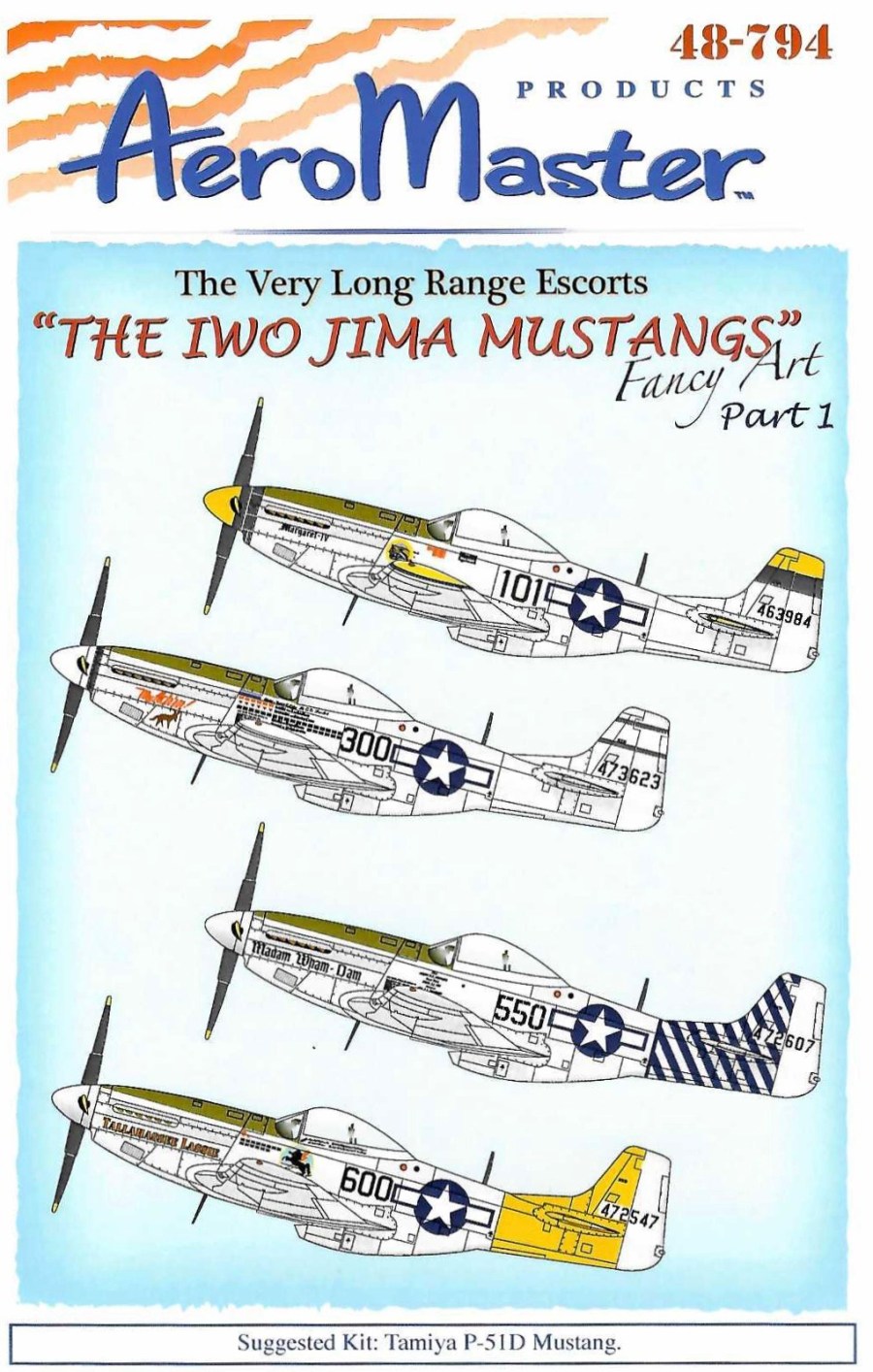
This is AeroMaster’s second decal sheet dedicated solely to Iwo Jima VLR Mustangs. Three additional sheets on Iwo Jima VLR Mustangs would be subsequently issued by AeroMaster under the series “The Very Long Range Escorts ‘The Iwo Jima Mustangs’ Fancy Art.”
AeroMaster Decals
This sheet provides markings for the planes of two VLR aces: Major James B. Tapp’s 101 “Margaret – IV” (8 aerial victories), and Major Harry C. Crim, Jr.’s 300 “My Achin! [Ass]” (6 aerial victories).
AeroMaster Decals
The sheet also provides markings for the planes of two 506th FG squadron commanders: Major Harrison E. Shipman’s 550 “Madam Wham-Dam” (458th FS), and Major Thomas D. DeJarnette’s 600 “Tallahassee Lassie” (462nd FG).
AeroMaster Decals
Originally issued in 2005, the decals look good, are in register and are for the most part accurate. Photo documentation that has recently emerged shows there are a few omissions and errors on this sheet, but this is still a very nice decal sheet.
AeroMaster Decals
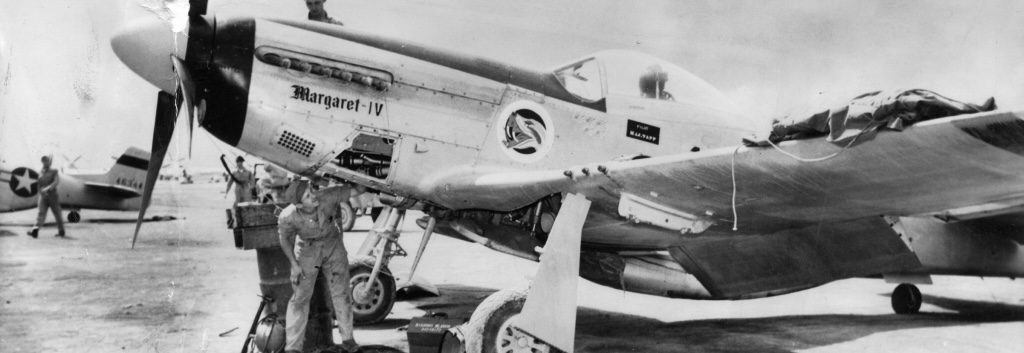
Major James B. Tapp (78thFS/15th FG) – Major Tapp was the second highest scoring VLR Mustang ace with 8 aerial victories. All eight victories were scored in 101 “Margaret – IV” (44-63984), a P-51D-20NA. Major Tapp scored 4 aerial victories on the first VLR mission on April 7, 1945. He scored another victory on April 12, 1945, which represents the 5 victories on the decal sheet.
Major James B. Tapp’s 101 Margaret-IV (7th Fighter Command Association/Mark W. Stevens)
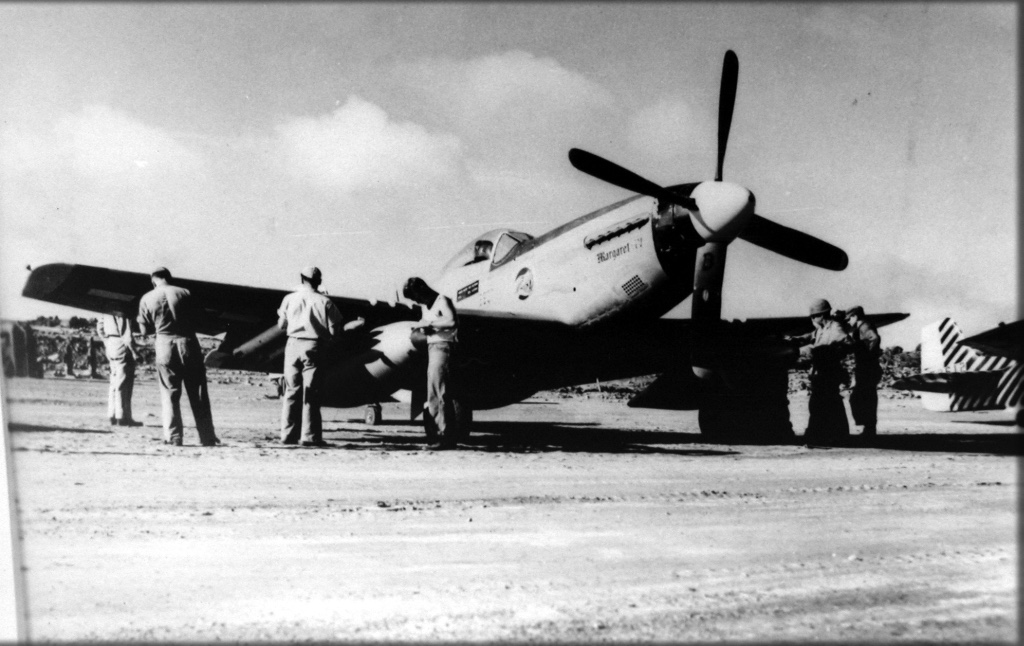
As can be seen from the photo above and the photo below, the name “Margaret – IV” and the Bushmaster squadron emblem are on both sides of the nose. The photo below shows that there are additional markings on the right side of the fuselage below the canopy.
Major James B. Tapp’s 101 Margaret-IV (7th Fighter Command Association/Mark W. Stevens)
This last photo shows the markings on the right side of the fuselage which includes kill and mission markings. In addition to the name of the Crew Chief Sergeant Blanco, there is the name of another ground crew member which is undiscernable from the photo. This photo also shows that the 0 in the fuselage number is broken rather than solid.
Crew Chief Sgt. Blanco on the wing of Major James B. Tapp’s 101 “Margaret-IV” with unknown crew member in cockpit (Brian Walter)
Unfortunately, the kill and mission markings on the right side of Major Tapp’s Mustang are not contained on this decal sheet. The most accurate and complete decals for 101 “Margaret – IV” are found in the Eduard kits.
Major Harry C. Crim, Jr. (531st FS/21st FG) – Major Crim was the 3rd highest scoring VLR ace with six confirmed victories, and the only fighter ace of the 21st FG. He joined the 21st FG in August, 1944, after serving with the 14th Fighter Group in Tunisia flying the Lockheed P-38 Lightning. Unable to score any aerials victories with 14th FG, he scored his first two victories, a Kawasaki Ki-61 “Tony” and a Kawasaki Ki-45 “Nick” on April 7, 1945, the first VLR mission flown by the 7th Fighter Command Mustangs. His last victory, a Mitsubishi A6M Zero, came on July 6, 1945 during a strike mission against Atsugi airfield. Major Crim was also credited with six ground victories.
Assistant Crew Chief Sergeant Stanley McCarro in the cockpit of Major Crim’s 300 “My Achin! [Ass]” (Harry Crim via Tom Ivie/Carl Molesworth)
44-73623 was a P-51D-25NA, and Major Crim’s second VLR Mustang. The kill markings, mission markings, and ground crews’ names appear to be very good on the decal sheet except for Asst. Crew Chief Stanley McCarro’s name being misspelled. The only other deficiency in these decals is the artwork for the donkey/ass.
Major Harry C. Crim Jr.’s 300 “My Achin! [Ass]”
The photo above shows a portion of the canvas wheel well covers which were a standard production feature that were discarded by European Theater Mustang groups, but were maintained in place by the Iwo Jima Mustang groups as a means of keeping sand and volcanic grit out of the wheel wells.
After Major Crim rotated home, “My Achin! [Ass]” was assigned to Flight Officer Theo Gruici, who had Major Crim’s kill and mission markings and the names of the ground crew removed, and had a reclining nude painted on the fuselage. Most decal manufacturers have a nude on the left landing gear cover for Major Crim’s markings, but I have yet to see a photo confirming this. The nude on the left landing gear cover is mostly obscured by the 110 gallon drop tank in the photo below, and it raises the question whether there was a nude also on the right landing gear cover. After inquiring of others who have more extensive photo collections than I do, there does not appear to be any photos of the right side of the plane. Some questions will never be answered.
Flight Officer Theo Gruici’s 300 “My Achin! [Ass]” (7th Fighter Command Association/Mark W. Stevens)
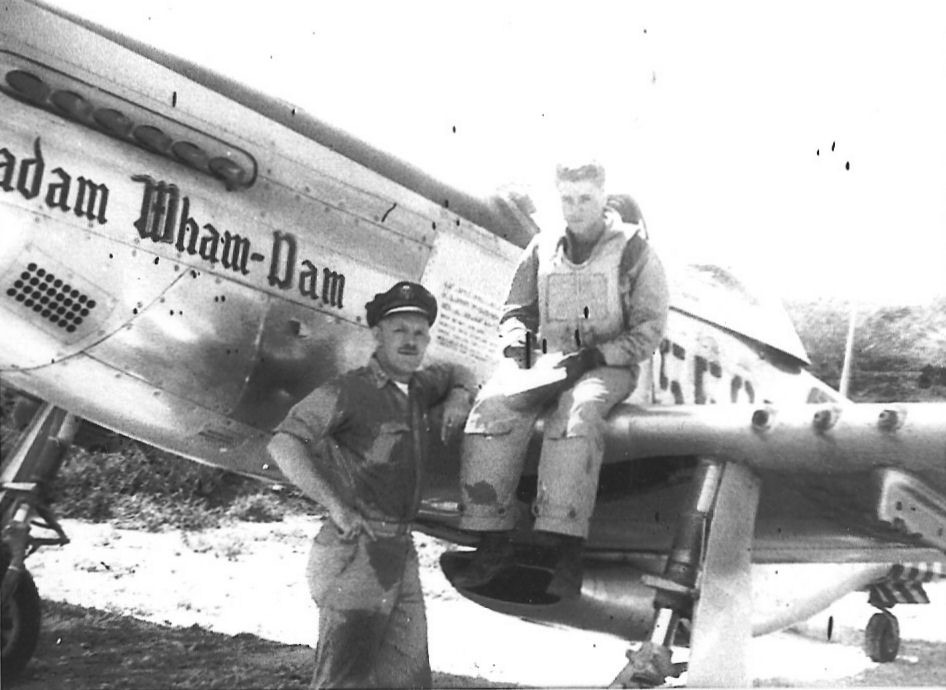
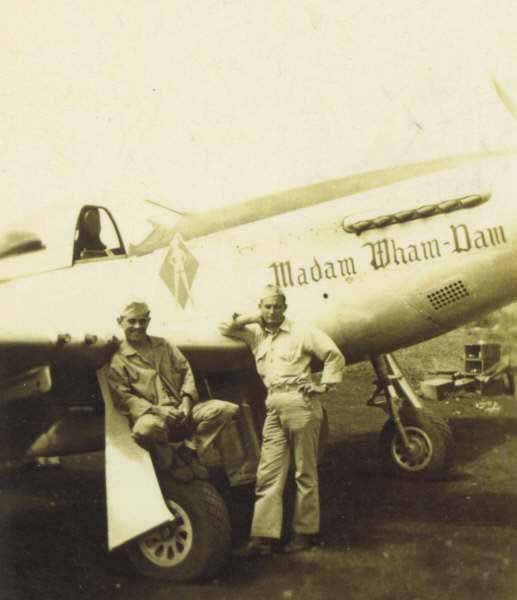
Major Harrison E. Shipman (458th FS/506th FG) – 550 “Madam Wham-Dam”, a P-51D-25NA, 44-72607, was assigned to Major Harrison E. Shipman, commander of the 458th FS. Major Shipman served as the 458th’s commander during the squadron’s time on Iwo Jima, and was not credited with any aerial victories.
Major Harrison E. Shipman in 550 “Madam Wham-Dam” (Harrison E. Shipman via 506th Fighter Group Association)
The actual color of the background for the nude nose art on the right side of the fuselage in front of the cockpit is unknown. AeroMaster provides you with three options; red, blue and yellow. My preference would be blue, but it could be red as well. It appears to be a little too dark for yellow.
Major Harrison E. Shipman sitting on the wing of 550 “Madam Wham-Dam” with Captain Pete Nowick(Harrison E. Shipman via 506th Fighter Group Association)
“Madam Wham-Dam’s” time on Iwo Jima was short lived. She arrived on either May 11th or the 13th and was lost on the disastrous June 1, 1945, Black Friday mission with 506th FG Deputy Commander Lt. Col. Harvey J. Scandrett at the controls.
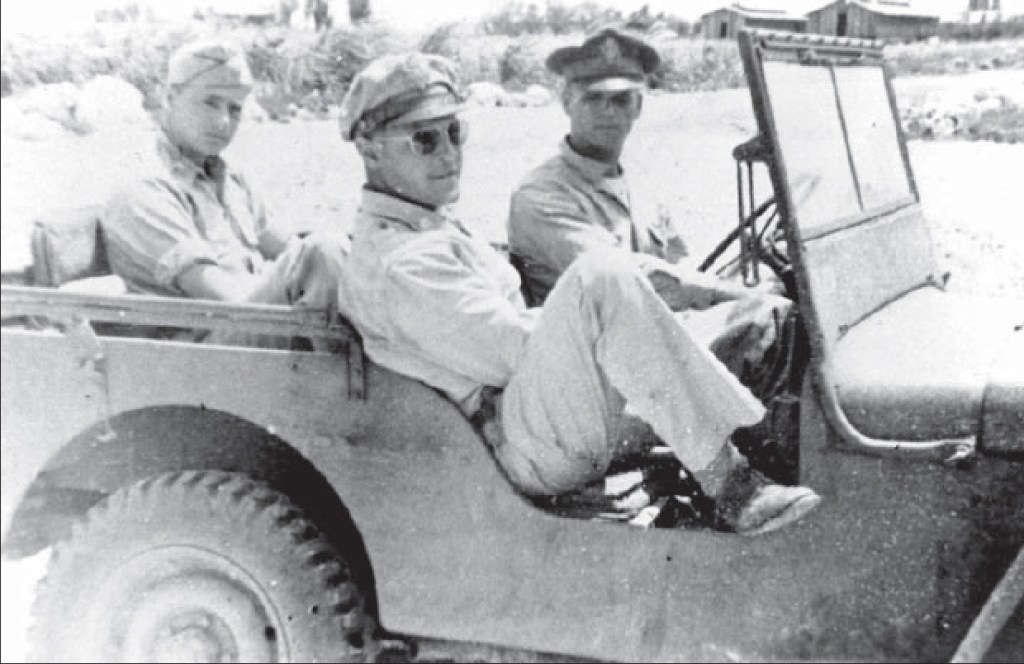
Major Harrison E. Shipman and Lt. Col. Harvey J. Scandrett with “Madam Wham-Dam” (Harrison E. Shipman via 506th Fighter Group Association)
Please note the last two photos of “Madam Wham-Dam” and the color of the main landing gear legs. They are considerably darker than the main landing gear legs on either Major Tapp’s “Margaret – IV” or Major Crim’s “My Achin! [Ass]” which suggests that they have been painted. I have also seen what appears to painted landing gear legs in pictures of 21st Fighter Group Mustangs.
506th Fighter Group Squadron Commanders from left to right: Major Harrison E. Shipman (458th), Major Thomas D. DeJarnette (462nd), and Major Malcolm C. “Muddy” Waters (457th) (Harrison E. Shipman via James Shipman)600 “Tallahassee Lassie” (Curt Gwaltney via Carl Molesworth)
Major Thomas D. DeJarnette (462nd FS/506th FG) – 600 “Tallahassee Lassie”, a P-51D-20NA, 44-72547, was also flown by Lt. Col. Harley Brown, Deputy Commander of the 506th Fighter Group. DeJarnette and Brown were well acquainted with each other having flown Bell P-39 Airacobras in combat with in 80th Fighter Squadron, 8th Fighter Group in New Guinea earlier in the war. Major DeJarnette is in the back row of the photo above, second from the left. Lt. Col. Brown is to Major DeJarnette’s left.
Major DeJarnette was credited with shooting down a Kawasaki Ki-61 ‘Tony’ on the June 10, 1945 escort mission to the Tokyo area. Lt. Col. Brown was credited with damaging a Nakajima Ki-84 ‘Frank’ on the July 19, 1945 fighter strike mission against targets in the Nagoya and Osaka areas. Both men survived the war.
This decal sheet has been long out of production but you can still find it on eBay with the other sheets in the series. Although there are a few inaccuracies and omissions, it is still a quality decal sheet.
If you are wanting to purchase a more recently produced decal sheet for some of these planes, DK Decals has produced a 1/72 scale sheet containing markings for “My Achin! [Ass] and “Madam Wham-Dam”. My review of this sheet is found here:
Very Long Range P-51 Mustang Units of the Pacific War; Carl Molesworth; Osprey Publishing Limited (2006).
As a condition of the use of materials from the 7th Fighter Command Association website, the following disclaimer is included: Permission to use, copy and distribute documents delivered from this Worldwide Web server and related graphics is hereby granted, provided 1) That the use of the data will not be used for obtaining a profit of any kind, and 2) That the above disclaimer notice appear in all copies and that both that disclaimer notice and this permission notice appear. All other rights reserved. The name of “7th Fighter Command Association” may not be used in advertising or publicity pertaining to distribution of this information without specific, written prior permission. Mark Stevens and the 7th Fighter Command Association makes no representations about the suitability of this information for any purpose. It is provided “as is” without express or implied warranty. Mark Stevens and the 7th Fighter Command Association disclaim all warranties with regard to this information, including all implied warranties of merchantability and fitness. In no event shall Mark Stevens or the 7th Fighter Command Association be liable for any special, indirect or consequential damages or any damages whatsoever resulting from loss of use, data or profits, whether in an action of contract, negligence or other action, arising out of or in connection with the use or performance of this information.
This is AeroMaster’s first decal sheet dedicated solely to Iwo Jima VLR Mustangs. Four additional sheets on Iwo Jima VLR Mustangs would be subsequently issued by AeroMaster.
AeroMaster Decals
This sheet provides markings for the planes of the three top VLR aces: Major Robert W. Moore’s 67 “Stinger VII” (12 aerial victories), Major James B. Tapp’s 101 “Margaret – IV” (8 aerial victories), and Major Harry C. Crim, Jr.’s 300 “My Achin! [Ass]” (6 aerial victories).
AeroMaster Decals
In addition, it provides markings for a 458th FS, 506th FG Mustang, 551 “Delta Queen”, flown by Captain J.B. Baker, Jr.
AeroMaster Decals
Originally issued in 1995, the decals are pretty accurate, but more accurate photo documentation has emerged to show there are omissions and errors on this sheet. Onto the planes, pilots and the decals.
AeroMaster Decals
Major Harry C. Crim, Jr. (531st FS/21st FG) – Major Crim was the 3rd highest scoring VLR ace with six confirmed victories, and the only fighter ace of the 21st FG. He joined the 21st FG in August, 1944, after serving with the 14th Fighter Group in Tunisia flying the Lockheed P-38 Lightning. Unable to score any aerials victories with 14th FG, he scored his first two victories, a Kawasaki Ki-61 “Tony” and a Kawasaki Ki-45 “Nick” on April 7, 1945, the first VLR mission flown by the 7th Fighter Command Mustangs. His last victory, a Mitsubishi A6M Zero, came on July 6, 1945 during a strike mission against Atsugi airfield. Major Crim was also credited with six ground victories.
Assistant Crew Chief Sergeant Stanley McCarro in the cockpit of Major Crim’s 300 “My Achin! [Ass]” (Harry Crim via Tom Ivie/Carl Molesworth)
44-73623 was a P-51D-25NA, and Major Crim’s second VLR Mustang. The kill markings, mission markings, and ground crews’ names appear to be very good on the decal sheet except for Asst. Crew Chief Stanley McCarro’s name being misspelled. The only other deficiency in these decals is the artwork for the donkey/ass.
Major Harry C. Crim, Jr.’s 300 “MyAchin! [Ass]”
The photo above shows a portion of the canvas wheel well covers which were a standard production feature that were discarded by European Theater Mustang groups, but were maintained in place by the Iwo Jima Mustang groups as a means of keeping sand and volcanic grit out of the wheel wells.
After Major Crim rotated home, “My Achin! [Ass]” was assigned to Flight Officer Theo Gruici, who had Major Crim’s kill and mission markings and the names of the ground crew removed, and had a reclining nude painted on the fuselage. Most decal manufacturers have a nude on the left landing gear cover for Major Crim’s markings, but I have yet to see a photo confirming this. The nude on the left landing gear cover is mostly obscured by the 110 gallon drop tank in the photo below, and it raises the question whether there was a nude also on the right landing gear cover. After inquiring of others who have more extensive photo collections than I do, there does not appear to be any photos of the right side of the plane. Some questions will never be answered.
Flight Officer Theo Gruici’s 300 “My Achin! [Ass]” (7th Fighter Command Association/Mark W. Stevens)
Major James B. Tapp (78thFS/15th FG) – Major Tapp was the second highest scoring VLR Mustang ace with 8 aerial victories. All eight victories were scored in 101 “Margaret – IV” (44-63984), a P-51D-20NA. Major Tapp scored 4 aerial victories on the first VLR mission on April 7, 1945. He scored another victory on April 12, 1945, which represents the 5 victories on the decal sheet.
Major James B. Tapp’s 101 “Margaret -IV” (7th Fighter Command Association/Mark W. Stevens)
As can be seen from the photo above and the photo below, the name “Margaret – IV” and the Bushmaster squadron emblem are on both sides of the nose. The photo below shows that there are additional markings on the right side of the fuselage below the canopy.
Major James B. Tapp’s 101 “Margaret – IV” (7th Fighter Command Association/Mark W. Stevens)
This last photo shows the markings on the right side of the fuselage which includes kill and mission markings. In addition to the name of the Crew Chief Sergeant Blanco, there is the name of another ground crew member which is undiscernable from the photo. This photo also shows that the 0 in the fuselage number is broken rather than solid.
Crew Chief Sergeant Blanco standing on the wing of Major Tapp’s 101 “Margaret – IV” with unknown crew member in cockpit (via Brian Walter)
Unfortunately, the kill and mission markings on the right side of Major Tapp’s Mustang are not contained on this decal sheet.
Major Robert W. “Todd” Moore (45th FS/15th FG) – Major Moore was the highest scoring VLR ace with 11 VLR aerial victories. He had one aerial victory with the 15th FG prior to arriving on Iwo Jima. 44-63483, a P-51D-20NA, was first assigned to Major Gilmore L. “Buck” Snipes and was named “Tom Kat”.
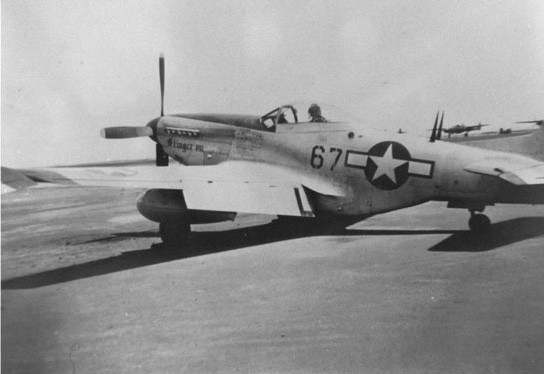
The three photos below provide some different marking variations for 67 “Stinger VII” during the time it was assigned to Major Moore. From these photos it appears that Major Moore was assigned to 67 during the time the squadron was transitioning from their original markings to the more simplified markings.
Below is a Loomis Dean photograph which show 67 “Stinger VII” with an unpainted spinner and the diagonal wing bands still in place as evidenced by the bands wrapping over the leading edge of the wing. It also appears that rails for HVAR rockets have been installed under the wings which can be seen just above the drop tanks on the left wing. These were field modifications as rocket rails were not installed at the factory during Block 20 production.
Major Robert W. Moore with 67 “Stinger VII” (USAAF/National Archives via Fold3)
The photograph below, while not the best in quality, appears to show that the diagonal bands have been removed from the wings, but still are present on the tail surfaces. It does not appear that the spinner has been painted solid green yet. Please also note that the number 67 also appears on the main landing gear covers. This was common practice for 45th FS Mustangs. Unfortunately, the this decal sheet does not provide the decals for the landing gear covers.
Major Robert W. Moore’s 67 “Stinger VII”
The last photo shows 67 “Stinger VII” with the simplified markings of a solid green spinner, green wing tips, green horizontal stablizer/elevator tips, and (assuming) green tail tip.
Major Robert W. Moore’s 67 “Stinger VII” (Robert W. Moore via Tom Ivie/Carl Molesworth)
Captain J.B. Baker, Jr. (458th FS/506th FG) – Captain Baker was the Flight Leader of “A” Flight of the 458th FS, and was assigned to a P-51D-20NA (44-72579) which was numbered 551, and he named “Delta Queen”.
Captain J.B. Baker, Jr.’s 551 “Delta Queen” (via Dr. John Benbow)
Captain Baker was credited with one aerial victory, a Nakajima Ki-44 Shoki which he shot down on a June 23, 1945 escort mission to the Nagoya and Kobe areas. He was also credited with a probable, a Mitsubishi JM2 Raiden during an strike mission against airfields in the Tokyo area, and two ground victories.
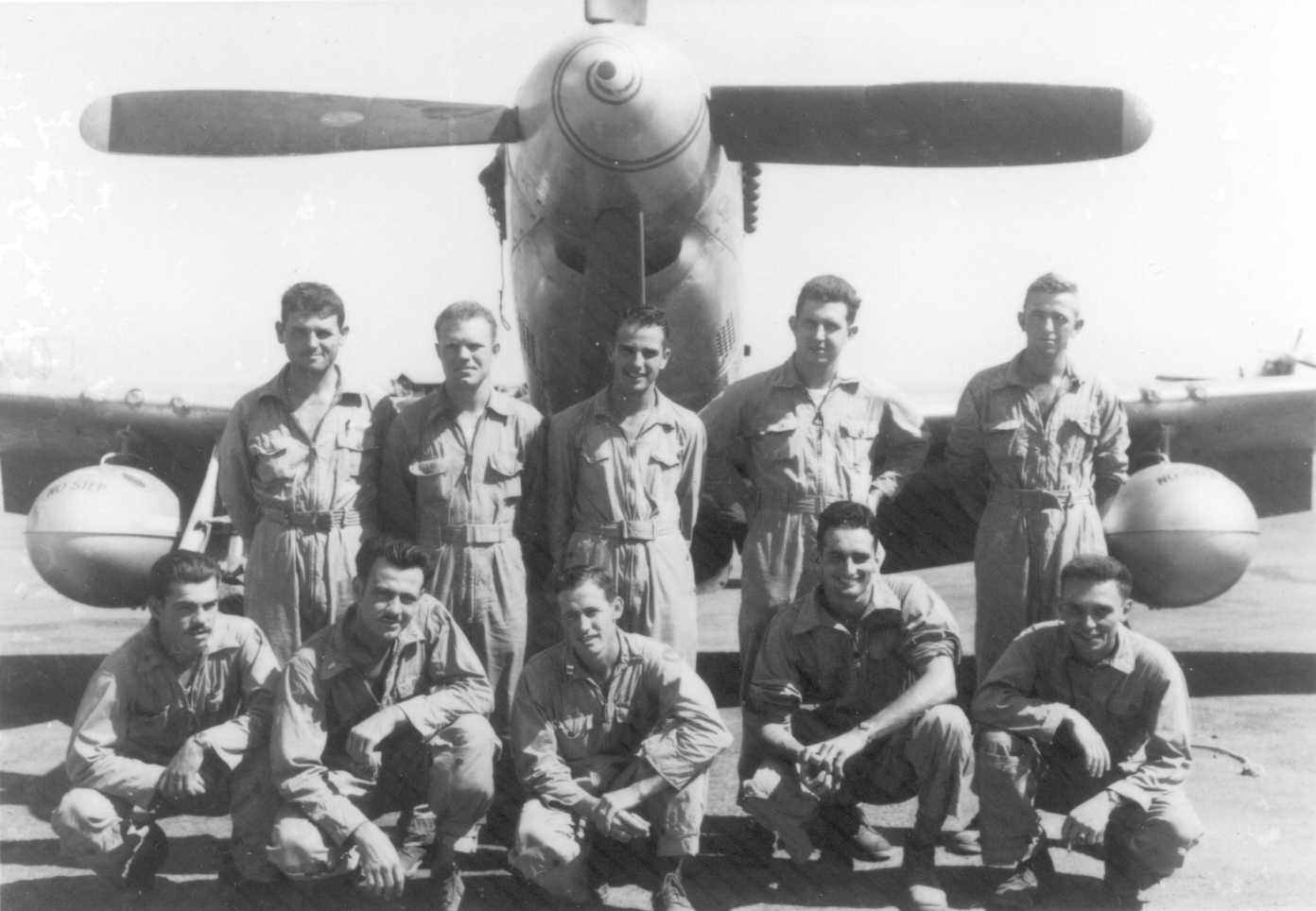
“A” Flight of 458th FS (back row, left to right – Norman Dostal, Henry Seegers, Ed Mikes, James Coleman, Raymond Feld; front row, left to right – Vance Middaugh, Bennett Commer, J.B. Baker, Jr., Robert Tatro) (Ralph Coleman via Dr. John Benbow)
Missing from this decal sheet are the dive angle markings on the wings which were applied to all 506th Mustangs. This sheet also provides two markings for the plane name “Delta Queen”, one is red and one in yellow. While the general consensus is that the plane name is yellow, it is nice to have both options.
This decal sheet was designed and sized for the Tamiya kit. I am not aware if the decals for the dark blue stripes on the tail of “Delta Queen” will fit properly on the Airfix, Hasegawa, HobbyBoss, ICM, Meng, and Revell/Monogram kits.
This is a very nice decal sheet, but it is no longer in production and is difficult to find. It shows up on eBay every so often, and Ultracast has one in stock at an inflated price of $34.95. If you are wanting to build a 1/48 Iwo Jima VLR Mustang with one of these markings, I would recommend buying the Eduard’s Very Long Range: Tales of Iwo Jima Limited Edition Kit (#11142). The decals in this kit include accurate markings for all of these planes (plus markings for 8 other planes).
As a condition of the use of materials from the 7th Fighter Command Association website, the following disclaimer is included: Permission to use, copy and distribute documents delivered from this Worldwide Web server and related graphics is hereby granted, provided 1) That the use of the data will not be used for obtaining a profit of any kind, and 2) That the above disclaimer notice appear in all copies and that both that disclaimer notice and this permission notice appear. All other rights reserved. The name of “7th Fighter Command Association” may not be used in advertising or publicity pertaining to distribution of this information without specific, written prior permission. Mark Stevens and the 7th Fighter Command Association makes no representations about the suitability of this information for any purpose. It is provided “as is” without express or implied warranty. Mark Stevens and the 7th Fighter Command Association disclaim all warranties with regard to this information, including all implied warranties of merchantability and fitness. In no event shall Mark Stevens or the 7th Fighter Command Association be liable for any special, indirect or consequential damages or any damages whatsoever resulting from loss of use, data or profits, whether in an action of contract, negligence or other action, arising out of or in connection with the use or performance of this information.









 Iwo Jima Models