The image above is a United States Army Air Force photo taken on Iwo Jima in July, 1945. The official caption for this photo reads, “Men of the 21st Bomber Command gather around the American Red Cross truck to relax over a cup of coffee and doughnuts after returning from a raid over Japanese installations. July 1945”. If they landed on Iwo Jima, the return trip was not complete.
The strategic importance of Iwo Jima to both Japan and the United States could not be overstated. Iwo Jima, part of the Bonin Islands, was approximately half way between the Mariana Islands and the Japanese Home Islands. For Japan, it provided a base from which their air forces could intercept B-29 bomber formations heading from the Marianas to the Home Islands, and from which to bomb 20th Air Force B-29 bases on Guam, Tinian and Saipan, which Japan did with some success.
For the United States, it not only provided a base for the VLR Mustang groups to fly escort and strike missions to the Home Islands, but also provided combat damaged and fuel starved B-29s a safe haven during the long over-water flights back to the Marianas. Many crippled B-29s landed safely on Iwo Jima and avoided ditching in the vast Pacific Ocean somewhere between the Home Islands and the Marianas.
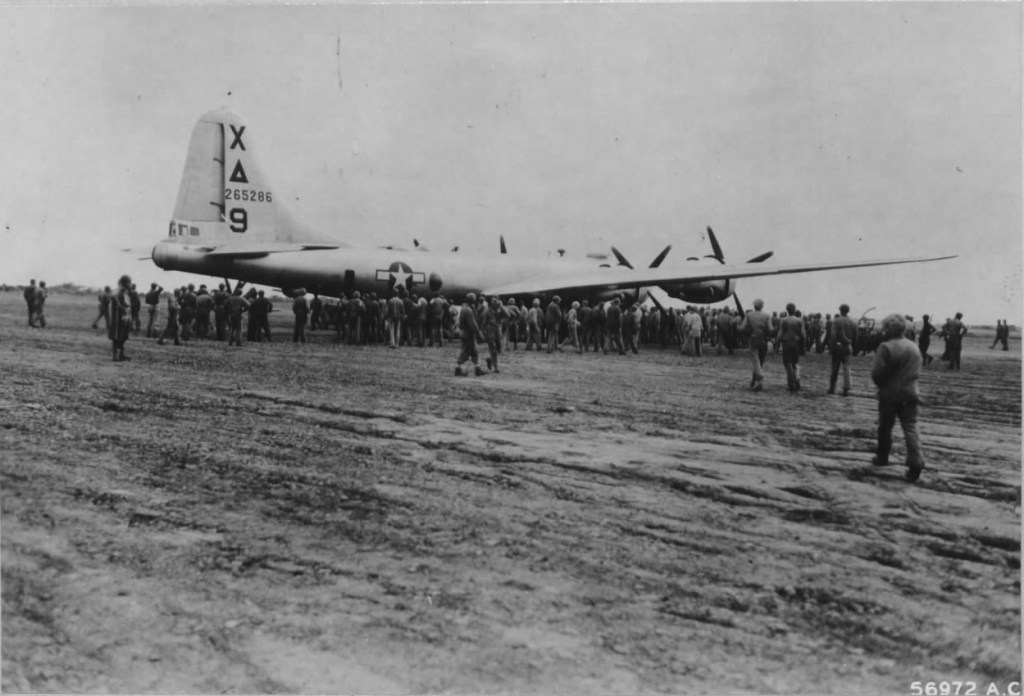
Boeing B-29A Superfortress “Dinah Might” on Iwo Jima (USAAF/National Archives via Fold3)
On March 4, 1945, Dinah Might was the first B-29 to make an emergency landing on Iwo Jima, just 13 days after the United States Marines stormed Iwo’s black sand beaches. With the battle still raging on between the Marines and Japanese forces, 1st Lt. Raymond F. Malo put his 1st BS/9th BG Superfortress down on South Field due to the inability to transfer fuel between tanks. As the picture above shows, Dinah Might was surrounded by hundreds of Marines and SeeBees. Mechanics made field repairs quickly, and after being refueled, 1st Lt. Malo lifted her off South Field while being fired at by Japanese forces.
Dinah Might’s emergency landing was the first of 2,451 forced landings on Iwo Jima. On June 7, 1945, 102 B-29s landed on Iwo Jima, and on July 24, 1945, another 186 B-29s landed on South and North Fields. As the picture below testifies to, Iwo Jima at times looked like a B-29 base.
USAAF/Loomis Dean/National Archives via Fold3
Kits-World makes decals in 1/72nd scale for Dinah Might for anybody interested in building the Academy kit into this history making B-29.
The photo below shows a North American P-51D Mustang receiving extensive maintenance from no less than 7 ground crew members on Iwo Jima. Neat photo that could be used for the basis a very busy diorama. You can make out the plane’s serial in the photo, which is 44-63959. This was a P-51D-20NA Mustang assigned to 462nd Fighter Squadron, 506th Fighter Group. I received the photo from Richard Smith, who is the son of Captain Lawrence S. Smith. Captain Smith was one of pilots lost during the infamous June 1, 1945, “Black Friday” mission.
644 “Sandra Leigh” (Richard Smith)
The plane’s fuselage number was 644. Please note that the stubs for carrying 5-inch high velocity aircraft rockets (HVARs) have been installed on 644. These were a field modification as the stubs were not factory installed on Block 20 Mustangs.
644 “Sandra Leigh” (506th Fighter Group Association via Richard Smith)
644 was flown by Flight Officer Harry Reese who named the plane, “Sandra Leigh”. Flight Officer Reese was not credited with any aerial or ground victories.
644 “Sandra Leigh” (506th Fighter Group Association via Harry Reese)
Below is a nice photo of Flight Officer Reese with a 20 mission crush on his cap.
Flight Officer Harry Reese (506th FG Association via Harry Reese)
There are no aftermarket decals in any scale for 644 “Sandra Leigh”. Thanks to Richard Smith for providing me with the top photo.
In his editorial in the January 2024 edition of Eduard Info, Vladimir Sulc announced the future release of the Eduard 1/72 North American P-51D Mustang. Eduard had previously indicated their intention to scale down their phenomenal 1/48 P-51D kit, so while it did not come as a complete surprise, it is great news.
Eduard
Eduard’s releases of their 1/48 P-51D kits covered every production block of the D model from the early filletless D-5 through the D-25, including the needed parts for the D-20/25 Iwo Jima VLR Mustangs and kits for the P-51K and the F-6D/K photo reconnaissance versions. The hope is that Eduard will follow suit with their 1/72 P-51D kits.
Eduard
The projected release of this kit is June of this year, the same month Eduard will be releasing their new 1/48 P-51B Mustang. With Arma Hobby releasing their 1/72 P-51D Mustang in the first quarter of this year, it is a good year to be a Mustang modeler.
UpRise Decals from St. Petersburg, Russia has released decal sheets featuring two 457th Fighter Squadron, 506th Fighter Group North American P-51D-25-NA Mustangs in 1/72nd, 1/48th, and 1/32nd scales.
UpRise produces decals for both World War II and modern military aircraft, civil aircraft and airliners, helicopters, ordinance, and insignia. Their website can be found here: https://uprise-decal.ru/
UpRise Decals
Decals are provided for 542 “Fighting Lady” (Serial No. 44-72570), and 528 “The Enchantress” (Serial No. 44-72671). Both of these planes are popular among modelers because of the pin up art which adorned their fuselages.
The decals are lazer printed and look exceptionally good, and each sheet comes with the dive angle stripes that appeared on the leading edge of the top of the wings and most of the exterior stencils that appeared on 506th FG P-51D Mustangs. The extensive exterior stencil decals are a nice nice touch on UpRise Decals’ part.
UpRise DecalsUpRise DecalsUpRise Decals
528 “The Enchantress” was assigned to 2nd Lt. William E. Saks. 2nd Lt. Saks went Missing in Action on the infamous June 1st “Black Friday” escort mission to Osaka in which 27 Mustangs and 24 pilots of the 15th, 21st and 506th Fighters Groups were lost to severe weather conditions encountered between Iwo Jima and the Japanese Home Islands. His Missing Air Crew Report indicates that he was flying a different P-51D-25 Mustang (Serial No. 44-72885) on that mission. The Enchantress survived the war and was transferred to Japan as part of the occupation forces after the cessation of hostilities.
528 “The Enchantress” (506th Fighter Group Association)
It is unknown if a second pilot was assigned initially to fly The Enchantress along with 2nd Lt. Saks, and if any other pilots were specifically assigned to the plane after 2nd Lt. Saks was lost on June 1st. We are unable to locate an individual picture of 2nd Lt. Saks, or a group picture that includes him. The picture below is of Dr. Theodore Paprocki, the 457th squadron’s medical officer, sitting on the wing of The Enchantress. Note the wear of the paint on the back sides of the propeller blades (uncuffed portions) due to the sand and volcanic ash on Iwo Jima.
Dr. Theodore Paprocki sitting on the wing of “The Enchantress (506th Fighter Group Association via Maurita Paprocki)
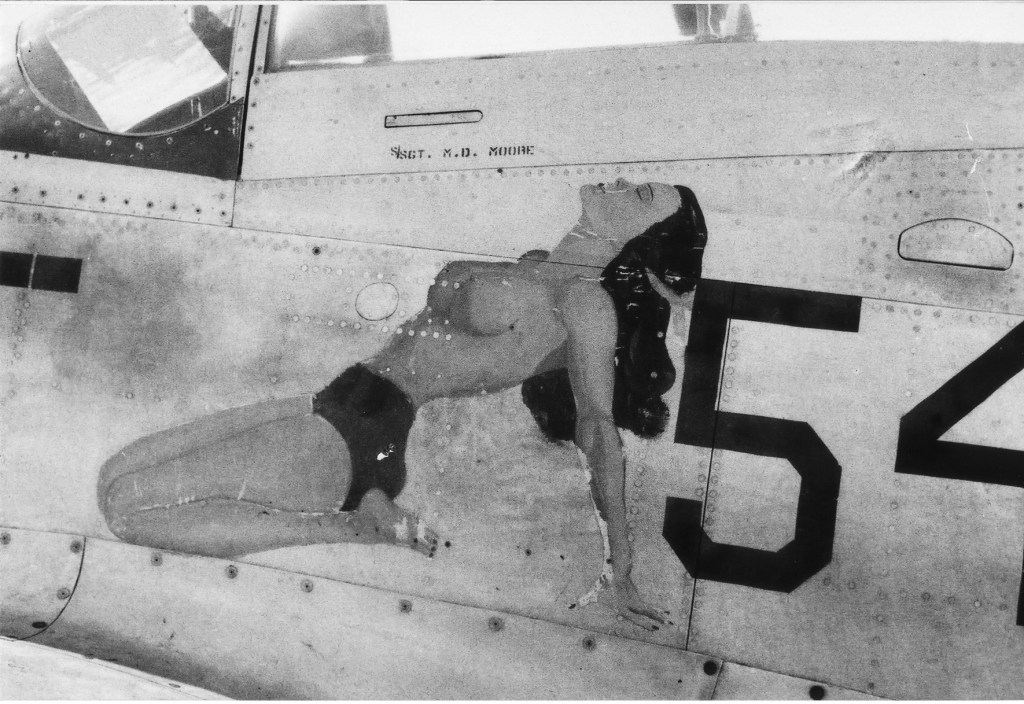
The other decals are for 542 “Fighting Lady” which was assigned to 1st Lt. Ralph Gardner and 1st Lt. Chester Jatzcak. Below is a nice close up picture of the pin up art that adorned the fuselage.
542 “Fighting Lady (506th Fighter Group Association)
While the quality of the below photo is not the best, it does clearly show the position of the name “Fighting Lady” on the nose below the engine exhaust stacks and the elegant design of the Mustang’s nose.
Unknown ground crew member lying on the wing of “Fighting Lady” (506th Fighter Group Association)
Norma Jatczak, 1st Lt. Chester Jatczak’s wife, was of the belief that the plane’s name was “Broadway Gal”. Unfortunately, the 506th Fighter Group Association does not have a photo to substantiate her belief.
1st Lt. Chester Jatczak crouched on the wing of “Fighting Lady” (506th Fighter Group Association via Norma Jatczak)
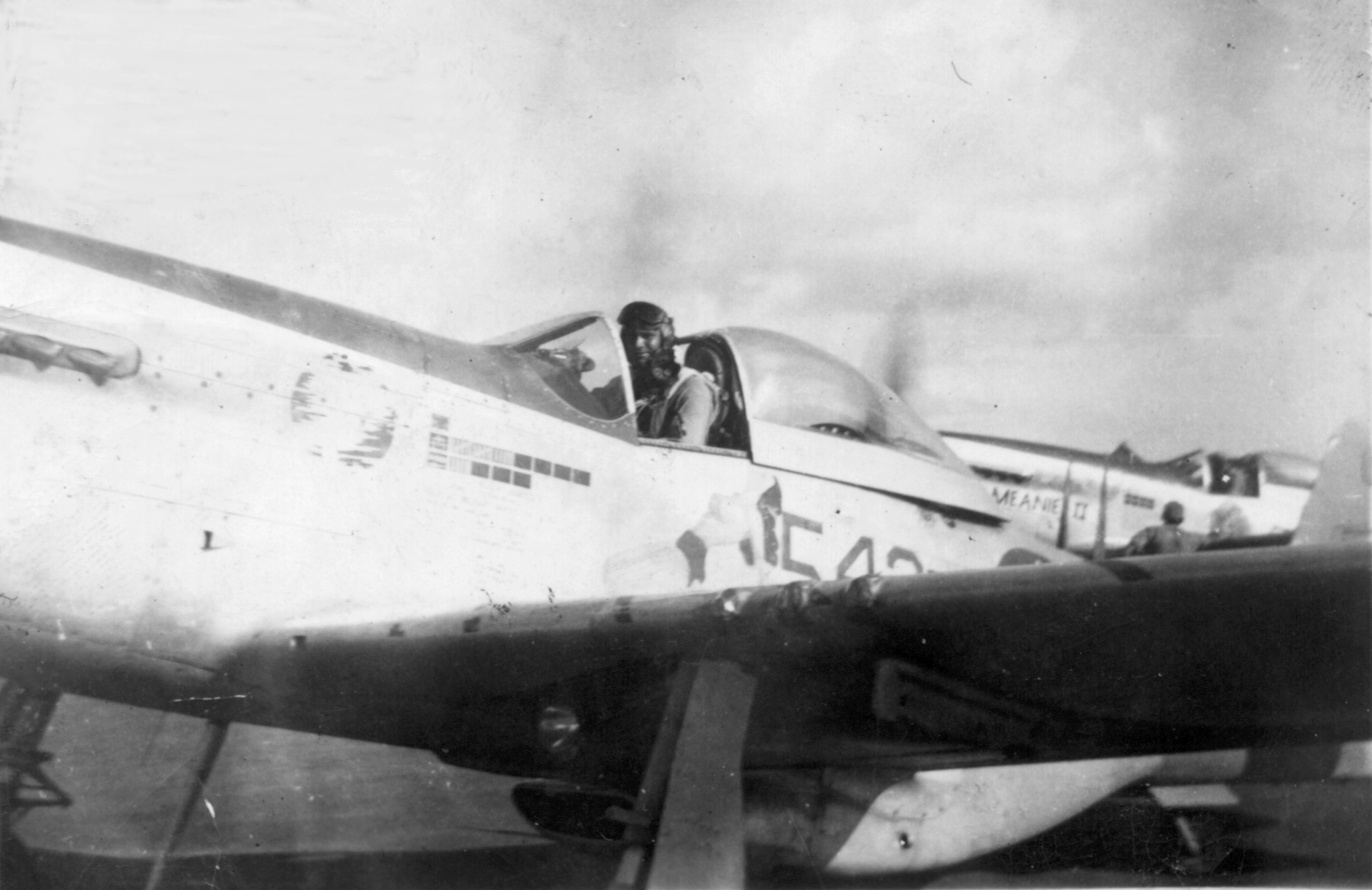
Please note the photo below does not have the name “Fighting Lady” on the nose yet. This photo was likely taken in June of 1945 as the plane has a solid green tail instead of the initial squadron markings of diagonal green stripes on the tail.
1st Lt. Ralph Gardner in the cockpit of “Fighting Lady” (506th Fighter Group Association)
I interviewed Ralph Gardner at the 2013 506th Fighter Group Reunion in Chino, California, but did not think to inquire about the whether the plane had the name of “Broadway Gal” at one point in time, or whether the name was on the right side of the nose. The photo below appears to dispel the notion that “Broadway Gal” appeared on the right side of the nose.
1st Lt. Ralph Gardner flying “Fighting Lady (506th Fighter Group Association)457th Fighter Pilots in front of “Fighting Lady” – Front row left to right; Lts. Alan Kinvig and George Hetland; Back row left to right; Lts. Ray Miller, Martin Ganschow, Ralph Gardner and Larry Grennan (506th Fighter Group Association via Ralph Gardner)
UpRise Decals uses Film Free Ability (FFA) for their decals. This is the technology that allows the modeler to remove the clear film that covers the decal during production. The initial application of FFA decals is the same as regular water slide decals. After applying the decals, whisking away the excess water, and working out any air bubbles from under the decals, you let the decals sit for 24 hours, and then gently remove the film that covers the decals. Without any film surrounding the decals, they look like they are painted on. Really nice!
A tutorial/description of UpRise Decals’ Film Free Ability decals is found here: https://uprise-decal.ru/ffa. There are also several YouTube videos providing tutorials on how to use these and similar decals from other manufacturers.
UpRise Decals can be purchased on eBay from two vendors who appear the be the same person. When I initially purchased these decals, the FFA was only available on their 1/32nd decal sheets, but now all their decals (1/144th, 1/72nd, 1/48th, 1/32nd and 1/24th) produced from November 2022 forward use the FFA technology. If you want to use UpRise’s FFA decals, you need to check to make sure that the particular decal sheet you are buying has the FFA technology. There are probably some the regular water slide decals still being sold or resold on eBay.
The thought of using a paint brush to hand paint the details on a 1/48th scale instrument panel has just never appealed to me. I am assuming I could do a decent job, but maybe I just lack the patience for that work. Kit supplied decals for the instrument panels, at least for me, have never quite looked the part.
So, thank goodness for Eduard, and other companies, that continue to provide innovative products to help modelers increase the level of detail and realism of model cockpits. This will be a quick comparison of Eduard’s photoetch, LooK, and Space instrument panels for Eduard’s 1/48 P-51D Mustang.
Eduard’s Pre-Painted Photo Etch Instrument Panel: My first experience with a photo etch instrument panel came from Eduard’s photo etch set for Academy’s 1/72 Consolidated PBY-5A “Black Cat” Catalina kit. It was an unpainted brass instrument panel front and a clear piece of acetate with the dial faces painted on. I painted the brass front black and sealed it with clear coat, and then sandwiched the clear acetate between the painted instrument panel front and a white piece of plastic card stock cut to the shape of the instrument panel. It was finished with a small drop of Microscale Industries Micro Kristal Klear in each dial to simulate the glass. It was definitely a step up in appearance from just slapping the kit supplied decal on the instrument panel kit piece.
Now we have exquisitely pre-painted photo etch frets that come with all of the pieces to make a highly detailed instrument panel. The main portion of Eduard’s photo etch instrument panel in their P-51D Mustang kit comes in three pieces that are sandwiched together. Eduard has developed the technology to simulate the glass covering the dials on the middle piece so that you no longer need to use Micro Kristal Klear to simulate the glass. Very nice touch. Eduard’s photo etch frets that come in the Profipack boxings also come with seat belts, other cockpit pieces, and some exterior pieces.
Eduard 1/48 Photo Etch Parts from the “Very Long Range: Tales of Iwo Jima” Kit
The downside to using these pre-painted photo etch sets is that there are numerous small pieces that are difficult to handle and to get in place. Although I enjoy using photo-etch update sets, the smaller pieces can really test one’s patience.
Eduard’s LooK Instrument Panel: Eduard’s “LooK” instrument panels are cast in black resin with colour printed dials, bezels, switches, knobs and more. The benefit of these products is that they take very little time to separate from their casting block, clean-up and assemble. No painting, no little photo etch parts to attach, and they are drop fit replacement parts for whatever kit they are made for. The standard LooK package also come with Eduard’s pre-painted steel seatbelts. Eduard also produces a LooK Plus version that comes with resin pieces such as exhaust stacks, tires, etc. . .
Eduard 1/48 P-51D-15+ LooK Instrument PanelPhoto Etch Seat Belts that are included with LooK Instrument Panel
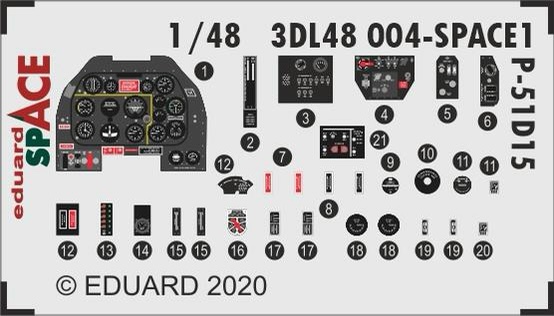
Eduard’s Space Instrument Panel: The Eduard Space product line are 3D instrument panels on decal sheets. These are decals that show actual relief of the instrument dial bezels, switches, toggles, etc . . . The sets not only come with the instrument panels, but also other cockpit details, and a fret of photo etch seat belt parts and levers.
Photo Etch Fret that is included with Space 3D Instrument Panel
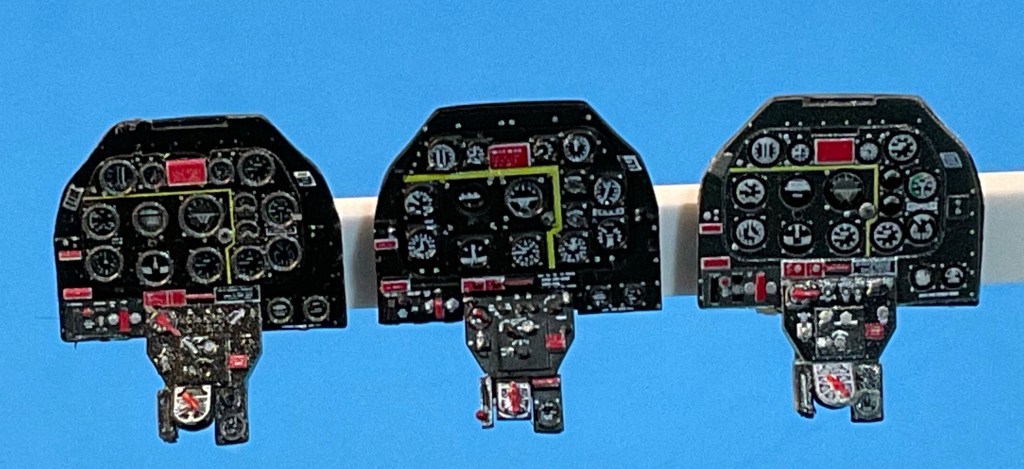
Below are the finished instrument panels with the photo etch instrument panel on the left, the LooK instrument panel in the middle, and Space instrument panel on the right. All three look very nice.
My preference is the photo etch instrument panel due to the quality of the bezels around the instrument dials. To me, they just make the photo etch instrument panel more realistic, but I would have no problem using either the LooK or Space instrument panels. The Space instrument panel took about the same amount of time to create as the photo etch instrument panel did. If you are looking for a great looking instrument panel with the least amount of work, then the LooK instrument panel is your choice.
Comments regarding what your preferences are, and your likes and dislikes about these products are welcome!
Kudos to Eduard for continuing all three product lines, and giving modelers choices. I highly recommend all three products.
Next up: A review of new decals for 457th Fighter Squadron, 506th Fighter Group Mustangs from UpRise Decals.









 Iwo Jima Models