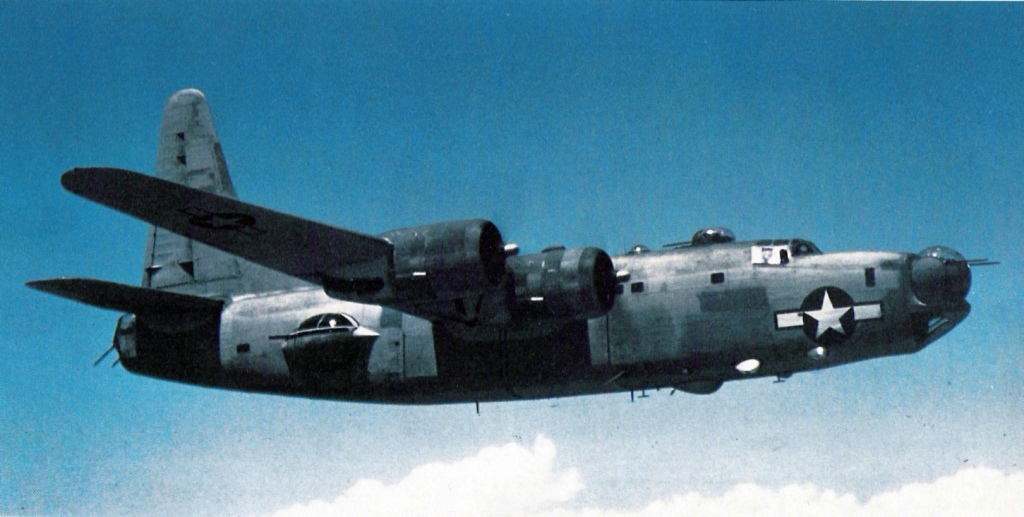
One plane that has been neglected by the mainstream injection molded model manufacturers is the Consolidated PB4Y-2 Privateer. Patrol bombers tend not to get a lot of love. While I often see the PB4Y-2 on a lot of modelers’ informal “wish lists” of kits they would like to see manufactured, that interest has not translated in a new injection molded kit being released.
This is not to say that a kit of PB4Y-2 has never been released. Matchbox released a PB4Y-2 in 1/72 scale way back in 1980. Revell reissued the kit in 2009, but the kit is seriously lacking by today’s standards.
After market manufacturers have stepped into to fill that void. Since Monogram’s release of its 1/48 scale Consolidated B-24J Liberator in 1976, several after market vacuform and resin manufacturers (Attic Aircraft, Concise Models & Graphics, Cutting Edge Modelworks, Koster Aero Enterprises, Wilde Sau Resin) have produced conversion parts to convert the Monogram B-24 kit into a PB4Y-2 Privateer. I have seen some really nice PB4Y-2 builds converted from the Monogram B-24 kit.
Mike West of Lone Star Models recently announced the upcoming release of a 1/48 scale full resin kit of the PB4Y-2 Privateer, with white metal parts, metal main landing gear struts, vacuformed clear pieces, and a large decal sheet. The price of the kit is listed at $290.00 which does not appear to be out of line since it is an all resin 1/48 scale four engine bomber.
Lone Star Models
Below are pictures from Lone Star Models’ website showing some of the resin, white metal and vacuformed kit pieces.
Lone Star ModelsLone Star ModelsLone Star Models
I have purchased several resin products from Lone Star Models over the years and have been impressed with the level of detail and the quality of casting.
If you are contemplating purchasing this kit, there are few things you need to know. First, Lone Star Models is a one man operation. Mike West does all of the product development, casting, order processing, and shipping. Because of a high demand for his products, he has to periodically shut off ordering on his website so that he can catch up with casting, processing, and shipping orders. If you are expecting a quick turnaround after ordering this kit, you might be disappointed.
Second, from time to time, this kit will not be available to order on Lone Star Model’s website (https://lonestarmodels.com/). As I am drafting this post, the kit is listed as “Out of Stock”, which means that Mike has sold the stock he has on hand. Once he has built back up his stock, it will become available to purchase. This is just one of the ways Mike has had to resort to so he does not fall too far behind. If you want to order this kit, you just have to be patient.
Since the kit has not actually been released yet, there have not been any on-line reviews.
A Consolidated PB4Y-2 Privateer kit has been on the top of my “wish list” for the last decade, and I have not seen any indication that any of the mainstream model manufacturers (Eduard, Hasegawa, Revell, Tamiya etc . . .) are even contemplating producing a PB4Y-2 in the foreseeable future. This may be a modeler’s only option for a complete kit for quite some time.
On March 1, 1945, just 11 days after the United States Marines stormed Iwo Jima’s black sand beaches, Lt (jg). Noah B. Butt, Jr. of VC-76 landed his General Motors FM-2 Wildcat (White 4) on South Field after experiencing difficulties with a drop tank. White 4 was the first U.S. Navy plane to land on Iwo Jima.
USAAF/National Archives via Fold3
Wanting to build an FM-2 Wildcat involved in the Battle for Iwo Jima, I was pleased to see Arma Hobby release a FM-2 Wildcat in 1/72 scale. I researched on-line build reviews for both the 1/48 Hobby Boss FM-2 and the 1/72 Arma Hobby FM-2, and decided to go with the Arma Hobby kit.
Founded in 2013, Arma Hobby is a Polish model manufacturer that has been releasing 1/72 airplane kits, and they are set to release their first 1/48 kit shortly. I have been following them for the last few years waiting for them to release a kit I wanted to build.
Arma Hobby
As is customary for Arma Hobby, they have released several boxings of this kit; an Expert Set (with photo-etch parts and masks), and two basic kits. There are three sprues included in the basic kit; one with fuselage, wings, and engine; one with cockpit, undercarriage, and horizontal surfaces; and one with the clear parts.
The casting is very well done with a minimal amount of flash, and the level of detail is very impressive for a 1/72 kit. The recessed panel lines and other surface detail are very nice and not overstated.
The level of detail in the cockpit parts is extremely nice and both types of wheels are included. Some of the undercarriage parts are quite delicate, but that is what you would expect for a 1/72 scale Wildcat.
The canopy comes in two parts so you can you can show off all that nice cockpit detail with an open canopy. The canopy parts are clear and thin.
The instructions are very well done with good illustrations. Decals are provided for White 29, flown by Lt (jg). Heatherly Foster, III, (VC-93/USS Petrof Bay); and White 35, flown by Lt. Ralph E. Elliot, Jr. (VC-27/USS Savo).
Arma HobbyArma Hobby
The decals, printed by Techmod, are in register and come with a lot of stencil details which will show up nicely on overall glossy Dark Sea Blue planes.
Arma Hobby
This looks like a really nice kit for 1/72 scale. I have red a few on-line builds, and it appears that it is well engineered without a lot of fit issues. Looking forward to building this kit.
William Glenn Ebersole was born on September 30, 1924, in Arcadia, Florida. Upon graduation from high school, he entered the University of Florida in Gainesville, as a freshman in September, 1942. Wanting to control his entry into active service in the armed forces, he enlisted in the Air Corps Reserve on October 31, 1942, shortly after turning 18. The thought that he might have two years of college before being called up was short lived as he was ordered to report for active duty on February 24, 1943, in Miami Beach, Florida. On his way to earning his wings, Bill flew in Stearman PT-17s, BT-13s, and AT-6s. He received his wings and a 2nd Lieutenant’s commission on April 15, 1944, at Craig Field in Selma, Alabama, as part of class 44-D. During his training as a fighter pilot, Bill flew the Curtiss P-40N Warhawk, and the A, B, C and D models of the North American P-51 Mustang.
Loomis Dean/USAAF/National Archives via Fold3
Bill was assigned to the 462nd Fighter Squadron of the 506th Fighter Group in early January of 1945. When deployed to Iwo Jima, half of the squadron’s fighter pilots ferried their brand new P-51D Mustangs to San Francisco, where they were loaded on the escort carrier Kalinin Bay and set out for Tinian. The other half of the pilots, which included 2nd Lieutenant Ebersole, took a troop train to Seattle, and then boarded the converted Swedish hospital ship, the Bloemfontein. They sailed from Seattle to Hawaii, Eniwetok Atoll, Tinian, and then finally to Iwo Jima.
William G. Ebersole via Brian Walter
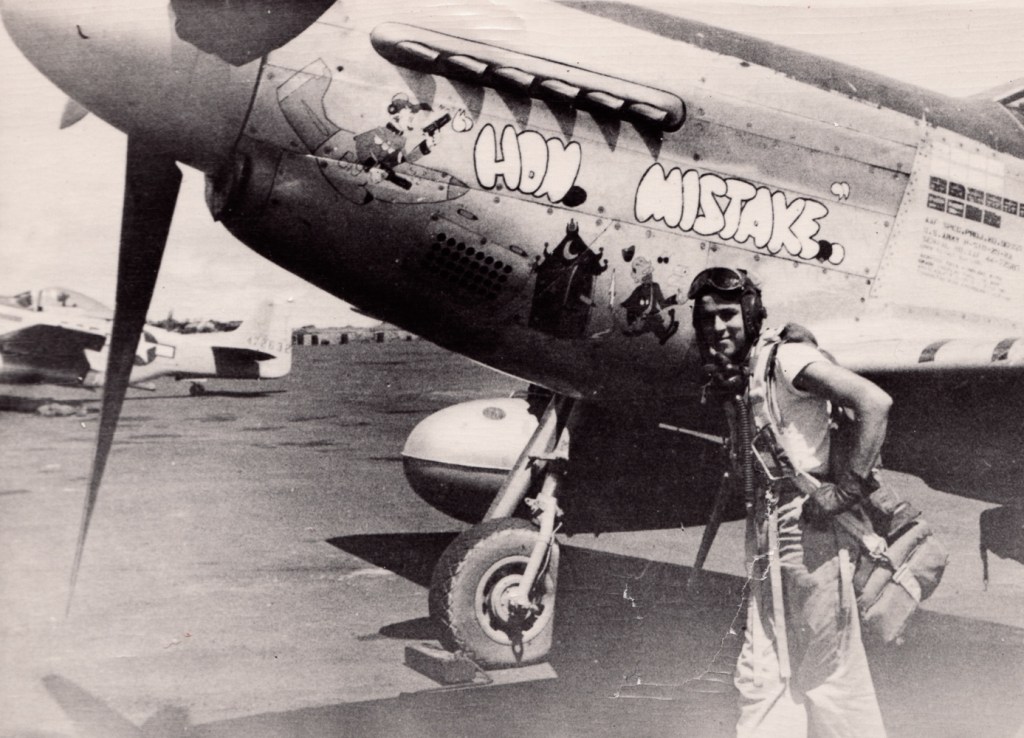
Bill was the youngest pilot in the 462nd Squadron at the ripe old age of 20 years while on Iwo Jima, and flew a total of 10 VLR missions, the first being on June 7, 1945 to Osaka, and the last being on August 5, 1945, to Tachikawa. He was assigned to fly 619 “Hon. Mistake”, a North American P-51D-20-NA Mustang (Serial # 44-72587) with 2nd Lt. James Bercaw. While on Iwo Jima, he was promoted to 1st Lieutenant, and was credited with destroying a twin engine bomber on the ground during a strafing mission. Bill took his last flight in a P-51D Mustang on December 4, 1945, when he led a flight of 4 planes from Guam to Isley Field on Saipan. From there, he took a ship for the long trip back to the United States.
Bill Ebersole re-enrolled at the University of Florida, and received a Bachelor of Arts in Journalism. At the pinnacle of his career, he was the publisher of The Gainesville Sun.
Bill was scheduled to take a return trip to Iwo Jima with his wife Anna in March of 2020 as part of veterans’ flight, but never took that trip due to the COVID-19 pandemic.
Brad McClenny/Gainesville Sun
Bill was a frequent attendee at 506th Fighter Group reunions. I first met Bill at the Iwo Jima VLR Symposium at the Planes of Fame Air Museum in 2012. Bill graciously spent several hours answering all of my questions, and I was fortunate to get to know Bill during several 506th Fighter Group reunions. His daughter, Glenda Ebersole Potts, said “I never met a man as good as my father . . . they don’t make’em like that anymore.” Anybody who knew Bill would heartily concur.
Bill Ebersole with the author during the Iwo Jima VLR Symposium at the Planes of Fame Air Museum, Chino California (July 7, 2012)
Happy New Year! Thank you to all who are following this blog, those who check in occasionally, and those who have stumbled here by mistake. I am not sure how to best describe 2020 globally, but here in the United States, it has been a strange and difficult year on so many different levels. For 2021, it is my prayers that you remain safe and healthy, and have a productive and fulfilling year.
A new feature of the blog will be to showcase the models built by you! If you have built a model related in anyway to Iwo Jima, please consider sharing that build with all of us. It does not matter if you are a beginner, novice or expert. Below are some categories:
Any VLR Mustang from either the 15th, 21st or 506th Fighter Groups;
506th Fighter Group Association
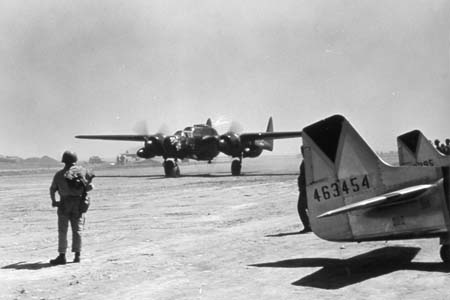
Any Northrup P-61A/B Black Widows from the 548th Night Fighter Squadron;
USAAF/National Archives via Fold3
Any United States Navy combat aircraft that participated either in the early raids from June 14, 1944 to August 5, 1944, or during the Battle for Iwo Jima (Curtiss SB2C Helldivers, General Motors FM-2 Wildcats, Grumman F6F Hellcats and TBF/TBM Avengers, and Chance Voight F4U Corsairs);
USAAF/National Archives via Fold3
Any 7th Bomber Command Consolidated B-24J Liberator which bombed Iwo Jima from U.S. Army Air Force bases in the Marianas;
USAAF/National Archives via Fold3
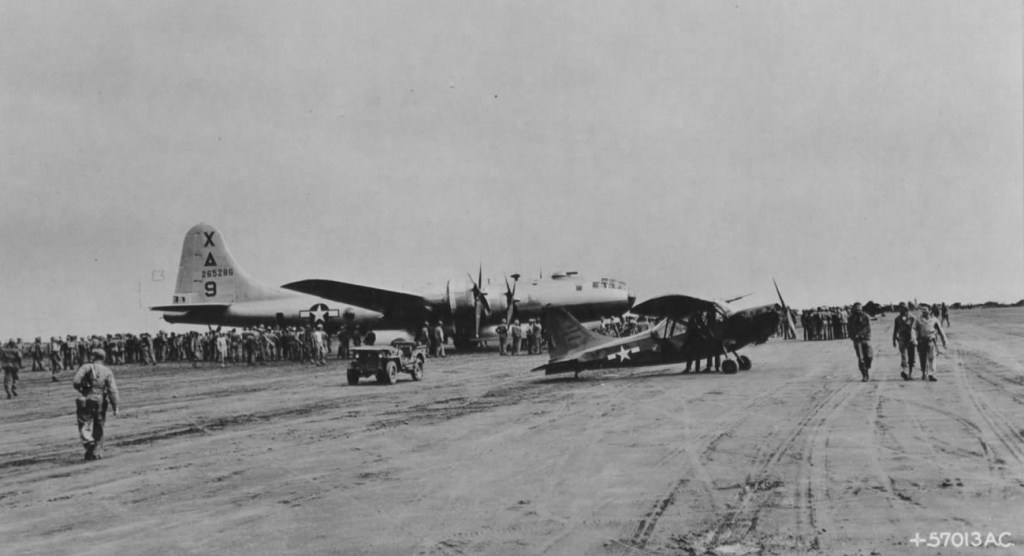
Any Marianas based Boeing B-29 Superfortress which bombed the Japanese Home Islands; and
USAAF/National Archives via Fold3
Any IJAAF or IJNAF fighter that participated in the defense of Iwo Jima or the defense of the Japanese Home Islands.
Wikipedia
If you would like to show your work here, please send me pictures of your build along with a narrative. The narrative can include information on the pilot/crew, squadron/group/unit, after market products used, if any, and any techniques used. Photos and narratives should be sent to: acarothers896@gmail.com.
I believe these are unprecedented times for modelers as far the the range of products that are available. We have seen the emergence of new kit manufacturers, and because of advances in design technology, the quality of kits (engineering) has improved to the point that more and more kits are easier to build without a lot of fit issues.
After market manufacturers have also taken advantage of advances in technology. In addition to traditional products such as photo-etch update sets, resin update sets, vacuformed canopies, white metal and brass landing gear sets, and brass machine gun and canon barrels, we are now seeing a proliferation of after market manufacturers producing 3-D decals for instrument panels and cockpit details. Because of advances in 3-D printer capability, some after market resin manufacturers are turning to 3-D printing of parts and away from the labor intensive and wasteful manual casting process.
Model paints have basically stayed the same as far as the types paints manufactured (acrylics, enamels and lacquers), but we have seen the emergence of new manufacturers, like Hataka Hobby and MRP, attempts improve on existing paints formulas, and the introduction of different lines of paints by certain manufacturers. We have at our disposal a variety of really good model paints with ever increasing ranges of colors.
One of the manufacturers introducing multiple lines of paint is AK Interactive. AK Interactive started with water based acrylic paints for armor, aircraft, and figures. Since that time, they have introduced a line of metallic paints (Extreme Metals), a line of acrylic lacquers for World War II and modern military vehicles and aircraft (Real Colors), and a new line of water based acrylics (3rd Generation Acrylics).
My initial attraction to their Real Colors line of acrylic lacquers was the range of their colors (114 colors for AFV and 133 colors for aircraft), and the fact that they have what appears to be a full line of paints for World War II Japanese Army and Navy aircraft. AK Interactive touts this line of paints as being developed in close consultation with experts who have spent years researching paints used by various combatants. The time spent by AK Interactive researching colors definitely shows. For instance, if you are a modeler that focuses on Luftwaffe aircraft, AK Interactive Real Colors Air series has 3 variations of RLM 76 (Lichtblau), and 3 variations of RLM 81 (Braunviolett) to take in account standard and late war variations.
Compatibility with other acrylic lacquer paint lines is a selling point pushed very hard by AK Interactive. The Real Colors line comes with its own thinner which AK Interactive labels as “High Compatibility Thinner” meaning that you can use it to thin other acrylic lacquer paints, such as Mr. Color and Hataka Hobby acrylic lacquers. Likewise, AK Interactive promotes that you can thin Real Colors with other acrylic lacquer thinners, like Mr. Color Leveling Thinner, and you can mix Real Colors with other acrylic lacquer paints.
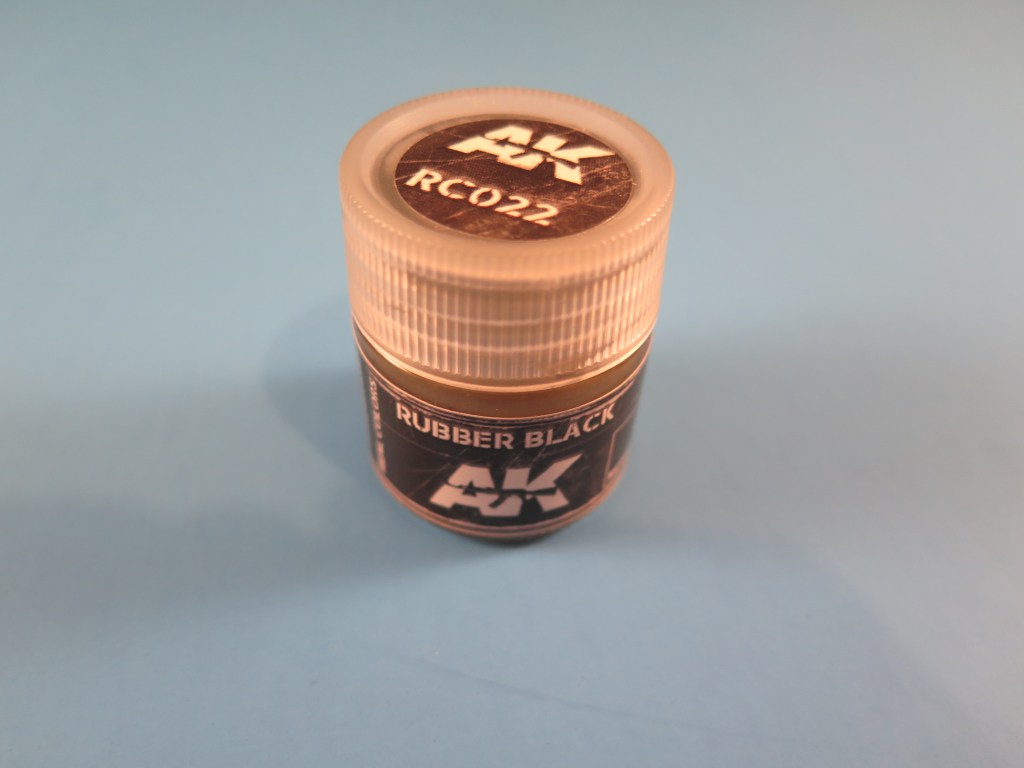
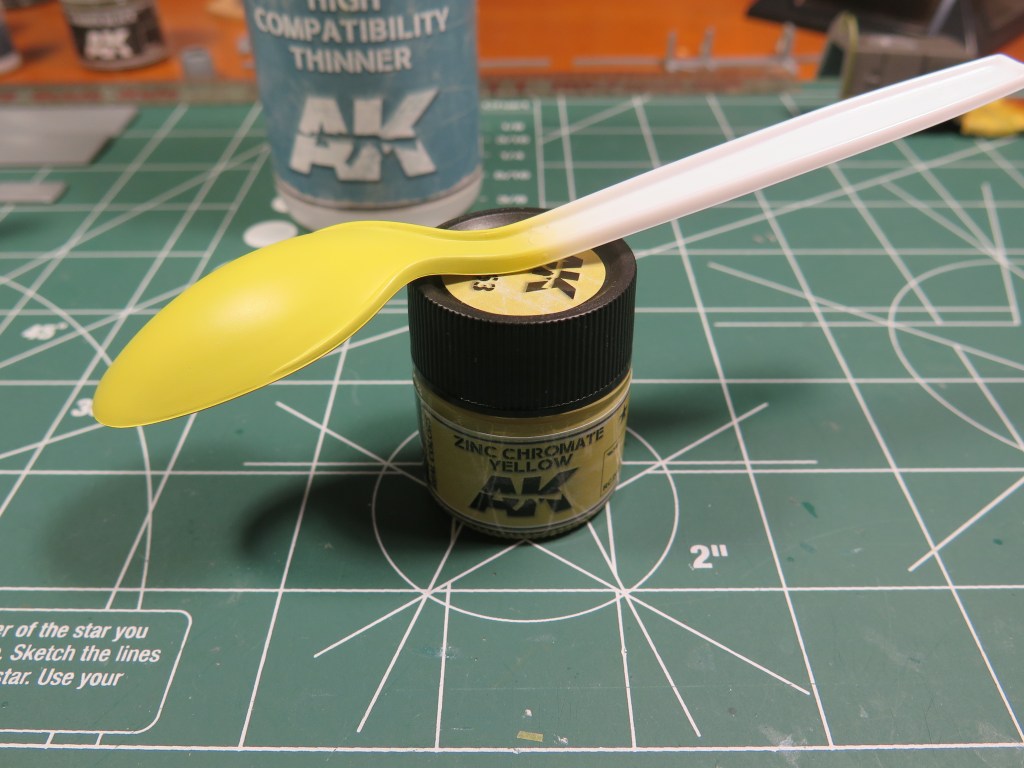
The paints come in 10 ml glass bottles and can be purchased individually or in convenient sets of four. I purchased the WW2 US Interior Color set (Dull Dark Green, RC230; US Interior Yellow Green, RC262; Zinc Chromate Yellow, RC263; and Bronze Green, RC264) and a few individual paints. The 10 ml bottle is the same type of bottle used by Tamiya, and has the color and the product number on the lid for easy identification.
I am going to test Real Colors using their own thinner, Mr. Color Leveling Thinner, Hataka Hobby’s acrylic lacquer thinner, and 91% isopropyl alcohol. The paints do not have an overly strong odor and mix very easily by just shaking the bottle.
The first is a test on a plastic spoon using Dark Dull Green, FS34092 (RC230) with AK Interactive’s High Compatibility Thinner. While the paint is not as thick as Mr. Color lacquers, it does need to be thinned. I thinned the Dark Dull Green at a rate of 2 parts paint to 1 part thinner to see how it would spray at that ratio, and sprayed it at 16 psi. The paint laid down beautifully to a smooth matte to semi-matte sheen and covered well. I did have an issue of getting a little paint spit when resuming to paint. I am not sure why the paint did this, but it may have been because the paint was not thinned sufficiently, or I was not spraying at a high enough pressure.
Next was US Interior Yellow Green (RC262) on a plastic spoon using Mr. Color Leveling Thinner at a ratio of 1 part paint to 1 part thinner. I increased the pressure to 20 psi. The paint thinned really well using the Mr. Color Leveling Thinner and again laid down beautifully to a very smooth matte to semi-matte finish. I did not experience the problem with the paint spitting after thinning it more and increasing the pressure. The paint dries within a few minutes to a very tough finish.
Next was Zinc Chromate Yellow (RC263) on a plastic spoon using the Hataka Hobby acrylic lacquer thinner at a ratio of 1 part paint to 1 part thinner at 20 psi. The paint thinned well using Hataka Hobby’s acrylic lacquer thinner, and again laid down beautifully to a very smooth matte to semi-matte finish. I did not experience the problem with the paint spitting. Even with a lighter color, the paint covered well.
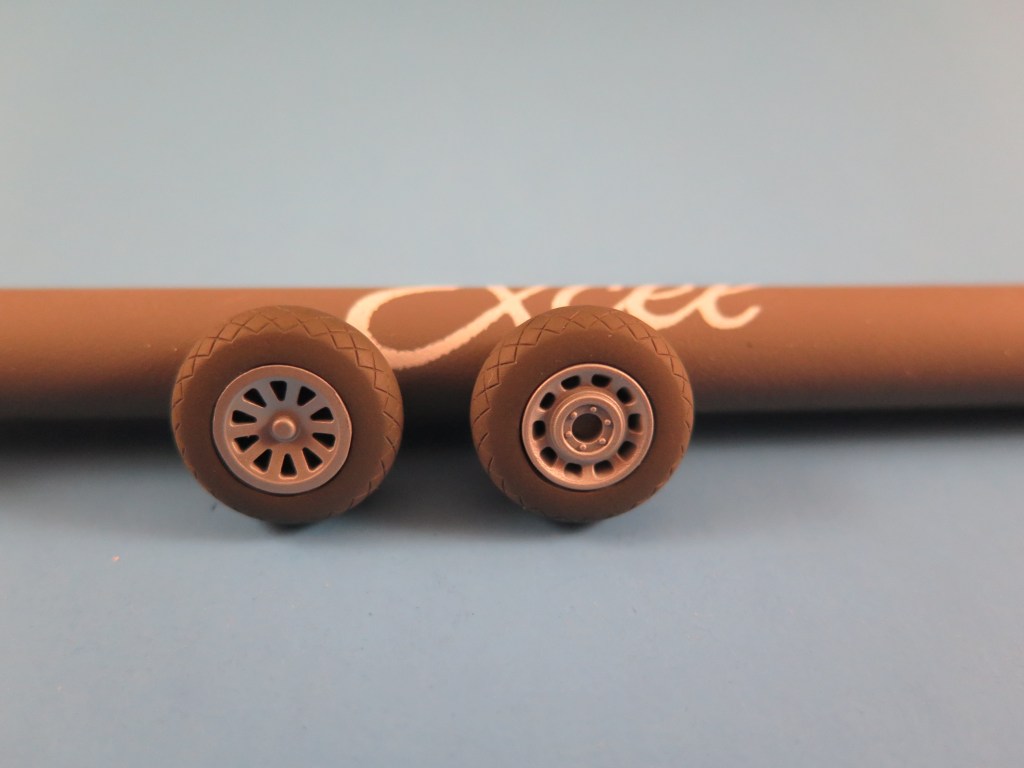
Last, I painted the tires and fuselage fuel tank from the Eduard P-51D Mustang kit with Rubber Black (RC022) using 91% isopropyl alcohol thinned to a 1 to 1 ratio. Again, as you can tell from the photos below, the paint laid down beautifully and covered very well.
So a few concluding remarks. First, cleanup was easy, and you do not have to break down and clean your airbrush between colors. Just flush out the prior color with a good airbrush cleaner (I use Alclad II Airbrush Cleaner), and load up the new color. Second, it appears that AK Interactive has lightened the paint to take into account the scale effect of color. Their water based acrylic paints are also lightened to take into account the scale effect of color.
I really like this line of paints. They thin nicely with any type of acrylic lacquer thinner, lay down beautifully to a smooth matte to semi-matte finish, dry quickly, and are very durable. The range of colors is very impressive. Highly recommended.
I did not attempt to thin Real Colors with anything other than thinners made for acrylic lacquers and isopropyl alcohol. AK Interactive markets Real Colors by claiming that they can be thinned with thinners used for water based acrylic paints. Flory Models did a comprehensive vlog of AK Interactive’s Real Colors on YouTube https://youtu.be/kvEwxVcY3TE using a lot of different thinners. Their vlog is worth watching.










 Iwo Jima Models