Kit Review: Eduard’s 1/72nd P-51D Mustang “Tales of Iwo Jima” Limited Edition Dual Combo Boxing

Eduard recently released its 1/72nd P-51D Mustang “Tales of Iwo Jima” Limited Edition Dual Combo boxing. The box art is very appealing.

Eduard

As can be seen from the kit’s aircraft profiles below, the decal options are similar to the 1/48th scale limited edition boxing in that it provides 12 decal options that cover all nine Iwo Jima VLR Mustang squadrons. They will be the same decal options with one change. The 457th Fighter Squadron decals will be for 539 “Lil Ole Meanie II”, flown by 2nd Lt. William G. Hetland and Lt. Hinkle, instead of 542 “Fighting Lady” flown by 1st Lt. Ralph Gardner and 1st Lt. Chester Jatzcak. The decals for 542 “Fighting Lady” are included in the 1/72 P-51D Mustang Profipack boxing.

Eduard

Below is a large aircraft profile of 539 Li’l Ole Meanie II. I am assuming it was included due to the pin-up art below the canopy of the beautiful woman in state of being partially undressed.

Eduard

I am not going to review the actual plastic parts as I have done that previously. You can find that review here. It is a beautiful and well engineered kit with exquisite rivet detail for a 1/72nd scale kit.

Eduard

No resin parts are included in this limited edition dual combo boxing. Customary of Eduard for limited edition boxings, a color photo etched fret is included for each kit that consists of cockpit components and scribing templates (Parts PE7 and PE19) to create accurate panel lines for the VLR Mustangs. The photo etched frets also contain the scribing and placement template, and parts (PE22-25) for the AN/APS-13 rear warning radar installed on the tail of late model Mustangs. Nice touch on Eduard’s part.

Some of Block 20(NA), and all of Block 25(NA) produced P-51Ds had the AN/APS-13 rear warning radar installed. The AN/APS-13 was a low power UHF tail warning radar transmitter/receiver which was used to detect aircraft approaching from the rear. Below 1500 feet it would have to be turned off, otherwise it would receive false readings from the ground. Its effective range against small fighter sized targets was 280 – 320 meters. When it detected an aircraft, a small red light would come on and a bell would ring. Below is a photo of a 462nd FS Mustang showing the location of the AN/APS-13 radar antennae on the tail.

Loomis Dean/USAAF/National Archives via Fold3

The AN/APS-13 radar was seen as somewhat of a blessing and a curse by pilots. Some 506th FG pilots that I have interviewed indicated it was an annoyance during formation flying because it would keep going off when a threat was not present unless you were the tail end Charlie. 1st Lt. William G. Ebersole of the 462nd FS indicated that it was common practice for pilots on VLR missions to turn the radar off during the long over water approach to Japan, and the long return trip back to Iwo Jima, only switching it on upon reaching the Japanese home islands.

There is a minor error on the assembly instructions that warrants pointing out. The avionics transmitters were different on Iwo Jima VLR Mustangs due to the addition of the SCR-695 IFF transmitter which was located right behind the SCR-522 radio transmitter. This addition necessitated moving the battery to the rear of engine compartment. Below is a nice computer generated image of how this set up looked.

John Terrell

Eduard has accurately produced the SCR-522 radio transmitter and SCR-695 IFF transmitter as one part (E3). Eduard also provides the normal configuration of the SCR-522 radio transmitter and battery as part E2. Below is page 3 of Eduard’s instructions (Step A) showing the assembly of the cockpit parts. Please note that the instructions indicate the correct part (E3), but the assembly drawing is of the SCR-522 radio transmitter/battery part (E2). Do not be confused by the wrong pairing of the part number and drawing. If you are building an Iwo Jima VLR Mustang, use part E3.

Eduard

Kudos to Eduard for putting out a 1/72nd Dual Combo Limited Edition boxing that provides decals for all 9 Iwo Jima VLR Mustang squadron. Nice to not to have to rely on the aftermarket decal industry to supply those options. If you want to build an Iwo Jima VLR Mustang in 1/72nd scale, this is the kit and the boxing to buy.

Photos of the Week; Bombing Up

Soon after their arrival on Iwo Jima on March 6th and 7th, the Mustangs of the 45th, 47th and 78th Fighter Squadrons of the 15th Fighter Group began offensive bombing operations against the remaining Japanese troops on the island. Taking off from South Field, they made short bombing hops to the northern portion of the island in support of United States Army and Marine ground forces.

The photo below shows an armorer adjusting the braces supporting a 500 pound general purpose bomb on a 45th FS Mustang. The distinctive diagonal green bands with black borders of the 45th FS can be seen on the bottom of the wing and on the right main landing gear cover.

USAAF/National Archives via Fold3

The small L shaped supports can also be seen on the bottom of the wing. These supports were added on both sides of the bomb racks and were used to hold the sway braces in place for the 110 and 165 gallon drop tanks.

The official caption for this photo reads: Armorer adjusting braces on a North American P-51 “Mustang” for 500 pound bomb which will be dropped in first P-51 dive- bombing assault on Iwo Jima, Bonin Islands.

Photo(s) of the Week; April 7, 1945 – First Trip to the Empire

I am posting this edition of Photo(s) of the Week a day early to observe and commemorate a significant event in the history of Iwo Jima VLR Mustang Groups. Seventy-nine years ago today, 108 P-51D Mustangs of the 15th and 21st Fighter Groups flew their first very long range mission to the Japanese Home Islands escorting 107 B-29s of the 73rd Bomb Wing to Tokyo and back.

1st Lt. Jule Carnes Mitchell, Jr., 47th FS/15th FG, is ready to take off on the first VLR mission to the Japanese Home Islands (USAAF/National Archives via Fold3)

The target for the B-29s was the Nakajima aircraft engine factories on the west side of Tokyo. The B-29s approached the target at 15,000 feet with the P-51Ds several thousand feet above the bombers in combat formation with the 15th Fighter Group on the right and the 21st Fighter Group on the left of the bombers.

1st Lt. Eurich L. Bright being readied in the cockpit of 176 “Moonbeam McSwine” for the April 7, 1945 VLR escort mission (USAAF/National Archives via Fold3)

1st Lt. Eurich L. Bright of the 47th Fighter Squadron, shown in the picture above, was one of the top scorers of the mission being credited with shooting down a Kawasaki Ki-61 Hein (Tony), a Mitsubishi A6M Zero, and a Nakajima Ki-45 Toryu (Nick).

USAAF/National Archives via Fold3

The photo above shows the 47th Fighter Squadron P-51D Mustangs being readied for the April 7, 1945, VLR escort mission to Tokyo. The 110 gallon metal drop tanks would have been mounted on the wings the day before, and filled the morning of the mission. Note the twin Uncle Dog antennae on 186. By the time of this mission, most, if not all the 15th and 21st Fighter Group Mustangs would have had them installed to help them form up with the B-29s on the trip to Japanese Home Islands, and to find their way back to Iwo Jima.

USAAF/National Archives via Fold3

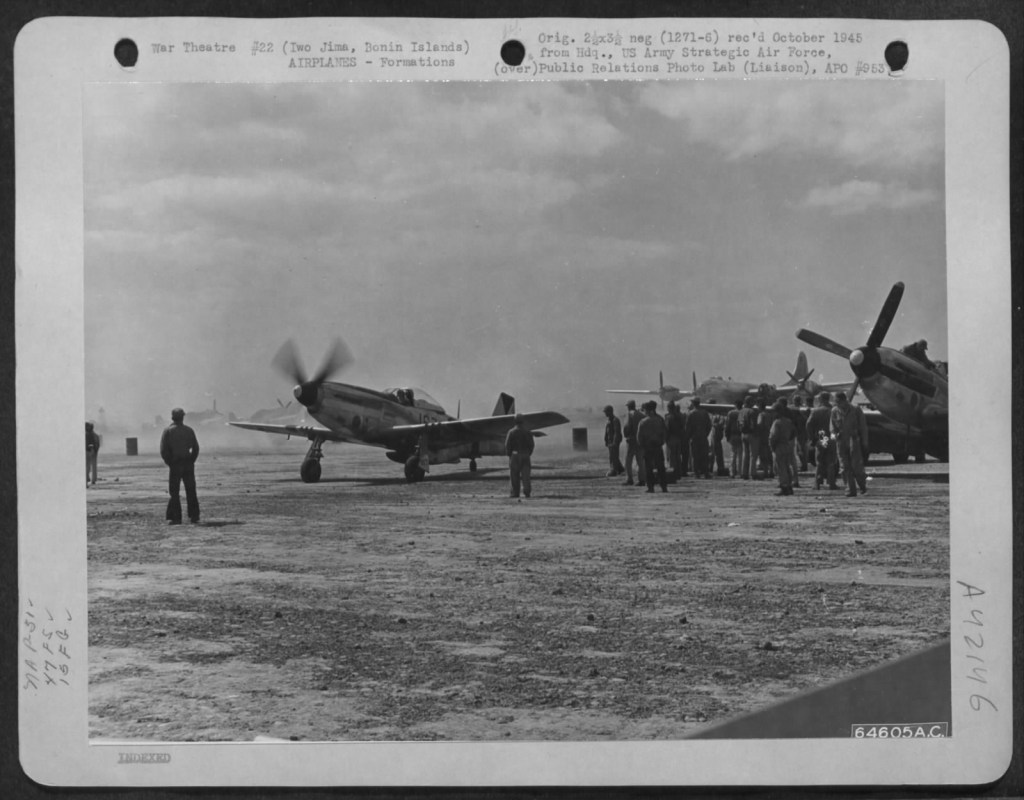
45th Fighter Squadron Mustangs warm up their engines in the photo above as part of the pre-flight preparation for the first VLR escort mission.

For the 7th Air Force Fighter Command, this mission was culmination of several years of being in the Central Pacific theater of operations and waiting to get into the fight on a larger scale. The 15th Fighter Group participated in the defense of Pearl Harbor on December 7, 1941, and then only saw sporadic combat until April 7, 1945. The 7th Fighter Command called themselves the “Sunsetters”, and their primary objective was to help bring the war in the Pacific to an end.

In the photo below, ground crew watch as 45th Fighter Squadron Mustangs move to begin taking off.

USAAF/National Archives via Fold3

Seventeen Mustangs had to abort and return to Iwo Jima, including Brig. General Ernest “Mickey” Moore and 15th Fighter Group commander Colonel James O. Beckwith. The Sunsetters were credited with twenty-six Japanese planes destroyed, one probably destroyed, and five damaged at the cost of two Mustangs and one pilot. Major James B. Tapp of the 78th Fighter Squadron was high scorer shooting down four Japanese defenders. More importantly, no B-29s were shot down by Japanese fighters. Two B-29s were lost to flak, and one to an aerial bomb dropped on the bomber formation.

If you have Eduard’s 1/48 “Very Long Range: Tales of Iwo Jima“ Limited Edition kit (No. 11142), it provides decals for the following pilots and planes that participated in the April 7, 1945 mission: Major Gilmore L. “Buck” Snipes’ 67 “Tom Kat” (45th FS/15th FG); Major James B. Tapp’s 101 Margaret -IV” (78th FS/15th FG); 1st Lt. Eurich L. Bright’s 176 “Moonbeam McSwine” (47th FS/15th FG); Major Paul W. Imig’s 250 “Dede Lou” (72nd FS/21st FG); and Major Harry C. Crim, Jr.’s 300 “My Achin! [Ass].

References:

1. The Long Campaign: The History of the 15th Fighter Group in World War II, John W. Lambert, Schaffer Publishing Ltd. (2006).

2. Very Long Range P-51 Mustang Units of the Pacific War; Carl Molesworth; Osprey Publishing Limited (2006).

Photo(s) of the Week; “My Achin’ Ass” (Loomis Dean)

No, this is not a picture of Major Harry C. Crim’s 531st Fighter Squadron, 21st Fighter Group P-51D Mustang, but an attempt at humor by Loomis Dean, a United States Army Air Force photographer stationed on Iwo Jima. This staged photo depicts a P-51 pilot clutching his rear end in front of a line up of 45th Fighter Squadron Mustangs supposedly after completing a very long range mission from Iwo Jima to Japan and back.

USAAF/Loomis Dean/National Archives via Fold3

The official caption for this photo reads: “A tired pilot . . . and North American P-51 “Mustangs” on the line at Iwo Jima, Bonin Islands. The boys suffered most just from the 8-hour rumba of seat against seat!” Seven to eight hour VLR missions in a small cockpit led to a sore seat and stiff legs. There was anecdotal evidence that some pilots had to be lifted out of their cockpits because they were so stiff and sore. None of the pilots I had the opportunity to interview ever remember seeing a pilot having to be lifted out of a cockpit, but it made for a good story.

Loomis Dean – If you have noticed, a lot of the United States Army Air Force photos posted recently in Photo(s) of the Week were taken by Loomis Dean. Mr. Dean started his photography career with the Ringling Brothers and Barnum & Bailey Circus prior to World War II. After the war, he joined the staff of Life Magazine in 1947 photographing celebrities such as Elvis Presley, Lucille Ball, Noel Coward, Ernest Hemingway, and Liberace. A lot of Mr. Dean’s photos taken while serving with the United States Army Air Force were shot from unique angles which can be seen in the above photo.

Photo(s) of the Week; No Time to Waste

The 15th Fighter Group wasted no time in getting into the thick of things after arriving on Iwo Jima. On March 8th, Major John Piper led two flights of 47th Fighter Squadron Mustangs to strafe Japanese positions in support of the Marines on the northern end of Iwo. Colonel James Beckwith and 45th Fighter Squadron got into the fight on the next day with three missions in support of the Marines. The photo below shows two 45th Mustangs loaded up with 500 pound bombs getting ready to take off on one of those missions. The 78th Fighter Squadron also flew 45 sorties in support of the Marines on March 10th.

USAAF/National Archives via Fold3

It would not take long for the 15th Fighter Group’s attention to be diverted elsewhere. On March 11th, the 47th FS would fly its first strike mission against Chichi Jima. I really like the photo below. Taken over the wing of a 47th FS Mustang, the photo below shows two bomb laden 47th FS Mustangs taxing into position to take off for their strike against Chichi Jima. I like how this photo shows the elegant lines of the Mustang’s nose.

USAAF/National Archives via Fold3

Chichi Jima was 147 miles north of Iwo Jima. A major communications center with radio and radar facilities, Chichi Jima had been occupied and fortified by the Japanese for decades. It had an airfield (Susaki Airfield), a deep water anchorage, and a seaplane base. Brig. General Moore and Colonel Beckwith in their Mustangs watched as seventeen 47th FS Mustangs bombed Chichi Jima.

USAAF/National Archives/via Fold3

The photo above shows a 47th FS Mustang landing on South Field upon its return from the March 11th strike mission against Chichi Jima as ground crew look on.

1st Lt. Robert Scamara in 167 Pappy Yochum 47th FS/15th FG (USAAF/National Archives via Fold3)

In the photo above, 1st Lt. Robert Scamara pulls his 47th FS Mustang 167 Pappy Yochum into parking position after his return from the March 11th strike mission against Chichi Jima. Ground crew and other pilots clamor around the parked Mustangs anxious to hear about the results of the mission. Note the single antenna on Scamara’s Mustang.

References:

John W. Lambert, The Long Campaign: The History of the 15th Fighter Group in World War II, Schiffer Publishing Ltd. (2006)

Carl Molesworth, Very Long Range P-51 Mustang Units of the Pacific War, Osprey Publishing (2006)