Kit Review: Eduard’s 1/72nd P-51D Mustang “Tales of Iwo Jima” Limited Edition Dual Combo Boxing

Eduard recently released its 1/72nd P-51D Mustang “Tales of Iwo Jima” Limited Edition Dual Combo boxing. The box art is very appealing.

Eduard

As can be seen from the kit’s aircraft profiles below, the decal options are similar to the 1/48th scale limited edition boxing in that it provides 12 decal options that cover all nine Iwo Jima VLR Mustang squadrons. They will be the same decal options with one change. The 457th Fighter Squadron decals will be for 539 “Lil Ole Meanie II”, flown by 2nd Lt. William G. Hetland and Lt. Hinkle, instead of 542 “Fighting Lady” flown by 1st Lt. Ralph Gardner and 1st Lt. Chester Jatzcak. The decals for 542 “Fighting Lady” are included in the 1/72 P-51D Mustang Profipack boxing.

Eduard

Below is a large aircraft profile of 539 Li’l Ole Meanie II. I am assuming it was included due to the pin-up art below the canopy of the beautiful woman in state of being partially undressed.

Eduard

I am not going to review the actual plastic parts as I have done that previously. You can find that review here. It is a beautiful and well engineered kit with exquisite rivet detail for a 1/72nd scale kit.

Eduard

No resin parts are included in this limited edition dual combo boxing. Customary of Eduard for limited edition boxings, a color photo etched fret is included for each kit that consists of cockpit components and scribing templates (Parts PE7 and PE19) to create accurate panel lines for the VLR Mustangs. The photo etched frets also contain the scribing and placement template, and parts (PE22-25) for the AN/APS-13 rear warning radar installed on the tail of late model Mustangs. Nice touch on Eduard’s part.

Some of Block 20(NA), and all of Block 25(NA) produced P-51Ds had the AN/APS-13 rear warning radar installed. The AN/APS-13 was a low power UHF tail warning radar transmitter/receiver which was used to detect aircraft approaching from the rear. Below 1500 feet it would have to be turned off, otherwise it would receive false readings from the ground. Its effective range against small fighter sized targets was 280 – 320 meters. When it detected an aircraft, a small red light would come on and a bell would ring. Below is a photo of a 462nd FS Mustang showing the location of the AN/APS-13 radar antennae on the tail.

Loomis Dean/USAAF/National Archives via Fold3

The AN/APS-13 radar was seen as somewhat of a blessing and a curse by pilots. Some 506th FG pilots that I have interviewed indicated it was an annoyance during formation flying because it would keep going off when a threat was not present unless you were the tail end Charlie. 1st Lt. William G. Ebersole of the 462nd FS indicated that it was common practice for pilots on VLR missions to turn the radar off during the long over water approach to Japan, and the long return trip back to Iwo Jima, only switching it on upon reaching the Japanese home islands.

There is a minor error on the assembly instructions that warrants pointing out. The avionics transmitters were different on Iwo Jima VLR Mustangs due to the addition of the SCR-695 IFF transmitter which was located right behind the SCR-522 radio transmitter. This addition necessitated moving the battery to the rear of engine compartment. Below is a nice computer generated image of how this set up looked.

John Terrell

Eduard has accurately produced the SCR-522 radio transmitter and SCR-695 IFF transmitter as one part (E3). Eduard also provides the normal configuration of the SCR-522 radio transmitter and battery as part E2. Below is page 3 of Eduard’s instructions (Step A) showing the assembly of the cockpit parts. Please note that the instructions indicate the correct part (E3), but the assembly drawing is of the SCR-522 radio transmitter/battery part (E2). Do not be confused by the wrong pairing of the part number and drawing. If you are building an Iwo Jima VLR Mustang, use part E3.

Eduard

Kudos to Eduard for putting out a 1/72nd Dual Combo Limited Edition boxing that provides decals for all 9 Iwo Jima VLR Mustang squadron. Nice to not to have to rely on the aftermarket decal industry to supply those options. If you want to build an Iwo Jima VLR Mustang in 1/72nd scale, this is the kit and the boxing to buy.

Photo(s) of the Week; Photo-Op for 47th Fighter Squadron Ground Crew

Neat photo! 47th Fighter Squadron ground crew members performing engine maintenance pause for their picture to be taken. This is a picture from a private collection that Mark Stevens of the 7th Fighter Command Association provided to me.

The simplified squadron marking of an all black spinner can be seen along the 47th FS emblem on the engine cowling panel leaning against the engine maintenance scaffolding.

7th Fighter Command Association via Mark Stevens

This photo is interesting for a number of reasons. First, there is absolutely nothing in the background to give any reference to where this maintenance activity took place. The only landmark on Iwo Jima, Mt. Suribachi, is not present, and there are no planes of any type or any other activity going on in the background. Unusual. Second, you can see a portion of the canvas wheel well cover that extends down onto the main landing gear leg. Canvas linings for the wheel wells were factory installed as a measure to keep grit, dirt and mud out of the wheel wells. In other theater of operations, like the European Theater, they were removed by ground crews. On Iwo Jima, they were a necessity to keep the volcanic grit and sand out of the wheel wells. Third, there is a black band painted on the inside of the landing gear cover and the main landing gear leg. This is very unusual and I have not been able to find another photo that shows this type of band.

This is most likely a Block 25 D model because of the presence of the HVAR rocket stubs underneath the wings.

Thanks to Mark Stevens for sharing this photo.

As a condition of the use of materials from the 7th Fighter Command Association website, the following disclaimer is included: Permission to use, copy and distribute documents delivered from this Worldwide Web server and related graphics is hereby granted, provided 1) That the use of the data will not be used for obtaining a profit of any kind, and 2) That the above disclaimer notice appear in all copies and that both that disclaimer notice and this permission notice appear. All other rights reserved. The name of “7th Fighter Command Association” may not be used in advertising or publicity pertaining to distribution of this information without specific, written prior permission. Mark Stevens and the 7th Fighter Command Association makes no representations about the suitability of this information for any purpose. It is provided “as is” without express or implied warranty. Mark Stevens and the 7th Fighter Command Association disclaim all warranties with regard to this information, including all implied warranties of merchantability and fitness. In no event shall Mark Stevens or the 7th Fighter Command Association be liable for any special, indirect or consequential damages or any damages whatsoever resulting from loss of use, data or profits, whether in an action of contract, negligence or other action, arising out of or in connection with the use or performance of this information.

Photos of the Week; Bombing Up

Soon after their arrival on Iwo Jima on March 6th and 7th, the Mustangs of the 45th, 47th and 78th Fighter Squadrons of the 15th Fighter Group began offensive bombing operations against the remaining Japanese troops on the island. Taking off from South Field, they made short bombing hops to the northern portion of the island in support of United States Army and Marine ground forces.

The photo below shows an armorer adjusting the braces supporting a 500 pound general purpose bomb on a 45th FS Mustang. The distinctive diagonal green bands with black borders of the 45th FS can be seen on the bottom of the wing and on the right main landing gear cover.

USAAF/National Archives via Fold3

The small L shaped supports can also be seen on the bottom of the wing. These supports were added on both sides of the bomb racks and were used to hold the sway braces in place for the 110 and 165 gallon drop tanks.

The official caption for this photo reads: Armorer adjusting braces on a North American P-51 “Mustang” for 500 pound bomb which will be dropped in first P-51 dive- bombing assault on Iwo Jima, Bonin Islands.

Photo(s) of the Week; Engine Removal

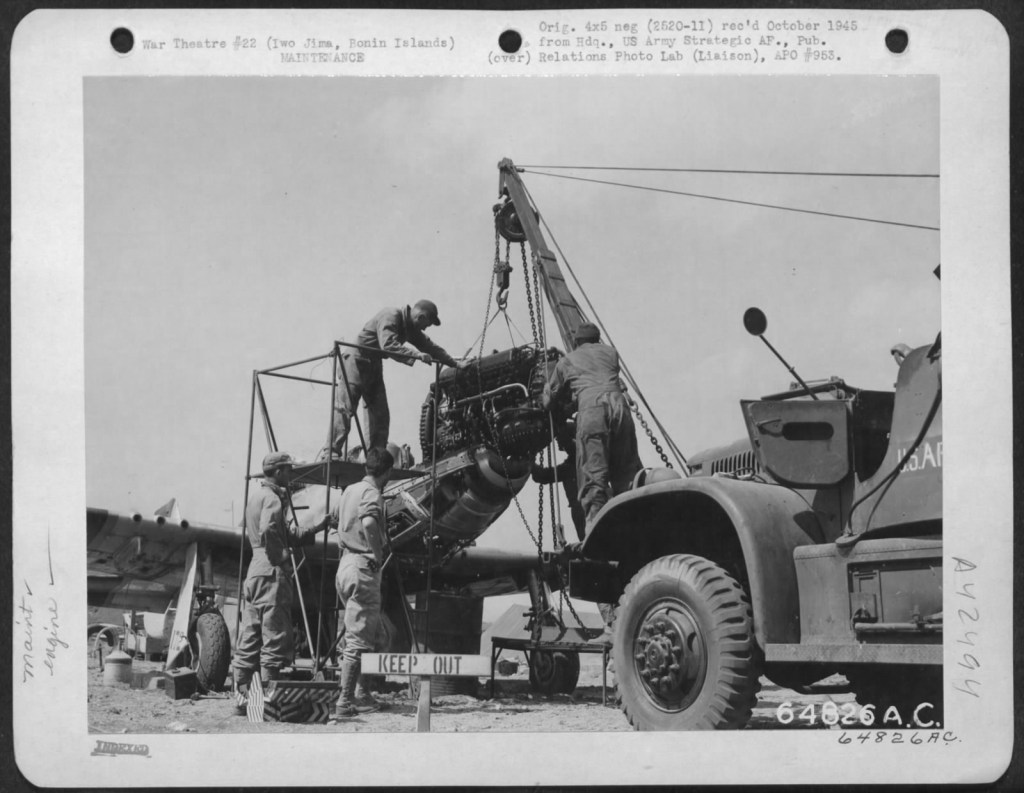
This photo is the companion photo to the last Photo(s) of the Week I posted recently; just taken from the right side of the plane. Ground crew have just hoisted the Packard built Rolls Royce Merlin engine after disconnecting it from the engine mounting framework and other connections. Very cool photo!

USAAF/National Archives via Fold3

This is 172, a 47th Fighter Squadron, 15th Fighter Group, P-51D Mustang. 7th Fighter Command ground crew worked under very challenging conditions. Just keeping the engine and machine guns clear of sand and the volcanic grit was a constant battle.

The official USAAF caption to this photo reads: Mechanics removing engine from a North American P-51 “Mustang”. Iwo Jima, Bonin Islands.

Photo(s) of the Week; Early Primitive Maintenance

A 47th Fighter Squadron P-51D Mustang, number 172, receives either engine maintenance or an engine replacement in an outdoor setting on Iwo Jima with another Mustang coming in for a landing in the background. This looks as if this may be a major periodic overall maintenance as engine work being done, the wing root fairing is removed, the machine guns are removed, the canopy is removed, and it appears that work is being done on the radiator as well.

USAAF/National Archives via Fold3

Early on, all maintenance and repairs were done outdoors. The construction of maintenance hangers would come later. The single antenna on this Mustang indicates that this maintenance was done shortly after 47th Fighter Squadron arrived on Iwo Jima as the twin Uncle Dog antennae have yet to be installed.

Please also note that the right tire has an oval tread pattern and the left tire has a diamond tread pattern. Different tread patterns were a fairly common occurrence, so important to check your photo references.

The official USAAF caption to this photo reads: A mobile repair unit of a 7th Fighter Command Service Group repairs a North American P-51 damaged in a landing on the rugged Iwo Jima airstrip. Soft spots, cross winds and roving clouds of volcanic dust make landings on Iwo Jima unusually hazardous. In the background another P-51 fighter comes in for a landing.