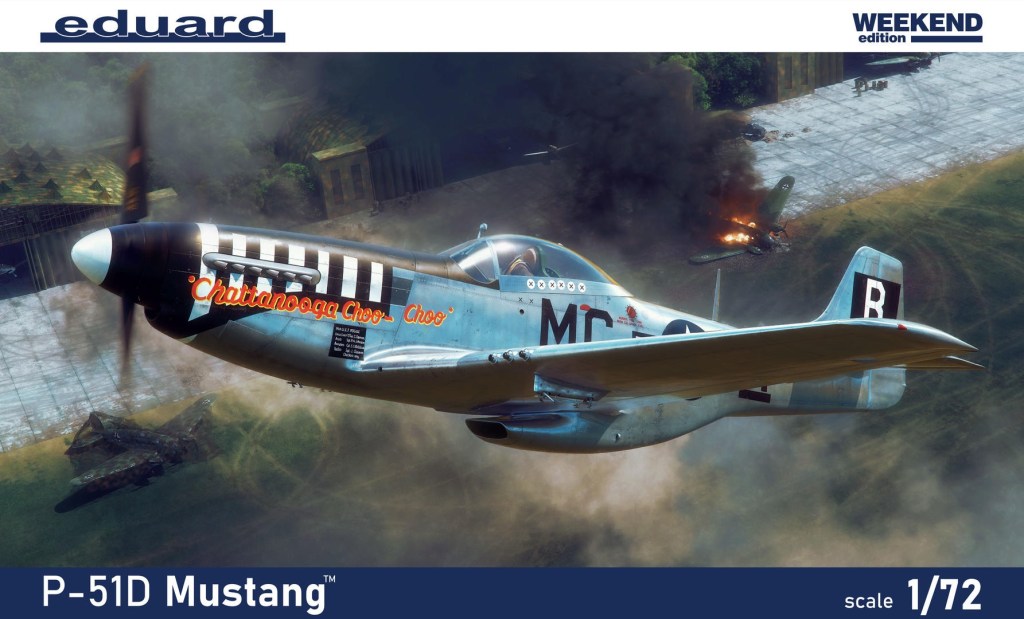
Eduard recently released the 2nd Weekend Edition boxing of its popular 1/72nd North American P-51D Mustang kit. The first three decal options are for Lt. Edward F. Pogue’s P-51D-5 “Chattanooga Choo-Choo” (79th FS, 20th FG, 8th AF); Capt. Clarence E. Anderson’s P-51D-10 “Old Crow” (363rd FS, 357th FG, 8th AF); Flt. Off. Charles A. Lane’s “Meatball Rap II” (99th FS, 332nd FG, 15th AF). All very interesting and popular subjects for modelers.
Eduard
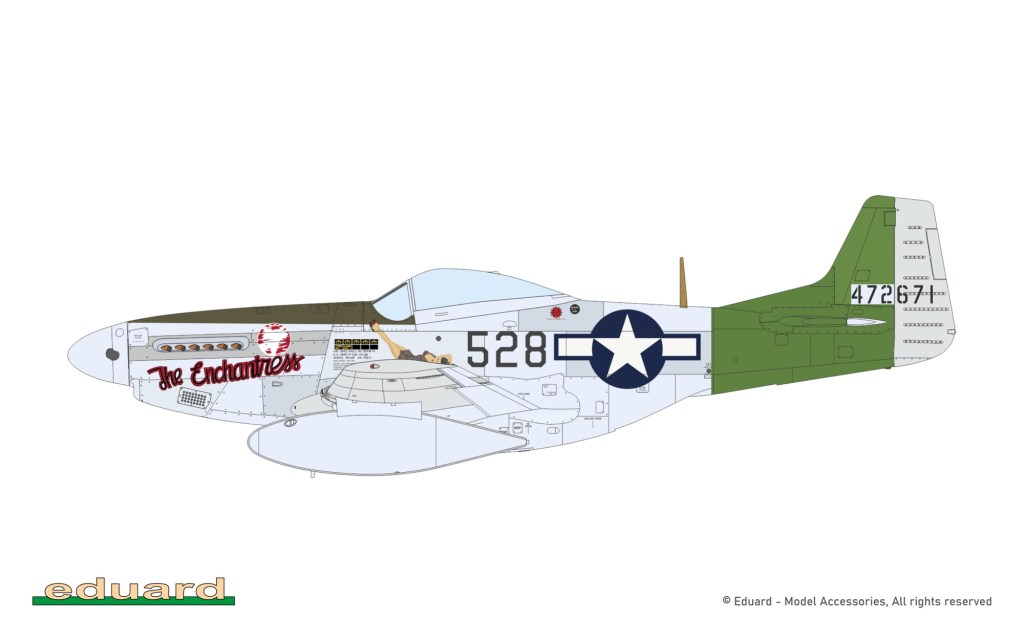
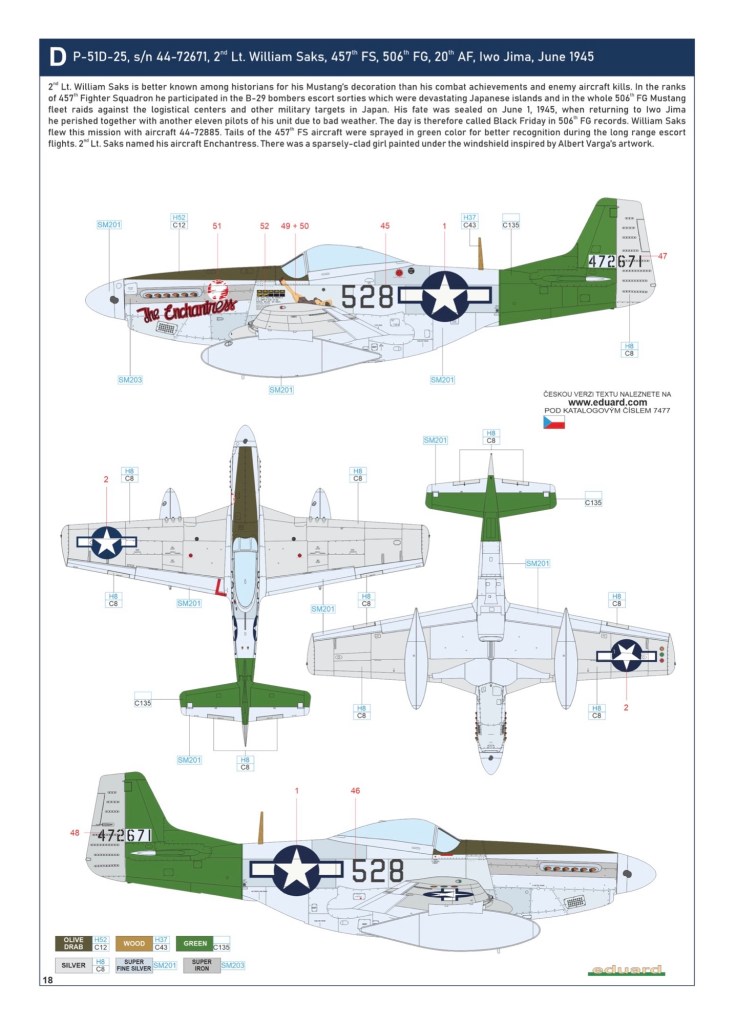
Iwo Jima VLR Mustang Decals: Eduard has again included decals for 528 “The Enchantress” (P-51D-25-NA, 44-72671), a 457th FS, 506th FG Mustang flown by 2nd Lt. William E. Saks. Unfortunately, 2nd Lt. Saks was one of the pilots lost on the infamous June 1, 1945 “Black Friday” mission, but he was not flying 528 on that day. “The Enchantress” is popular amongst modelers because the nose art and the Albert Varga pin-up girl that adorns the fuselage.
Eduard
2nd Lt. Saks did not score any aerial or ground victories and was lost within a few weeks after the 506th Fighter Group arrived on Iwo Jima.
Dr. Theodore Paprocki sitting on the wing of “The Enchantress (506th Fighter Group Association via Maurita Paprocki)
Below are the aircraft profile drawings for the plane that are included in the instructions for the kit.
Eduard
528 “The Enchantress” survived the war and was part of the USAAF’s inventory that was transferred to Japan as part of the occupation.
528 “The Enchantress” (506th Fighter Group Association)
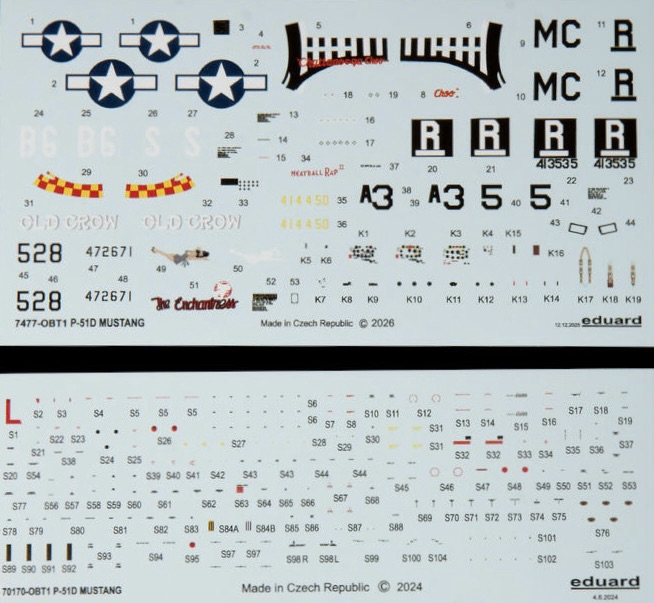
Because this is a Weekend Edition boxing, there are no photo etch or resin update sets within the kit. The decals included in the kit are very nice, in register, and with a full set of stencils for a 1/72nd kit. Just what we all have come to expect for Eduard.
Eduard
Kudos to Eduard for including decals for an Iwo Jima VLR Mustang in this boxing!
Eduard recently released its 1/72nd P-51D Mustang “Tales of Iwo Jima” Limited Edition Dual Combo boxing. The box art is very appealing.
Eduard
As can be seen from the kit’s aircraft profiles below, the decal options are similar to the 1/48th scale limited edition boxing in that it provides 12 decal options that cover all nine Iwo Jima VLR Mustang squadrons. They will be the same decal options with one change. The 457th Fighter Squadron decals will be for 539 “Lil Ole Meanie II”, flown by 2nd Lt. William G. Hetland and Lt. Hinkle, instead of 542 “Fighting Lady” flown by 1st Lt. Ralph Gardner and 1st Lt. Chester Jatzcak. The decals for 542 “Fighting Lady” are included in the 1/72 P-51D Mustang Profipack boxing.
Eduard
Below is a large aircraft profile of 539 Li’l Ole Meanie II. I am assuming it was included due to the pin-up art below the canopy of the beautiful woman in state of being partially undressed.
Eduard
I am not going to review the actual plastic parts as I have done that previously. You can find that review here. It is a beautiful and well engineered kit with exquisite rivet detail for a 1/72nd scale kit.
Eduard
No resin parts are included in this limited edition dual combo boxing. Customary of Eduard for limited edition boxings, a color photo etched fret is included for each kit that consists of cockpit components and scribing templates (Parts PE7 and PE19) to create accurate panel lines for the VLR Mustangs. The photo etched frets also contain the scribing and placement template, and parts (PE22-25) for the AN/APS-13 rear warning radar installed on the tail of late model Mustangs. Nice touch on Eduard’s part.
Some of Block 20(NA), and all of Block 25(NA) produced P-51Ds had the AN/APS-13 rear warning radar installed. The AN/APS-13 was a low power UHF tail warning radar transmitter/receiver which was used to detect aircraft approaching from the rear. Below 1500 feet it would have to be turned off, otherwise it would receive false readings from the ground. Its effective range against small fighter sized targets was 280 – 320 meters. When it detected an aircraft, a small red light would come on and a bell would ring. Below is a photo of a 462nd FS Mustang showing the location of the AN/APS-13 radar antennae on the tail.
Loomis Dean/USAAF/National Archives via Fold3
The AN/APS-13 radar was seen as somewhat of a blessing and a curse by pilots. Some 506th FG pilots that I have interviewed indicated it was an annoyance during formation flying because it would keep going off when a threat was not present unless you were the tail end Charlie. 1st Lt. William G. Ebersole of the 462nd FS indicated that it was common practice for pilots on VLR missions to turn the radar off during the long over water approach to Japan, and the long return trip back to Iwo Jima, only switching it on upon reaching the Japanese home islands.
There is a minor error on the assembly instructions that warrants pointing out. The avionics transmitters were different on Iwo Jima VLR Mustangs due to the addition of the SCR-695 IFF transmitter which was located right behind the SCR-522 radio transmitter. This addition necessitated moving the battery to the rear of engine compartment. Below is a nice computer generated image of how this set up looked.
John Terrell
Eduard has accurately produced the SCR-522 radio transmitter and SCR-695 IFF transmitter as one part (E3). Eduard also provides the normal configuration of the SCR-522 radio transmitter and battery as part E2. Below is page 3 of Eduard’s instructions (Step A) showing the assembly of the cockpit parts. Please note that the instructions indicate the correct part (E3), but the assembly drawing is of the SCR-522 radio transmitter/battery part (E2). Do not be confused by the wrong pairing of the part number and drawing. If you are building an Iwo Jima VLR Mustang, use part E3.
Eduard
Kudos to Eduard for putting out a 1/72nd Dual Combo Limited Edition boxing that provides decals for all 9 Iwo Jima VLR Mustang squadron. Nice to not to have to rely on the aftermarket decal industry to supply those options. If you want to build an Iwo Jima VLR Mustang in 1/72nd scale, this is the kit and the boxing to buy.
Back in October of 2024, Eduard announced the future release of a limited edition “Very Long Range: Tales of Iwo Jima” boxing of their excellent 1/72nd North American P-51D Mustang kit. They announced that kit would be released in the second quarter of 2025, and it would most likely contain the same decal options as their 1/48th limited edition “Very Long Range: Tales of Iwo Jima” boxing.
Eduard
The British on-line retailer Hannants now shows the kit as a limited edition dual combo boxing to be a July 2025 release. Hannants anticipates having it in stock in late June.
Eduard
As can be seen from the kit’s aircraft profiles above, it will similar to the 1/48th scale limited edition boxing in that it provides 12 decal options that cover all of the all nine of the Iwo Jima VLR Mustang squadrons. They will be the same decal options with one change. The 457th Fighter Squadron decals will be for 539 “Lil Ole Meanie II”, flown by 2nd Lt. William G. Hetland, instead of 542 “Fighting Lady” flown by 1st Lt. Ralph Gardner and 1st Lt. Chester Jatzcak. The decals for 542 “Fighting Lady” are included in the 1/72 Profipack boxing.
Kudos to Eduard for releasing the Very Long Range Tales of Iwo Jima in 1/72nd scale, and for making it a dual combo boxing.
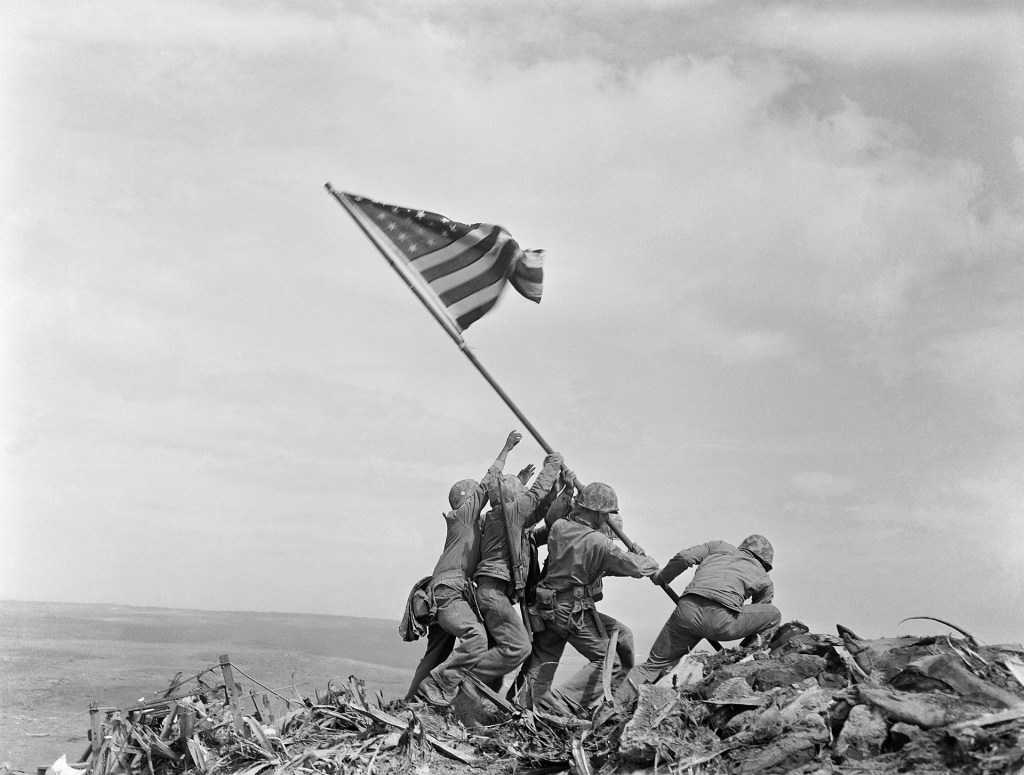
“Freedom is never more than one generation from extinction. We didn’t pass it to our children in the bloodstream. It must be fought for, protected, and handed on for them to do the same.” Ronald W. Reagan, 40th President of the United States of America
Joe Rosenthal/Associated Press via Fold3
This Memorial Day we have a chance to pause and honor the brave men and women who made the ultimate sacrifice for our country. We owe them such a tremendous debt, for the freedoms we enjoy today were paid for with an extremely high price! Their sacrifices ensures that our liberties and freedoms largely continue today – from the ability to gather with loved ones, to worship together, to speak as we see fit (and the companion right not to be forced to speak that which we know to be false), and to assemble and peacefully protest to effectuate change.
Captain John W.L. Benbow, 457th Fighter Squadron, 506th Fighter Group; Lost on the July 16, 1945 Strike Mission to Nagoya
The statue below is outside of the National Archives building in Washington D.C. It is of an ever watchful soldier holding his helmet, sword, and shield. The inscription below the statue reads “ETERNAL VIGILANCE IS THE PRICE OF LIBERTY”.
Guardianship Statute by James Fraser (Photo by Jeff Reed, National Archives)
Let us not be asleep at the wheel. We have forces from within that are intolerant, and this intolerance is being cultivated in our schools, colleges and universities. Speech which a few years ago was considered normal speech, is now being touted as hate speech. And we are now being told that we need to address certain individuals in ways that has no basis in reality.
Six thousand eight hundred twenty-one United States servicemen lost their lives securing in the battle for Iwo Jima. Many more, like Captain Benbow, lost their lives in bringing World War II to a close. If we do not protect our liberty and freedoms, the sacrifices made by them, and so many more, will have been in vain.
With VLR pilots spending so much time on missions over the vast expanse of the Pacific Ocean, every effort was made to reduce the amount of time a pilot spent in the water or on the water. Naval resources were stationed along the route to pluck pilots out of the Pacific. Submarines were stationed off of the coast of Japan to pick up pilots who were successful in reaching the Pacific before having to bail out or to ditch. Destroyers were stationed along the route, and PBY Catalinas were in the air.
The United States Army Air Force aircraft were also involved in air-sea rescues of their own pilots. Boeing B-17 Flying Fortresses (SB-17s) were modified to carry a motorized 27 foot A-1 Higgins boat to be dropped to downed pilots. North American P-51D Mustangs were also involved in these efforts.
15th Fighter Group members Major James B. Tapp and Captain Vic Mollan combined to develop a droppable rescue kit packaged into a 110 gallon metal drop tank while on Oahu. The picture below shows a life raft rescue kit installed on 15th Fighter Group commander Colonel James O. Beckwith’s P-51D Mustang 15 Squirt.
USAAF/National Archives via Fold3
The kit was contained within a zipper type kapok bag as shown in the photo below and consisted of a A-3 life raft, a Gibson Girl radio, a Naval kit of visual signal equipment, and rations.
Major James B. Tapp inspecting the results of a test of the life raft rescue kit (USAAF/National Archives via Fold3)
When the tank was released, it would separate and a static line would open a parachute that allowed the kit to descend slowly to the pilot in water. The life raft rescue kit was first tested by Major Tapp on December 11, 1944 as shown in the photo below.
Major James B. Tapp tests the life raft rescue kit while on Oahu prior to deploying to Iwo Jima (David Beyl via John W. Lambert)
On December 12, 1944, Major Tapp tested the kit again, this time with 2nd Lt. Charles C. Heil, the 78th Fighter Squadron’s resident swimming champion, in the water off Oahu. The concept and equipment worked so well that the Hickman Air Depot began assembling these kits.
During actual operations on Iwo Jima, the P-51D Mustangs carrying the life raft rescue kits were code named “Josephines”. In the picture below, three 462nd Fighter Squadron Mustangs are flying combat air patrol around Iwo Jima. The P-51D Mustang in the foreground of the photo, 628, is carrying a life raft rescue kits under its left wing and is being flown by Lt. Edward Linfante. The middle Mustang is 602 Metalball and is being flown by Lt. Edward Bahlhorn. The Mustang in the background isbelieved to be 603 Little Joe and most likely being flown by Lt. Jesse Sabin.
Three 462nd Fighter Squadron Mustangs flying Combat Air Patrol around Iwo Jima (506th Fighter Group Association via Ed Linfante)
References:
1. The Long Campaign: The History of the 15th Fighter Group in World War II, John W. Lambert, Schaffer Publishing Ltd. (2006).







 Iwo Jima Models