506th Fighter Group ground crewmen push a North American P-51D-20-NA Mustang (Serial No. 44-72560) across Marsden matting in the 462nd Fighter Squadron dispersal area on North Field. While it is not known who was assigned to fly this Mustang, members of the 506th Fighter Group Association believe the plane was named Little Joe.
USAAF/Loomis Dean/National Archives via Fold3
Several things to note about this picture for modelers. First is the wear on the backside of the propeller blades from the sand and volcanic grit on Iwo Jima. The cuff at the bottom of the blade was made of a hardened rubber so it does not show the wear that the metal portion of the blade does. Second is the light color and the pattern of the exhaust staining down the side of the fuselage. Third is the wooden twin Uncle Dog antennae, and their location and spacing on the spine. Fourth is the AN/APS-13 rear warning radar installed on the tail.
The official caption to this photo is 7th Fighter Command personnel push a North American P-51 “Mustang” toward the dispersal area at an airfield on Iwo Jima. July 1945.
Eduard recently released the 2nd ProfiPACK boxing of its popular 1/72nd North American P-51D Mustang kit. Most of decal options are of fighter aces; Lt. Col. John D. Landers’ Big Beautiful Doll, Lt. Col. John C. Meyer’s Petie 3rd, Maj. Leonard K. Carson’s Nooky Booky III, Lt. Col. Glenn T. Eagleston’s P-51D-20-NA, and Capt. Fredie F. Ohr’s “Marie”.
Eduard
But it also includes decals for 542 Fighting Lady, a P-51D-20-NA assigned to the 457th Fighter Squadron, 506th Fighter Group. Neither of the pilots assigned to fly Fighting Lady were aces.
Eduard
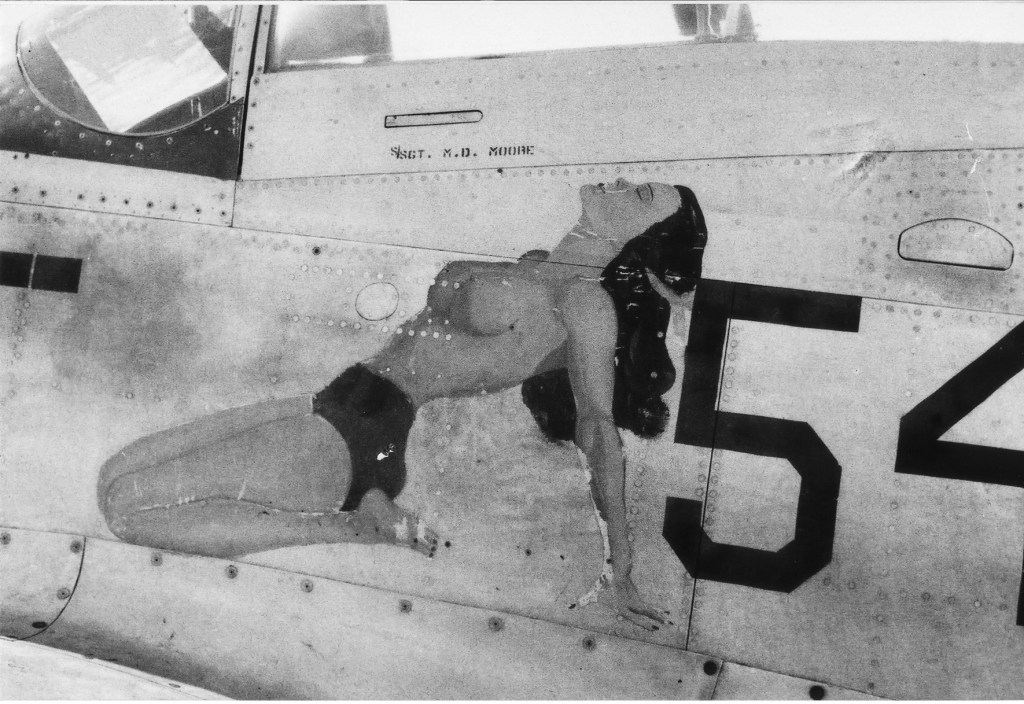
542 Fighting Lady was assigned to 1st Lt. Ralph Gardner and 2nd Lt. Chester Jatzcak. Below is a nice close up picture of the pin up art that adorned the fuselage.
542 Fighting Lady (506th Fighter Group Association/Dr. John Benbow)
While the quality of the below photo is not the best, it does clearly shows the position of the name Fighting Lady on the nose below the engine exhaust stacks and the elegant design of the Mustang’s nose.
Unknown ground crew member lying on the wing of Fighting Lady (506th Fighter Group Association/Dr. John Benbow)
Norma Jatczak, 2nd Lt. Chester Jatczak’s wife, was of the belief that the plane’s name was “Broadway Gal”. Unfortunately, the 506th Fighter Group Association does not have a photo to substantiate her belief. Eduard suggests in its instructions that the name of the plane was changed from Fighting Lady to “Broadway Gal” at a later date.
2nd Lt. Chester Jatczak crouched on the wing of “Fighting Lady” (506th Fighter Group Association via Norma Jatczak)
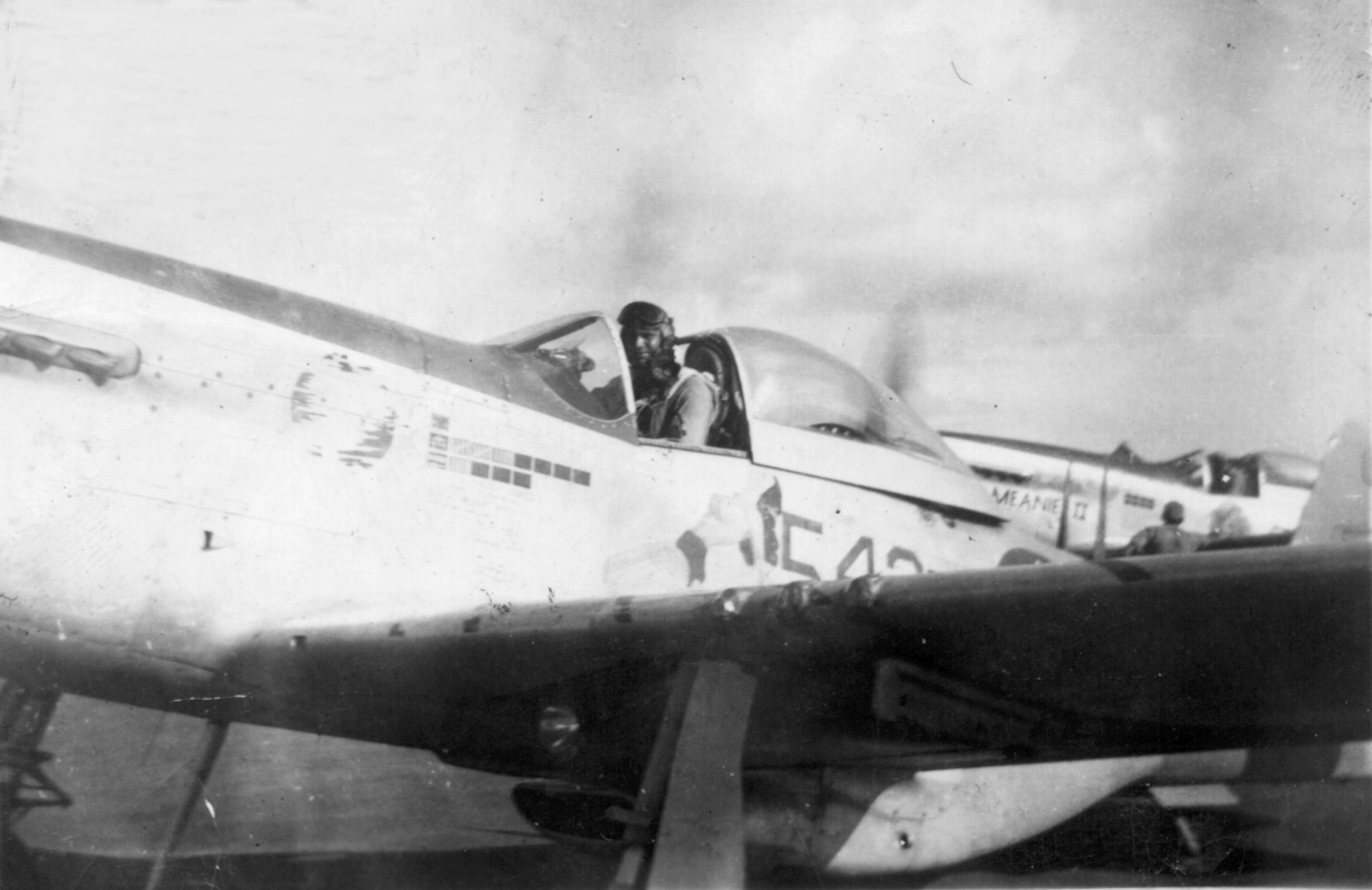
Please note the photo below does not have the name Fighting Lady on the nose yet. This photo was most likely taken in June of 1945 as the plane has a solid green tail instead of the initial squadron markings of diagonal green stripes on the tail.
1st Lt. Ralph Gardner in the cockpit of Fighting Lady (506th Fighter Group Association/Dr. John Benbow)
I interviewed Ralph Gardner at the 2013 506th Fighter Group Reunion in Chino, California, but did not think to inquire about whether the plane had the name of “Broadway Gal” at one point in time, or whether the name was on the right side of the nose. The photo below appears to dispel the notion that “Broadway Gal” appeared on the right side of the nose.
1st Lt. Ralph Gardner flying Fighting Lady (506th Fighter Group Association/Dr. John Benbow)457th Fighter Pilots in front of Fighting Lady – Front row left to right; Lts. Alan Kinvig and George Hetland; Back row left to right; Lts. Ray Miller, Martin Ganschow, Ralph Gardner and Larry Grennan (506th Fighter Group Association via Ralph Gardner)
1st Lt. Gardner was credited with an aerial victory on June 10, 1945.
Thanks to Eduard for including decals for an Iwo Jima VLR Mustang in this boxing!
I received Eduard’s 1/72nd North American P-51D Mustang Royal Class Dual Combo boxing recently. In scaling down their 1/48th scale P-51D kit to 1/72nd scale, Eduard made it so can you build any variant from a D-5 through a D-25,including the K, without having to buy any extra sprues or after market accessories. For instance, you can build an Iwo Jima VLR Mustang from any boxing they release because all of the necessary parts are present in the kit. Wise decision on Eduard’s part. On to the sprues.
Eduard
The first sprue (A) is the clear parts and they are crystal clear and provide all three of the variations of rear portion of the canopy. The clear parts are bagged separately to protect against scratches.
Eduard
The second sprue (B/C) contains the fuselage halves, wings, and horizontal and vertical stabilizers. All three tails are present, the D-5 without the fillet, the D-5 with the sway-back fillet, and tails with the regular fillet that were on most D-10s and all D-15s, D-20s, D-25s and Ks. Both the flaps and ailerons are molded separately which gives the modeler the ability to position them as he or she desires.
Eduard
The rivet detail is exquisite as shown in the picture below. Yet, Eduard also showed restraint and did not put them on the wings where they would have been puttied over to increase the laminar flow over the wings. Nice touch on Eduard’s part.
Eduard
The third sprue (E) contains a variety of different parts, including the cockpit parts, wheel wells and landing gear parts, spinner and propeller parts, and other external parts. Both types of pilot seats are provided; Warren-McArthur seat ( part E14 ), and Schick- Johnson seat (part E33 ).
The SCR-522 radio set and SCR-695 set which are mounted above the fuselage fuel tank behind the pilot’s seat are molded as one piece along with the mounting framework ( part E3)
Included also are the twin Uncle Dog antennae (parts E56 & E57).
Because Eduard designed the kit so you can build any variant of the D model from Block 5 through Block 25, Eduard has included three different versions of the right side cockpit panel. Nice touch on Eduard’s part.
The fourth sprue (F) contains all of the underwing ordinance and drop tanks carried by Mustangs, the Hamilton uncuffed propeller blades, the Aero Products propeller blades, and some minor cockpit parts. Included are the 110 and 165 gallon drop tanks (with sway braces), and HVAR rockets carried by Iwo Jima VLR Mustangs.
As we come to expect from Eduard, this Royal Class Dual Combo boxing comes with a lot extra goodies. In addition to two pre-painted photo etch cockpit frets and canopy masks, there are two 3D printed Warren-McArthur seats, two 3D printed sets of exhaust stacks (one shrouded and one unshrouded), two sets of cast resin main tires, and two cast resin tail wheels.
Eduard
In addition, Eduard has included a set of OMask foam wheel well plugs that make it incredibly easy to paint the wing area around wheel wells without any tape. They also included OMask foam wheel well plugs in their 1/48 North American P-51B Mustang Royal Class Dual Combo boxing and their 1/48 Curtiss P-40E Warhawk Royal Class Dual Combo boxing. Really nice touch on Eduard’s part! Let’s hope this trend continues.
There decals for 14 different planes in this boxing. Included are decals for two Iwo Jima VLR Mustangs.
Iwo Jima VLR Mustang Decals: The first set of markings is for 528 “The Enchantress” (P-51D-25-NA, 44-72671), a 457th FS Mustang flown by 2nd Lt. William E. Saks. 2nd Lt. Saks was one of the pilots lost on the June 1, 1945 “Black Friday” mission, but he was not flying 528 on that day. “The Enchantress” is popular amongst modelers because the nose art and pin-up girl that adorns the fuselage.
Eduard
The second set of VLR markings is for 555 “The Ole Lady/Little Anne/My Darlin Betty Ann” (P-51D-25-NA, 44-72628), a 458th FS Mustang flown by 2nd Lts. James E. Coleman and Ralph R. Coltman, Jr. I like the markings that appear on the right side of the fuselage, and decals are provided for the blue diagonal stripes on the tail.
Eduard
The main decals come in one really large decal sheet along with two smaller decal sheets that contain complete sets of stencils.
EduardEduardEduard
This looks like an extremely nice 1/72nd North American P-51D Mustang kit. From what I have seen of already built models, they certainly look every bit the part of the real thing. If you are wanting to build a Iwo Jima VLR Mustang in 1/72nd scale, this is your kit.
Eduard also announced that they will do a limited edition Iwo Jima VLR Mustang boxing in the 2nd quarter of this year. If you want additional decal options, the limited edition boxing will be worth waiting for.
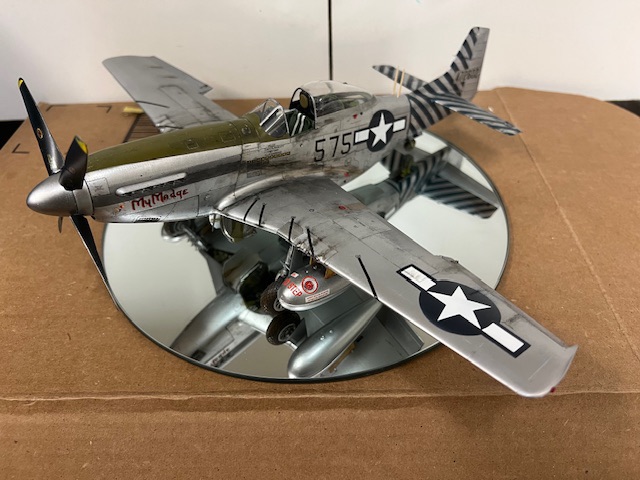
Andrew Willet has provided us with photos of his Tamiya 1/32nd North American P-51D-20-NA Mustang finished with the markings of 575 My Madge/‘Julia’ll Fool Yer’, a 458th Fighter Squadron, 506th Fighter Group Iwo Jima VLR Mustang.
Andrew WilletAndrew Willet
Andrew used the original boxing of Tamiya’s superlative 1/32nd scale Mustang. This boxing has the parts for the SCR-695 IFF transmitter (multi-band airborne transponder which allowed a plane to be identified on friendly radars) which were installed in the VLR Mustangs, and the bracket which allows the battery to be moved to the engine compartment. Unfortunately, the boxing does not include either the 110 gallon or 165 gallon metal drop tanks used by Iwo Jima VLR Mustang groups.
Tamiya
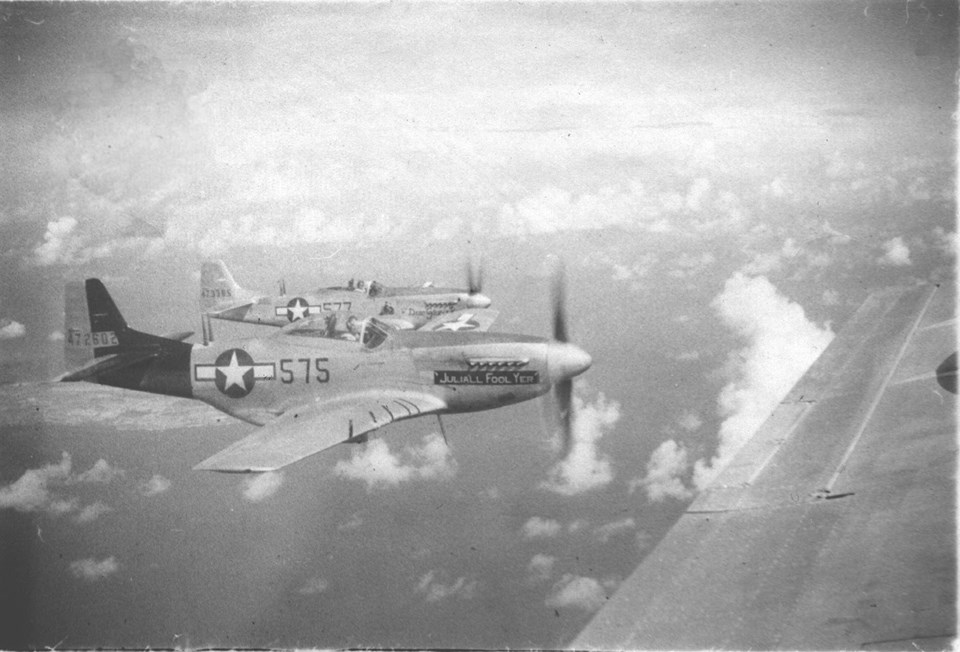
575 My Madge/‘Julia’ll Fool Yer’ was flown by Captain Goldie Marcott. If there was another pilot assigned to fly 575, we have not been able to identify who that pilot was. Captain Marcott was not credit with any aerial victories. Below are photos of Captain Marcott and both sides of 575.
Captain Goldie Marcott (via Brian Walter)
I think this is a great photo. It shows the graceful and aerodynamic lines of the nose/cowling.
575 “My Madge/Julia’ll Fool Yer” (via Brian Walter)575 “My Madge/Julia’ll Fool Yer” (via Dr. John Benbow)
Andrew’s original intent was to build 551 Delta Queen, another 458th FS/506th FG Mustang flown by Captain J.B. Baker, Jr. He had seen a build of Eduard’s 1/48th scale P-51D Mustang with Delta Queen’s markings and the striped blue tail. Unfortunately, there are no after market decals for 551 Delta Queen in 1/32nd scale. Wanting to build a 458th FS Mustang with a striped blue tail, Andrew purchased DK Decals’ P-51D/K Mustang over the Pacific and Australia (32022) with decals for 575.
The only other after market decal sheet that includes markings for a 458th FS Mustang in 1/32nd is Hussar Productions’ P-51 Over Pacific, Part 1, which has decals for 590 “Little Que” flown by 1st Lt. Quarterman Lee.
Andrew did a great job of painting and weathering the cockpit sidewalls, and adding additional detail.
Andrew Willet
Andrew used Ammo of MiG’s Atom Acrylic Paint Zinc Chromate Green (Atom-20074) for the cockpit area, and Tamiya Yellow Green (XF-4) for all other interior areas. Tamiya’s Yellow Green is an excellent match for Zinc Chromate Yellow.
Andrew Willet
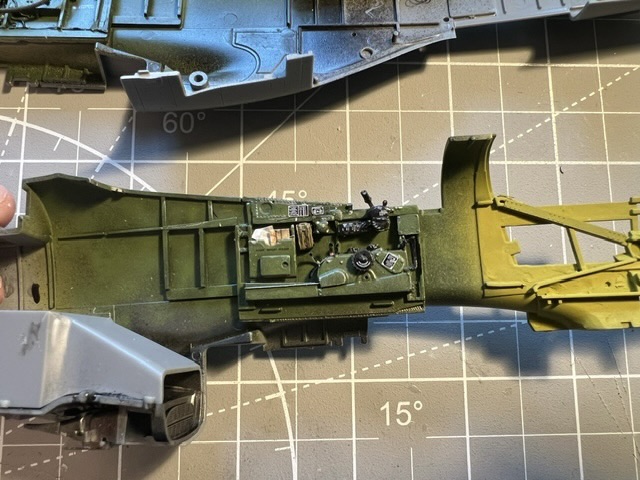
The photo below shows the assembled and painted cockpit components installed on the left side of the kit fuselage. Andrew did a really nice job of chipping the areas in front of the rudder pedals to simulate the wear of the black non-skid material down to the wood cockpit floor. Nice touch! The seat belts are from HGW.
Andrew Willet
The wheel wells of the D model of the Mustang looked like the photo below. The roof was unpainted Alclad aluminum, with the sides, ribs, stringers, other components painted primarily Zinc Chromate Yellow. As can be seen, a few parts were painted Zinc Chromate Green.
Andrew K. Carothers
Fundekals 🙂 produced a North American P-51D stencil data decal sheet that includes the red stencil markings on the unpainted Alclad aluminum.
Fundekals 🙂
Andrew used those stencils decals in the wheel wells. He first used Bare Metal Foil to simulate the unpainted aluminum, then applied the stencil decals to the Bare Metal Foil, and the added the remaining wheel well component. Very nice detail that increases the realism of the wheel wells.
Andrew Willet
Andrew also added fluid and electrical lines to the wheel wells to add more visual interest.
Andrew WilletAndrew Willet
Andrew used various shades of Alclad II Metallics for his natural metal finish on 575. Unfortunately, there are no after market decals for the diagonal stripes on the tail in 1/32nd scale. You have to mask and paint them which most modelers shy away from in favor of a solid tail 506th FG Mustang.
Andrew Willet
The diagonal tail stripes on the actual 506th Fighter Group Mustangs were 4 inches wide. When scaling them down to 1/32nd, Andrew calculated that the diagonal tail stripes were approximately 3.1 mm. Andrew used Mr. Paint Sea Blue (MRP-237) for the stripes.
Andrew Willet
To finish the model, Andrew purchased Brengun Models resin 1/32nd 110 gallon drop tanks. They are a very accurate scaled down version of the real tanks.
Brengun Models
The tanks are not 3D printed, but cast resin. They come with cast resin sway braces, photo etched pieces, and decals.
Brengun Models
After applying the decals, Andrew completed the model by weathering it to reflect the actual look of the Mustangs due to the less than hospitable conditions on Iwo Jima.
Andrew WilletAndrew Willet
Congrats to Andrew for an excellent build! He has also purchased the Revell 1/32nd P-51D Mustang in which he intends to finish using decals for 528 The Enchantress, a 457th Fighter Squadron, 506th Fighter Group Iwo Jima VLR Mustang. We look forward to updates as he builds another Iwo Jima VLR Mustang.
Andrew Willet is a CMDR in the Royal Australian Navy who specializes in logistics. In his more than 25years in the RAN, he has been all over the world, both at sea and ashore. Commander Willet has always had an interest in aviation especially in the Pacific. His preferred scale is 1/32nd.
All three Iwo Jima VLR Mustang Groups were tasked with flying combat air patrols around Iwo Jima to protect the island against attacks by the Japanese. The photo below shows three 462nd Fighter Squadron, 506th Fighter Group Mustangs on combat air patrol around Iwo Jima. The closest Mustang, 626, is being flown by 1st Lt. Edward Linfante. The middle Mustang, 602 “Meatball” is being flown by 1st Lt. Edward Bahlhorn, and third Mustang, “Little Joe”, is being flown by 2nd Lt. Jesse Sabin. Really nice photo.
Three 462nd Fighter Squadron Mustangs flying Combat Air Patrol around Iwo Jima (506th Fighter Group Association via Ed Linfante)
Mt. Suribachi was the central orbit for all CAPs. Starting with North and every 45 degrees clockwise around the compass 10 miles is an orbit point each with a code name as shown on the diagram below.
Combat Air Patrol Diagram from 506th Fighter Group Indoctrination Handbook
In the event of an air raid during the time the CAP flights were airborne, they would join their respective squadrons at the designated orbit points when Agate Base on Mt. Suribachi announced “All flights Kalamazoo”. When Agate Base announced “All flights fluorescent”, all flights except the CAPs would return to Iwo Jima.












 Iwo Jima Models