Kit Review: Eduard’s 1/72nd P-51D Mustang “Tales of Iwo Jima” Limited Edition Dual Combo Boxing

Eduard recently released its 1/72nd P-51D Mustang “Tales of Iwo Jima” Limited Edition Dual Combo boxing. The box art is very appealing.

Eduard

As can be seen from the kit’s aircraft profiles below, the decal options are similar to the 1/48th scale limited edition boxing in that it provides 12 decal options that cover all nine Iwo Jima VLR Mustang squadrons. They will be the same decal options with one change. The 457th Fighter Squadron decals will be for 539 “Lil Ole Meanie II”, flown by 2nd Lt. William G. Hetland and Lt. Hinkle, instead of 542 “Fighting Lady” flown by 1st Lt. Ralph Gardner and 1st Lt. Chester Jatzcak. The decals for 542 “Fighting Lady” are included in the 1/72 P-51D Mustang Profipack boxing.

Eduard

Below is a large aircraft profile of 539 Li’l Ole Meanie II. I am assuming it was included due to the pin-up art below the canopy of the beautiful woman in state of being partially undressed.

Eduard

I am not going to review the actual plastic parts as I have done that previously. You can find that review here. It is a beautiful and well engineered kit with exquisite rivet detail for a 1/72nd scale kit.

Eduard

No resin parts are included in this limited edition dual combo boxing. Customary of Eduard for limited edition boxings, a color photo etched fret is included for each kit that consists of cockpit components and scribing templates (Parts PE7 and PE19) to create accurate panel lines for the VLR Mustangs. The photo etched frets also contain the scribing and placement template, and parts (PE22-25) for the AN/APS-13 rear warning radar installed on the tail of late model Mustangs. Nice touch on Eduard’s part.

Some of Block 20(NA), and all of Block 25(NA) produced P-51Ds had the AN/APS-13 rear warning radar installed. The AN/APS-13 was a low power UHF tail warning radar transmitter/receiver which was used to detect aircraft approaching from the rear. Below 1500 feet it would have to be turned off, otherwise it would receive false readings from the ground. Its effective range against small fighter sized targets was 280 – 320 meters. When it detected an aircraft, a small red light would come on and a bell would ring. Below is a photo of a 462nd FS Mustang showing the location of the AN/APS-13 radar antennae on the tail.

Loomis Dean/USAAF/National Archives via Fold3

The AN/APS-13 radar was seen as somewhat of a blessing and a curse by pilots. Some 506th FG pilots that I have interviewed indicated it was an annoyance during formation flying because it would keep going off when a threat was not present unless you were the tail end Charlie. 1st Lt. William G. Ebersole of the 462nd FS indicated that it was common practice for pilots on VLR missions to turn the radar off during the long over water approach to Japan, and the long return trip back to Iwo Jima, only switching it on upon reaching the Japanese home islands.

There is a minor error on the assembly instructions that warrants pointing out. The avionics transmitters were different on Iwo Jima VLR Mustangs due to the addition of the SCR-695 IFF transmitter which was located right behind the SCR-522 radio transmitter. This addition necessitated moving the battery to the rear of engine compartment. Below is a nice computer generated image of how this set up looked.

John Terrell

Eduard has accurately produced the SCR-522 radio transmitter and SCR-695 IFF transmitter as one part (E3). Eduard also provides the normal configuration of the SCR-522 radio transmitter and battery as part E2. Below is page 3 of Eduard’s instructions (Step A) showing the assembly of the cockpit parts. Please note that the instructions indicate the correct part (E3), but the assembly drawing is of the SCR-522 radio transmitter/battery part (E2). Do not be confused by the wrong pairing of the part number and drawing. If you are building an Iwo Jima VLR Mustang, use part E3.

Eduard

Kudos to Eduard for putting out a 1/72nd Dual Combo Limited Edition boxing that provides decals for all 9 Iwo Jima VLR Mustang squadron. Nice to not to have to rely on the aftermarket decal industry to supply those options. If you want to build an Iwo Jima VLR Mustang in 1/72nd scale, this is the kit and the boxing to buy.

Photos of the Week; Bombing Up

Soon after their arrival on Iwo Jima on March 6th and 7th, the Mustangs of the 45th, 47th and 78th Fighter Squadrons of the 15th Fighter Group began offensive bombing operations against the remaining Japanese troops on the island. Taking off from South Field, they made short bombing hops to the northern portion of the island in support of United States Army and Marine ground forces.

The photo below shows an armorer adjusting the braces supporting a 500 pound general purpose bomb on a 45th FS Mustang. The distinctive diagonal green bands with black borders of the 45th FS can be seen on the bottom of the wing and on the right main landing gear cover.

USAAF/National Archives via Fold3

The small L shaped supports can also be seen on the bottom of the wing. These supports were added on both sides of the bomb racks and were used to hold the sway braces in place for the 110 and 165 gallon drop tanks.

The official caption for this photo reads: Armorer adjusting braces on a North American P-51 “Mustang” for 500 pound bomb which will be dropped in first P-51 dive- bombing assault on Iwo Jima, Bonin Islands.

Photo(s) of the Week; Life Raft Rescue Kit

With VLR pilots spending so much time on missions over the vast expanse of the Pacific Ocean, every effort was made to reduce the amount of time a pilot spent in the water or on the water. Naval resources were stationed along the route to pluck pilots out of the Pacific. Submarines were stationed off of the coast of Japan to pick up pilots who were successful in reaching the Pacific before having to bail out or to ditch. Destroyers were stationed along the route, and PBY Catalinas were in the air.

The United States Army Air Force aircraft were also involved in air-sea rescues of their own pilots. Boeing B-17 Flying Fortresses (SB-17s) were modified to carry a motorized 27 foot A-1 Higgins boat to be dropped to downed pilots. North American P-51D Mustangs were also involved in these efforts.

15th Fighter Group members Major James B. Tapp and Captain Vic Mollan combined to develop a droppable rescue kit packaged into a 110 gallon metal drop tank while on Oahu. The picture below shows a life raft rescue kit installed on 15th Fighter Group commander Colonel James O. Beckwith’s P-51D Mustang 15 Squirt.

USAAF/National Archives via Fold3

The kit was contained within a zipper type kapok bag as shown in the photo below and consisted of a A-3 life raft, a Gibson Girl radio, a Naval kit of visual signal equipment, and rations.

Major James B. Tapp inspecting the results of a test of the life raft rescue kit (USAAF/National Archives via Fold3)

When the tank was released, it would separate and a static line would open a parachute that allowed the kit to descend slowly to the pilot in water. The life raft rescue kit was first tested by Major Tapp on December 11, 1944 as shown in the photo below.

Major James B. Tapp tests the life raft rescue kit while on Oahu prior to deploying to Iwo Jima (David Beyl via John W. Lambert)

On December 12, 1944, Major Tapp tested the kit again, this time with 2nd Lt. Charles C. Heil, the 78th Fighter Squadron’s resident swimming champion, in the water off Oahu. The concept and equipment worked so well that the Hickman Air Depot began assembling these kits.

During actual operations on Iwo Jima, the P-51D Mustangs carrying the life raft rescue kits were code named “Josephines”. In the picture below, three 462nd Fighter Squadron Mustangs are flying combat air patrol around Iwo Jima. The P-51D Mustang in the foreground of the photo, 628, is carrying a life raft rescue kits under its left wing and is being flown by Lt. Edward Linfante. The middle Mustang is 602 Metalball and is being flown by Lt. Edward Bahlhorn. The Mustang in the background is believed to be 603 Little Joe and most likely being flown by Lt. Jesse Sabin.

Three 462nd Fighter Squadron Mustangs flying Combat Air Patrol around Iwo Jima (506th Fighter Group Association via Ed Linfante)

References:

1. The Long Campaign: The History of the 15th Fighter Group in World War II, John W. Lambert, Schaffer Publishing Ltd. (2006).

Thank You Veterans!

Today, November 11th, is the federal holiday in the United States to honor those who have served in the United States Armed Forces.

78th Fighter Squadron pilots pose for a picture with one of their Curtiss P-40K Warhawks while stationed on Midway Island in 1943 (Mark Stevens/7th Fighter Command Association)

Veterans Day coincides with other holidays, including Armistice Day and Remembrance Day, which are commemorated in other countries, marking the anniversary of the end of World War I. Major hostilities of World War I ended on the 11th hour of the 11th day of 11th month of 1918, when the armistice with Germany went into effect.

Ground crew and pilots assigned to 640 “The Shawnee Princess/Empire Commuter” pose for a picture in front of their 462nd Fighter Squadron P-51D Mustang. From left of right: Cpl. Sheetz (armorer), Cpl. Riley (radioman), 1st Lt. Seale (pilot), Capt. Zagorsky (pilot), and Sgt. Jackson (crew chief) (506th Fighter Group Association)

Originally known as Armistice Day in the United States, it was renamed Veterans Day in 1954 at the urging of the major organizations representing veterans in the United States.

Crew members of “Thumper” pose for a picture in front of their Boeing B-29 Superfortress on Tinian Island in 1945 (870th Bomb Squadron, 497th Bomb Group, 73rd Bombardment Wing)

Veterans Day is distinct from Memorial Day which is observed in May of each year. Veterans Day commemorates the service of all those who served in the United States Armed Forces, while Memorial Day specifically honors those who died in military service to our country.

457th Fighter Squadron pilots pose for a picture along side 642 “Fighting Lady” (506th Fighter Group Association)

Thank you to all veterans who have served in the United States Armed Forces. Your service and sacrifices to protect and preserve the freedoms we continue to enjoy are greatly appreciated!

Iwo Jima VLR Mustang Squadron Markings Part III; 78th Fighter Squadron, 15th Fighter Group

This is the third part of a nine part series on the markings of the VLR Mustang squadrons. Six of the nine squadrons changed their markings during their time on Iwo Jima after the 7th Fighter Command ordered the VLR Fighter Groups to adopt more simplified markings. The 78th Fighter Squadron was one of those squadrons.

The fuselage numbers for the 78th Fighter Squadron Mustangs were 100 through 149. During their time in the Central Pacific, the 78th FS adopted the nickname the “Bushmasters” after the largest venomous pit viper in the world. When the 78th received its Mustangs, the squadron emblem was applied to both sides of the nose in front and below of the windscreen.

78th Fighter Squadron “Bushmaster” Emblem

The first iteration of the Bushmaster squadron emblem appeared after the 78th FS began receiving Curtiss P-40K Warhawks while on Hawaii. The Bushmaster snake head was painted on almost all of front fuselage/cowling on both sides.

Major Gordon R. Hyde, Commander of the 78th Fighter Squadron, next to his Curtiss P-40K Warhawk “Hyde’s Harlot” (Robert W. Moore)

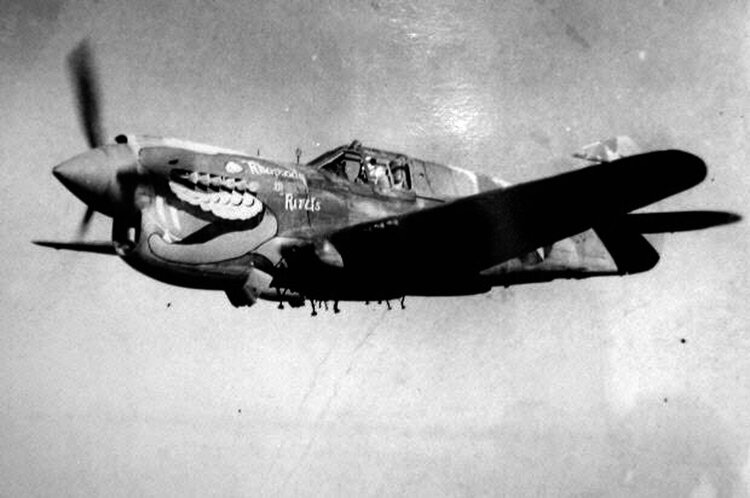
Below is a great in-flight photo of the 78th Fighter Squadron’s P-40K “Rhapsody in Rivets” showing the squadron’s Bushmaster nose art. The hours that ground crew spent painting the Bushmaster head on their P-40Ks had to be incredibly high.

“Rhapsody in Rivets”, 78th Fighter Squadron Curtiss P-40K Warhawk (Robert W. Moore)

The 78th Fighter Squadron would eventually transition to the Republic P-47D Thunderbolt. Delivered to the 78th Fighter Squadron on Hawaii unpainted except for the anti-glare panel and national insignias, the 78th Thunderbolts’ cowlings would be completely covered with wide black/yellow/black bands. In addition, a yellow band above a black band adorned the vertical tails, while yellow tips outboard of black bands were painted on the wings and tailplanes.

A formation of 78th Fighter Squadron Republic P-47D Thunderbolts over Hawaii (Robert W. Moore)

The second iteration of the 78th Fighter Squadron Bushmaster emblem is shown nicely in the color photo below. This time around the Bushmaster’s head was painted on a black and yellow circular background with a narrower black border centered on the Thunderbolt’s large cowling. Note the fuselage numbers on the 78th’s Thunderbolt in the above photo – in the 200s instead of the 100s.

78th Fighter Squadron Pilot Robert W. “Todd” Moore standing on the wing of his Republic P-47D Thunderbolt “Stinger V” (Robert W. Moore)

Prior to being stationed on Iwo Jima, the 78th Fighter Squadron would transition to the long range North American P-51D Mustang. While retaining the yellow and black bands on the vertical tail and the tips of the wings and the tailplanes, the spinner was painted yellow and black with 6 inch black band on the nose behind the spinner as shown on Eduard’s excellent aircraft profiles of Major James B. Tapp’s 101 “Margaret – IV”

Eduard

The last iteration of the 78th Fighter Squadron’s Bushmaster emblem during World War II was the Bushmaster’s head on a circular blue and yellow background with no border as shown at the top of this post.

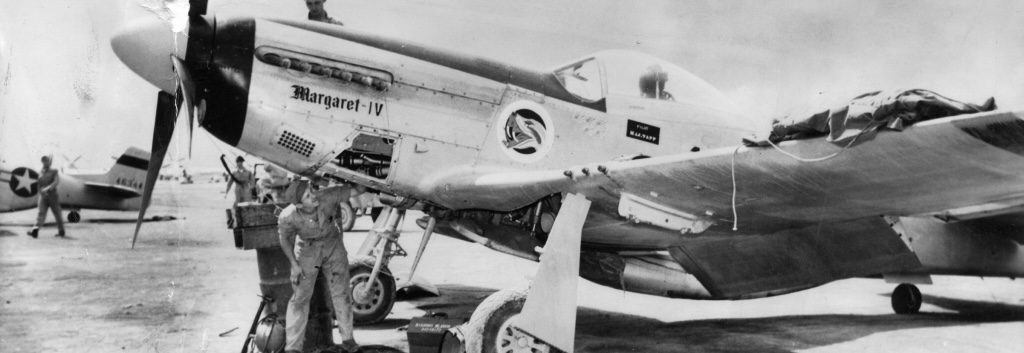
Major James B. Tapp’s North American P-51D Mustang 101 “Margaret IV” on Iwo Jima (Mark W. Stevens/7th Fighter Command Association)

It is interesting to note that some 78th Fighter Squadron Mustangs had their plane number painted on their main landing gear covers, but others did not. As shown in the above photo, Major James B. Tapp’s 101 “Margaret – IV” did not have the plane number on the main landing gear covers, while the photo below shows the plane number (or a plane number) on the main landing gear cover. I say in parentheses “or a plane number” because the plane number on the main landing gear cover does not appear to match the plane number on the fuselage. Always check your references!

USAAF/National Archives via Fold3

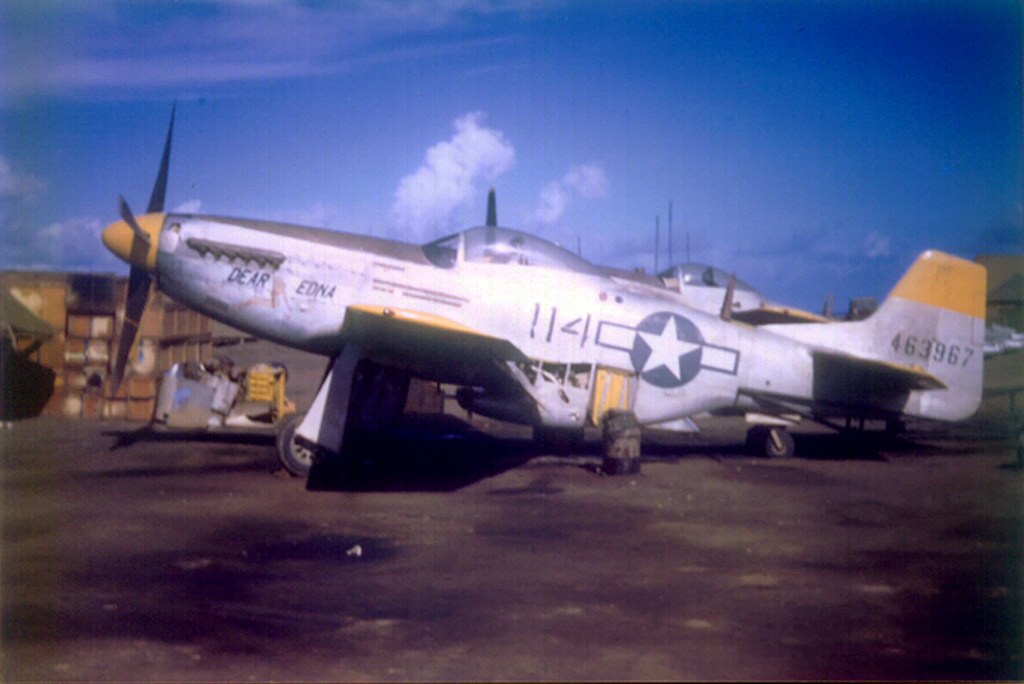
When the 78th Fighter Squadron transitioned to more simplified markings while on Iwo Jima, the spinner was painted all yellow, the black band on the nose behind the spinner was removed except where it crossed the anti-glare panel, and the black bands on the vertical tail, wing tips and tailplanes were overpainted with yellow as shown in the color photo of 1st Lieutenant Frederick A. Bauman’s 114 “Dear Edna”.

1st Lieutenant Frederick A. Bauman’s North American P-51D Mustang 114 “Dear Edna” on Iwo Jima (Mark W. Stevens/7th Fighter Command Association)

In the close-up color photo below of 114 “Dear Edna”, you can see where the black nose band was not removed where it crossed over the anti-glare panel.

1st Lieutenant Frederick A. Bauman’s North American P-51D Mustang 114 “Dear Edna” on Iwo Jima (Mark W. Stevens/7th Fighter Command Association)

Thanks again to Mark W. Stevens of the 7th Fighter Command Association for providing photos which illustrate the 78th Fighter Squadron’s markings during World War II.

References:

1. The Long Campaign: The History of the 15th Fighter Group in World War II, John W. Lambert, Schaffer Publishing Ltd. (2006).

2. The Pineapple Air Force: Pearl Harbor to Tokyo; John W. Lambert; Schaffer Publishing Ltd (2006).

3. Very Long Range P-51 Mustang Units of the Pacific War; Carl Molesworth; Osprey Publishing Limited (2006).

As a condition of the use of materials from the 7th Fighter Command Association website, the following disclaimer is included: Permission to use, copy and distribute documents delivered from this Worldwide Web server and related graphics is hereby granted, provided 1) That the use of the data will not be used for obtaining a profit of any kind, and 2) That the above disclaimer notice appear in all copies and that both that disclaimer notice and this permission notice appear. All other rights reserved. The name of “7th Fighter Command Association” may not be used in advertising or publicity pertaining to distribution of this information without specific, written prior permission. Mark Stevens and the 7th Fighter Command Association makes no representations about the suitability of this information for any purpose. It is provided “as is” without express or implied warranty. Mark Stevens and the 7th Fighter Command Association disclaim all warranties with regard to this information, including all implied warranties of merchantability and fitness. In no event shall Mark Stevens or the 7th Fighter Command Association be liable for any special, indirect or consequential damages or any damages whatsoever resulting from loss of use, data or profits, whether in an action of contract, negligence or other action, arising out of or in connection with the use or performance of this information.