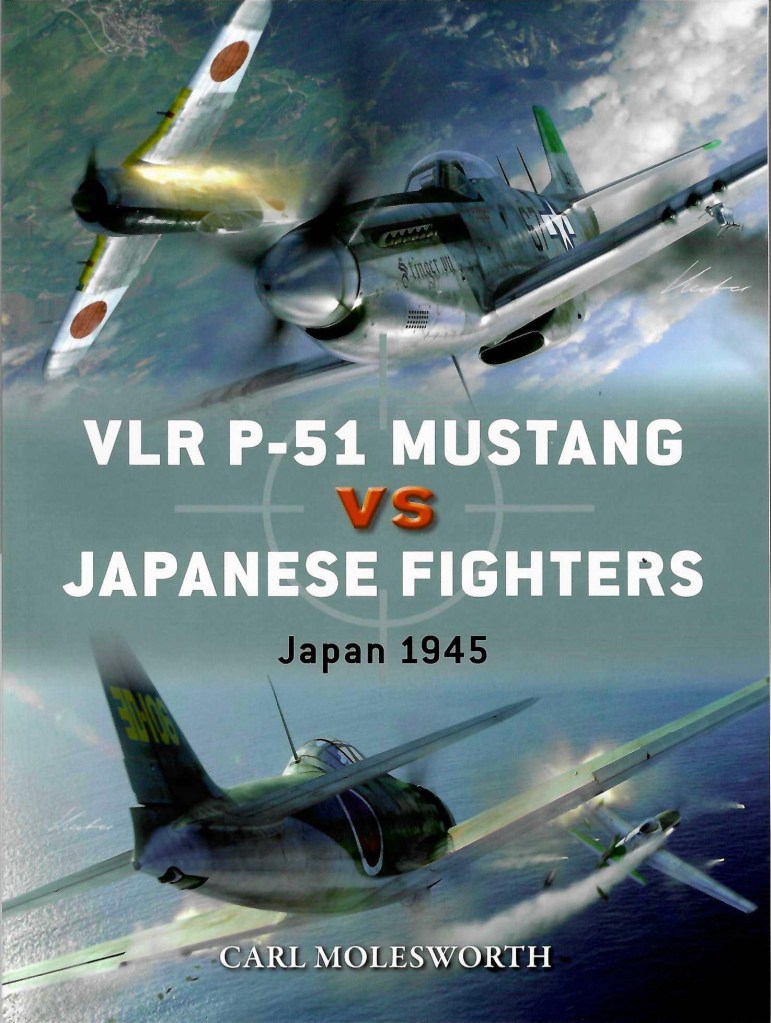
Published in 2025 by Osprey Publishing as part of their Duel Series (#147), this softbound book has 80 pages. Written by noted aviation historian and author, Carl Molesworth, the book focuses on the air war over Japan as fought by United States and Japanese pilots from April 7, 1945 through the end of World War II, and covers combat between the North American P-51D Mustang and the following Japanese fighters: Mitsubishi A6M5 Reisen (Zeke), Mitsubishi J2M3 Raiden (Jack), Kawanishi N1K2-J Shiden-Kai (George), Nakajima Ki-44 Shoki (Tojo), Kawasaki Ki-61 Hein (Tony), Nakajima Ki-84 Hayate (Frank), and Kawasak Ki-100 Goshikisen.
The stunning cover artwork above and the battle scene artwork below were created by Scottish digital artist, Gareth Hector.

As is customary with Osprey aviation titles, airplane profiles and cockpit and armament views by Jim Laurier are included. The profiles and cockpit and armament views are all very nicely done as can be seen from the profile of the Nakajima Ki-84-I Hayate (Frank).
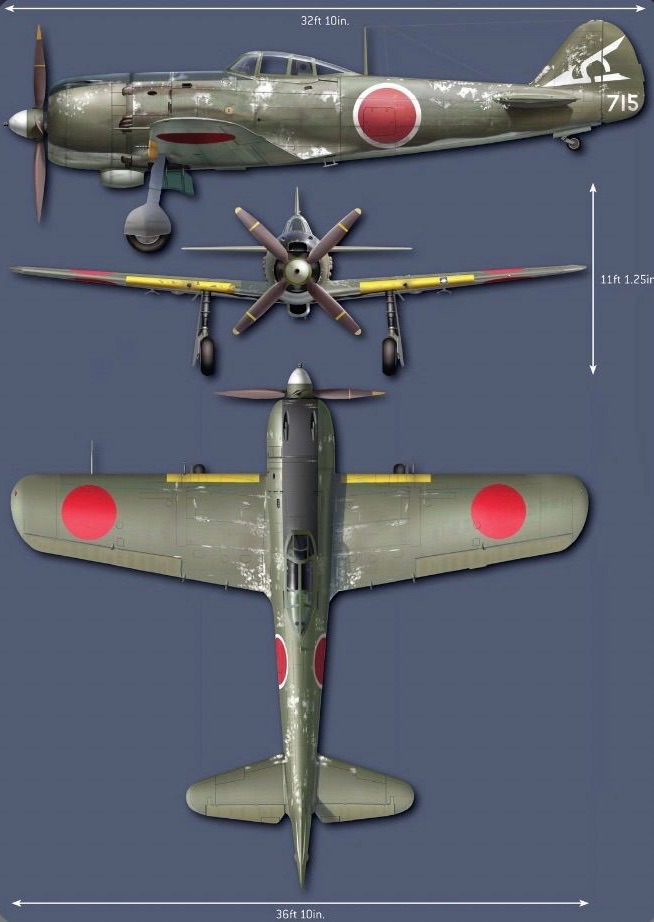
The text is supplemented with numerous photographs, many from the private collections of combatants who dueled over the skies of Japan.
Airplane profiles are provided for the North American P-51D Mustang and the Nakajima Ki-84-I Hayate (Frank). Cockpit views are provided for the Mustang and the Nakajima Ki-44 Shoki (Tojo). Armament views are provided for the Mustang, the Mitsubishi A6M5 Reisen (Zeke), Kawanishi N1K2-J Shiden-Kai (George), Nakajima Ki-44-IIb Shoki (Tojo), and Kawasaki Ki-61-Ia Hein (Tony).
After an introductory chapter, Chapter 2 addresses the design and development of each fighter aircraft. Right before this chapter, is a nice three page chronology spanning from 1939 to 1945 which touches upon the significant dates in the development of each plane. Chapter 3 discusses the technical specifications for each plane with the armament views for the planes identified above.
Chapter 4 discusses the strategic situation in 1945 including the build up of the United States Army Air Force’s B-29s on the Mariana Islands and the establishment of airstrips on Iwo Jima for the three VLR Mustang groups. Chapter 5 focuses on the combatants and contrasts the effectiveness of pilot training between the United States and Japan at that point in the war, and the organization and tactics of each air force.
Chapter 6 is where everything comes together and Mr. Molesworth discusses the actual aerial combats over the Japanese homeland. Specifically discussed are the escort or strike missions on the following dates: April 7, 1945, April 12, 1945, April 19, 1945, May 29, 1945, June 10, 1945, June 23, 1945, July 9, 1945, July 16, 1945, August 3, 1945, and August 10, 1945.
Chapter 7 discusses statistics and gives a brief analysis, and Chapter 8 gives an aftermath discussing the Japanese fighter planes that survived the war and where they are located.
If you are interested in the air war in the Pacific Theater of Operations or the air war over Japan in the closing months of the war, this book is highly recommended. Kudos to Carl Molesworth and Osprey Publishing!