Decal Review – DK decals Pacific Fighters Part One (48017)

If you are following this blog or check in occasionally, it is my hope and prayer that you remain healthy and safe during the COVID-19 pandemic. We are now living under very different circumstances that most of us could not have imagined, and we are all wondering whether our lives will return to what we once knew as normal. If you are under a stay-at-home order to prevent or slow the virus, I hope that my blog fills some of that time.

My good friend, and one of the 506th Fighter Group historians, Brian Walter, recently brought to my attention the Czech decal manufacturer, DK decals. Even though it appears that DK decals has been in business since 2014, they have escaped my notice because their decals are not widely distributed in the United States.

DK decals produces decals for World War II aircraft in 1/144, 172, 1/48 and 1/32 scales, and to this point, it appears that some of their focus has been on aircraft used in the Pacific and China/India/Burma theaters. Any company that produces decals of aircraft used in either of those theaters of operation is very welcome. Their Pacific Fighters Part One (48017) includes decals for Major Harry C. Crim’s 300 “My Achin!” Ass (21st FG, 531st FS), so I purchased that decal sheet to review. More on Major Crim in an upcoming post.

As can be seen below, their aircraft profiles on their decal placement and painting guide are very nicely done, their decals are in register, and they look excellent.

The decals for Major Crim’s Mustang are very accurate when compared to the photo below. From what I have seen of their decal sheets, they are very well researched. Kudos to DK decals.

Mark W. Stevens/7th Fighter Command Association

I real test is how the decals actually perform. I took a scrap piece of plastic sheet, scribed two vertical lines on it, sprayed on a primer coat of Alclad II Grey Primer & Microfiller (ALC 302), and then sprayed on Alclad II Aluminum (ALC 101). The result was smooth surface upon which a decal could be tested without having to put down a gloss coat.

I no longer use a decal setting solution or a decal solvent when applying decals. I have just had inconsistent results using decal solvents. Instead, I wet the area with water where the decal is to be placed, place the decal and move it to its proper position, and then roll out the water underneath the decal with a cotton swab. With a brush, I apply a thin coat of Future acrylic floor polish over the decal and let it dry. Because Future is self-leveling, when it dries, it pulls the decal down over minor raised details and into recessed panel lines. This method has been basically fool proof for me.

As you can see above, the decal performed wonderfully using this method. The decal snuggled down into the scribed panel lines and the decal film basically disappears. I would highly recommend DK decals. Great products.

DK decals products are widely distributed in Europe, but it is difficult to find a hobby store in the United States that carries their products. I purchased this decal sheet with two others from Hannants in Great Britain. I did find an on-line model web store in the Chicago area, but their prices were so high, I could not justify buying from them. I have also been finding them on eBay occasionally.

The good news is that DK decals has recently released a 1/48 decal sheet for P-51D/K Mustangs over the Pacific & Australia (48028) that contains decals for five Iwo Jima VLR Mustangs. I have this decal sheet on order and will review it once received. In addition, they have announced the release of a 1/72 decal sheet dedicated solely to Iwo Jima VLR Mustangs (P-51D Mustang – Very Long Range P-51 Units Iwo Jima 1945; 72087). Again, kudos to DK decals!

Paint Comparison: Hataka Hobby Orange Line and MRP Mr. Paint Lacquers

I have been looking for a hobby paint that is a close match for the green used on the tails of 457th FS Mustangs. From my research, it appears that the 457th used Willow Green (FS14187/ANA 503), or something very close to Willow Green. Willow Green was originally used by the U.S. Navy in some of their colorful pre-war paint schemes. I was pleased to find out that both Hataka Hobby and MRP Mr. Paint manufacture a Willow Green lacquer based paint.

Eduard

I enjoy using lacquers because of their quick drying times and durability. When laid down with an airbrush, they “bite” into the plastic, and therefore, tend to adhere well. The downside to lacquers is that their composition uses chemicals that are dangerous to humans. Prolonged exposure to these chemicals can cause serious health problems, so painting in a well ventilated area is recommended. Those who take the label warnings seriously usually attempt to mitigate these effects by using a paint booth with an exhaust fan that vents the paint fumes to the outside, or a ventilation mask. In addition to the chemicals and the associated strong smell, airbrush clean-up is a little more difficult and time consuming as compared to water based acrylics, and the range of paints in the past have been limited as far as colors.

Both Hataka Hobby and MRP have been around for several years, but their paints have not been readily available in the United States until the last few years. Fortunately now, several U.S. on-line retailers carry both brands, and their wide range of colors are welcomed by modelers who enjoy using lacquer based paints. This is the first time I have had the opportunity to use either paint.

Hataka Hobby Orange Line – Based in Poland, Hataka Hobby produces both water based acrylic paints (Blue Line optimized for brushing, and Red Line optimized for airbrushing) and lacquer paints (Orange Line). Their Orange Line of lacquer paints has a total of 282 colors for both aircraft and military vehicles, and you can purchase them individually or in convenient sets of 4 to 8 colors. Hataka Hobby also provides a proprietary lacquer thinner to thin their paints.

Their paints come in 17 ml plastic bottles with dropper tips and include a stainless steel ball bearing to aid mixing the pigments into suspension. These are similar to the type of bottles used by AK Interactive, Ammo of Mig Jimenez, and Vallejo use for their water based acrylic paints, and the dropper tips make dispensing paint from the bottle incredibly easy. Kudos to Hataka Hobby for using these bottles for their lacquer paints. These paints are not airbrush ready out the bottle, and Hataka Hobby recommends thinning with a 40/60 to 60/40 thinner to paint ratio. Hataka Hobby also recommends spraying them between 10 and 20 psi.

Using my Badger 100GF dual action airbrush, I thinned the paint to a 50/50 paint to thinner ratio, and sprayed it at 15 psi. The paint laid down beautifully, covered well, and dried quickly to a nice matte to semi-matte sheen. There is not a overly strong odor to these paints, and clean-up was not difficult.

Hataka Hobby Orange Line Willow Green (HTK-C221)

MRP Mr. Paint – MRP Mr. Paint is based in Slovakia, and first introduced their line of acrylic lacquer paints (86 colors at last count) for both aircraft and military vehicles. It has now released two lines of water based acrylic paints; one for figure painting and one for airbrushing.

Their acrylic lacquer paints come in either 30ml glass bottles or 30ml plastic bottles with a flip top dropper cap. It appears that MRP is going away from the glass bottles to the plastic bottles (more on the plastic bottles below). They are airbrush ready out of the bottle; no thinning necessary. Because they are pre-thinned, no agitator is necessary as they mix quickly with very little effort. I really like the convenience of not having to thin the paint. Kudos to MRP.

The on-line reviews I have read and listened to, modelers have raved about how good these paints are and their ease of application. I would have to concur wholeheartedly. I sprayed it at 15 psi, and the paint laid down beautifully, covered well, and dried quickly to a nice satin sheen. Again, there is not an overly strong odor to these paints, and clean-up was not difficult.

MRP Mr. Paint Willow Green (MRP-385)

My only complaint about MRP’s acrylic lacquers is not about the paint itself, but about the 30 ml plastic bottles with the flip top dropper cap. Do not hold the bottle at an angle when attempting to transfer paint from the plastic bottle to a paint cup as it will just run onto the cap and not into the airbrush’s paint cup. The best way to transfer paint from the plastic bottle to an airbrush paint cup is to turn the plastic bottle completely upside down and apply pressure to the sides of the bottle. The plastic bottle is fairly stiff, so it really does not lend itself to squeezing. I found it awkward, and like the bottle used by Hataka Hobby much better.

MRP Mr. Paint’s Willow Green is almost an exact match to the color chip for ANA 503 found in The Official Monogram U.S. Navy and Marine Corps Aircraft Color Guide, Volume 2: 1940-1949. Hataka Hobby’s Willow Green is slightly lighter, and looks as if it has been lightened to take into account the scale effect of color. I am not sure if that is intentional on Hataka Hobby’s part as I could not find anything on their website to suggest that they formulated their paint colors in this way. Either paint will work nicely for a 457th FS Iwo Jima VLR Mustang.

I would highly recommend either paint to modelers. The colors appear to be accurate, and both lay down beautifully, cover well, dry quickly, and are very durable. Kudos to both companies.

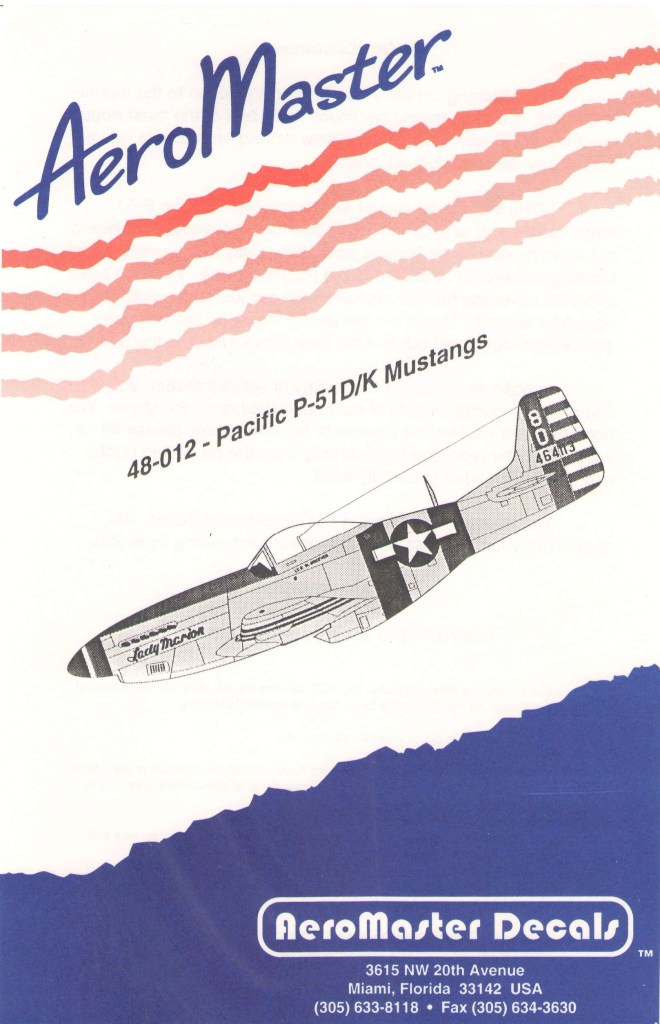
Decal Review – Aeromaster Pacific P-51D/K Mustangs (48-012)

As modelers, we certainly have been blessed by after market decal manufacturers who have provided us with many options to build models of planes with markings not included in a particular kit. For the better part of three decades, decal manufacturers have issued numerous decal sheets which have either been dedicated solely to the Iwo Jima VLR Mustangs or have included decals for Iwo Jima VLR Mustangs. While many of them are no longer being printed, you can still acquire them on eBay or model web stores, so there are a lot of options for modelers to build an Iwo Jima VLR Mustang.

I have acquired almost all of the VLR Mustang decal sheets over the years. For the most part, the decal sheets are very accurate, but rarely do we find a decal sheet of World War II aircraft that do not contain an inaccuracy or two. Inaccuracies are due to either the lack quality photos of a plane showing all of the markings, or the inevitable guessing game of trying to determine what color was used from a black and white photo. Some of it is also due to inaccuracies that have been perpetuated over the years. The purpose of these decal reviews is not to criticize decal manufacturers, but to provide modelers with accurate information regarding the actual plane.

The first decal sheet that Aeromaster issued with VLR Mustangs was their Pacific P-51D/K Mustangs sheet (48-012).

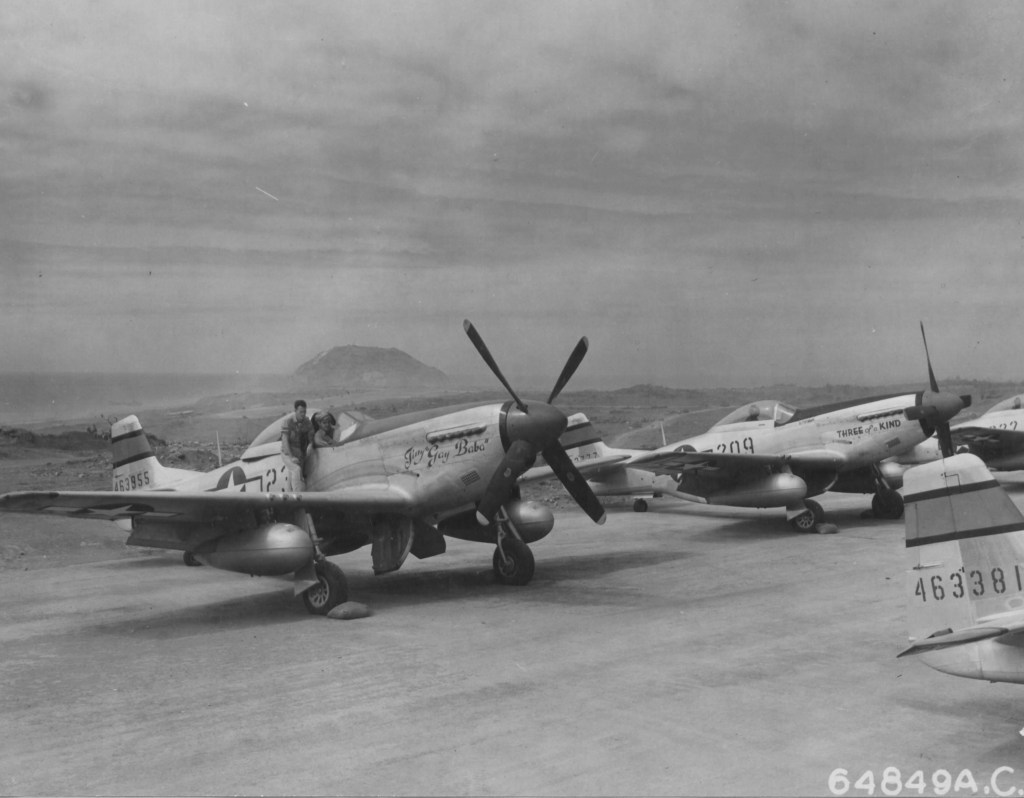
The two Iwo Jima VLR Mustangs on this sheet are 150 “Lil Butch”, a P-51D-20NA (44-63822) of the 47th Fighter Squadron, 15th Fighter Group flown by CaptainWalter H. “Sam” Powell, commander of the 47th FS from June 11, 1945 to July 30, 1945; and 231 “Tiny Gay Baba”, a P-51D-20NA (44-63955) of the 46th Fighter Squadron, 21st Fighter Group, pilot or pilots unknown. The other two planes on the decal sheet are 5th Air Force Mustangs.

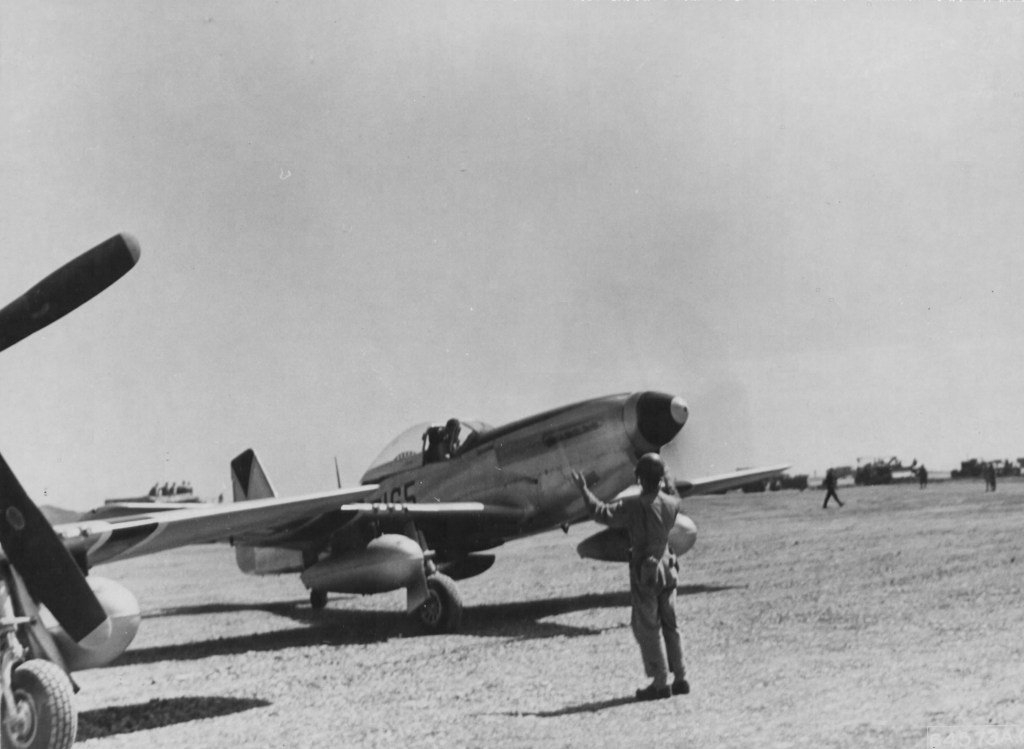
150 “Lil Butch” – As has can be seen from the photos below, the actual markings of 47th FS Mustangs are a yellow/black/yellow propeller spinner, a black band with yellow borders on the rear fuselage behind the national insignia, a black wedge with yellow borders on the upper fin/rudder, and black 18 inch bands with yellow borders on the wings and tail planes. I am not sure how Aeromaster arrived at light blue bands, but they corrected it on a subsequent decal release. The other errors on this decal sheet are that the 5 and the 0 in the fuselage plane number are broken when they should be solid, and the plane number that appears on the landing gear wheel well doors are missing on the decal sheet.

USAAF/National Archives via Fold3

It is interesting that there was no uniformity within the 47th Fighter Squadron with respect to the application of the plane numbers. Apparently, there were no common stencils used to paint the plane numbers on the fuselage. Most likely, maintenance crews made due with what was available to them at the time. The four photos above reinforce that point. 150 has solid fuselage numbers and the plane number appears on the landing gear wheel well doors; 165 has solid fuselage numbers, but the plane number does not appear on the landing gear wheel well doors; 167 has broken fuselage numbers and the plane number appears on the landing gear wheel well doors, and 186 has broken fuselage numbers. This lack of uniformity was also evident in the other VLR Mustang squadrons, so it is nice to have good photo documentation when building a model of an Iwo Jima VLR Mustang.

Captain Walter H. “Sam” Powell was credited with 1 aerial victory, but was lost on July 30, 1945 while flying 188 “Adam Lazonga”. His plane was hit by ground fire while attacking airfields in the Kobe/Osaka area. Captain Powell was able to nurse his damaged Mustang out over the water, but was unable to bail out before it plummeted into the sea.

231 “Tiny Gay Baba” – Below is the only photograph I can find of 231 “Tiny Gay Baba”. I think this a great photograph; 21st FG Mustangs lined up on Central Field on an overcast day with the South Field airstrip and Mt. Suribachi in the background. I have been unable to determine the pilot or pilots whom were assigned to “Tiny Gay Baba”, and we do not have a photograph of the left side of the nose to determine if “Tiny Gay Baba” was also on the left side as well. The good news is that the decals on this sheet are accurate with the photo documentation below.

USAAF/National Archives via Fold3

While this decal sheet has long been out of production, it appears on eBay every so often, and the on-line Canadian webstore, Ultracast, has one in stock. Aeromaster also produced this decal sheet in 1/72 (72-004) with the same inaccuracies, and there is one currently up for sale on eBay.

Kit Preview: Eduard 1/48 North American P-51D Mustang Addendum

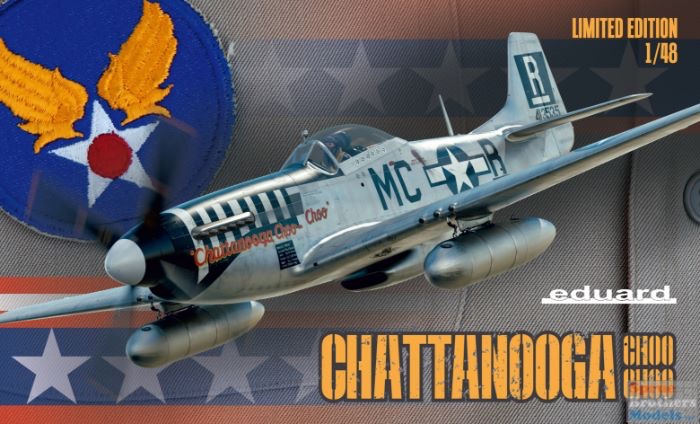
As advertised, Eduard recently released its Royal Class P-51D Mustang Dual Combo boxing. With this release, Eduard provides the 110 and 165 gallon drop tanks and two decal options for Iwo Jima VLR Mustangs. Consistent with Eduard’s practice of including extra “goodies” in with their Royal Class boxings, Eduard does not disappoint with this release. In addition to the two complete kits, Eduard has thrown in an unpainted PSP (Marsden mats) display base for those who enjoy dioramas, and some nice Brassin products: shrouded and unshrouded exhaust stacks, and two pairs of wheels randomly chosen between diamond, cross, block and oval treads.

Eduard

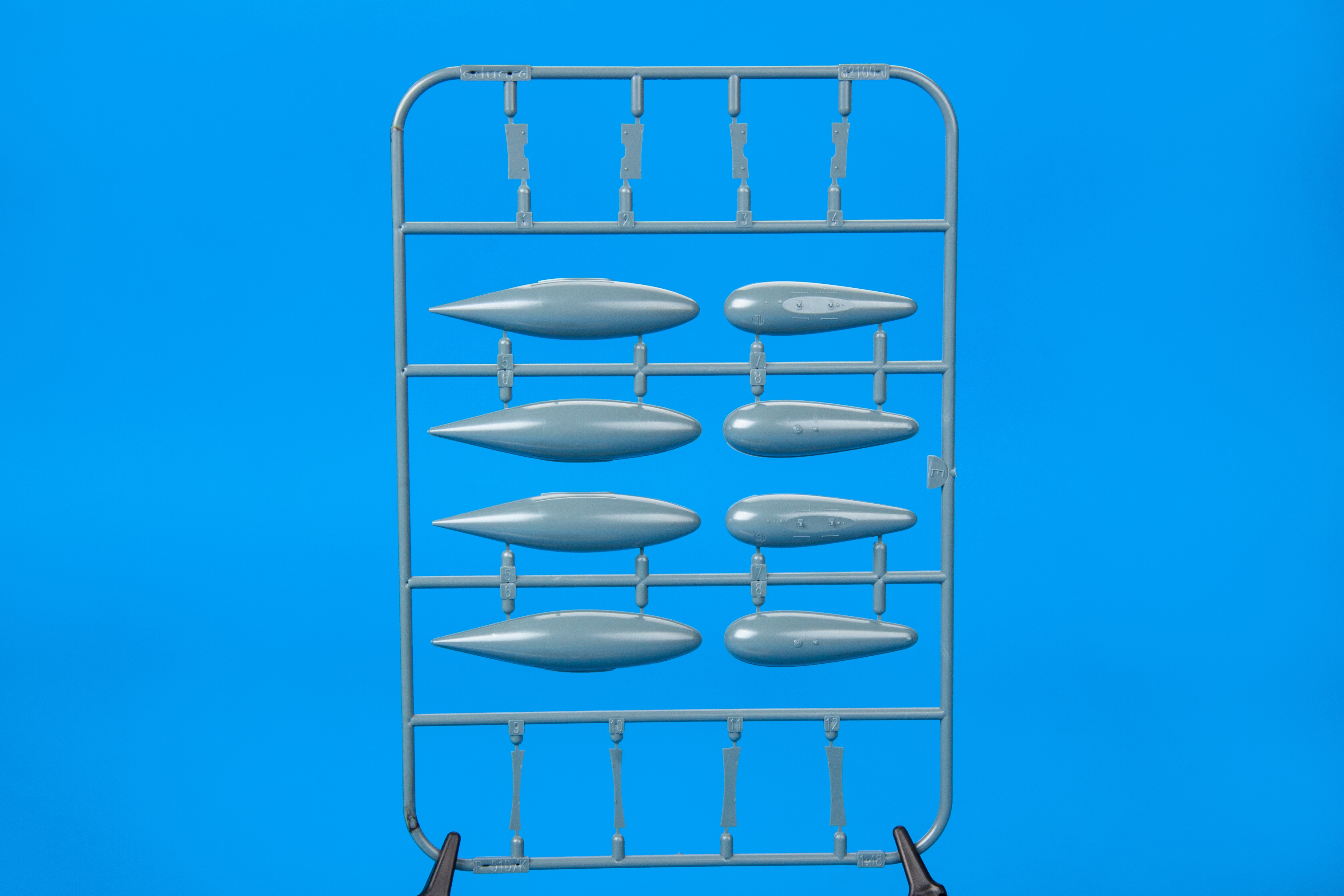
110 & 165 Gallon Drop Tanks: Eduard did an excellent job on reproducing in 1/48 scale the 110 and 165 gallon drop tanks used on VLR missions, and they included the sway braces. Finally, a model manufacturer gets it completely right!

Eduard

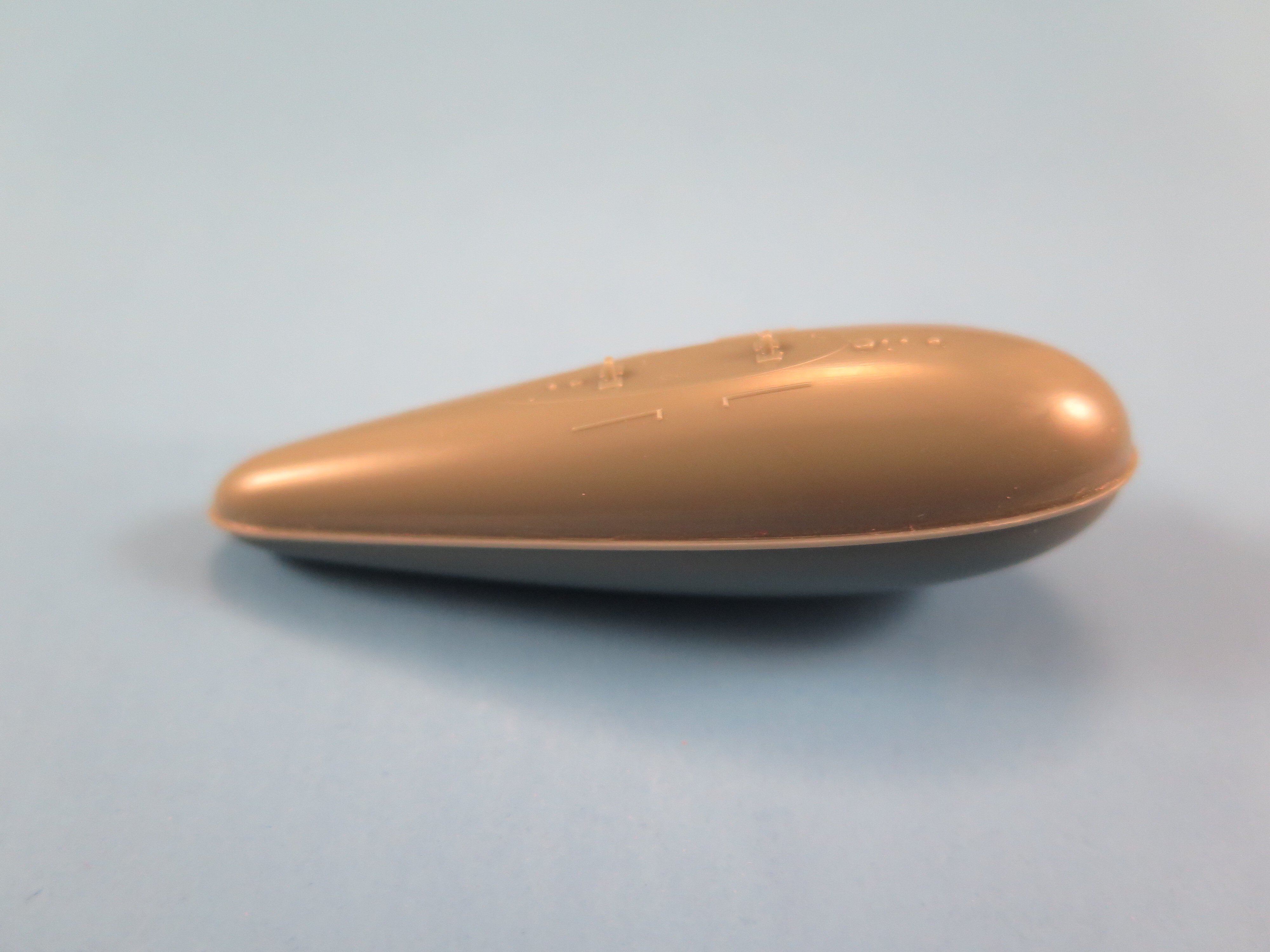
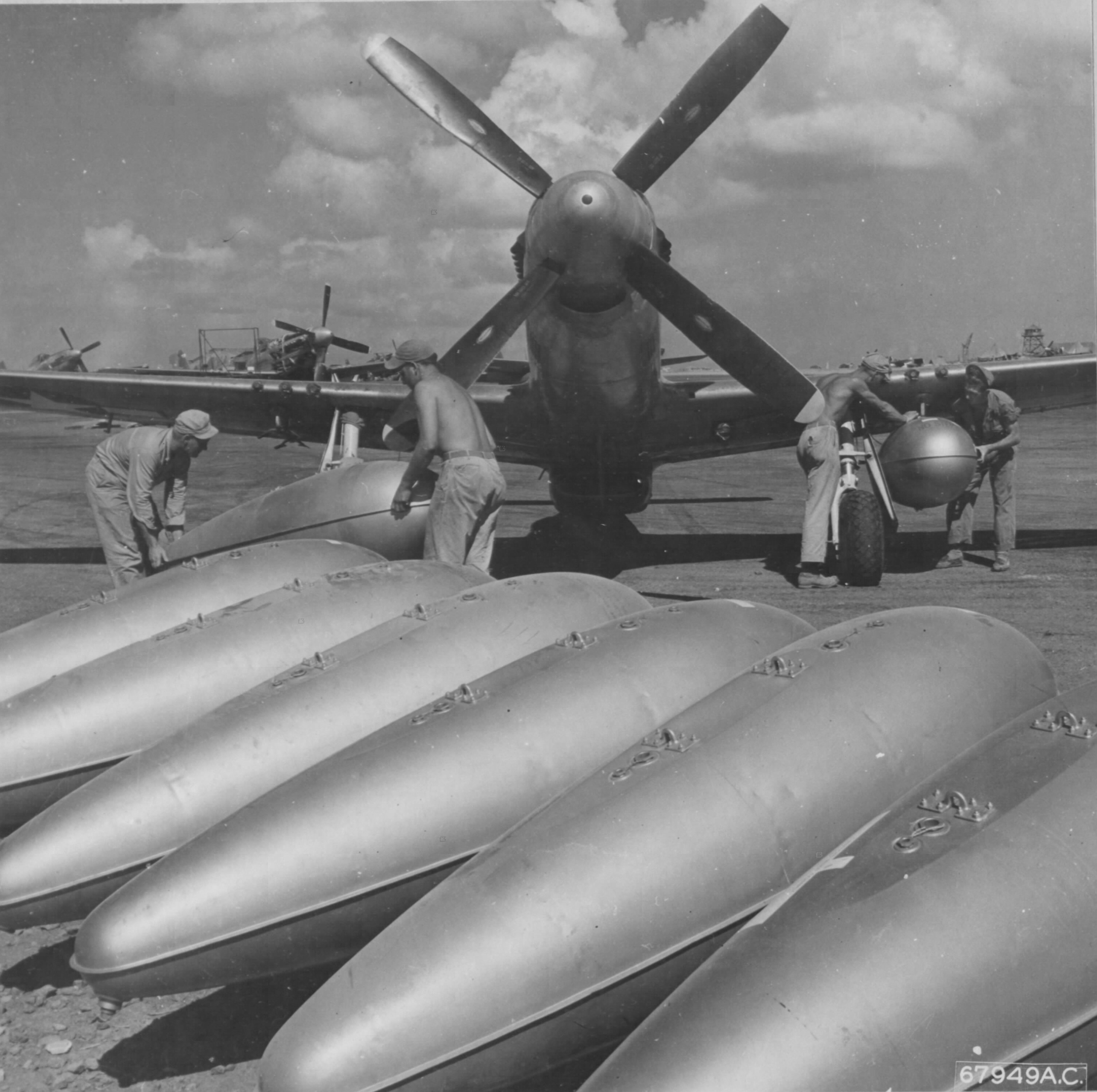
Not wanting to wait until I started a new build with Eduard’s kit, I removed the drop tank pieces from the sprue, cleaned them up, and put them together just to see how they look. Below is a photo of the Eduard 110 gallon tank, and a photo of the actual tank. Judge for yourself on how well Eduard did.

Loomis Dean/USAAF/National Archives via Fold3

Eduard appears to have captured the contours, shape and size of the 110 gallon tanks really well. The flat portion on the top of the tank is represented well, as is the other adjacent detail. Please note the raised lines just below the flat portion of the tank. It appears that Eduard has incorporated them on both sides of the tanks to aid the modeler in positioning the sway braces on the tanks. This should make it much easier to install the sway braces when positioning between the tanks and the wings, and since the raised lines are fairly light, you should not notice them on the completed model. Extremely nice and well thought out with the modeler in mind. So do not sand off these raised lines!

The 165 gallon drop tanks look equally nice. However, instead of the raised lines as an alignment aid for the sway braces, Eduard has instead built in slots for the sway braces on each side of the tank. I test fit one of the sway braces, and they appear to fill the slots completely without the need of any putty to fill any gaps. We will see how well they work when we get into the build. Again, kudos to Eduard and their design team in having the modeler in mind when engineering the installation of the sway braces.

Iwo Jima VLR Mustang Decals: Eduard has included two decal options for Iwo Jima VLR Mustangs, both of the 506th Fighter Group. The first is 555 “The Ole Lady/Little Anne/My Darlin Betty Ann” (P-51D-25-NA, 44-72628), a 458th FS Mustang flown by 2nd Lts. James E. Coleman and Ralph R. Coltman, Jr.

Eduard

The second is 528 “The Enchantress” (P-51D-25-NA, 44-72671), a 457th FS Mustang flown by 2nd Lt. William E. Saks. 2nd Lt. Saks was one of the pilots lost on the June 1, 1945 “Black Friday” mission, but was not flying 528 on that day. “The Enchantress” is popular amongst modelers because the nose art and pin-up girl that adorns the fuselage.

Eduard

Along with the release of the Royal Class Dual Combo boxing, Eduard also released a separate Overtrees boxing with just the P-51D VLR Drop Tanks (Cat. No 82109X) should you want to build multiple Iwo Jima VLR Mustangs, or convert another manufacturer’s 1/48 P-51D Mustang to a VLR Mustang. In addition, Eduard announced the January 2020 release of both the 110 and 165 gallon VLR drop tanks as resin upgrades as part of their Brassin line. Lastly, Eduard announced the release of a Pacific Theater VLR Profipack boxing for August 2020. Sometimes I have to pinch myself just to make sure that I am not dreaming. Life is good!

Kit Preview: Eduard’s 1/48 North American P-51D Mustang

This was the first release of Eduard’s much anticipated 1/48 P-51D Mustang. Its official release date was August 7th at the 2019 IPMS Nationals in Chattanooga, Tennessee. Not wanting to wait until Eduard released the rumored separate Pacific Theater VLR boxing, I ordered mine as soon as preorders were being accepted at Sprue Brothers. That proved to be a good move as this limited edition kit sold out completely in less than a month.

As indicated in an earlier post, all of the necessary parts to make an accurate Iwo Jima VLR Mustang are in this kit except for the drop tanks and sway braces. And, as was announced by Eduard recently in their September edition of their INFO Eduard on-line magazine, the additional sprues with the drop tanks will be in be their Royal Class boxing that will be released prior to Christmas. I am being told that at least two, and maybe three, decal options for Iwo Jima VLR Mustangs will be in the Royal Class boxing. That is great news!

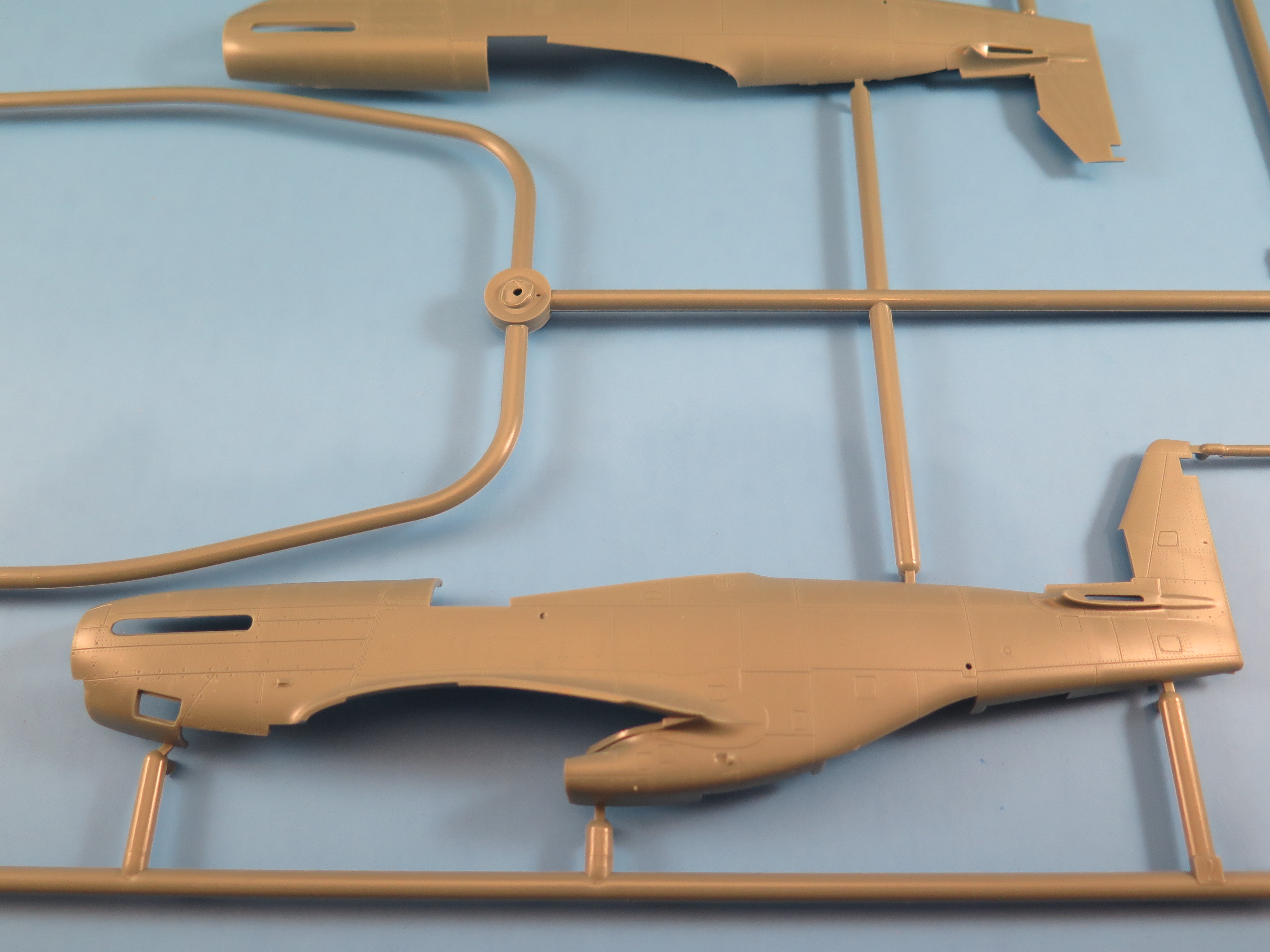
Kit Preview; Sprue D (Fuselage Parts) – Eduard certainly did its homework, and the level of detail for a 1/48 scale model is amazing. So let’s take a look at the various sprues. First up is the fuselage sprue (Sprue D).

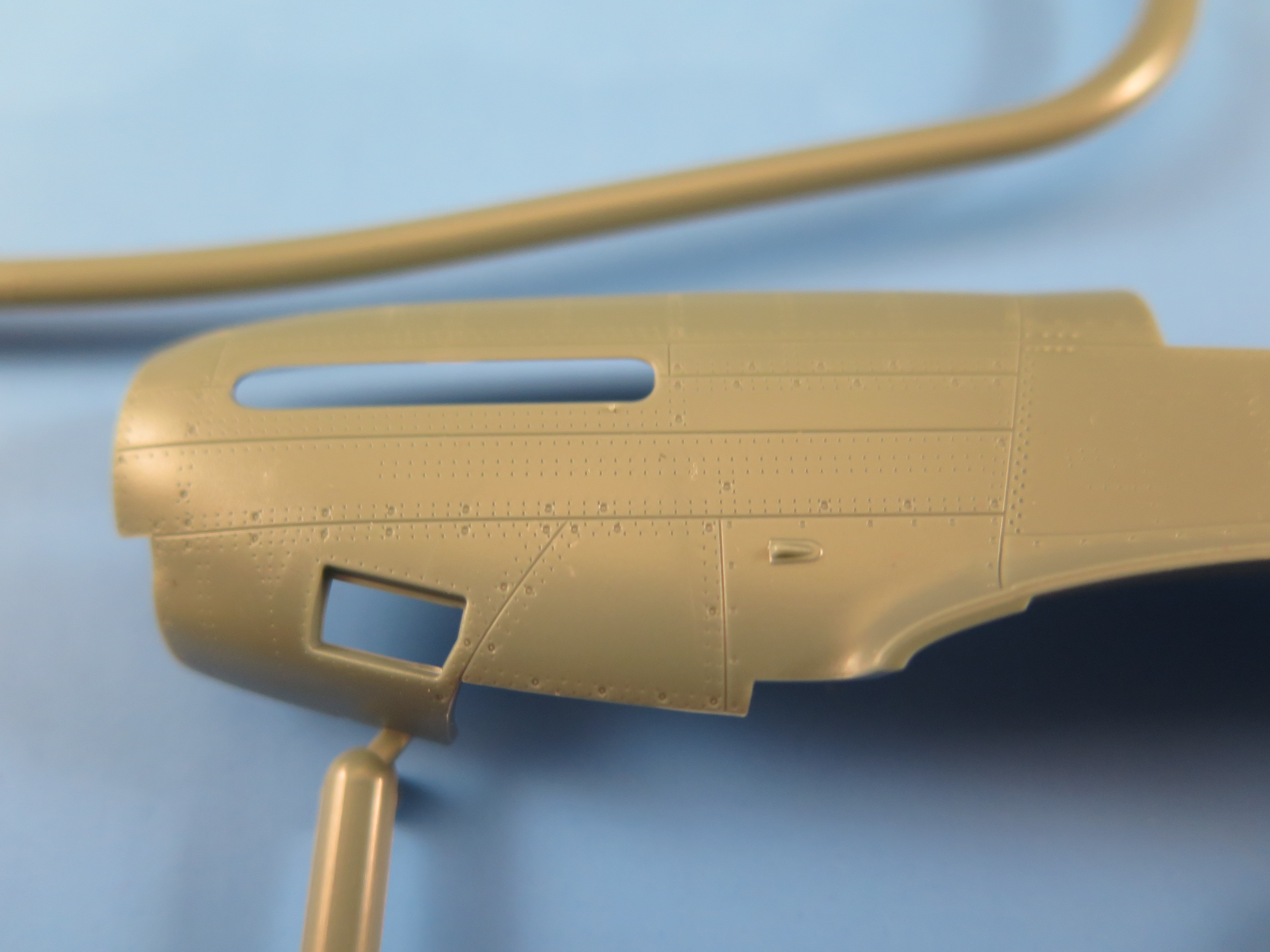
What caught my eye initially is the intricate rivet detail over the entire fuselage and the druz fasteners on the engine cowling panels. Very nice and not overdone. Best not to be too heavy handed with primer and color coats to avoid losing all of that rivet detail. Included in the detail is the small air scoop that was added to the left side of the cowling when the battery was moved to the engine compartment. The other thing I pay pretty close attention to is the contours of the nose, especially at the front of the engine cowling. There are some very subtle contour changes that most model manufacturers have failed to capture correctly. I believe that Tamiya did a very nice job in this area with their 1/32 scale Mustang kit, and it appears that Eduard has done a very nice job as well.

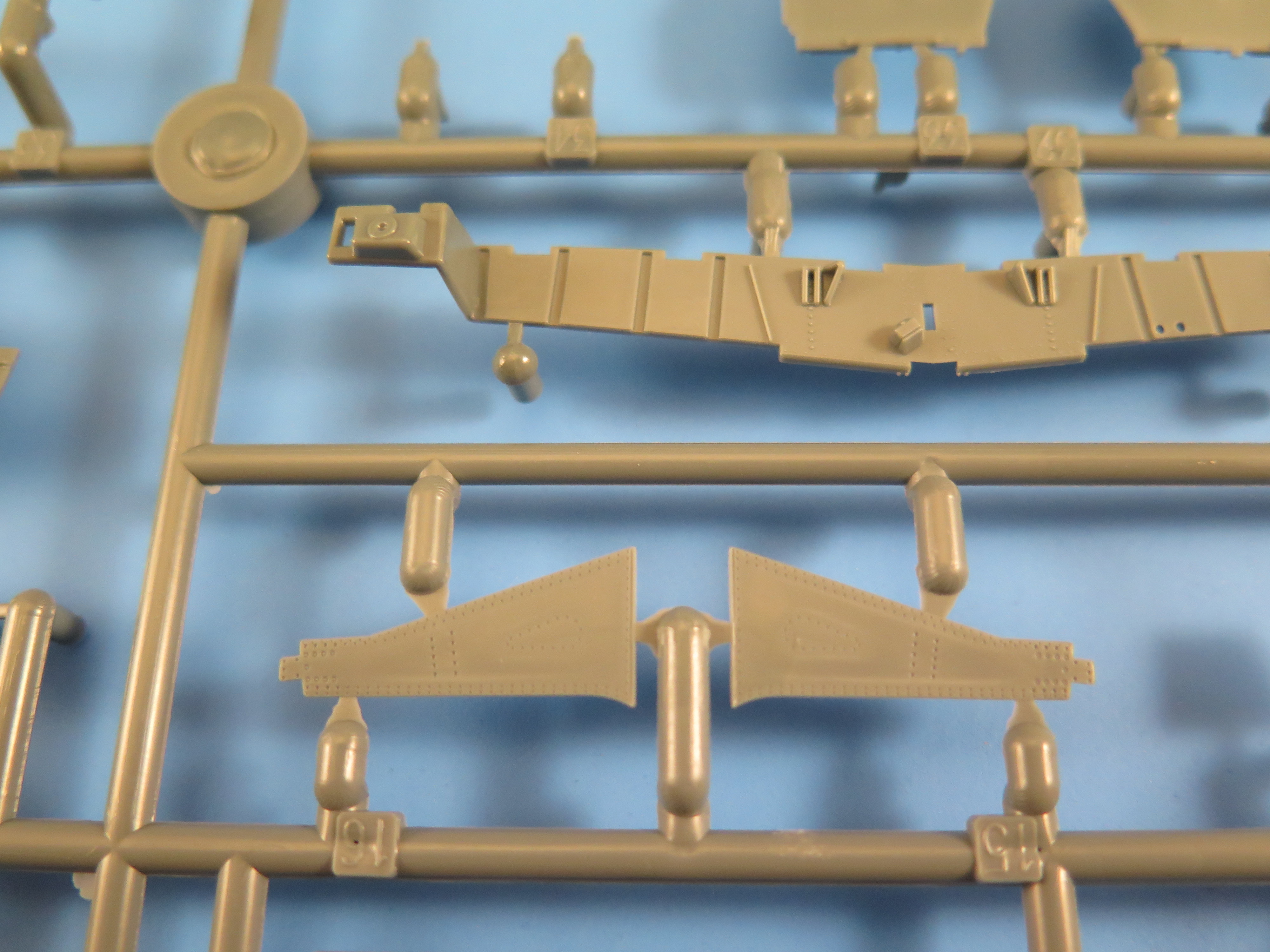
Sprue B (Wings & Horizontal Stabilizers) – The wings and horizontal stabilizers are nicely done with separate control surfaces (flaps, ailerons, and elevators).

I am impressed by the fact that the rivet detail on the wings is accurate. The Mustang has a laminar flow wing which increases the efficiency of air flowing over the wing. To further increase the laminar flow effect over the wing, North American puttied over panel joints and rivet depressions, sanded everything smooth, and then painted the majority of the wings with a silver lacquer paint. The general consensus is that only the gun bays, landing gear access panels, and other access panels were not puttied. Below is a diagram of the wings by Jennings Heilig of fundekals 🙂 that shows which panel lines were puttied.

The faint lines on the above diagram show the panel joints that were puttied. Like all kit manufacturers who have produced 1/48 Mustangs (Airfix, Hasegawa, Meng, and Tamiya), Eduard has represented the panel joints on the wings by recessed panel lines. But some kit manufacturers (Dragon 1/32, Tamiya 1/32, Meng 1/48, and Airfix 1/48) filled their wings with rivet detail, so if you are building these kits and want to portray an accurate puttied wing, you not only have to fill and sand the correct panel lines, but also all of the rivet detail. While this is not overly difficult, eliminating the rivet detail is a tedious and very time consuming task. With the Eduard kit, all you have to do is fill and sand the the correct panel lines. Kudos to Eduard.

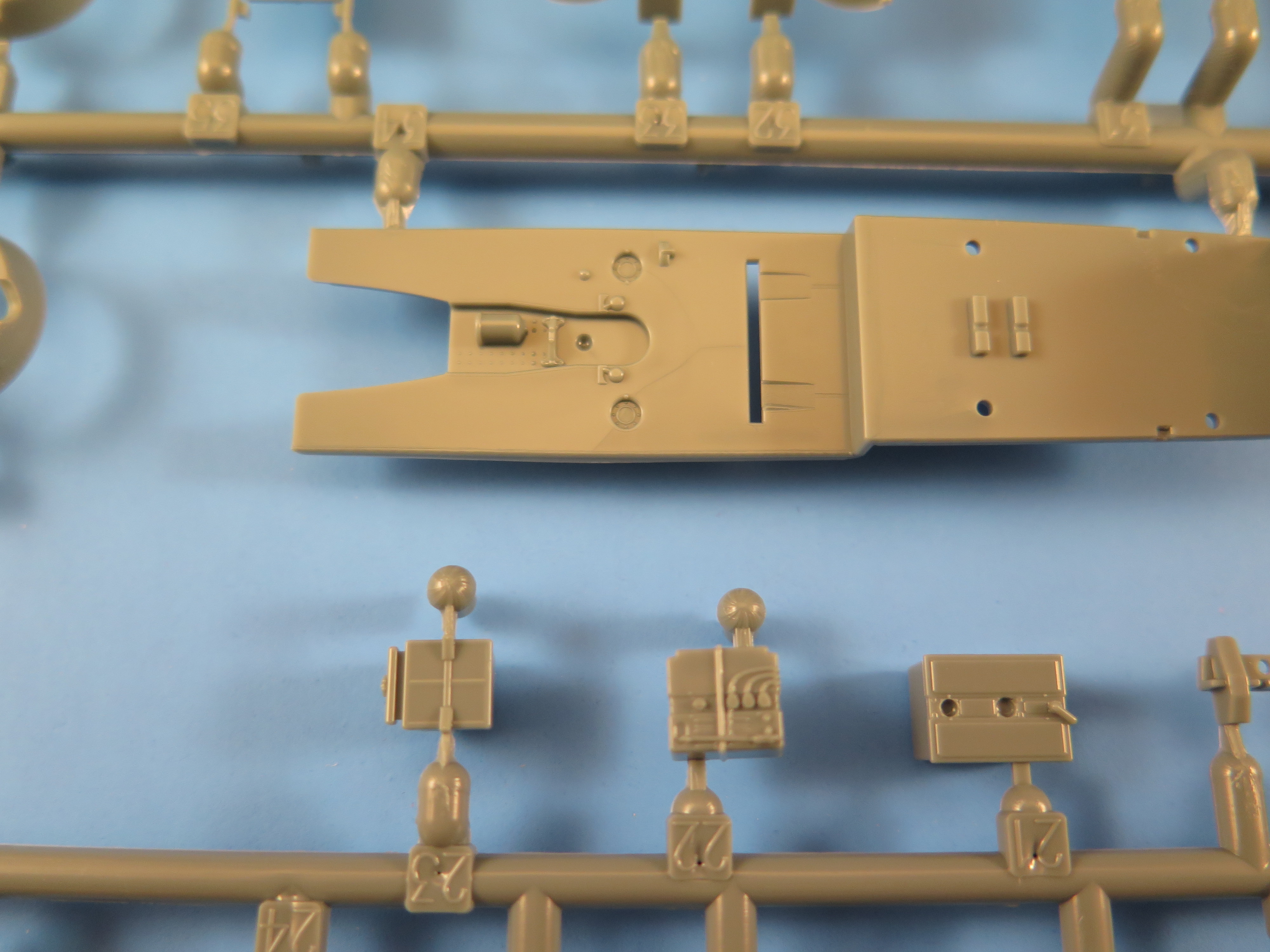
Sprue H (Interior Parts) – This sprue has all of the cockpit parts plus two different spinners and the three different propellers (Hamilton Standard cuffed, Hamilton Standard uncuffed, and Aeroproducts).

It appears to have all the cockpit parts for a D-5 through a D-25 (early and late instrument panels, the two different styles of instrument panel comings, Warren MacArthur and Schick Johnson seats, the different control panels for the right side of the cockpit, etc . . .). However, what I am most interested in is the parts to make an accurate Iwo Jima VLR Mustang. SCR-695 IFF transmitter is part H22, and the level of detail is fantastic for 1/48 scale.

Also included are the SA-3/A Inertia Switch (IFF Detonator Switch) and the BC-727 Indicator Lights (part H50).

So there you have it, all of the necessary cockpit parts are present in this kit to make an accurate Iwo Jima VLR Mustang; first time in a 1/48 kit.

Sprue G (Exterior Parts, Wheel Wells & Landing Gear) – One of the main complaints with early Mustang models is inaccurate wheel wells. Tamiya solved that problem with their 1/32 P-51D Mustang kit, and the other kit manufacturers (Revell 1/32, Zoukei-Mura 1/32, Airfix 1/48, and Meng 1/48) including Eduard, have now followed suit and for the most part imitated the Tamiya design for the wheel wells.

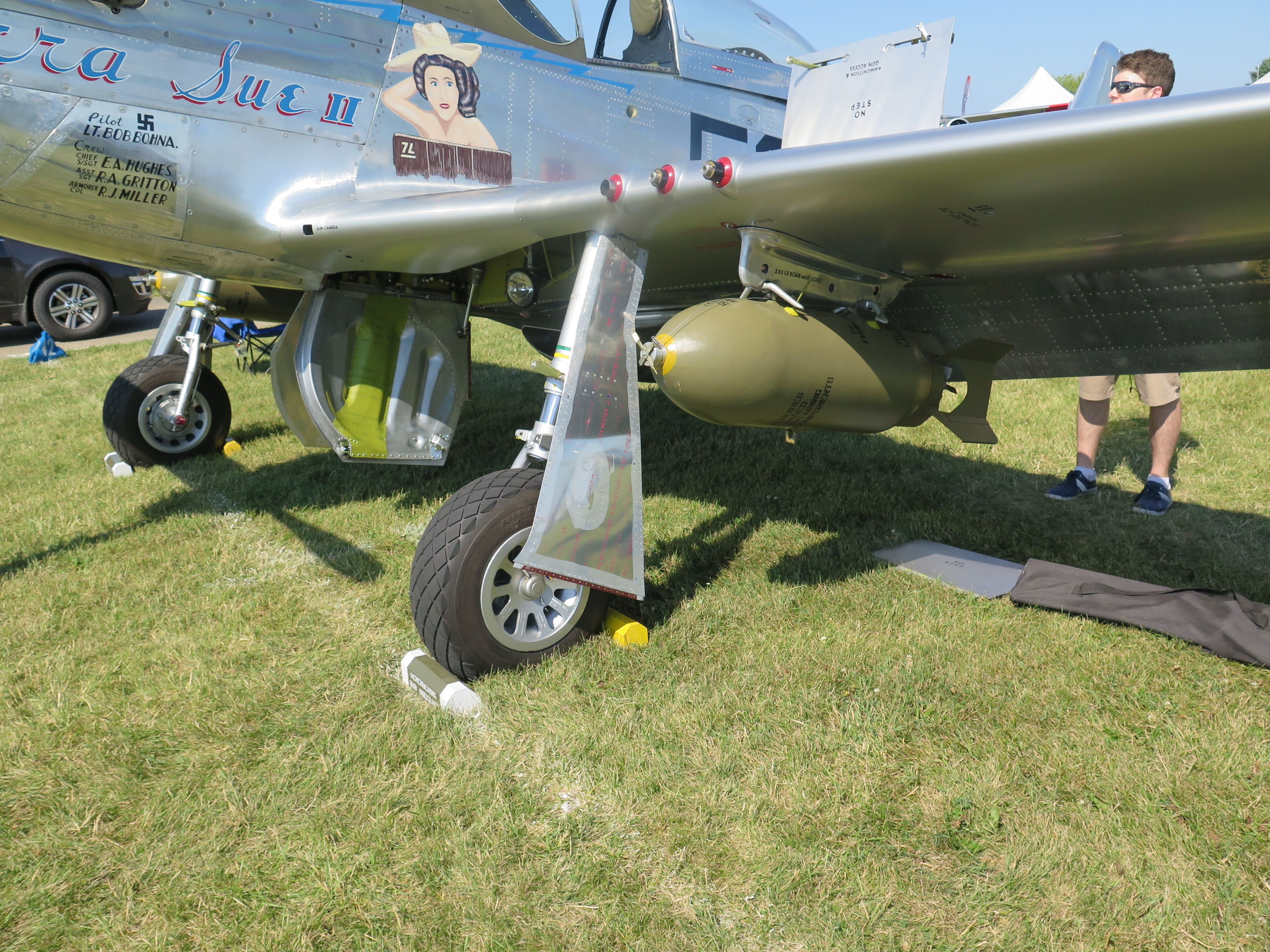
Again, the level of detail is amazing. Below is a picture of the main landing gear wheel well doors in this kit, and a picture of one of Sierra Sue II’s landing gear wheel well doors that was taken shortly after its complete restoration. As you can see, the Eduard parts accurately depict the rivet detail.

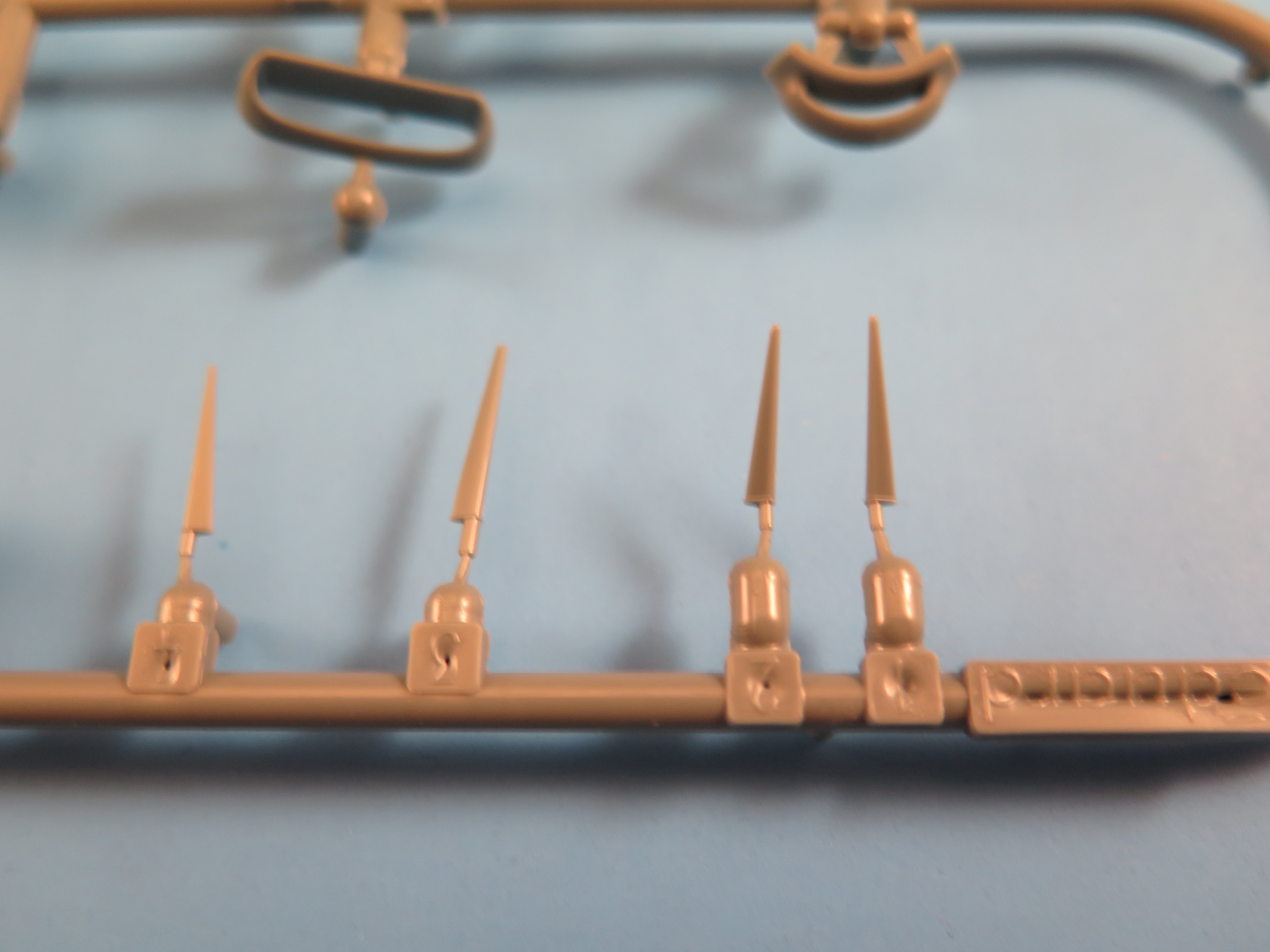
The twin Uncle Dog antennae are located on Sprue G as parts G1 and G2. Their attachment pins are set at an angle and there are no locating holes on the inside of the fuselage parts to indicate their position on the fuselage spine. Because this limited edition kit does not use those parts, the kit instructions do not provide any guidance. So we will have to wait on the instructions in the Royal Class boxing as far as the exact location.

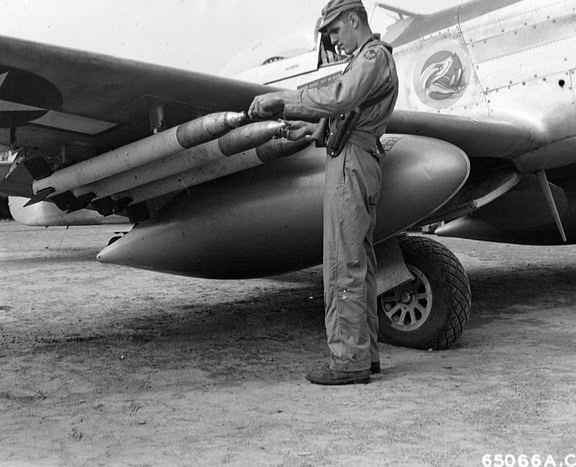
Sprue F (Drop Tanks & Underwing Ordinance) – This sprue contains the drop tanks used in the European Theater of operations, and the various underwing ordinance (bombs, HVAR rockets, and rocket launching tubes).

Eduard designed the HVAR rockets and their wing attachment points as one piece. While this will add an extra step in painting the rockets, it will make rocket alignment a non-issue. Locating holes are on the bottom half the wings.

The sprue consisting of the clear parts have all three canopy types and are crystal clear.

Initial Impressions – This is an extremely nice looking kit with a lot of intricate detail and some delicate parts. The fuselage contours look really good. Kudos to Eduard for spending the necessary time to get things right. When I have the Royal Class boxing in my possession, I will review the sprue with the 110 and 165 gallon drops tanks, and the decals for the Iwo Jima VLR Mustangs. Hopefully, Eduard will include the sway braces for the drop tanks. I am really looking forward to building Major James B. Tapp’s 101 “Margaret IV” (78th FS, 15th FG) with 165 gallon drop tanks and HVAR rockets using this kit.

Major James B. Tapp (USAAF/National Archives via Fold3)

Eduard just released the D-5 ProfiPACK edition, and I am being told that they are still planning to release a limited edition Pacific Theater VLR Mustang ProfiPACK edition in 2020. Again, this is great news!