Eduard has previously indicated that it intended to release a Pacific VLR boxing of its 1/48 P-51D Mustang kit in August of 2020. What was not known, until now, was whether the decal options for the boxing would be solely for Iwo Jima VLR Mustangs, or a mixture of decals for Iwo Jima VLR Mustangs and other Pacific Mustangs.
That question is answered in the July 2020 Edition of INFO Eduard. The boxing will be a Limited Edition release entitled “Very Long Range: Tales of Iwojima”, and will include twelve different decal options for Iwo Jima VLR Mustangs that covers all nine squadrons of the three Iwo Jima VLR Mustang groups. Below are the decal options.
EduardEduardEduard
It’s fantastic to see all nine squadrons represented in this release, and especially nice to see decals for the three squadrons (46th, 72nd and 531st) of the 21st Fighter Group. Other than Major Harry C. Crim’s 300 “My Achin” Ass, 21st FG Mustangs tend not to get a lot of love from kit makers and after market decal manufacturers. While modelers want to build models of fighter aces, and kit manufacturers cater to that demand, it is nice to see decals of lesser known pilots included.
A few notes about the decal options. First, there are two decal options for the 45th FS, 15th FG P-51D-20-NA Mustang serial number 44-63483. This plane was originally assigned to Major Gilmer L. “Buck” Snipes, the CO of the 45th FS, and was named “Tom Kat”. It was later assigned to top VLR ace Major Robert W. “Todd” Moore who scored a total of 12 victories, and was renamed “Stinger VII”.
Second, a modeler has decal options for the two planes flown by the second leading VLR fighter ace, Major James B. Tapp of the 78th FS, 15th FG. The first is “Margaret IV”, a P-51D-20-NA, which is the most recognized P-51D Mustang flown by Major Tapp. The second is “Margaret V”, a P-51D-25-NA, which Major Tapp flew in the last few weeks of the Pacific war. It is nice to have both options.
Third, decals are provided for Lt. Colonel John W. Mitchell’s 11, “Annie Lee”. Lt. Colonel Mitchell gained fame and notoriety for leading the long over water mission that resulted in the downing of the Mitsubishi G4M Betty carrying Admiral Isoroku Yamamoto. Lt. Colonel Mitchell added 3 VLR victories to the 8 aerial victories he had while serving with the 339 FS. He served as the CO of the 15th FG from July 19, 1945, to the end of the war. Very nice addition to the decal options.
Lastly, the decal options provide a nice mix of the early squadron markings and the later standardized squadron markings that were mandated in the last few months of the war. More about the change in squadron markings in a later post.
Kudos to Eduard on this release! If you are contemplating purchasing this boxing when it is released in August, I would not wait too long as Eduard Limited Edition releases tend to sell out fairly quickly.
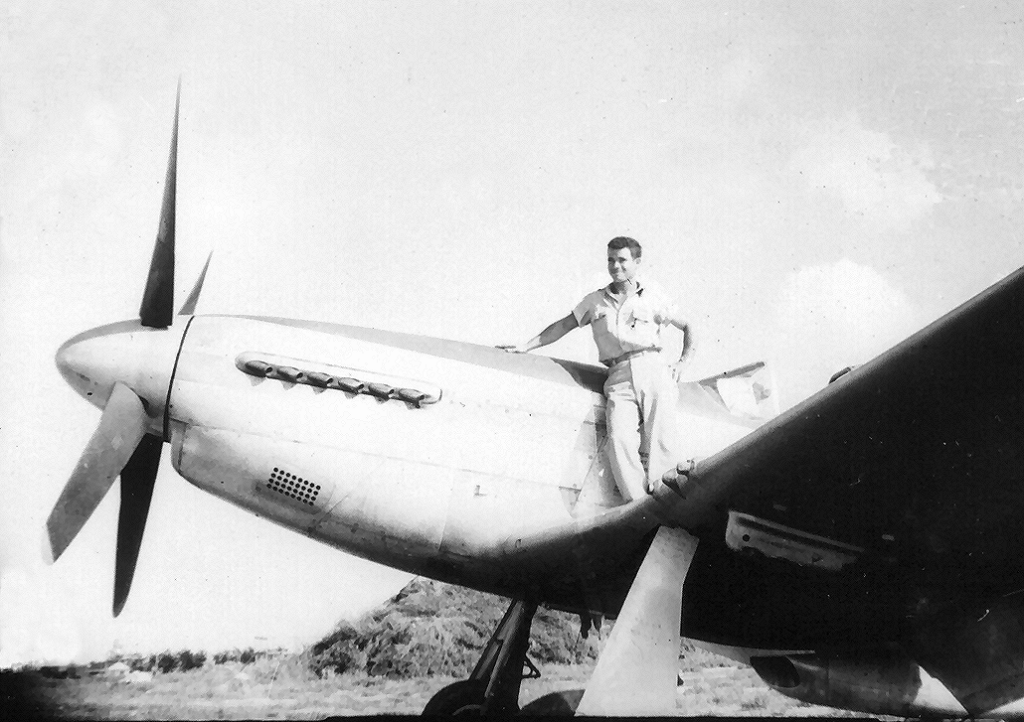
Abner Maurice Aust, Jr., was born on October 7, 1921, in Scooba, Mississippi. After graduating from high school, he enrolled at Sunflower Junior College in Morehead, Mississippi. While in college, Abner joined the Civilian Pilot Training Program (CPTP) and completed pilot training on June 15, 1942. Abner then enlisted in the Aviation Cadet Program of the U.S. Army Air Forces on June 23, 1942. He was commissioned a 2nd Lieutenant and awarded his pilot wings at Luke Field, Arizona, on April 12, 1943, and then served as an instructor pilot during which time he was promoted to the rank of 1st Lieutenant and then Captain. Desiring to get into combat and become an ace, Captain Aust joined the 457th Fighter Squadron of the 506th Fighter Group at Lakeland Army Air Field, Florida, in October 1944, shortly after its activation.
Captain Aust was the only fighter ace in the 506th Fighter Group with 5 confirmed victories, and has the distinction of being the last fighter ace of World War II.
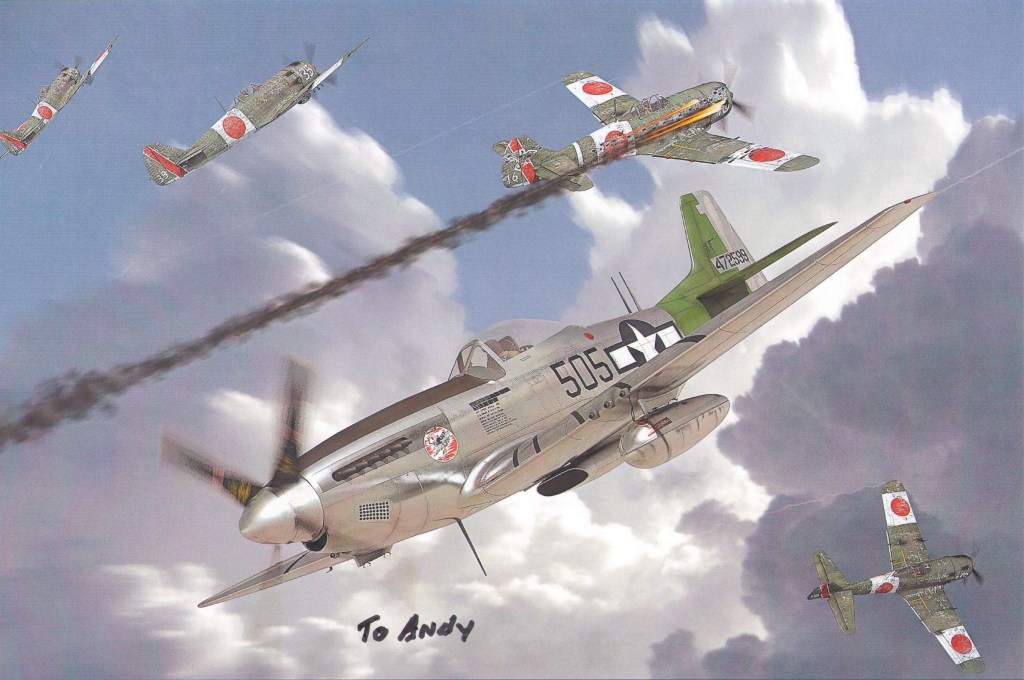
Only encountering enemy opposition on two VLR missions, Captain Aust took advantage of those opportunities. He claimed his first victories on a VLR strike mission to the Nagoya/Bay of Ise area on July 16, 1945, engaging six Nakajima Ki-84 Hayates (Franks) head on and shooting down three in quick succession.
Artwork by David J. Ails
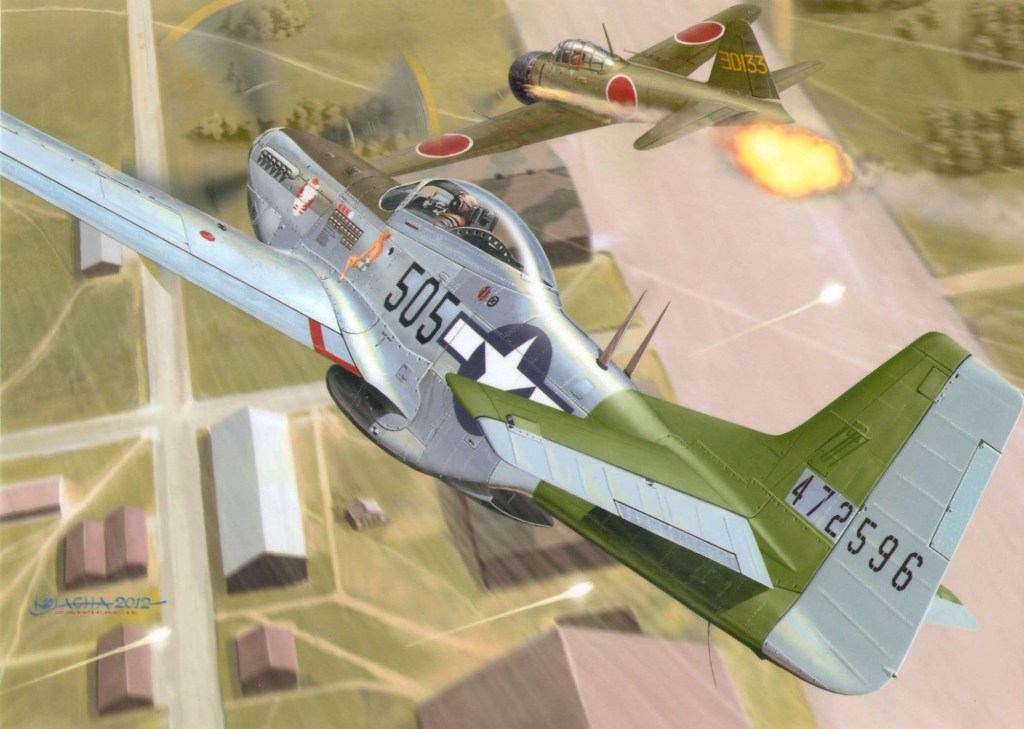
His next opportunity to score came on August 10, 1945, on a VLR mission escorting B-29s to the northeast of Tokyo. Captain Aust shot down a Mitsubishi Zero at 25,000 feet for his first victory of the day. He quickly spotted another Zero and made two passes damaging his adversary’s plane both times. After the second pass, the Zero dived into clouds and disappeared. Captain Aust was able to spot a third Zero, get behind it, and shot it down over an airfield for this second victory of the day, and his fifth aerial victory of the war.
Artwork by Zbigniew Kolacha
Unfortunately, during his various aerial encounters on August 10th, Captain Aust became separated from his wingman, 1st Lieutenant Jackie Horner. In addition, to Captain Aust’s misfortune, the armorer maintaining his plane erroneously set the gun camera film at 75 frames per second instead of the normal speed of 16 frames per second. Because of this, his gun camera film only provided proof of the first Zero shot down at 25,000 feet, and the two passes made on the second Zero that disappeared in the clouds. The gun camera film ran out before he shot down the third Zero over the Japanese airfield. Captain Aust did not have an American eyewitness or gun camera film to corroborate his claim of shooting down the second Zero. He would find out several years later than there were several Japanese eyewitnesses to his downing of the third Zero. What follows is an excerpt from the book the “506th Fighter Group: The History of the 506th Fighter Group, Iwo Jima 1945”, describing Captain Aust’s efforts to gain official confirmation of his fifth aerial victory.
“It took me 18 years to confirm the fifth aircraft destroyed. I kept all my mission records for this mission. My brother-in-law, Phillip Edward was stationed at Misawa AB in northern Japan during the early 1960s. He married a Japanese lady. I sent her all the facts concerning this mission. He and his wife visited this airfield and confirmed my claim by statements from Japanese men who were working at this airfield that day in 1945. That was the only aircraft ever shot down over that air base. They confirmed that it happened about 12 noon and that the airfield anti-aircraft were doing everything they could to shoot me down. Phillip Edward sent me the facts and proof to support my claim. I sent this information with a letter to the Office of Correction of Military Records. This office, after review, approved my requests as did The American Fighter Aces Association. I finally became a WWII Fighter Ace in 1963!”
Captain Aust flew a total of 14 VLR missions during the 506th FG’s deployment on Iwo Jima, and he was credited also with 3 enemy planes destroyed on the ground. His description of the July 16th and August 10th VLR missions are contained in the “506th Fighter Group: The History of 506th Fighter Group, Iwo Jima 1945”.
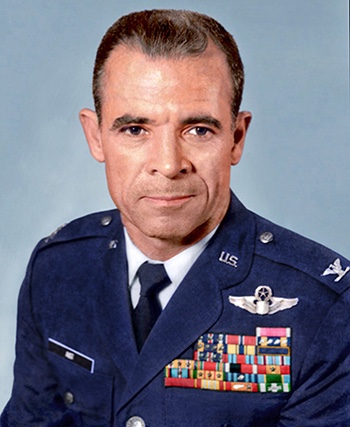
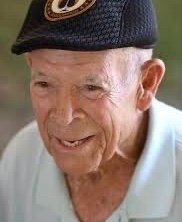
Colonel Abner M. Aust, Jr.
He became a career officer in the United States Air Force obtaining the rank of Colonel, and commanded 31st and 3rd Tactical Fighter Wings during the Vietnam War flying both F-100 Super Sabres and F-4 Phantoms.
Colonel Aust passed away on June 16, 2020, at the Lakeland Regional Medical Center at 98 years of age. I had the honor and privilege to interview Colonel Aust on several occasions during 506th Fighter Group reunions, and looked forward to every opportunity to speak with him. He remained active until the end, had a keen intellect, and a memory that rarely failed him.
DKdecals recently released a new 1/48 decal sheet for Pacific based P-51D/K Mustangs. It contains decals for five Iwo Jima VLR Mustangs; one from the 15th FG, one from the 21st FG, and three from the 506th FG. This sheet is unique in that it provides decals for lesser known planes that have never been produced before. We tend to see the same decals for planes with great nose art ( i.e. 528 “The Enchantress”), or planes the aces flew (i.e. Major Todd W. Moore’s 67 “Stinger VII”, Major James B. Tapp’s 101 “Margaret IV”, and Major Harry C. Crim’s 300 “My Achin” Ass), so it is nice to have a variety of lesser known planes. Kudos to DKdecals.
The painting and decal placement guide is nicely done. The five decals for the Iwo Jima VLR Mustangs are as follows:
114 “Dear Edna”; 78th FS, 15th FG; P-51D-20-NA, 44-63967; flown by 1st Lt. Frederick A. Bauman. Lt. Bauman was credited with one aerial victory on the June 10, 1945 mission to Atsugi Airdrome near Tokyo.
1st Lt. Frederick A. Bauman in front of 114 “Dear Edna” (via Mark W. Stevens/7th Fighter Command Association)
235 “Slow Roll”; 46th FS, 21st FG; P-51D-20-NA, 44-63891; flown by 2nd Lt. John W. Brock. Lt. Brock was credited with three aerial victories, his first on April 12, 1945, and the second and third on July 9, 1945. Below is the only photo I can find for “Slow Roll”. It does not appear that the nose art has been applied when the photo was taken.
235 “Slow Roll” (USAAF/National Archives via Fold3)
522 “Buzz Buddy”; 457th FS, 506th FG; P-51D-25-NA, 44-72876. It is unknown who was assigned to fly “Buzz Buddy”. However, it is known that 1st Lt. Chauncey A. Newcomb scored two aerial victories while flying “Buzz Buddy”. 1st Lt. Newcomb was actually assigned to 514 “Erma Lou” along with 1st Lt. Francis “Frank” Albrecht. It was not uncommon for pilots to fly VLR missions in planes they were not assigned to. Because there only black and white photos of “Buzz Buddy”, and it is difficult to tell what the color of the name on of the nose is, DKdecals provided the name in both red and black. Nice touch.
522 “BuzzBuddy” (via Robert Newcomb/Dr. John Benbow)
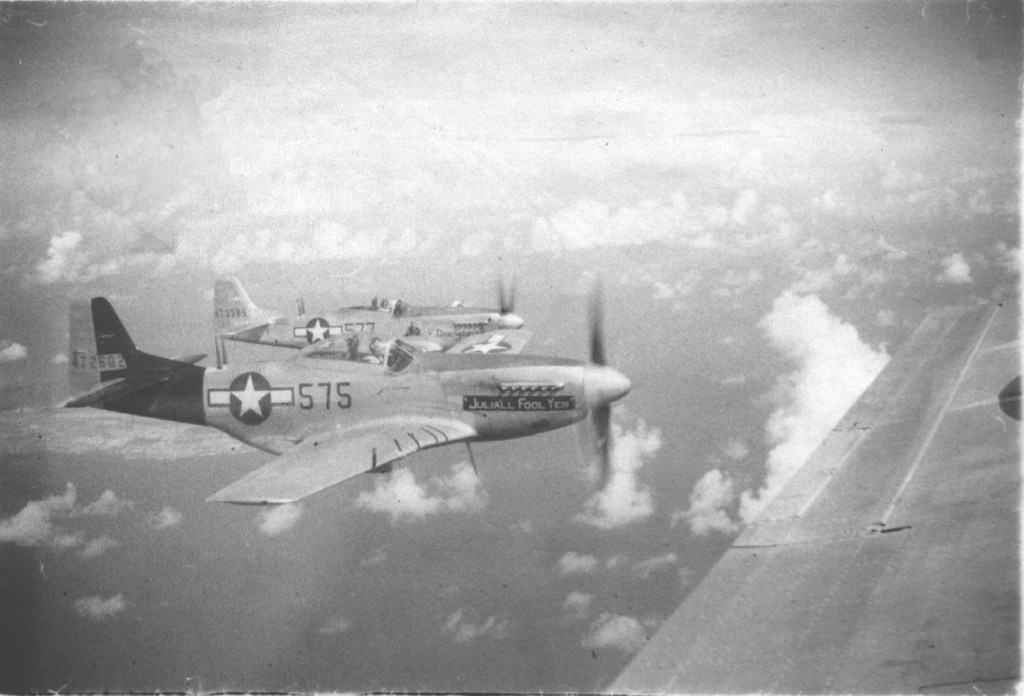
575 “My Madge/Julia’ll Fool Yer”; 458th FS, 506th FG; P-51D-20-NA, 44-72602; flown by Captain G. Marcott.
575 “My Madge/Julia’ll Fool Yer” (via Dr. John Benbow)
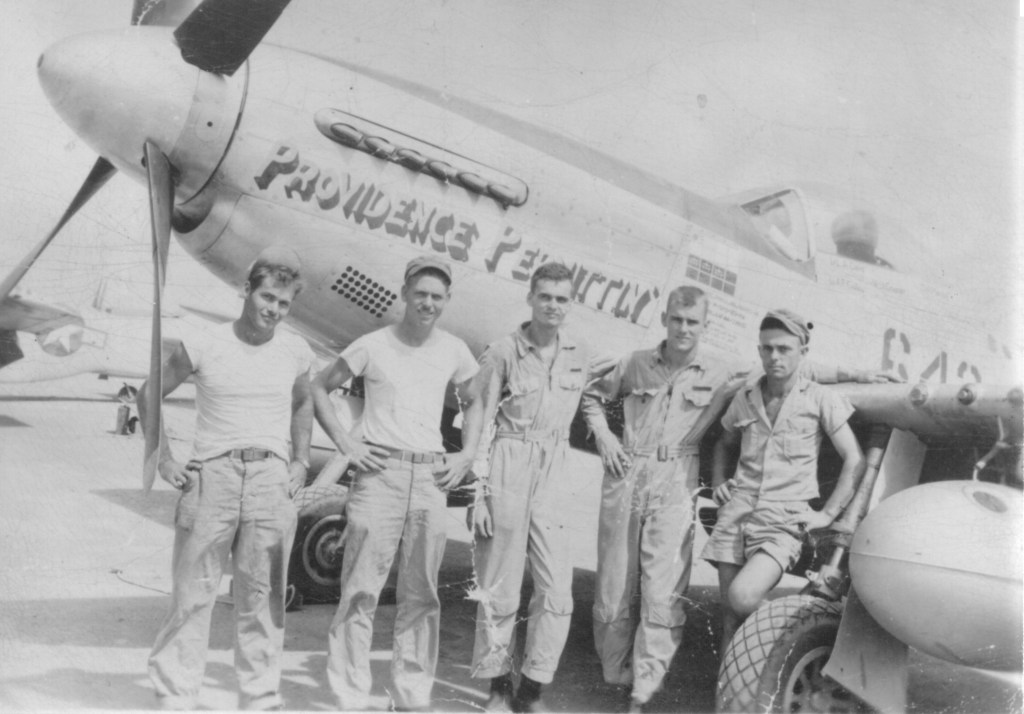
643 “Providence Permitting”; 462nd FS, 506th FG; P-51D-25-NA, 44-72855; flown by 1st Lt. Allen F. Colley and 1st Lt. Leonard A. Dietz.
1st Lts. Allen F. Colley and Leonard A. Dietz and ground crew in front of 643 “Providence Permitting” (via Bill Ebersole/Dr. John Benbow)
The decals are in register, and the artwork is exceptional. If you are interested in building a lesser known Iwo Jima VLR or Pacific Mustang with some really nice markings, this decal sheet is highly recommended.
As a condition of the use of materials from the 7th Fighter Command Association website, the following disclaimer is included: Permission to use, copy and distribute documents delivered from this Worldwide Web server and related graphics is hereby granted, provided 1) That the use of the data will not be used for obtaining a profit of any kind, and 2) That the above disclaimer notice appear in all copies and that both that disclaimer notice and this permission notice appear. All other rights reserved. The name of “7th Fighter Command Association” may not be used in advertising or publicity pertaining to distribution of this information without specific, written prior permission. Mark Stevens and the 7th Fighter Command Association makes no representations about the suitability of this information for any purpose. It is provided “as is” without express or implied warranty. Mark Stevens and the 7th Fighter Command Association disclaim all warranties with regard to this information, including all implied warranties of merchantability and fitness. In no event shall Mark Stevens or the 7th Fighter Command Association be liable for any special, indirect or consequential damages or any damages whatsoever resulting from loss of use, data or profits, whether in an action of contract, negligence or other action, arising out of or in connection with the use or performance of this information.
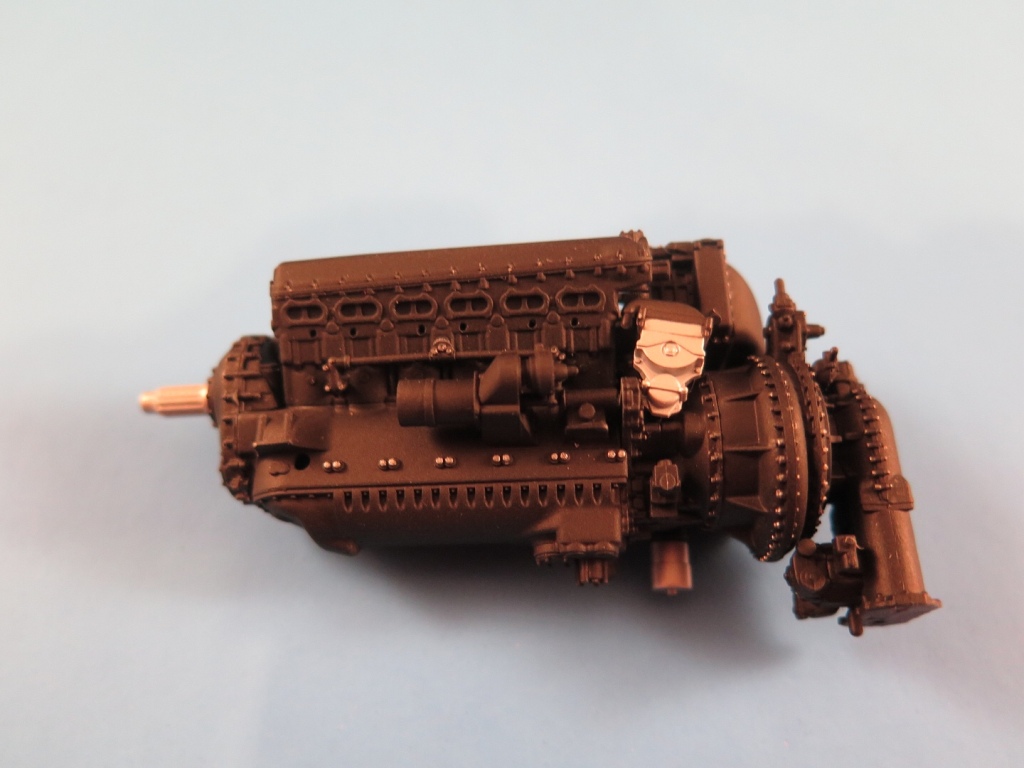
Here is the assembled and painted Packard built Rolls Royce Merlin engine. I painted the engine with Mr. Color Flat Black (33) because I wanted the durable finish that only a lacquer based paint can provide. It will be handled some while adding detail (ignition harnesses, spark plug wires, plumbing, etc . . .), and water based acrylics are just not that durable. I used a flat paint because I colored the numerous bolt heads and nuts with a Sanford Prismacolor Metallic Silver pencil, and these pencils just do not work well on gloss paints.
I purchased some round lead wires ranging from .2 mm to .6 mm for some of the additional detail to be added to the engine from UMM-USA. The lead wires should make it easier as far as forming the ignition harnesses and spark plug wires.
Owned by master modeler, John Vojtech, UMM-USA is an on-line store specializing in tools and supplies for adding fine detail to models. Worth a look if you are getting into adding fine detail to your models. http://www.umm-usa.com/
“Freedom is never more than one generation from extinction. We didn’t pass it to our children in the bloodstream. It must be fought for, protected, and handed on for them to do the same.” Ronald W. Reagan, 40th President of the United States of America
Today, we remember and honor the men and women who have fallen while serving in the United States Armed Forces to preserve the freedoms we exercise and enjoy on a daily basis. Let us never take these freedoms for granted, for they were paid for with an extremely high price.
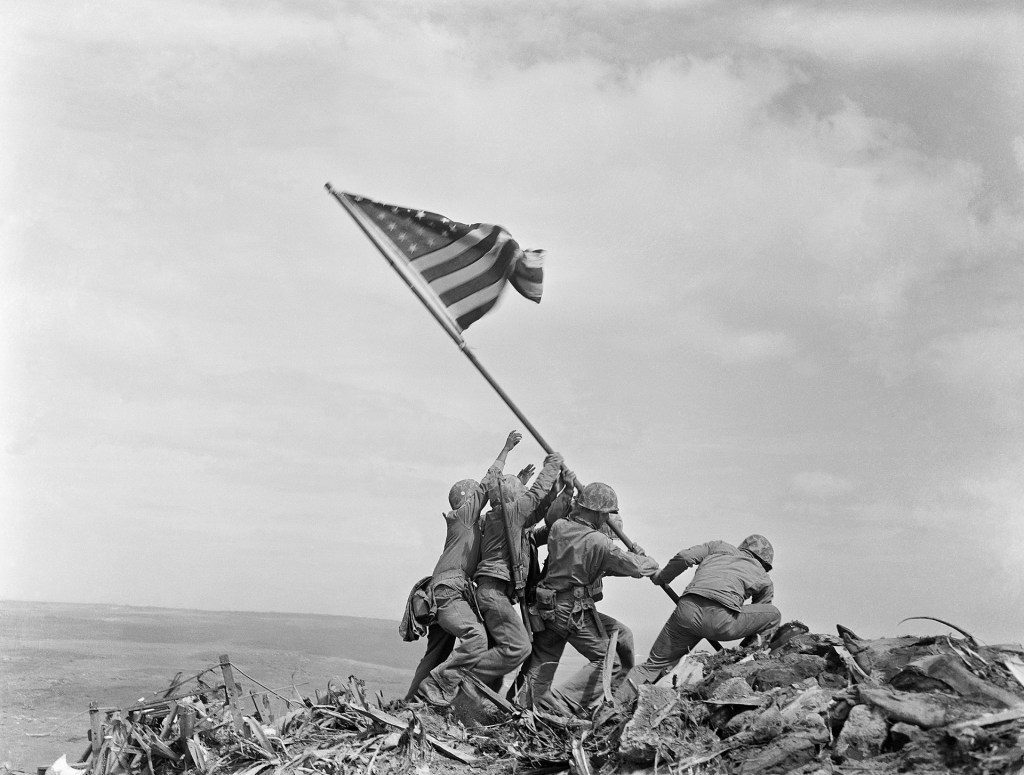
Joe Rosenthal
The Battle of Iwo Jima was costly for both the United States and Japan. American military planners believed that Iwo Jima would be securely in the United States’ hands within one week due to the intense aerial and naval bombardment leading up to the invasion. Instead, the battle lasted five weeks (February 19th to March 26th), and consisted of some of the fiercest and bloodiest fighting of the Pacific War. The United States suffered a total of 26,040 casualties. Of that number, a total of 6,821 United States servicemen made the ultimate sacrifice. It is estimated that approximately 21,000 Japanese troops were on the island when the landings began on February 19th. Of that number, only 216 were captured or surrendered. The rest perished on Iwo Jima.
But the 6,821 United States servicemen who perished during the invasion of Iwo Jima were not the first, nor the last, to fall in service to their country due to the strategic importance of Iwo Jima to both Japan and the Untied States.
One of the First Casualties at Iwo Jima – Lt. Harold G. Payne, Jr., VT-32 (USN) Lieutenant Harold G. Payne, Jr. was the Air Combat Intelligence (ACI) officer for VT-32 aboard the USS Langley. His main duties were debriefing pilots and air crews after strike missions, and preparing Aircraft Action Reports. Because of his duties, he was familiar with all the air crews of VT-32, and became a close friend of one of the TBF Avenger pilots, Lt. David A. Marks.
Lt. Harold G. Payne, Jr. (left) and Lt. David A. Marks on the deck of the USS Langley
Lt. Payne did not just to debrief air crews after strike missions, but would also frequently go on missions as an observer, or to take reconnaissance photos. The June 15, 1944, strike mission against Iwo Jima was no exception. The USS Langley was part of a task force that was given the responsibility of reducing the ability of the Japanese to send aircraft from Iwo Jima to the Marianas while the United States Marines were establishing their beachheads on Saipan. This mission was the United States Navy’s first strike against Iwo Jima.
Lt. Payne flew on Lt. Marks’ Grumman TBF-1C Avenger. The June 15th mission did not start well due to deteriorating weather conditions, and four the the USS Langley’s Avengers were delayed attempting to navigate through a weather front. Time was of the essence. By the time Lt. Marks began his attack on Motoyama No. 2 (Central Field), some of the other Avengers had already dropped their bombs, and the anti-aircraft fire had become intense.
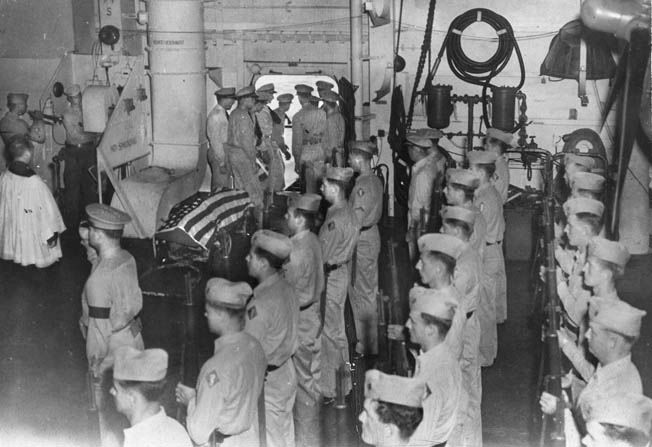
Lt. Marks’ Avenger took several 40 mm hits, and one went through the trailing edge of the right wing and exploded. One of the shell fragments tore through Lt. Payne’s right chest and exited the left side of his back. Lt. Payne succumbed to his injuries within minutes. Lt. Marks was able to land his battered Avenger back on the deck of the Langley, but Lt. Payne had already passed. One other aircrewman, Aviation Radioman 2nd Class Arnold “Blackie” Marsh, also was killed in action on the June 15th strike mission. Both Payne and Marsh were buried at sea on June 16, 1944.
Funeral Service for Lt. Harold G. Payne, Jr. aboard the USS Langley
Black Friday Casualty – Captain Lawrence S. Smith, 462nd FS, 506th FG, (USAAF) Lawrence S. Smith enlisted in the Aviation Cadet Program of the U.S. Army Air Corps on January 29, 1942, at the age of 24. He was commissioned a 2nd Lieutenant and awarded his pilot wings at Brooks Field, Texas, on October 9, 1942, as part of Class 42-I. Like many of the older pilots in the 506th Fighter Group, he served as an instructor pilot until he was assigned to the 462nd Fighter Squadron of the 506th Fighter Group at Lakeland Army Air Field, Florida, in October 1944 shortly after its activation.
Captain Lawrence S. Smith (via Richard Smith/Dr. John Benbow)
Prior to the 506th FG’s deployment, Captain Smith became the 462nd FS’s supply officer. Not content to sit behind a desk on Iwo Jima, Captain Smith volunteered to fly in the 506th’s second VLR mission, a maximum effort escorting a force of 400 B-29s to Osaka, on Friday, June 1, 1945. One hundred forty-eight P-51D Mustangs of the 15th, 21st, and 506th FGs took off from Iwo Jima at 7:57 a.m. and proceeded to Japan with the assistance of B-29 navigation aircraft.
Some 250 miles out, the force began to encounter scattered cumulus clouds in layers. By the time the force was 375 miles out, the fighters encountered a massive weather front that appeared to begin at sea level and continue well above 30,000 feet. While the B-29 weather ship ahead of the formation was able to successfully penetrate the front, it was a different situation for the much smaller P-51D Mustangs.
Not able to climb above the front, the fighters attempted to penetrate the front. Absolute chaos ensued. Fighter pilots attempting to tighten formation while flying through the front collided with each other. Heavy rain pelted the Mustangs, and they were severely buffeted by updrafts and downdrafts. Radio communications became difficult due to the electrically charged storm. Many pilots lost horizons and spun out of control to a watery grave below.
Twenty-seven Mustang pilots were able to successfully penetrate the front. Only when the last Mustang landed on Iwo Jima, did the magnitude of the losses hit home. Twenty-seven Mustangs failed to return with a loss of 24 pilots. The 506th FG bore the brunt of those losses, losing 12 pilots; Captain Lawrence S. Smith being one of them. The June 1, 1945 VLR mission will be forever remembered as “Black Friday” to the Iwo Jima VLR Mustang groups.
Both Lieutenant Harold G. Payne, Jr. and Captain Lawrence S. Smith could have played it safe, but chose not to out of a sense of duty to their country. This post is dedicated to them and all of the other American servicemen who made the ultimate sacrifice in the Pacific Theater of operations.
The names of United States servicemen who are missing in action, or lost or buried at sea in the Pacific during World War II, the Korean War, and the Vietnam War are inscribed on marble slabs in the ten Courts of the Missing at the Honolulu Memorial in the National Cemetery of the Pacific. The names of Harold G. Payne, Jr. and Lawrence S. Smith can be found there along with 28,786 other names.
Honolulu Memorial at the National Memorial Cemetery of the Pacific











 Iwo Jima Models